Primary Technologies for Industrial Water Purification
Industrial water purification relies on a layered combination of physical and chemical separation processes, not a single magic unit. The right starting point depends on whether you need to remove dissolved salts, suspended solids, or specific target ions.
When evaluating industrial wastewater equipment or intake treatment, most schemes begin with one of four core technologies: Reverse Osmosis, Ultrafiltration, Ion Exchange, or softening. The table below compares their primary contaminant removal and typical application fit.
| Technology | Primary Contaminant Removal | Typical Performance | Advantages | Limitations | Typical Industrial Application |
|---|---|---|---|---|---|
| Reverse Osmosis (RO) | Total Dissolved Solids (TDS), salts, silica | >98% salt rejection, permeate TDS often <10 mg/L | High purity, consistent output, compact footprint | Pretreatment required; generates concentrate stream | Boiler feed, pharmaceutical process water, electronics rinse |
| Ultrafiltration (UF) | Suspended solids, colloids, bacteria, macromolecules | 0.01–0.1 µm nominal pore size | Low pressure, chemical-free barrier, robust | Does not remove dissolved salts; fouling management needed | RO pretreatment, cooling tower make-up, surface water clarification |
| Ion Exchange (IX) | Target ions (hardness, nitrate, heavy metals) | Hardness <1 mg/L as CaCO₃, resistivity >18 MΩ·cm for mixed bed | Selective removal, deep demineralization | Chemical regeneration, higher OPEX on high-TDS feed | Boiler demineralization, ultrapure water polishing, softening |
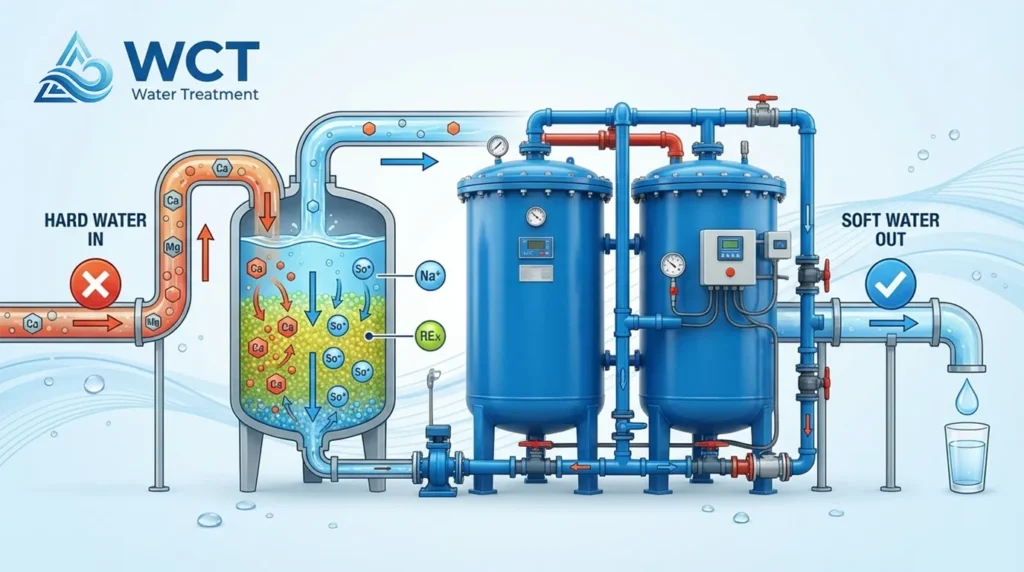
| Softening (Lime/Soda or SAC Resin) | Calcium, magnesium hardness | Hardness reduced to <5 mg/L | Simple, low chemical cost | Only addresses hardness; does not reduce TDS | Cooling tower make-up, laundry, low-pressure boiler feed |
Note: Performance values are typical benchmarks; request certified performance data for the specific model and feedwater conditions.
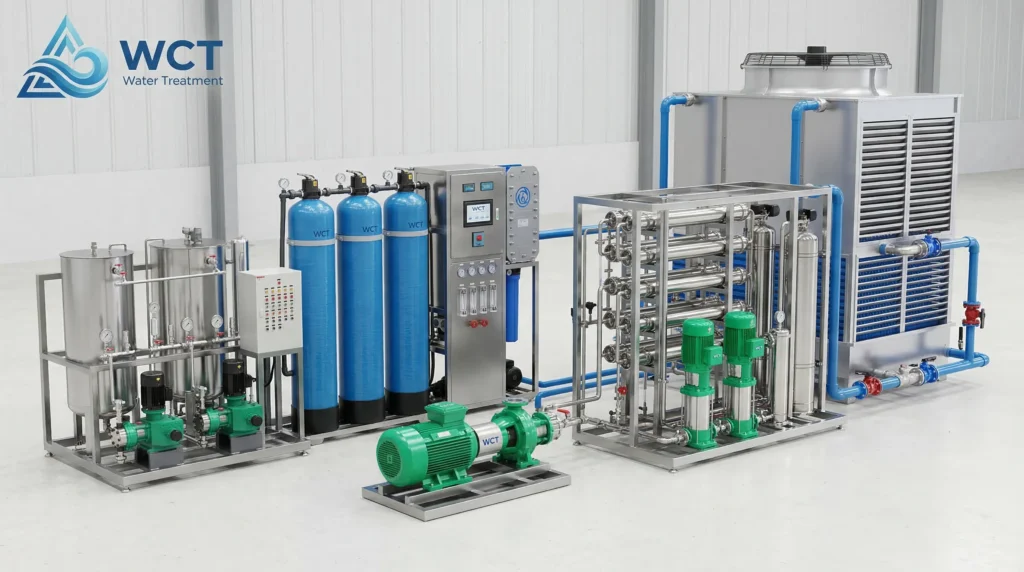
For facilities requiring high flow rates, multiple parallel trains on a common skid allow stable output while simplifying maintenance. Modern industrial water treatment systems frequently pair UF as pretreatment with RO to protect membranes and extend run time between cleanings.
Key Selection Criteria: Defining System Requirements
Before comparing quotes, you must quantify the gap between your raw water and the required effluent specification. Vague targets lead to oversized equipment or compliance failures.
Use the checklist below to assemble the data an application engineer will need. A current, lab-certified influent water analysis is non-negotiable.
- Influent Water Analysis: TDS, pH, hardness, alkalinity, silica, iron, manganese, and any process-specific contaminants.
- Required Flow Rate: Peak demand and average daily volume (GPM or m³/h). Define whether the system must run continuously or batch.
- Target Purity Levels: Required conductivity, resistivity, or specific contaminant limits. Cite the governing standard (ASTM D1193, ISO 3696, USP, etc.).
- Spatial Constraints: Available footprint, ceiling height, and access for chemical tanks. Skid-mounted equipment often reduces civil work.
- Waste Stream Limitations: Brine disposal restrictions, zero liquid discharge (ZLD) targets, or permit limits on wastewater volume.
With these parameters in hand, you can move from a generic technology list to a configured system. Many industrial effluent treatment solutions integrate multiple stages precisely because the feedwater analysis reveals a combination of challenges that single-stage equipment cannot handle.
Matching Water Quality Challenges to Equipment Solutions
Equipment selection becomes straightforward when you map the specific pain point to the technology that directly addresses it. The matrix below links common industrial water problems to the core equipment solution.
| Water Problem | Recommended Equipment | How It Works | Key Benefit |
|---|---|---|---|
| Scale / Hardness | Water Softener, Ion Exchange | Exchanges Ca²⁺, Mg²⁺ for Na⁺ or H⁺ | Prevents scale on heat exchangers and boiler tubes |
| High TDS | Reverse Osmosis System | Pressurized cross-flow membrane separation | Broad reduction of all dissolved salts |
| Suspended Solids & Silt | Multimedia Filter, Ultrafiltration | Depth filtration or barrier separation | Protects downstream membranes and reduces turbidity |
| Bacteria / Organics | Ultrafiltration, UV Disinfection, Ozone | Physical removal or oxidative inactivation | Ensures microbiological safety without chemical byproducts |
| Specific Ion Contamination (Nitrate, Heavy Metals) | Selective Ion Exchange, RO | Targeted resin chemistry or membrane rejection | Meets tight discharge or product water limits |
Note: Actual selection must be based on a full influent water analysis; this matrix provides general guidance.
No single unit solves everything. A well-designed train always includes adequate pretreatment—filtration or softening—to protect the more expensive downstream membranes. Pre-treatment extends membrane life and keeps chemical cleaning frequency manageable.
Industry-Specific Equipment Configurations
Different industries require distinct equipment trains to meet regulatory and operational targets. The following configurations represent common starting points.
- Power & Energy: Boiler feedwater demands deep demineralization and silica removal. A typical train includes softening or RO followed by mixed-bed ion exchange or EDI to achieve low conductivity and prevent turbine blade deposits.
- Food & Beverage: Ingredient water must be consistent and free of taste/odor compounds. Standard setups combine activated carbon, UF, and RO with UV final disinfection. Stainless steel piping and hot-water sanitization are common.
- Pharmaceutical: Production of USP Purified Water or Water for Injection (WFI) relies on multi-stage systems integrating RO and EDI, often with a hot storage and distribution loop. Water treatment for pharmaceutical manufacturing must comply with cGMP and regular validation.
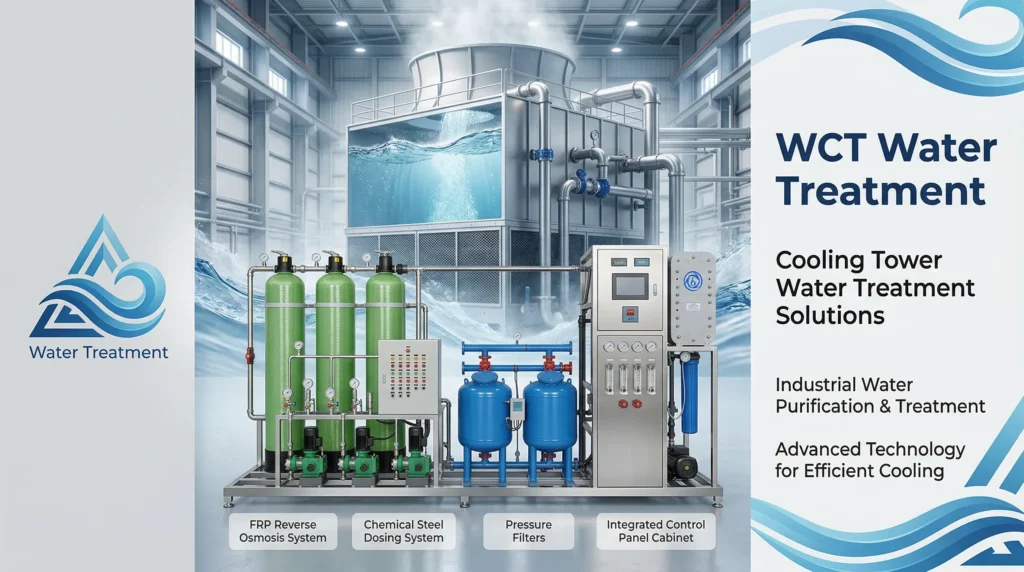
- Manufacturing & General Industry: Cooling tower make-up systems often use side-stream filtration and chemical softening to control scale and corrosion. For wastewater treatment equipment for factories, pre-treatment may also include oil-water separation or sludge handling.
In each case, the equipment package is not a catalog number but a configured train tailored to the specific influent chemistry and required effluent quality.
Evaluating Equipment Scalability and Custom Engineering
Industrial water treatment equipment differs from commercial-grade units in its ability to scale and integrate with plant-wide control systems. If you expect future production changes, the design must accommodate them without a total replacement.
Skid-mounted, pre-piped assemblies reduce on-site construction time and allow for modular expansion. Look for designs that permit adding parallel membrane housings or extra media vessels as demand increases.
What to verify:
- Integration with existing SCADA or BMS via hardwired I/O or industrial communication protocols.
- N+1 redundancy on critical pumps and control valves for 24/7 operations.
- Standardized piping connections that simplify future capacity additions.
Many industrial wastewater equipment packages are engineered this way from the start, allowing you to add treatment stages without breaking the original process flow.
Operational Considerations: Maintenance and ROI
Capital cost is only one piece of the total cost of ownership. Over a 15–20 year lifespan, energy, chemicals, membrane replacement, and labor dominate the operational budget.
Focus your evaluation on these factors:
- Membrane fouling rates and CIP cycles: How often will the system require chemical cleaning? A poorly protected RO can foul in weeks. Compare CIP system automation—manual cleaning increases labor and variability.
- Automation level: Remote monitoring, automated data logging, and alarm notifications reduce operator rounds. Ask about trend screens and predictive fouling indices that alert you before performance drops.
- Energy consumption: High-pressure RO systems benefit significantly from energy recovery devices (ERDs) that can cut energy use by up to 60%. Confirm whether the quoted system includes turbochargers or isobaric ERDs.
- Chemical and consumable cost: IX regenerant chemicals, CIP detergents, and filter cartridges add up. Request an estimated annual consumable spend based on your water analysis.
- Service and parts availability: Local technical support and quick access to replacement membranes, seals, and media shorten downtime. Confirm lead times for critical spares.
A slightly higher upfront investment in robust pretreatment and monitoring often returns its value within the first few years through reduced chemical cleaning and longer membrane life. For comprehensive waste handling, integrating wastewater sludge treatment solutions into the plant design further reduces disposal costs.
Consultation and Custom System Design
Because every industrial water source is unique, a standard catalog product is rarely the final answer. A water treatment equipment for industrial use installation must be designed around your specific feedwater composition, space constraints, and discharge permits.
The most accurate way to move forward is to share a recent, lab-certified water analysis report with an application engineer. That data allows proper sizing, material selection (e.g., 316L stainless vs. duplex for high salinity), and pretreatment configuration.
We recommend requesting a custom system assessment that includes a process flow diagram, projected chemical and energy consumption, and a clear scope of supply. This step ensures you compare quotes on an apples-to-apples basis—not just on skid price, but on expected operational cost and system reliability over 10 years.
Frequently Asked Questions
What is the difference between commercial and industrial water treatment?
Industrial systems handle higher flow rates, use more durable materials of construction, and incorporate multi-stage treatment trains designed for continuous operation. Commercial units typically address lower volume and intermittent demand, often with simpler control schemes.
How often do industrial RO membranes need to be replaced?
With proper pretreatment and cleaning cycles, industrial RO membranes typically last 3–5 years. Aggressive feedwaters or poor pretreatment can shorten that to 18–24 months. Routine normalized data trending helps predict replacement timing.
Can industrial water equipment help with environmental compliance?
Yes. Systems such as Membrane Bioreactors (MBR) or Zero Liquid Discharge (ZLD) trains allow facilities to meet strict wastewater discharge permits by reducing contaminant load or eliminating liquid discharge altogether.
Is a water analysis required before purchasing equipment?
Absolutely. A current, lab-certified water analysis is the only way to guarantee equipment performance and warranty coverage. Without it, you risk selecting the wrong technology or voiding manufacturer support.