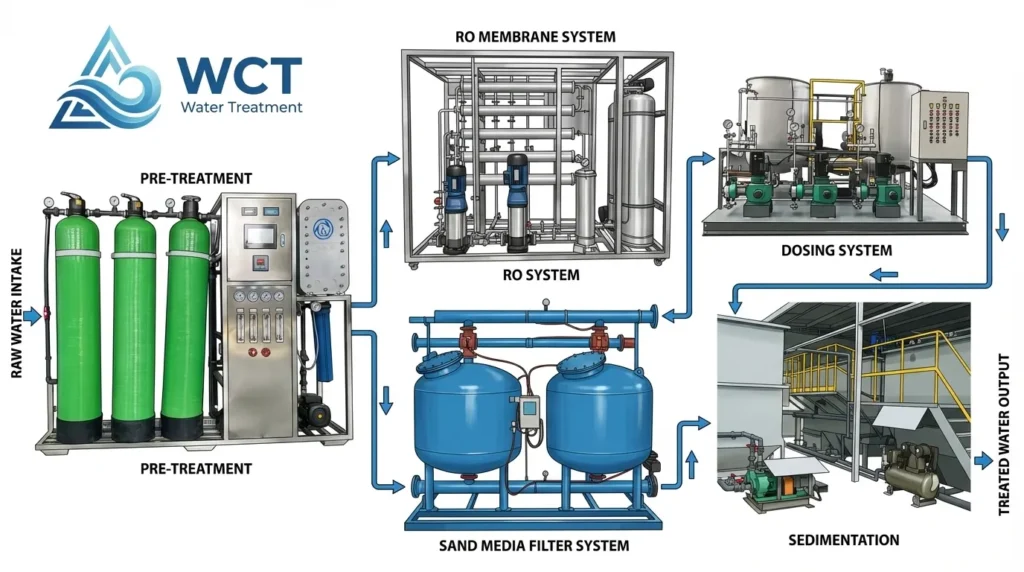
Choosing wastewater treatment equipment for factory operations isn’t about finding the most advanced technology on paper. It starts with what’s in your waste stream and what your discharge permit demands.
Without a clear influent profile, even well-made equipment becomes a compliance liability. Start with the water, the limits, and the true production flow—not a catalog spec sheet.
Establishing a Selection Logic for Factory Wastewater
Equipment selection must be driven by your specific influent profile—the physical and chemical makeup of the untreated stream—and the effluent limits set by local utilities or EPA standards. A professional wastewater analysis, not a guess, sets the boundary conditions for every downstream choice.
Factory scale also dictates system architecture. High daily flows often justify continuous-flow treatment, while smaller batch processes or intermittent discharge may fit a batch reactor or holding-and-treat approach. You must know peak hydraulic loading in GPM, not just average GPD, to avoid undersized equipment that fails during production surges.
This early logic separates projects that pass their first compliance test from ones that require expensive retrofits later. If you’re starting a new selection, request a lab analysis of TSS, BOD, pH, oils, and any regulated metals before comparing equipment.
Core Equipment Categories for Industrial Treatment Stages
Industrial systems are grouped into primary, secondary, and tertiary stages based on whether they target physical separation, chemical or biological transformation, or final polishing for reuse. Almost every factory treatment train combines equipment from multiple stages.
- Primary (Physical Separation): Clarifiers, oil-water separators, and screen filters remove settleable solids and free-floating oils. These are the frontline defense against heavy solids loading that would overwhelm downstream processes.
- Secondary (Chemical/Biological Conversion): pH adjustment skids, dissolved air flotation (DAF) units, and aerobic/anaerobic reactors degrade or transform dissolved contaminants. This is where most Biological Oxygen Demand (BOD) reduction and targeted metal precipitation occur.
- Tertiary (Advanced Polishing): Membrane bioreactors (MBR), activated carbon filtration, and UV sterilization address remaining trace constituents and enable water reuse. This stage is critical when discharge limits are stringent or the goal is zero liquid discharge.
Most factories don’t need every category; the combination depends on what your discharge permit requires. Many metal finishing plants, for example, stop at a well-designed secondary stage with chemical precipitation, while food processors may need the full tertiary train for BOD and nutrient limits.
Industrial Equipment Functionality Matrix
Comparing equipment by its primary mechanical purpose helps buyers match the machine type to the separation task. The table below outlines common units and the waste fractions they target.
| Equipment Type | Primary Function | Target Waste Type |
|---|---|---|
| Clarifiers | Gravity settling of suspended solids | Sludge, heavy settleable particles |
| Filter Presses | Mechanical dewatering of sludge | Concentrated sludge, high solid loads |
| Dissolved Air Flotation (DAF) | Floatation of light solids, fats, oils | Oil/water emulsions, low-density solids |
| Evaporators | Thermal volume reduction, zero-liquid discharge | Concentrated brine, high TDS waste |
Note: Performance values such as solids capture rate and dewatering cake dryness vary by model and influent characteristics. Request batch test reports or pilot data from the supplier to confirm expected results for your specific waste stream.
Beyond the core function, always ask about the compatibility with upstream and downstream equipment. A filter press that squeezes sludge to 30% dry solids may still be too wet for your disposal contract, meaning you need a dryer or an alternative dewatering approach.
Matching Treatment Technologies to Factory Contaminants
Selecting the wrong technology for a specific contaminant leads to permit exceedance or premature equipment failure. Use the following matrix to identify the proven technology for your plant’s dominant waste streams.
| Contaminant | Recommended Technology | Typical Industry Application |
|---|---|---|
| Heavy Metals | Chemical precipitation + clarifier | Plating, anodizing, metal finishing |
| Oil & Grease | DAF or Coalescing Separators | Food processing, automotive, machining |
| High Total Suspended Solids (TSS) | Filter Press or Clarifier | Manufacturing washdown, ceramics, pulp |
| BOD/COD | Biological treatment (aerobic/anaerobic) | Food & beverage, chemical processing |
This table represents typical pairings based on common industrial applications. Actual design must account for flow variability, temperature, and co-contaminants; always confirm with treatability testing.
Many real-world streams contain mixed contamination. A metal finisher might have oil from cutting fluids alongside dissolved zinc. That often requires pre-treatment with a coalescing separator before chemical precipitation, followed by a dissolved air flotation system or polishing filter. The sequence matters as much as the equipment type.
Key Technical Specifications for Procurement
Beyond treatment capability, equipment must be sized for peak flow, site constraints, and long-term operating conditions. Use this checklist when evaluating proposals to avoid common oversights.
- Hydraulic loading rate (GPM): Verify that rated capacity covers peak production days, not just average daily flow. Clarifier rise rates and DAF surface loading rates directly determine separation efficiency under surge conditions.
- Footprint and height restrictions: Confirm whether a skid-mounted pre-engineered package fits through existing doorways and under mezzanines. Include maintenance access clearance in your layout.
- Material of construction: Match wetted components to your waste stream pH and chemical profile. 316 stainless steel, polypropylene, or specialized coatings may be necessary for acidic or high-chloride streams.
- Automation and PLC integration: Define the required level of remote monitoring, alarm setpoints for high turbidity or pH, and integration with your plant’s SCADA if that’s a permit requirement.
Missing any of these during specification can turn a well-designed system into a maintenance headache or a compliance risk. Ask the supplier for general arrangement drawings and a full material takeoff early in the evaluation.
Configuration Choice: Pre-Engineered vs. Custom-Built Systems
Most factory projects land on either a pre-engineered industrial wastewater equipment skid or a site-specific custom build. The right choice depends on your schedule, waste complexity, and budget flexibility.
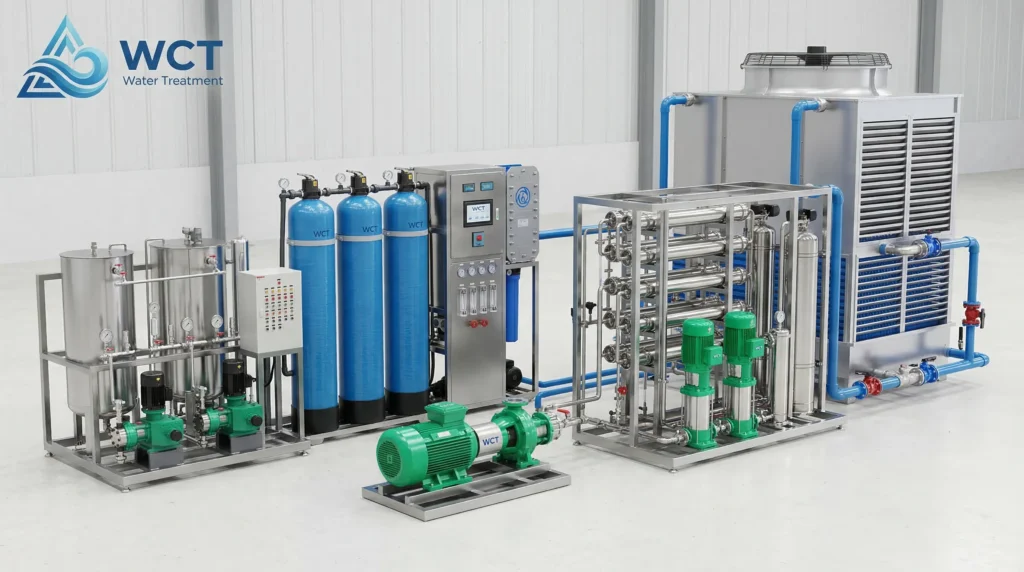
- Pre-engineered skids: These systems ship as factory-tested modules with standard capacities. Deployment is fast, capital costs are lower, and the equipment fits common small-to-mid-range flow rates. Best when your contaminant profile matches the standard design.
- Custom-built systems: Designed around your specific chemical mix, peak loads, and facility footprint. Engineering costs are higher and lead times longer, but they handle unusual waste streams or very large flows where off-the-shelf units fall short.
In practice, many plants combine both: a standard dewatering filter press with a custom chemical feed package designed for their unique pH and metal profile. When comparing options, request a guaranteed performance curve for the complete assembly, not just individual components.
Decision rule: If your discharge permit is straightforward and volume is under 50,000 GPD, pre-engineered often wins on time and cost. For multi-stream complex waste or very tight compliance limits, custom engineering reduces long-term risk.
Maximizing ROI through Sludge Reduction and Water Reuse
The biggest operational savings in factory wastewater treatment come from reducing the weight of waste that leaves the site and slashing fresh water intake. Dewatering equipment and closed-loop reuse often deliver payback within two to three years in hauling and utility costs.
- Sludge volume reduction: A sludge dewatering equipment such as a filter press can reduce wet sludge weight by 70–85%, dramatically lowering disposal fees per ton.
- Closed-loop water reuse: Tertiary treatment with membrane or carbon filtration can return process water to cooling towers, wash stations, or even production baths, cutting municipal water purchases.
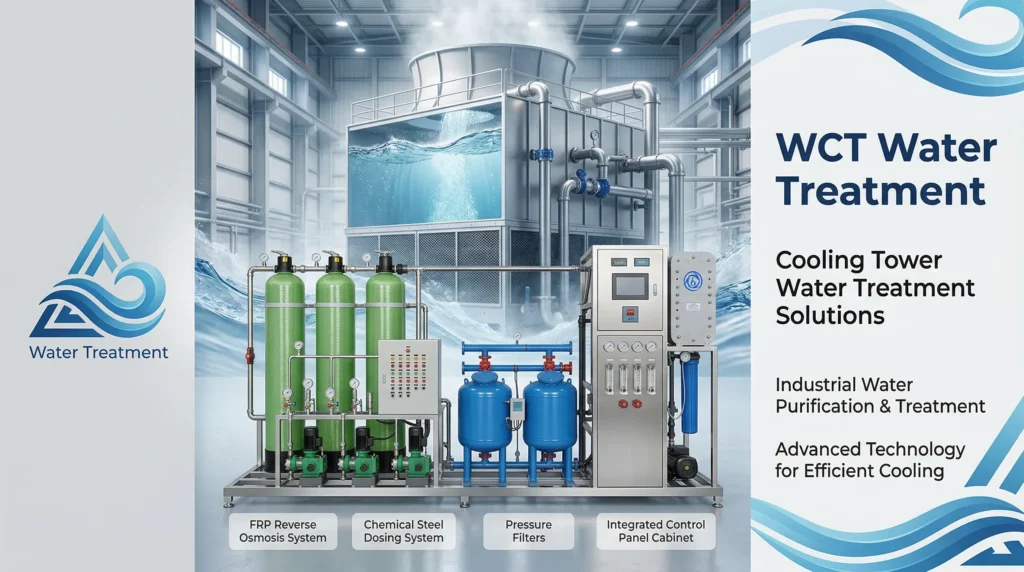
- Chemical optimization: Automated chemical dosing system controls minimize overfeed, reducing chemical spend while maintaining proper coagulation and pH control.
Calculate ROI using your current hauling invoices and water bills—not generic estimates. Even a modest 60% sludge mass reduction in a mid-sized plant often recovers the capital cost of a filter press quickly when disposal rates are high.
Request a Facility Audit and Equipment Specification
The final step in selecting wastewater treatment equipment for factory operations is a technical site audit combined with bench-scale testing of your actual sample. Real wastewater rarely behaves exactly like textbook parameters; jar tests, treatability studies, and flow data confirm performance before you commit capital.
Gather at least a year’s worth of discharge monitoring reports, local sewer use ordinance limits, and any past violation notices. Then, contact our systems engineers to schedule an on-site assessment. We’ll review your influent analysis, footprint constraints, and compliance requirements to propose a matched equipment train—whether that’s a pre-engineered skid or a custom-designed solution. Request a custom quote or facility audit today.
Frequently Asked Questions
What is the most cost-effective equipment for sludge disposal?
A filter press is the standard for reducing hauling weight and volume. It produces a drier cake than belt presses or simple settling, which directly translates to lower transportation and disposal costs.
Can I integrate new equipment into an existing factory wastewater system?
Yes. Most modern industrial equipment is modular and skid-mounted, designed to tie into existing treatment trains with minimal civil work. Integration typically focuses on matching hydraulic profiles and control signals to the upstream and downstream units.
What capacity (GPD) do I need for a mid-sized manufacturing plant?
There is no single number. You must calculate peak daily flow and peak hourly surge flow based on production data. A plant that averages 10,000 GPD but spikes to 25,000 during cleaning cycles needs equipment sized for the surge, not the average.
How does pH adjustment equipment impact compliance?
Many municipal sewers require discharge between pH 6.0 and 9.0. An automated pH adjustment skid with chemical dosing and mixing ensures effluent stays within range, preventing permit violations and potential fines for corrosion or upset at the municipal plant.