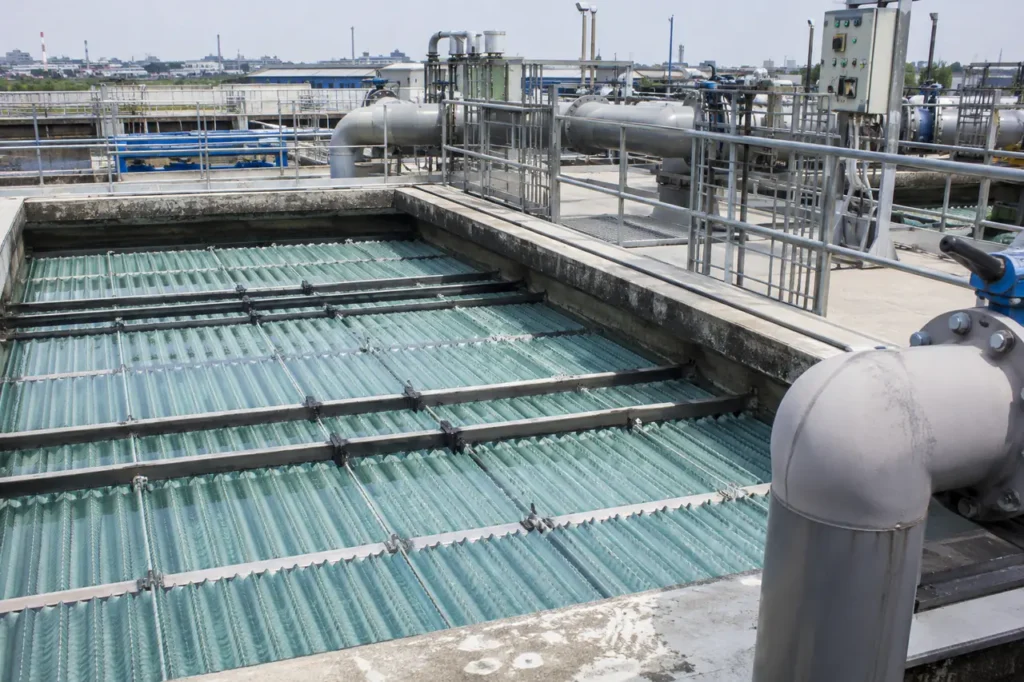
Plant expansion plans often stall when civil site boundaries leave no room for new concrete sedimentation basins, but integrating a modular tube settler array into existing clarifiers allows municipal and industrial plants to double throughput while keeping the current physical footprint.
Operational Mechanics: The Physics of Enhanced Sedimentation
Tube settlers increase clarification capacity by stacking sloped tubular channels at a 60-degree angle. This drastically reduces the vertical distance suspended solids must fall before coalescing, creating a high effective settling area within a compact tank volume.
Gravity Settling and the 60-Degree Inclination
Gravitational settling in water treatment depends directly on available surface area rather than basin depth. In a standard open tank, a flocculated particle must travel several meters downward to reach the sludge floor.
Sloped channels cut this vertical drop down to roughly 3 to 5 centimeters. When raw water flows upward through the module, suspended solids settle onto the lower tube surface and slide downward into the hopper.
An inclination angle of 60 degrees represents the exact mechanical threshold where gravity overcomes sludge friction. If the channel slope drops below 55 degrees, accumulated solids cling to the walls, leading to channel clogging.
Angles above 65 degrees allow easy sludge drainage but significantly reduce the projected horizontal settling area. Managing the Hydraulic Loading Rate Clarifier balance relies on maintaining this exact 60-degree geometry across the media block.
Increasing Effective Surface Area
Modifying settling geometry changes the fluid flow pattern inside the basin from turbulent to laminar. Passing liquid through narrow tubular channels drops the local Reynolds number well below 50.
Low Reynolds numbers eliminate hydraulic short-circuiting and thermal density currents. Fluid moves in predictable, parallel streamlines that prevent delicate flocculated particles from shearing apart.
The effective settling area formula incorporates module length, channel diameter, and angle of inclination. Equipping tanks with Wct Honeycomb Inclined Tube Packing For Sedimentation Tank modules increases effective clarification surface area by 400% to 1,200%.
When hydraulic loading rises, upward velocity competes with particle settling velocity. The reduced settling depth lets a particle reach the lower tube surface before the upward stream carries it out, so the basin can accept higher flow without turbidity carryover.
- Settling distance: Reduced from 3-4 meters down to 35-50 millimeters.
- Laminar flow control: Reynolds number maintained below 50 to stop floc shear.
- Self-cleaning slope: 60-degree pitch forces continuous gravitational sludge sliding.
- Critical velocity: Particle settling speed exceeds upward liquid rise rate.
System Comparison: Tube Settlers vs. Lamella Plates vs. Standard Clarifiers
While both tube modules and parallel plate settlers increase effective surface area, modular tube packs provide a far higher strength-to-weight ratio. They also simplify retrofit installations inside existing round or square tanks.
| System Type | Footprint Required | Installation Complexity | Settling Efficiency | Ideal Use Case |
|---|---|---|---|---|
| Standard Open Clarifier | Baseline (100%) | Low | Moderate | New plants with unrestricted civil footprint |
| Traditional Lamella Plates | Small (25-35%) | High | High | Heavy industrial plants, deep steel tank builds |
| Modular Tube Settler Packs | Compact (20-30%) | Low to Moderate | High | Plant capacity upgrades, circular tank retrofits |
Parallel plate systems rely on heavy stainless steel or thick flat sheet assemblies. Their structural mass requires heavy overhead crane support and complex internal framing inside circular basins.
Modular tube packs utilize lightweight thermoformed polymer sheets welded into rigid honeycomb structures. Operators can hand-carry individual packs through standard tank manways during retrofits.
For high-volume municipal or industrial projects evaluating Wct Inclined Plate Settler For Sewage Disposal against tube media, tube packs consistently offer lower structural deadweight and lower capital expenditure.
Before selecting between standard clarifiers, plate settlers, and tube packs, verify these decision points:
- Existing footprint: Tube packs fit fixed circular basins where plate settlers would require major steelwork.
- Hydraulic target: Specify modular tubes when peak flow must rise by 80% or more without new concrete.
- Solids type: Avoid fine tube channels if fibrous or sticky solids could blind the media.
- Lifecycle load: Compare dry weight plus fouled sludge mass when sizing support grids and manway handling.
Core Applications in Water and Wastewater Treatment
Modular settling packs integrate into both drinking water treatment trains and heavy industrial effluent systems. They improve final water clarity and protect downstream filtration units.
Municipal Drinking Water Clarification
Surface water treatment facilities face seasonal raw water changes. Turbidity spikes caused by heavy rainfall or algal blooms often overwhelm traditional settling basins during high-demand summer months.
Retaining existing concrete basins while installing high-density media packs allows municipalities to process higher flow volumes. The media accelerates particle drop-out after alum or ferric coagulation.
Lowering effluent turbidity before sand or membrane filters extends backwash intervals. Applying correct Sedimentation Tank Design principles cuts chemical polymer dosing requirements by up to 30%.
Operating checks for municipal clarification upgrades:
- Confirm raw water turbidity spikes and peak summer flow projections before retrofitting settling basins.
- Verify coagulant mixing zones and polymer dosing points remain effective upstream of the media pack.
- Set post-media turbidity targets close to downstream filter design limits to extend filter run times.
- Plan for seasonal sludge removal; increased solids capture requires matched hopper pumping capacity.
Industrial Process and Wastewater Treatment
Industrial facilities handle variable suspended solids loads, oily emulsions, and heavy metal precipitates that strain conventional settling tanks.
Installing targeted Clarifier For Industrial Wastewater media accelerates heavy metal hydroxide drop-out in plating shop effluent and paper mill wash water.
- Mining operations: Tailings thickeners and quarry wash-water solids recovery.
- Metal finishing: Hydroxide precipitation and rinse-water clarification.
- Food and beverage: Biological secondary sludge clarification.
- Power generation: Flue-gas desulfurization (FGD) wastewater treatment loops.
- Chemical processing: Neutralization basin solids separation.
Material Selection Guide: PP vs. PVC Tube Settlers
Polypropylene (PP) and Polyvinyl Chloride (PVC) are the dominant polymers used in media pack fabrication. Choosing the correct polymer depends on chemical exposure, water temperature, and sunlight levels.
| Selection Metric | Polypropylene (PP) | Polyvinyl Chloride (PVC) | Application Impact |
|---|---|---|---|
| Specific Gravity & Weight | Lightweight (~0.91 g/cm³) | Heavy (~1.40 g/cm³) | PP lowers structural load on support grids |
| Chemical Resistance | Excellent (acids, bases, solvents) | Good (vulnerable to aromatics) | PP suits aggressive industrial chemical streams |
| Thermal Limit | Up to 80°C (176°F) | Up to 60°C (140°F) | PP prevents thermal softening in warm processes |
| UV Resistance | Requires UV inhibitor additives | Inherently better UV resistance | Outdoor basins need carbon black UV stabilization |
| Cost Profile | Moderate initial cost | Low to moderate cost | PP delivers longer lifecycle in tough environments |
Managing Outdoor UV Exposure and Structural Load
Outdoor open-top basins expose plastic media to persistent solar radiation. Standard untreated polymers undergo photo-oxidation, turning brittle and cracking under sludge loading.
Quality PP media incorporates carbon black and hindered amine light stabilizers (HALS) into the resin during extrusion. This additive package maintains structural elasticity under full sunlight.
Weight differences become critical during maintenance washing. PP packs weigh roughly 35% less than PVC packs of identical volume, reducing grid strain when media fills with heavy solids.
Before approving PP or PVC media, request the following batch verification data:
- Accelerated weathering or UV stabilization test data for the actual resin grade.
- Measured specific gravity and flexural modulus for load-bearing modules.
- Chemical compatibility test data for the exact wastewater pH, temperature, and solvent profile.
- Welded joint tensile records or supplier assembly quality checks.
Plant Retrofitting: Upgrading Clarifier Capacity
Retrofitting existing settling tanks with modular media provides an immediate capacity boost. Plant operators expand throughput without breaking ground for new civil structures.
Integration with Circular and Rectangular Basins
Rectangular basins accept modular packs seamlessly because straight wall geometry matches standard rectangular pack dimensions. Installers lay packs side-by-side on parallel support beams.
Circular clarifiers require specialized boundary trimming. Media blocks must be cut to fit the curved tank perimeter while leaving clearance for center drive shafts and sludge scraper arms.
Upgrading to a High Rate Clarifier configuration allows circular units to operate at double their original hydraulic loading rates.
Support Structures and Baffle Design
Structural support grids must carry both the dry weight of the media and the weight of trapped sludge during maintenance drawdowns.
Supports typically utilize 304 or 316 stainless steel I-beams, or structural fiberglass (FRP) grating. Anti-flotation hold-down bars prevent media blocks from shifting during rapid basin filling.
Proper baffle configuration prevents inlet water from short-circuiting under the media zone. Integrating complementary components like Wct Tube Diffuser For Water Treatment units in upstream aeration zones ensures smooth hydraulic handoffs into the clarification basin.
Modernizing an older Wastewater Clarifier with optimized distribution launders ensures even flow distribution across every square meter of media.
Before installation approval, verify these structural and hydraulic interface points:
- Support beam spacing matches the media pack unsupported span and wet sludge dead load.
- Baffle walls extend below the media bottom to prevent inlet short-circuiting.
- Launder placement draws water evenly from the full media surface area.
- Center drive shaft, sludge scraper arms, and manway access remain clear after media trimming.
What to Prepare Before Custom System Design
Specifying a tube settler system requires compiling exact hydraulic, physical, and chemical site data. Providing accurate baseline metrics ensures proper channel sizing, support grid engineering, and material selection.
Essential Engineering Data Checklist
- Basin dimensions: Precise length, width, side water depth, and slope angles (or circular diameter and center well dimensions).
- Flow parameters: Minimum, average, and peak hourly hydraulic flow rates.
- Influent quality: Average and peak Total Suspended Solids (TSS) and turbidity ranges.
- Chemical characteristics: Water pH, operating temperature range, presence of oils or aggressive organic solvents.
- Coagulation profile: Type and dosage of coagulants or flocculant polymers currently in use.
- Physical constraints: Open-air vs enclosed installation, overhead clearance, access manway dimensions, and scraper geometry.
Preparing these site specifications allows engineering teams to calculate required effective surface areas, module pitch, and support framing. Consult with a clarification specialist at WCT to evaluate your basin geometry, calculate hydraulic loading parameters, and receive a complete retrofit proposal.