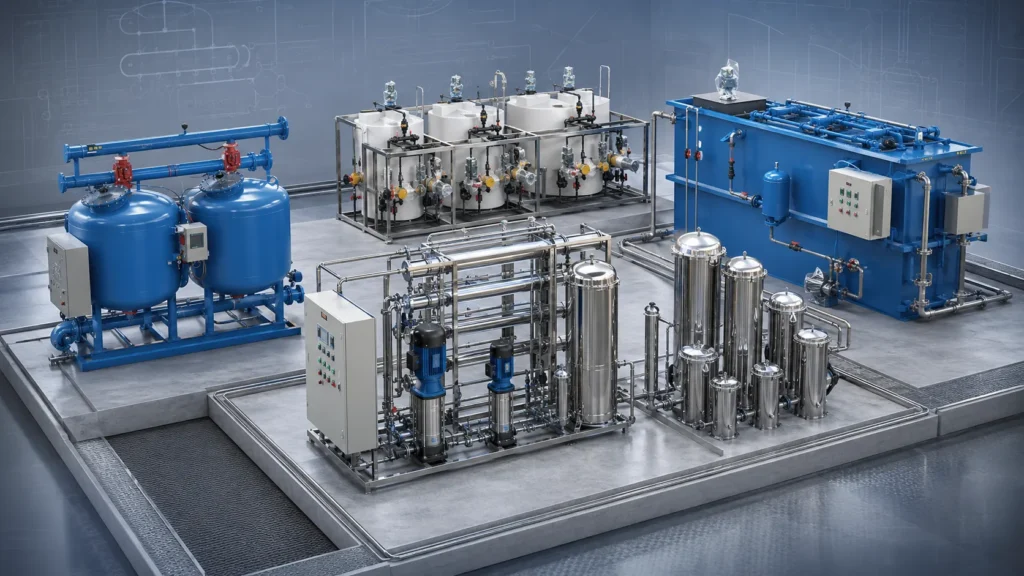
Engineering project water treatment isn’t a catalog pick. Site-specific chemistry, variable flows, and discharge limits turn equipment selection into a balancing act. Choose without front-end engineering and you risk membranes that foul early or clarifiers that can’t handle peak loads. This technical framework helps engineers and project managers match water treatment equipment for engineering projects to real conditions — not just datasheets.
Technical Comparison of Water Treatment Technologies
Membrane selection hinges on what you’re removing — dissolved salts, hardness, turbidity. The table below compares the primary technologies engineers use to form a treatment train.
| Technology | Targeted Contaminants | Flow Rate Capacity | Operating Pressure (Typical) | Maintenance Intensity |
|---|---|---|---|---|
| Reverse Osmosis (RO) | Dissolved salts, TDS, heavy metals, microorganisms | Wide range, from pilot skids to large municipal trains | 10–70 bar (depending on salinity) | Moderate to high (membrane cleaning, periodic replacement) |
| Nanofiltration (NF) | Divalent ions (hardness), organic matter, color | Scalable arrays, often used alongside RO for pretreatment | 5–15 bar | Moderate |
| Multimedia Media Filters | Suspended solids, turbidity, some iron/manganese | High flow, typically as pretreatment for membranes or discharge | 1–5 bar | Low to moderate (backwashing, media replacement cycles) |
| Clarifiers | Settleable solids, oil & grease, flocculated particles | High volume, primary treatment stage | Gravity-fed, low pressure | Low (mechanical components, sludge handling) |
Actual specs vary with feed water quality. Get performance data validated for your project’s water before committing.
Mapping Equipment to Project Environments
A municipal potable line demands pathogen barriers that an oilfield brine stream doesn’t. The matrix below matches project type to primary equipment and the constraints that drive design.
| Project Category | Primary Equipment Used | Critical Design Constraint | Regulatory Standard (EPA/Local) |
|---|---|---|---|
| Municipal Potable | RO, NF, media filters, clarification | Pathogen removal, TDS limits, SDWA compliance | EPA SDWA, local health department |
| Oil & Gas Produced Water | Clarifiers, hydrocyclones, media filters, RO/NF (if recycling) | High TDS, oil content, silica scaling | EPA NPDES, local discharge limits |
| Industrial Manufacturing Recycling | Ultrafiltration, RO, media filters | Chemical oxygen demand (COD), heavy metals, variable load | Local industrial pretreatment standards |
| Civil Infrastructure Remediation | Mobile clarification, media filters, carbon adsorption | Site space, runoff variability, turbidity | EPA construction stormwater, local standards |
Standards shift by jurisdiction; obtain the latest from local authorities. Closed-loop recycling often calls for process water treatment systems configured for zero liquid discharge, while complex effluents need tailored industrial effluent treatment solutions. Municipal projects sometimes integrate integrated sewage treatment equipment for combined flows.
Custom Fabrication and Engineering Design Considerations
Off-the-shelf packages rarely survive corrosive streams or tight site footprints. What to specify in your fabrication scope.
- Material selection: Stainless steel (304/316L) resists most municipal and industrial waters, but high-chloride streams (Oil & Gas) demand duplex alloys or specialized coatings to prevent crevice corrosion.
- Structural standards: Tanks, headers, and support frames should meet ASME or ASTM standards for pressure and seismic loads. Verify weld procedures and NDT documentation during fabrication audits.
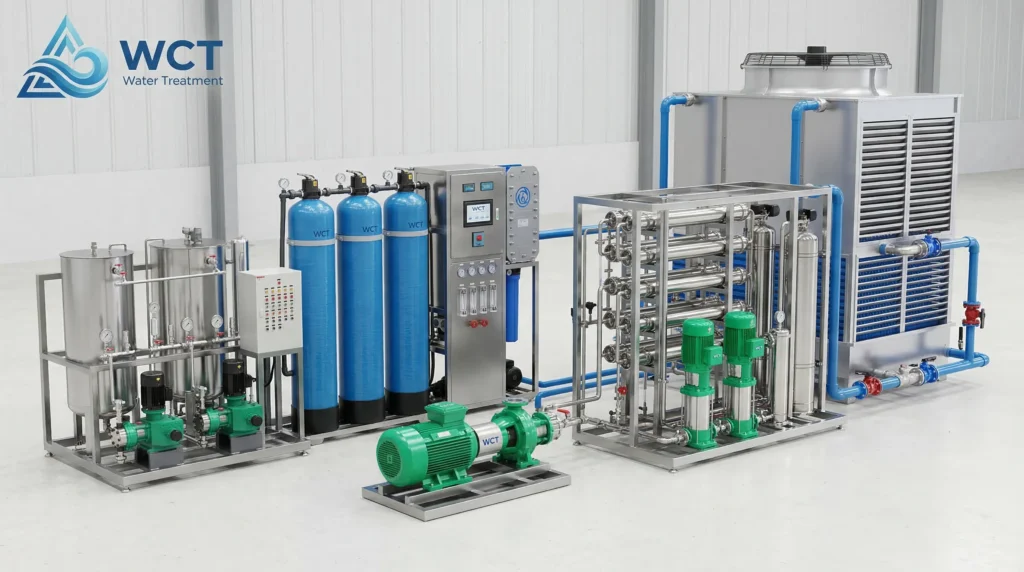
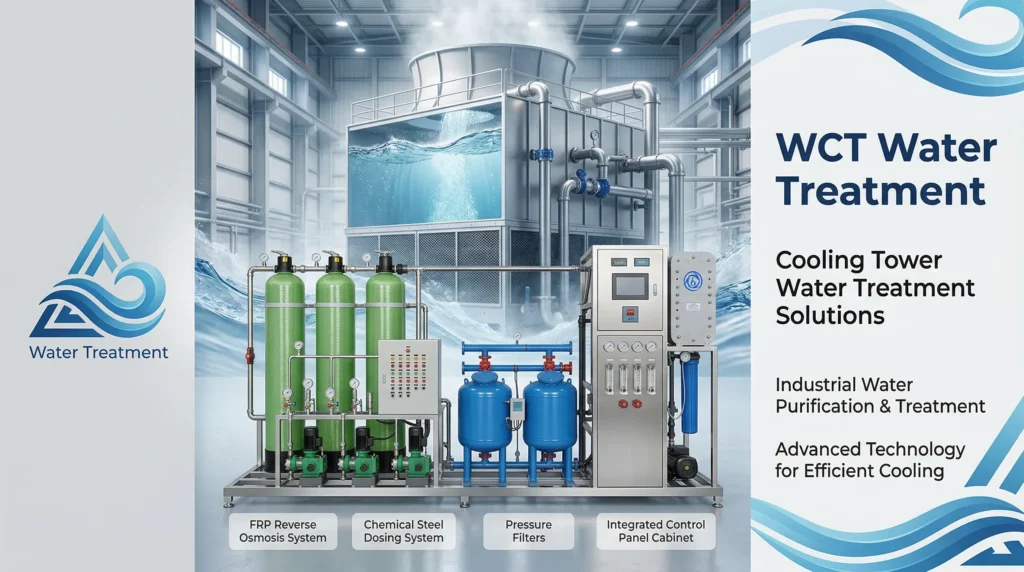
- Modular and skid-mounted designs: For projects requiring rapid deployment, modular water treatment systems offer pre-engineered, skid-mounted configurations that reduce field assembly time and allow phased capacity additions.
- Control integration: Custom PLC programming and remote I/O compatibility with existing SCADA ensure seamless process alignment and reduce commissioning delays.
Compliance and Regulatory Verification Standards
Regulatory compliance must be engineered in from the start, not added later. Verify these items in every equipment specification.
- Material safety: Confirm wetted components hold NSF/ANSI 61 certification for potable applications or equivalent food-grade material listings.
- Effluent quality guarantees: Request performance warranties tied to specific feed conditions — not just design averages. Look for process guarantees covering TDS rejection, turbidity, and microbiological reduction.
- Monitoring and reporting automation: Verify that the control package supports EPA-required data logging (turbidity, chlorine residual, flow) and can interface with remote compliance reporting platforms.
Scalability and Mobile System Solutions
Mobile or containerized systems keep treatment running during construction or emergencies. Modular skid-mounted systems reduce civil works and allow phased capacity expansion. A standard 40-foot container can house a full RO train or clarifier package, treating tens to hundreds of m³/day. For temporary needs, rental contracts with performance guarantees bridge the gap, and the same unit may later become a permanent auxiliary. Before deployment, confirm structural wind/seismic code compliance and factory wet-test documentation.
Engineering Vendor Evaluation Checklist
A supplier’s engineering depth matters as much as their hardware. Use this checklist to compare fabrication partners.
- Design-build capabilities: Does the vendor have in-house process engineering to size membranes, clarifiers, and chemical feed systems from raw water analysis?
- Fabrication certifications: Check for AWS D1.1/D1.6 welding certifications and ASME BPVC pressure vessel stamps where required.
- Technical documentation: Confirm that the vendor follows water system design best practices for site-specific hydraulic profiling and can supply CAD/BIM models early for clash detection.
- Site-specific performance testing: Ask for pilot study results or factory acceptance test protocols that validate performance under the project’s actual water chemistry.
- After-installation support: Evaluate whether the vendor offers commissioning assistance, operator training, and a stocked spare parts inventory for extended project lifespans.
Technical Consultation and RFP Submission
Complex water treatment needs require early-stage engineering collaboration. Instead of finalizing specifications in isolation, forward a water analysis and site schematics to get a custom equipment proposal. Our engineers will refine the treatment train, verify material compatibility, and size units to your exact duty point — reducing capital and compliance risk. For a technical deep-dive or RFP request, explore our custom fabrication capabilities or review existing engineering project solutions.
Frequently Asked Questions
How do flow rate fluctuations affect equipment selection?
Wide flow swings reduce clarifier efficiency and can damage membranes through sudden pressure bursts. Sizing equalization tanks upstream or selecting modular trains with variable-speed pumps allows the system to operate across a wider range without compromising effluent quality.
Can mobile treatment systems meet municipal potable standards?
Yes, if configured with EPA-validated membrane filtration and disinfection stages. Containerized units can include multi-barrier treatment — media filtration, RO, and UV or chlorine dosing — that meets SDWA requirements when properly monitored and maintained.
What is the typical lead time for custom-fabricated clarifiers or tanks?
Lead times for engineered-to-order vessels range from 12 to 20 weeks, depending on material availability and complexity. Early engagement during front-end engineering design (FEED) helps avoid schedule conflicts and ensures fabrication finishes before site installation begins.