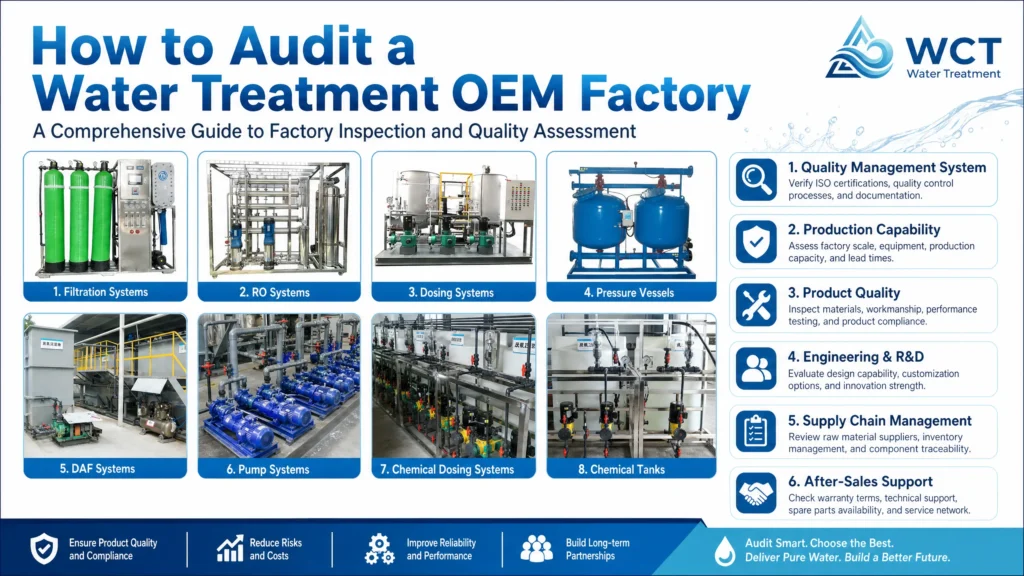
What is The Use of A Water Treatment OEM Factory Audit
What is a Water Treatment OEM Factory Audit?
A water treatment OEM factory audit is a systematic, independent evaluation of a manufacturing facility to see its operational capabilities, quality standards and it complies with regulatory requirements. This audit can be considered the first step in vetting a water treatment products supplier and manufacturer if your business is pursuing an ODM manufacturing partnership. It goes beyond the paperwork to assess the actual factory floor, verifying that a partner has well documented processes and can consistently manufacture custom equipment—reverse osmosis systems, ultrafiltration units, industrial water softeners—that meets specific engineering criteria.
The Importance of Auditing Your OEM Supplier
In international trade, the reputation of your products solely lies in their reliability. Clearly any water treatment OEM who cannot provide proven or verifiable performance data introduces serious pitfalls such as premature fouling on membranes, failure of structural components and potentially non-conformance to the relevant global drinking water standards.
For many operational reasons, we must perform a thorough audit:
- Avoids pitfalls from poor designs and engineering practices before production starts: It helps point out the bottlenecks — uses sub-standard raw materials, weak engineering practices, etc. before going into mass production
- Financial Safety: No more expensive product recalls, cargo rejections at customs and warranty claims.
- Supplier Qualification: Sets the bar for financial stability and technical understanding of scaling within your manufacturers regarding growth.
Objective and the Scope of Audit
The key aim of your audit would be to bring along the manufacturing end result in line together with all worldwide excellent command requirements. An audit verifies that the facility is safe, legal, and efficient.
| Audit Focus Area | Core Objective |
|---|---|
| Engineering Capability | Test that the site can read advanced technical drawings and perform accurate assembly. |
| Quality Architecture | Make sure to use a strong factory audit checklist at each stage of production from raw materials through finished goods. |
| Regulatory Alignment | Validation is to ensure the factory complies with regulations governing environmental health and safety guidelines necessary for export markets worldwide. |
Pre-Audit Preparation and Planning
Establishing the Audit Criteria and Scope
We lay down the definitive line in the sand for inspection before we even step foot inside a Water Treatment OEM facility. Beneath all this a successful factory audit checklist depends entirely on defining what is being evaluated; are we talking about only one line of reverse osmosis systems, or even just industrial water softeners in general, which may have be an industry wide knowledge of technical performance? Our criteria coincide with specific global safety standards and technological capabilities along with the engineering practices that our clients in the global markets would look for, so that no critical process remains unaddressed.
Crisis Response: The ‘Audit Team’ And Experts
We don’t just send inspectors; we send a specialized team that knows the ins and outs of water purification technology. Our squad typically features:
- Manage Quality Control Validator: Checks quality control requirements and all-encompassing administration frameworks
- Technical Engineer — analyzes structural strength and stability, hydraulic designs, compatibility of parts
- Compliance Officer: A Compliance Officer reviews local environmental impacts, safety certifications and labor laws.
Essential Document and Compliance Checklist
We require preliminary core documentation to confirm the quality and validity of ODM manufacturing partnerships. Going through these files before your site visit can save you time during your site visit, and show you what to look out for right away.
| Document Type | Critical to Review |
|---|---|
| Quality Management | ISO 9001 Certification, Internal Calibration logs, Defect Tracking Reports. |
| Technical Records | Testing records and component traceability including material safety data sheets (MSDS) as well as third-party pressure vessel certifications |
| Compliance & Licensing | Business operation licenses, environmental discharge permits and safety clearances. |
The paperwork review creates an excellent baseline for our supplier qualification process before any physical walkthroughs,

Reviewing Regulatory Compliance and Certifications
Verifying ISO and Environmental Certifications
We are a global supplier, and manufacturer of water treatment products, and we understand the valid certificates are the foundation of trust. When you are conducting an OEM factory audit for water treatment, we check that the facility has valid ISO 9001 (Quality Management) and ISO 14001 (Environmental Management) certifications on file. We check for official registrar stamps, expiration dates and what the certification in question exactly covers—specifically whether it applies to the exact water treatment systems or components being manufactured.
Review Local Environmental and Safety Regulations
You can ensure a strong supply chain with a compliant factory. We verify that the facility is complying with local environmental legal frameworks, wastewater discharge permits as well as occupational health and safety standards. For facilities that utilize advanced aeration technologies, compliance verification ensures core component production — including a few key WCT tube diffusers for water treatment (check out the link)- remains within stringent environmental output requirements or face regulatory shutdown.
Examining Quality Management System (QMS) Records
A search through the QMS records of the factory reveals a wealth of information that informs us about existing practices as well as compliance with key processes and accountability. A well-established Water Treatment OEM has to be transparent with the paper trail and also demonstrate on scheduled internal audits, management reviews, and non-conformance reports in order.
We review the following elements within a QMS in our evaluations:
- Corrective Action Records: Typical information that demonstrates how defects related to manufacturing were responded to from past generations.
- Employee Training Logs: Evidence the assembly and testing technicians are appropriately trained to work on specialty water treatment equipment.
- Change control procedure: Documents of approval and tracking for design changes or material substitutions.
Evaluating Production Capability and Equipment
Inspecting Manufacturing and Assembly Facilities
Shop floor – A walk of the shop floor during a water treatment OEM factory audit will yield what capacity a supplier is realmente able to offer. We are looking for streamlined assembly lines, proper segregation of workflow, and dedicated zones in different stages of equipment. AScatted floor generates production flaws. The workshop has to comply with high dust and contamination controls — all of which are essential for accommodating the assembly of high-performance water purification systems, &; our experience as both a water treatment products supplier and manufacturer ensures this need is catered for.
Reviewing Calibration and Maintenance Protocols
Reliable hardware requires precise instrumentation. Simply put, we keep an eye on the factory’s logs to ensure that every welding device, every pressure gauge and automated testing rig is routinely calibrated.
- Calibration Logs: Should provide evidence to national standards.
- Preventive maintenance — Equipment breakdowns must be proven as serviced by scheduled downtime logs.
- Tool Management: Identify assembly tools that must have torque and pressure applications monitored.
How to Assess Membrane Plant and Filtration Equipment Performance
At the heart of any advanced water system are its filtration components. In the course of conducting a factory audit checklist, we examine the processes such as membrane housing and automated element rolling by the OEM. When auditing a partner that constructs industrial-scale purification systems, confirming their maturity in constructing heavy-duty filtration rigs should be a prerequisite. For example, seeing how they incorporate high-capacity elements (like those found in a stout municipal water filtration system) provides an immediate insight into the limits of their engineering. We inspect pressure testing stations to ensure that no membrane housing is prone to bypass or leak during the course of normal operations.
Evaluating Quality Assurance and Testing Protocols
For example, when we audit a water treatment OEM factory, the QC department is where we invest the most time. You can be operating the best factory in the world, running beautifully efficient assembly lines but unless that equipment Is rigorously tested before it ships, the chances of field failure rapidly increase. We seek programmable defined quality assurance for each and every stage of production.
Evaluating In-Coming Component Inspection
Quality begins long before assembly. We have confirmed how the factory treats raw materials and parts coming in: valves, pressure vessels, pumps.
- Sampling Protocols: We review whether the factory employs standard statistical sampling (e.g., AQL thresholds) to inspect incoming lots.
- Defect Management — Non-conforming components must be easy to identify & segregated in a reject-area to avoid them hitting the production line.
- Supplier Qualification: The OEM shall maintain logs that with records to demonstrate that their own sub-vetted suppliers are performance qualified against stringent component specifications.
Reviewing In-Process Testing and Validation
A good Water Treatment OEM will not wait until a system is fully constructed to test it. Our factory has step-by-step validation during assembly to maintain strong reliability long after the equipment is delivered.
| Test Phase | Critical Inspection Items | Goal of Outcome |
|---|---|---|
| Welding & Framing | Non-destructive Testing (NDT), Visual inspection | Structured integrity, no leaks |
| Electrical Wiring | Pressure test to assess continuity and PLC Program simulation | Safe operation mode verification, Correct automation logic |
| Hydraulic Pressure | Pipe Network for High pressure | No drop in pressure, establish that the seal is good |
In-process validation is what ensures that integrated sewage treatment equipment, to be used for large-scale municipal or industrial projects, continue to function as designed without premature weld failures or structural leaks.
Analyzing Water Quality Testing Protocols
Water produced on a category-defining system is the ultimate proof of performance. We review testing lab setups on what was done in the factory to confirm it simulates real purification performance.
- Wet Testing Capabilities: We find out if the factory does full wet tests with real water to determine flow rates, consumption rates and system pressure.
- Lab Instrument Calibration: Calibrated meters: Total Dissolved Solids (TDS) meters, pH meters and turbidity sensors all need current calibration stickers
- Performance Data Logs — Final FAT Documentation Templates: Prior to shipping, the factory has to log exact water quality parameters.
Supply Chain & Raw Material Management
The supply chain can be the backbone of any water treatment OEM factory. At the time of auditing a facility, we carefully consider the sourcing, tracking and storage of raw materials to maintain consistency in final product.
Supplier Evaluation and Management Systems
We assess how a factory chooses its own sub-vendors and audits them. A first-class manufacturer must adhere to a stringent vendor qualification process so that inferior materials never touch the production line. Our partners, as authorized brand suppliers and manufacturers of water treatment products, maintain healthy supplier qualification levels. These include ongoing performance reviews, quality risk assessments, and corrective action plans for sub-vendors.
Traceability on Key Components and Materials
Critical filtration components require traceability. When we review the factory audit checklist, one of the questions we ask is whether a finished product can be traced back to its raw material batch.
- Check that high-stakes components have clear serialization or batch coding on them, such as for a high-performance RO membrane found in reverse osmosis filters.
- Material certificates: Make sure there are Mill Test Certificates (MTCs) and material data sheets available for piping, valves, and pressure vessels.
- Logistics Records: Ensure there is a one-to-one correlation between logs received and production line utilization records.
Inventory Storage and Handling Practices
Correct storage does not allow both parts to degrade before construction has even begun. The warehouse inspection is to ensure the factory has stringent inventory control.
| Requirement | Description & Audit Potential Risk |
|---|---|
| Climate Controlled Stores | Stores that are within the heat and humidity threshold for sensitive seals, membranes, & Electronics. Over time, this can lead to premature aging, the warping of material, or the failure of individual components. |
| Stock Rotation (FIFO) | First-In, First-Out system for stock rotation. Old parts or seals that have degraded during assembly. |
| Segregation Rack | Clear segregation of approved material, rejected stock and work in progress. Unintentional cross-contamination or use of faulty components. |
Post-Audit Evaluation and Reporting
After we complete a on–the-ground physical inspection of a water treatment OEM facility, the actual qualification work starts! Collecting data is only half the challenge; smart scoring of the factory, filling in those gaps, getting long term reliability locked down is how to secure a high-value supply chain for us.
Analyzing Audit Findings and Scoring
To remove the guess work we evaluate your factory with a structured factory audit checklist. Each non-conformance is subjected to risk classification which helps determine the final supplier score.
| Risk Level | Definition and Effect on Partnership |
|---|---|
| Critical | Direct impact on function, safety or regulatory compliance. Immediate fail. Partnership on Hold until issue fully resolved. |
| Major | Significant departure from quality control or process control. Conditional pass. Mandatory corrective action plan. |
| Minor | Small process deviation not affecting final product performance. Approved. Target for continuous improvement. |
Creating a Corrective and Preventive Action (CAPA) Plan
Audit success is not about achieving a perfect factory on day one, but it is about ownership. In case of any major or critical gap observed during the water treatment OEM audit, a formal CAPA request is generated.
- Root-cause Analysis — The manufacturer needs to demonstrate that they have found the why behind this happening, not just the what.
- Containment Actions: Quick Band-aid solutions to safe guard current production lots.
- Preventive Actions: Solution is not one-off but instead long term (e.g. engineering or systemic changes) to ensure that the issue never happens again.
- Hard Deadlines: Less serious issues get 30 days, while more severe ones require a plan to remediate within 10.
Establishing Continuous Performance Monitoring
Transition from periodic gatekeeping to continuous oversight is needed to secure reliable ODM manufacturing partnerships. Our audit isn’t one and done; tracking performance in real time & against evolving quality metrics.
- Quarterly KPI Reviews: This means tracking defect rates, on time delivery, engineering response times.
- Spot Checks: They are random visits to the factory without notice to find out whether the current operations align with what was observed during the official audit.
- Component Reliability Monitoring : Field reliability assessments of critical in-house components—from structural housings to high-efficiency elements such as a proprietary screw press sludge dewatering machine—to ensure long term field reliability matches stringent brand standards.