The biggest mistake we see in dewatering procurement isn’t undersizing the press—it’s ignoring how plate design determines long-term maintenance costs. A recessed chamber filter press eliminates the separate spacer frames that cause leaks and make cake discharge a manual chore in older plate-and-frame systems. That single design choice dictates whether your operators spend their time watching automated cycles or wrestling with stuck cakes.
We’ve seen too many teams fixate on feed pump specs while skipping the structural advantages that keep a hydraulic plate pack sealed under sustained pressure. In this guide, we’ll break down exactly what you need to verify before you buy, from plate material selection to sizing calculations that match your real slurry conditions.
What Is a Recessed Chamber Filter Press?
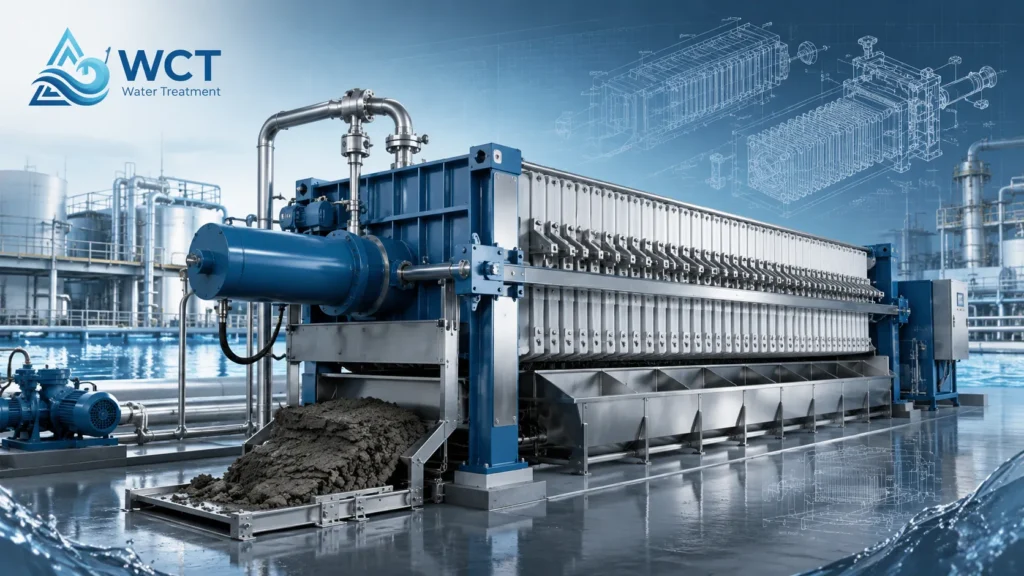
A recessed chamber filter press is an industrial dewatering machine that uses a series of recessed-design plates clamped under hydraulic force to form sealed internal cavities where slurry is filtered and dry solids are captured as cakes. Unlike plate and frame configurations, each plate serves as both chamber former and filtration surface, dramatically reducing seal paths and labor for cake discharge.
The Anatomy of a Recessed Filter Plate
Recessed plates are molded from chemically resistant polymers—most commonly virgin-grade polypropylene—with a concave central depression and raised sealing edges around the perimeter. The recessed profile creates a hollow chamber between adjacent plates when they’re pressed together. Drain ports sit behind the filter cloth, directing filtrate out while solids accumulate on the cloth surface. The center feed eye allows slurry to enter each chamber uniformly, and the plate’s structural ribs prevent flexing under high-pressure differentials.
How Chambers are Formed and Clamped
A hydraulic closing system compresses the entire plate pack against a fixed end plate, forming a watertight seal between each recessed plate. The clamping force must counteract the internal pressure that builds during slurry feeding—typically 100 PSI or more—so the hydraulic cylinder continuously monitors and adjusts pressure. This ensures the sealing surfaces stay compressed, preventing bypass leakage even as filter cake resistance increases toward the end of the cycle.
Slurry Flow and Cake Capture Principles
Slurry enters through the center feed eye, fills the chamber cavities, and deposits solids on the filter media that lines each recessed plate. Filtrate passes through the cloth and drains via corner ports or internal channels to collection manifolds. Cake builds progressively from the cloth surface inward, with the pressure differential driving water removal. The key performance metric is cake dry solids content, which depends on feed pump pressure, slurry characteristics, and cloth permeability.
How a Recessed Chamber Filter Press Operates: The Filtration Cycle
The filtration cycle of a recessed chamber press runs in batch phases—clamping, slurry pumping, pressure filtration, air drying, and plate separation—to separate liquids from solid cakes. Understanding each phase’s timing and pressure profile helps operators avoid wet cakes, plate blowouts, and premature cloth wear.
Phase 1: Hydraulic Clamping and High-Pressure Seal
The hydraulic cylinder advances the moving end plate, compressing the entire plate pack to the specified clamping pressure. This pressure must exceed the highest anticipated internal feed pressure to maintain a seal. Automatic systems use pressure transmitters to verify the seal before the feed pump starts, preventing slurry from spraying between plates.
Phase 2: Slurry Feed and Cake-Building Phase
A feed pump—typically a progressive cavity or diaphragm pump—injects conditioned slurry through the center feed manifold. Initially, low pressure fills the chambers quickly; as cake thickness grows, the pump pressure ramps to maintain flow. The filtration cycle continues until the cakes fill the chambers and the flow rate drops to a predetermined endpoint, usually signaled by a flow meter or timer. During this phase, the hydraulic system compensates for any thermal expansion or pressure fluctuations that could compromise the seal.
Phase 3: Core Blow and Air Drying
Before opening the plates, a core blow cycle pushes compressed air through the feed manifold to evacuate residual wet slurry from the feed eye and center piping. This minimizes slurry dribbling onto the plate sealing surfaces when the press opens. Extended air drying can further reduce cake moisture, especially for sludges that hold water in capillary pores. This step is critical for ensuring a clean cake discharge in the next phase.
Phase 4: Pressure Release and Cake Discharge
The hydraulic system retracts, the moving end plate pulls back, and the plates separate sequentially. Automated plate shifters move each plate one by one, allowing gravity or a scraper mechanism to drop the filter press cake into a collection hopper. Operators should visually inspect that all cakes have fallen before closing the press for the next cycle, as residual cakes can cause misalignment and leakage.
Recessed Chamber vs. Plate and Frame Filter Press Designs
While plate and frame presses use separate hollow frames to collect cake, recessed chamber presses combine the chamber and plate into a single molded unit, resulting in fewer joint seals, lower leakage rates, and easier automated cake discharge. The structural difference directly impacts labor, cycle time, and long-term maintenance.
Structural Differences and Chamber Cavity Formation
In a plate and frame filter press, alternating solid plates and open spacer frames create the cavity; the filter cloth sits between them. A recessed chamber system eliminates the separate frame entirely, with the cavity recessed directly into each plate. This design halves the number of sealing surfaces, dramatically reducing the risk of cross-contamination and slurry bypass.
| Feature | Plate and Frame | Recessed Chamber |
|---|---|---|
| Chamber Formation | Hollow frames inserted between solid plates | Concave recess molded directly into each plate |
| Sealing Surface Count | Double the sealing points (plate-frame-plate interfaces) | Single seal at each plate-to-plate junction |
| Cake Discharge | Manual scraping; automated shifting complex | Automated plate shifting; cakes drop freely |
| Filter Media | Often uses paper or fine filter media for specific washing | Primarily uses robust filter cloths for industrial dewatering |
| Leakage Vulnerability | Higher due to multiple gasketed joints | Lower; sealing surfaces are integral to the plate |
Buyers should verify that plate materials meet their chemical resistance requirements, regardless of press type. Manufacturer testing data should support any claims about maximum operating pressure and temperature.
Labor Intensity, Cycle Times, and Automation Capabilities
Recessed chamber presses excel in high-duty-cycle operations where automated cake discharge minimizes operator intervention. The integrated chamber-plate design supports reliable plate shifters and spray wash systems, cutting total cycle time. Plate and frame units still find niche use in pharmaceutical or specialty chemical applications requiring extremely precise cake washing or delicate filter paper media, but for most industrial filter press for sludge dewatering tasks, the recessed chamber is the lower-labor choice.
Capital Expenditures vs. Long-Term Maintenance Costs
Initial capital for a recessed chamber press is often higher due to the more complex plate molding, but the total cost of ownership shifts favorably once you factor in reduced maintenance labor, fewer replacement gaskets, and higher uptime. A wastewater treatment equipment budget that ignores these lifecycle costs will overvalue older plate-and-frame bids. We typically recommend recessed chamber designs for any plant running more than a few cycles per day.
Critical Technical Specifications and Engineering Sizing Criteria
Correct sizing of a recessed chamber filter press depends on calculating the total dry solids weight per batch, the density of the wet slurry, and selecting a press frame with matching chamber volume and pressure rating. Getting this wrong leads to undersized cakes that don’t fill the chambers, or overpressure conditions that crack plates.
Calculating Slurry Sizing and Chamber Volume Requirements
Start with the dry solids loading per hour or batch. Convert that to wet cake volume using the expected cake dry solids percentage and wet cake density. The required chamber volume is simply the total cake volume per cycle, with a safety margin for variable feed conditions.
Engineering takeaway: We recommend running a pilot test with a bench-scale filter press or Buchner funnel test on the actual slurry to establish the filtration rate and final cake moisture. These empirical numbers prevent costly oversizing.
- Determine average dry solids mass per batch (kg or lb).
- Measure or estimate wet cake dry solids content from pilot testing.
- Calculate wet cake volume: Dry solids mass / (cake density × dry solids fraction).
- Select a press frame with a nominal chamber volume at least 15–20% above the expected cake volume to account for feed variation.
Maximum Operating Pressure Limits and Feed Pump Selection
Standard wastewater sludge treatment applications run at 100 PSI (7 bar), but difficult-to-dewater mineral slurries or oily sludges may require pressures up to 130 PSI or even 225 PSI. The press frame and plates must be rated for the selected pressure range. Feed pump pressure must be matched to the press’s rated maximum, and the pump’s flow characteristic should allow slow initial filling to prevent uneven cake buildup and pressure spikes.
Materials of Construction for Plates: Polypropylene vs. Specialty Polymers
Virgin-grade homopolymer polypropylene handles most municipal and industrial sludges up to 80°C. For high-temperature, acidic, or solvent-laden streams, we specify polymers like PVDF or glass-filled polypropylene for improved rigidity and chemical resistance.
| Plate Material | Typical Application | Thermal Limit | Key Advantage |
|---|---|---|---|
| Homopolymer Polypropylene | Municipal sludge, neutral pH slurries | ~80°C | Cost-effective, wide chemical compatibility |
| Glass-Filled Polypropylene | High-pressure abrasive mining slurries | ~90°C | Reduced creep under sustained clamping pressure |
| PVDF | Strong acids, solvents, >90°C | ~100°C+ | Excellent chemical and thermal resistance |
| Aluminum/Stainless Steel | Specialty high-temperature non-corrosive | Above polymer limits | Used only where polymers fail; verify corrosion |
Buyers should request material certifications from plate manufacturers. Verify that virgin resin is used, not recycled regrind, which can develop microcracks under cyclic mechanical and thermal stress.
Key Components: Hydraulics, Manifolds, and Control Systems
Reliable solid-liquid separation requires a hydraulic closing system that continuously monitors and compensates for pressure changes inside the plate pack during the slurry feed cycle. The manifold design and PLC logic determine whether a press operates hands-off or demands constant operator attention.
Hydraulic Closing Systems: Manual, Semi-Automatic, and Fully Automatic
Manual hydraulic hand-pump systems suit small, infrequently operated presses, but most production dewatering lines use electro-hydraulic power packs with automatic pressure holding circuits. These units automatically top up clamp pressure if a thermal drop or minor seal leakage occurs. What to verify: In a fully automatic system, the hydraulic cylinder stroke should have a mechanical safety lock or check-valve circuit that prevents plate separation if power fails mid-cycle.
Inlet and Outlet Piping Manifolds and Valve Sequencing
The feed manifold typically runs along the top or center of the plate pack, while filtrate collection can be open discharge (visible streams) or closed manifold piping. Closed systems are cleaner and easier to monitor with flow meters. Automated valves sequence the slurry feed, core air blow, and manifold drain steps, reducing the chance of operator error. We often integrate polymer dosing for filter press feed conditioning directly upstream, using static mixers to improve floc formation before the slurry enters the feed eye.
Control Panels and Integration with Plant PLC Systems
Modern filter presses ship with a dedicated PLC control panel that manages the entire filtration cycle timing, hydraulic pump logic, valve actuation, and fault alarms. The panel should include pressure transmitters on both the hydraulic clamp circuit and the slurry feed line. For larger plants, the press controller communicates with a central DCS or SCADA system via hardwired I/O or fieldbus protocols, allowing remote start/stop and alarm monitoring. When specifying electrical panels, verify that the enclosure rating matches the plant environment and that any hazardous-area certifications (ATEX, Class I Div 2) are provided if needed.
Common Failure Modes, Troubleshooting, and Maintenance Best Practices
Operational failures in recessed chamber presses are typically driven by uneven slurry distribution, plate misalignment, or cloth blinding, all of which can be mitigated through scheduled wash cycles and seal inspections.
Preventing Bypass Leakage and Plate Blowouts
Buyer warning: Feeding slurry too aggressively at the start of a cycle creates uneven pressure across the plate pack, which can break plate alignment stays or cause a plate to blow out. Use a variable-speed feed pump that starts at low pressure and ramps only after initial cake buildup solidifies the chamber fill. Regularly clean plate sealing surfaces with a scrubber or automated wash system to remove grit that prevents full face-to-face contact.
Managing Cloth Blinding and Implementing Wash Cycles
Cloth blinding—where fine particles lodge permanently in the weave—increases cycle times and produces wet cakes. Monofilament filter cloths resist blinding better than multifilament weaves but may allow initial fine particle breakthrough. The remedy is a two-part practice: first, install an automated spray wash system that cleans cloths between cycles with water jets; second, optimize upstream chemical conditioning using a PAM dosing system to build larger, porous flocs that release water more easily. Operators should log cloth wash frequency and replace filter media proactively when wash cycles no longer restore flow rates.
Addressing Hydraulic Pressure Drop and Cylinder Seal Wear
A gradual drop in hydraulic clamping pressure during the cycle points to internal cylinder seal bypass or a leak in the pressure-holding circuit. Test the hydraulic system by dead-heading the cylinder and checking for pressure decay; a drop greater than 10% in 30 minutes warrants seal replacement. Keep hydraulic oil clean and at the correct level, and inspect the rod for pitting that will destroy new seals quickly. What to verify: Ensure the hydraulic power pack includes a low-level and over-temperature shutdown to protect the pump.
Recessed Chamber Filter Press Sizing and Selection Checklist
Commercial buyers should evaluate their slurry’s specific gravity, pH, temperature, and particle size distribution before finalizing their filter press specifications. A screw press or other dewatering equipment may appear cheaper on CapEx, but for many mineral and sludge streams, a correctly sized recessed chamber press delivers drier cakes and lower chemical consumption.
Physical and Chemical Slurry Characterization
Before you approach a supplier, collect the data that influences plate material, cloth selection, and pressure rating:
- Total solids concentration and dry solids production rate (kg/h or ton/day).
- Particle size distribution (percent passing 200 mesh, median particle size).
- Chemical composition: pH, presence of solvents, oils, or abrasive grit.
- Slurry temperature and expected seasonal variations.
- Coagulant/flocculant type and dosage if a pre-treatment for filter press thickener or settling step is used.
Cycle Frequency and Plant Duty Cycle Constraints
Determine how many cycles per day or week the press must run. A press that requires 4-hour cycles must be sized with chamber volume to handle the batch volume in that window. If space constraints limit frame size, consider a higher plate count rather than larger plates, within the hydraulic closing system’s capacity. Best-fit scenario: For continuous processes running 24/7, we often recommend two smaller presses rather than one large unit to allow maintenance without stopping production.
Supplier Quality, Certifications, and Support Capabilities
What to verify: Inspect the frame and sidebars for full-penetration welds and structural steel certification. Ask whether the hydraulic ram wear plates are replaceable and if the plate machining tolerances hold plate parallelism within a few thousandths of an inch—misalignment causes leaks and plate cracking. Confirm that control panels carry appropriate certifications (UL, CE) and that the supplier can provide on-site commissioning and aftermarket support for WCT sludge dewatering solutions. Many water recycling solutions also depend on reliable cake dryness, so insist on a field pilot trial before final specification approval.
Ready to Optimize Your Dewatering Operation?
Selecting the ideal filtration system requires matching your specific slurry dynamics with proven press engineering. We’ve seen plants slash hauling costs and chemical usage simply by getting the sizing and chamber volume right and choosing plate materials that handle the real process temperature, not just the design nominal value.
Gather the critical process parameters: daily slurry volume, dry solids percentage, chemical additives (polymers/coagulants), and available footprint. Our applications team can then run a detailed slurry analysis and size a customized recessed chamber filter press system that fits your production schedule and operational reality. Reach out for a technical datasheet and setup a pilot-scale dewatering test using your own sludge sample.
Frequently Asked Questions
What is the maximum operating pressure for a recessed chamber filter press?
Standard systems operate at 100 PSI (7 bar), while heavy-duty models can run up to 130 PSI (9 bar) or 225 PSI (15 bar) to maximize liquid extraction from difficult-to-dewater materials. The press frame and plates must be explicitly rated for the higher pressure tier.
How do you size a recessed chamber filter press for industrial slurry?
Sizing is calculated by determining the weight of dry solids per hour or batch, converting that to cake volume based on expected wet cake density, and selecting a press frame capacity that meets or exceeds that batch volume with a safety margin.
What is the difference between a membrane filter press and a recessed chamber press?
A recessed chamber press relies solely on feed pump pressure to squeeze water out, whereas a membrane press uses flexible plates inflated with water or air to mechanically squeeze the cake after the slurry feed cycle ends, achieving higher cake dryness but increasing capital cost.
How often do filter cloths need to be replaced?
Cloth lifespan ranges from a few weeks to several months depending on slurry abrasiveness, chemical exposure, operating temperatures, and the frequency of automated cloth wash cycles. Tracking wash-cycle pressure drop trends helps predict replacements.
Why is my filter press leaking between the plates during the cycle?
Leakage is typically caused by insufficient hydraulic clamping pressure, solids build-up on the plate sealing surfaces, wrinkled or damaged filter cloths, or over-pressurizing the feed pump early in the cycle before a uniform cake has formed.