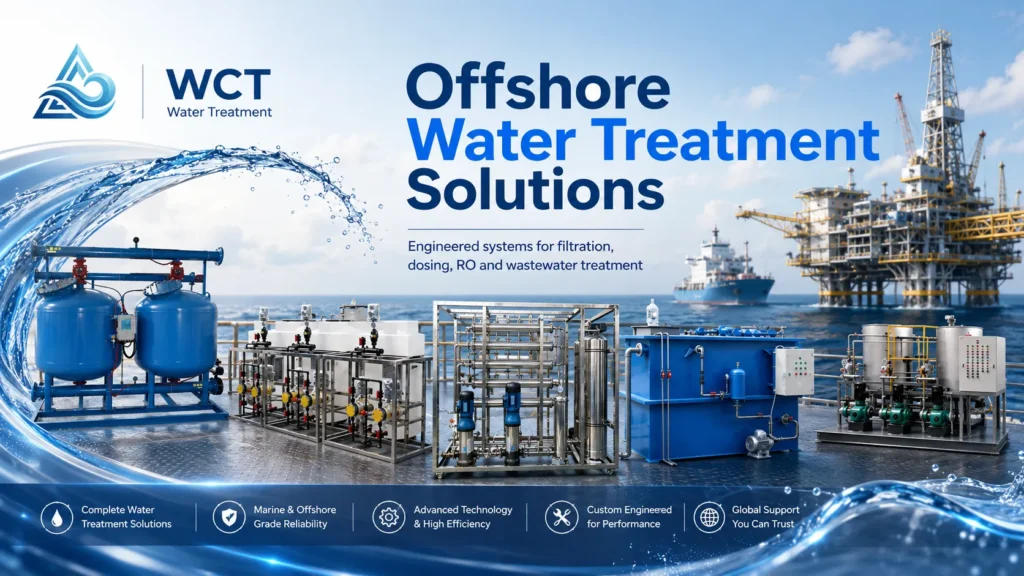
We see the same procurement mistake on offshore platforms year after year: treating seawater desalination and produced water treatment as separate, unrelated decisions. They aren’t. Both loops ultimately depend on the same physical realities—deck space, weight limits, and marine corrosion—and the wrong choice on one side will cascade into the other.
That’s why we engineer every offshore water treatment solution as a unified system: intake pre-filtration that handles algae blooms and oil sheen also protects downstream RO membranes; produced water polishing that hits 5 ppm OIW also keeps subsea injection pumps from seizing. There’s no room for vendor silos offshore.
Dual-Mandate Offshore Water Treatment: Seawater Intake vs. Produced Water Discharge
Offshore assets run two distinct water loops, each imposing extreme demands on treatment hardware. Seawater must become potable, utility, and high-purity process water. Meanwhile, produced water—typically the platform’s largest liquid waste stream—needs hydrocarbon and solids removal before ocean discharge or reservoir reinjection. The two loops share common engineering constraints: space, weight, and 24/7 reliability in a corrosive marine atmosphere.
Seawater Desalination & Potable/Process Water Generation
Seawater reverse osmosis (SWRO) is the backbone of offshore desalination, but the key differentiator from land-based plants is pre-treatment. Open-intake seawater carries marine organisms, algae, suspended solids, and occasional oil sheen. Without aggressive pre-filtration, biofouling destroys membrane performance in weeks. We specify self-cleaning coarse screens, followed by multimedia filtration and often ultrafiltration, to deliver a reliable feed to the high-pressure RO membranes. The result is water suitable for drinking, turbine wash, boiler feed, and chemical injection—all within a fraction of the deck footprint of a terrestrial plant. Robust offshore water treatment solutions integrate this pre-treatment chain as a compact, skid-mounted package.
Produced Water Treatment & Hydrocarbon Separation
Produced water treatment starts with bulk oil removal and progresses through polishing stages to meet discharge limits. The core goal is to strip dispersed and dissolved hydrocarbons, along with fine solids, from water that can contain several thousand ppm of oil in water (OIW). The treated water then either goes overboard under strict environmental compliance or is reinjected for pressure maintenance. Either pathway demands consistent, reliable separation performance, even during flow surges and chemical upsets from the wellstream. Water recycling for offshore facilities often links produced water polishing with reinjection strategies, reducing the overall water procurement burden.
Primary, Secondary, and Tertiary Produced Water Treatment Technologies
The physical properties of the produced water stream—droplet size distribution, temperature, salinity, and emulsion stability—dictate the technology train. We evaluate these properties to select the right sequence of mechanical and chemical separation. The table below summarizes the typical stages and their roles.
| Stage | Technology | Typical Oil Removal Efficiency | Best For | Limitations |
|---|---|---|---|---|
| Primary | Deoiler Hydrocyclone / Degasser | 90–95% of bulk oil (>20 µm droplets) | High-flow, initial bulk separation; unsteady flows | Poor on emulsified oils; performance drops below 10 µm |
| Secondary | Compact Flotation Unit (CFU) | Removes droplets down to 5–10 µm; OIW <50 ppm typical | Stable operations, moderate flow variations | Sensitive to chemical defoamer dosage; requires consistent bubble size |
| Tertiary | Coalescence / Media Filtration / Membranes | <5 ppm OIW achievable, down to 1 ppm | Stringent discharge zones; subsea injection prep | Higher OPEX; media replacement frequency depends on oil load and solids |
Note: Performance data assumes design conditions; actual OIW output varies with temperature, flow stability, and feed composition. Buyers should verify with vendor pilot data.
Primary Oil-Water Separation: Hydrocyclones and Degassers
A deoiler hydrocyclone uses centrifugal force to split oil and water—oil migrates to the core while cleaner water exits the underflow. The unit has no moving parts, handles high throughput, and provides the first line of defense against bulk oil. Degassers complement hydrocyclones by removing entrained gas that can destabilize downstream flotation. In our experience, proper flow conditioning upstream is critical: a poorly distributed inlet stream can cut hydrocyclone efficiency by half.
Secondary Separation: Compact Flotation Units (CFUs) and Gas Flotation
Compact flotation unit (CFU) technology injects micro-bubbles to float dispersed oil droplets and fine solids to the surface. Induced gas flotation or dissolved gas flotation can be chosen based on available gas supply and space. CFUs excel at removing intermediate droplet sizes that slip past hydrocyclones, routinely bringing OIW into the 20–40 ppm range. The key tuning parameters are bubble size distribution, residence time, and chemical compatibility—defoamers injected upstream can collapse the flotation froth, eroding performance.
Tertiary Polishing: Coalescence, Media Filtration, and Membranes
To achieve ultra-low OIW (5 ppm or less), we turn to polymeric coalescers, nutshell or walnut shell media filters, and advanced ceramic or polymeric membranes. Membrane desalination is rarely used for produced water polishing unless salinity reduction is also required; instead, advanced membrane filtration for offshore focuses on hydrophobic or oleophobic barriers that reject hydrocarbons. Coalescence media aggregate fine oil droplets into larger ones, which then separate gravitationally. The trade-off is higher pressure drop and media replacement cost, making total lifecycle economics the deciding factor.
Physical Constraints: Footprint, Weight, and Modular Retrofit Engineering
On a producing platform, every square meter of deck and every kilogram of structural loading is budgeted. Modular retrofit solutions must compress full-scale water treatment capacity into a shipping-container-sized envelope while respecting strict weight limits. This isn’t just about packaging; it’s about designing for maintenance access, lifting paths, and piping tie-ins in cramped corridors.
Minimizing Deck Footprint with Compact Modular Designs
We lean heavily on modular skid-mounted water systems that stack equipment vertically and integrate multiple process steps onto a single structural base frame. A combined pre-filtration, RO, and CIP (clean-in-place) skid can occupy a fraction of the area of a traditional laydown design. Procurement teams should request 3D CAD models early to verify clearance for membrane element replacement and hydrocyclone liner swap-outs—these are the maintenance tasks that become nightmares if access is blocked.
Brownfield Retrofitting without Operational Disruption
Retrofitting an existing asset demands a plug-and-play approach. We engineer connections for existing process drains, power supplies, and flare headers so that tie-ins require minimal hot work. Typical strategies include:
- Pre-commissioned skids with all inter-piping and wiring completed at the fabrication yard
- Use of bolted or clamped connections to eliminate welding on a live platform
- Staged commissioning that allows the new system to process a slipstream while the legacy unit remains online
For brownfield projects, we always recommend a 3D laser scan of the existing deck to avoid clashes with structural members or cable trays. Offshore wastewater treatment processes integrated into these compact packages reduce the risk of production shut-ins during cutover.
Material Selection and Marinization for Harsh Marine Environments
Corrosion is the single biggest driver of offshore maintenance cost. The combination of saline mist, high humidity, and occasional splash zones demands a materials strategy that upstream onshore plants simply don’t need. Selecting the wrong alloy can turn a nominally efficient water treatment system into a recurring maintenance headache.
| Material | Corrosion Resistance | Weight | Best Application | Cost Indicator |
|---|---|---|---|---|
| Super Duplex Stainless Steel | Excellent pitting/crevice; high strength | Medium | High-pressure RO piping, hydrocyclone cones | High |
| Titanium | Near-immune to seawater corrosion | Low | Critical heat exchangers, subsea pressure housings | Very High |
| Glass-Reinforced Epoxy (GRE) | Inert to seawater; no electrolysis | Very low | Low-pressure seawater intake, drain lines | Moderate |
| High-Performance Epoxy Coatings | Good barrier protection; must be mechanically intact | N/A | Structural skid frames, pump bases | Low to Moderate |
Note: Material suitability depends on exact salinity, temperature, and presence of H₂S or CO₂. Always request specific corrosion test data.
Corrosion Resistance in Offshore Metallurgy
Super Duplex (UNS S32750) gives us the best balance of strength and chloride resistance for pressure-containing parts. For low-pressure seawater intake, we often specify GRE because it eliminates galvanic corrosion altogether and weighs a fraction of metal alternatives. We avoid any 316L in continuous seawater service—its pitting resistance is insufficient for the temperature and salinity spikes common offshore.
Pressure Vessel Design and Subsea Considerations
Vessels must withstand not just operating pressure but also hydrotest conditions and occasional slug loads. For subsea water injection applications, external hydrostatic pressure drives wall thickness, and we design according to recognized subsea codes (e.g., API 17). Electrical enclosures on deck carry hazardous area certifications (ATEX/IECEx) and IP56 or higher to survive deluge and salt fog. A custom offshore water treatment system built without these marine-specific details will fail prematurely, regardless of how well its internal process works.
Regulatory Compliance and Environmental Discharge Standards (OIW Limits)
Regulations define the minimum acceptable performance, but top-tier operators target well below the legal limit to avoid shutdown risk. The real question isn’t “Can we meet 30 ppm?” but “Can we hold 10 ppm during a slug flow when the wellstream chemistry changes overnight?”
Meeting Global Oil-in-Water (OIW) Discharge Thresholds
In the North Sea, OSPAR sets a monthly average of 30 mg/L (ppm) for oil in water (OIW) discharge; the US EPA’s Gulf of Mexico permit typically mirrors similar values. However, many fields demand 5–10 ppm, especially for sensitive marine ecosystems or when reinjection into tight formations demands ultra-clean water. Achieving 5 ppm consistently requires a tertiary polishing stage, not just primary and secondary separation. The business case for a tighter specification often rests on avoiding a single day of lost production—a shut-in that can cost more than the entire treatment upgrade. Offshore water treatment for commercial use must account for these shifting compliance landscapes.
Environmental Stewardship and Marine Ecosystem Protection
Beyond legal compliance, produced water treatment is a visible environmental commitment. Operators who consistently discharge at ultra-low levels reduce the chronic impact on benthic communities and protect their social license. From a procurement standpoint, we look for systems that maintain performance stability during production upsets—an alarm-driven automatic diversion to slop tanks is a common failsafe that prevents non-compliant discharge.
Strategic Vendor Evaluation and Procurement Criteria
Comparing technical datasheets alone won’t predict offshore reliability. Procurement decisions must be grounded in lifecycle economics and practical supportability.
Total Cost of Ownership (TCO) vs. Initial Capital Expense (CAPEX)
A low-CAPEX offer often hides high OPEX in the form of:
- Chemical consumption (defoamers, scale inhibitors, cleaning chemicals)
- Membrane or coalescer media replacement frequency
- Power draw, especially for high-pressure pumping
- Labor hours for manual cleaning and filter changes
We calculate TCO over a 10-year field life, factoring in an assumed number of production upsets and annual maintenance days. The difference between a well-optimized system and a commodity package can be tens of millions in OPEX over that horizon.
Serviceability, Consumables, and Remote Support Architecture
Vendor support networks must include offshore-certified technicians and regional spare parts warehouses. We also prioritize remote diagnostics: a system that ties into the platform SCADA and sends condition-based maintenance alerts cuts unplanned downtime dramatically. When evaluating a supplier, ask for evidence of long-term service contracts on similar assets and confirm that the control architecture is compatible with your existing safety shutdown systems. Industrial water system design for offshore must bake in remote support from day one, not as an afterthought.
Specifying Your Offshore Water Treatment Solution
Before you reach out to engineering partners, compile the design basis parameters that will define the system envelope. A structured specification package prevents scope creep and speeds up technical alignment. Key data points include:
- Raw water analysis: salinity, total suspended solids (TSS), OIW concentration, temperature range, and presence of hydrogen sulfide or scaling ions
- Required treated water quality: potable, process, or injection standard; maximum OIW for discharge
- Available deck footprint and allowable wet and dry weights, including lifting constraints
- Hazardous area classification (Zone 1/Zone 2, Class I Div 2) and required certifications
- Existing utility tie-ins: power voltage/frequency, instrument air, drain headers
With this data in hand, a qualified marine engineering firm can quickly narrow the technology options and deliver a front-end engineering package that avoids costly late-stage redesigns.
Frequently Asked Questions
What is the typical oil-in-water (OIW) discharge limit for offshore platforms?
Many jurisdictions mandate a monthly average around 30 mg/L, but sensitive areas or proactive operators target 5–10 ppm through tertiary polishing. Actual limits depend on regional permits such as OSPAR or EPA.
How does seawater RO desalination differ on an offshore platform compared to land-based facilities?
Offshore RO must handle severe biofouling and intermittent oil sheen via robust pre-filtration, use marine-grade materials like Super Duplex for corrosion resistance, and fit within extreme space and weight constraints.
What are modular retrofit solutions in offshore water treatment?
These are pre-engineered skids that bolt into existing deck footprints with minimal hot work, enabling a brownfield platform to upgrade water treatment without a prolonged shutdown.
How do operators handle chemical treatment in produced water systems?
Demulsifiers, defoamers, and scale inhibitors are injected upstream; the water treatment system must be chemically compatible to avoid fouling membranes or destabilizing flotation froth.
Can offshore water treatment systems operate autonomously?
Yes, modern systems use PLC controls, automated backwash cycles, and remote diagnostics to reduce the need for continuous operator attendance on minimally staffed platforms.