The biggest mistake we see in sludge dewatering projects isn’t under-specifying the press—it’s ignoring the real cost of wet sludges. A filter press that produces cake at 22% dry solids can double your disposal bills compared to one reaching 38%, and that gap compounds over every ton hauled.
This engineering guide for specifying a filter press for sludge dewatering is built for process engineers and plant managers who need more than a spec sheet. We’ll walk through the mechanical choices, sizing calculations, chemistry optimization, and total cost of ownership factors that separate a reliable press from an expensive operational bottleneck.
What is a Filter Press for Sludge Dewatering and How Does It Work?
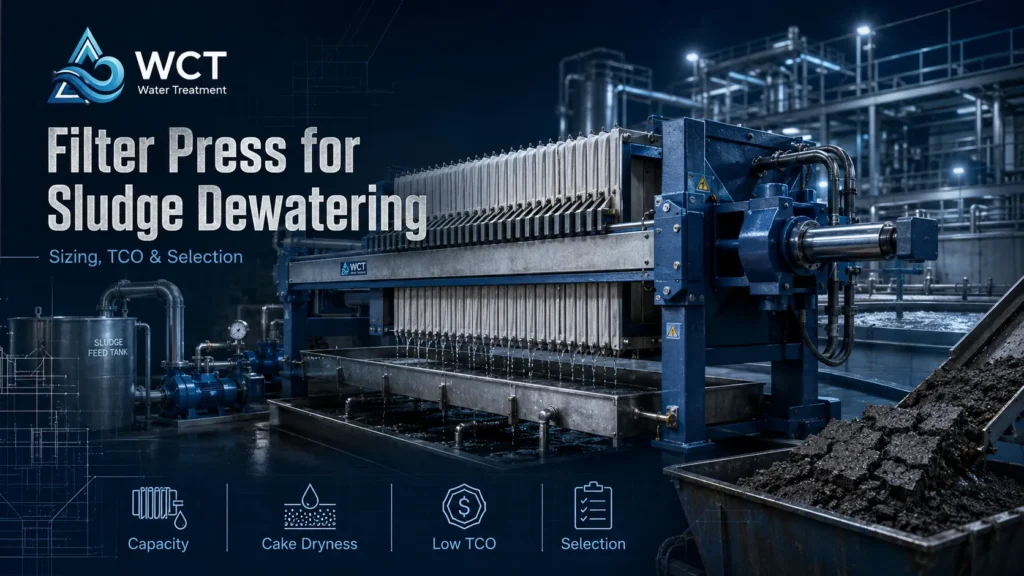
An industrial filter press for sludge dewatering uses high‑pressure mechanical separation to squeeze water out of liquid waste, transforming thin slurries into manageable, low‑moisture dry cake solids. The process relies on a series of recessed chambers or flexible membrane plates that trap solids while liquid passes through filter cloths, producing a stackable filter cake with predictable dryness. This sludge treatment process is the standard for achieving the highest solids capture among mechanical dewatering technologies.
The Core Mechanical Components: Plates, Frames, and Cloths
A filter press is built around a plate pack pressed tightly between a stationary head and a moving follower. The key elements that determine performance are:
- Recessed chamber plates – hollow‑cavity polypropylene or cast iron plates that form the filtration chambers.
- Filter cloths – monofilament or multifilament fabrics hung over each plate; cloth weave and permeability are selected based on particle size distribution.
- Feed manifold and filtrate discharge – central or corner‑fed slurry entry and clean‑filtrate exit piping that collects clarified water.
- Hydraulic closing system – maintains plate‑pack seal against feed pressure, typically up to 225 psig for high‑performance units.
The 4‑Stage Mechanical Dewatering Cycle
Every filtration cycle follows a predictable, time‑sequenced pattern. It begins with plate closure and seal verification, followed by slurry filling, then high‑pressure filtration where the cake consolidates inside the chambers, and finally an optional air blowdown to purge residual free water before plate opening and dry cake discharge. The sequence ensures maximum dry cake solids before the next cycle starts.
The Critical Role of Chemical Pretreatment and Polymer Dosing
Even the best‑designed filter press cannot dewater fine organic or biological sludges without proper chemical conditioning. Flocculation—typically using cationic or anionic polyelectrolytes—aggregates sub‑micron particles into porous flocs that dewater rapidly and resist blinding the filter media. Without this step, the filter cloths become a barrier of impermeable gel. Choosing the correct polymer dosing system and dosage rate is as important as selecting the press itself. Inorganic conditioners like ferric chloride and lime also play a role for certain municipal biosolids, but they increase total dry cake volume and alter ash content.
Comparing Filter Press Configurations: Recessed Chamber vs. Membrane Squeeze
Decision rule: If your disposal contracts penalize moisture content above 70 %, a membrane squeeze press will almost always deliver the necessary dryness, while a recessed chamber press is a lower‑capital solution for inorganic, fast‑draining sludges where 30–35 % dry solids is acceptable.
Recessed Chamber Plates: Low‑Maintenance, High‑Volume Performance
Recessed chamber designs are the workhorse of industrial dewatering. They rely on constant‑pressure filtration: slurry fills the cavity, solids build a cake against the cloth, and sustained feed pressure forces water through the cake and media. This design has no moving internal parts other than the plate shifter, which makes it simple to operate and maintain. For mineral tailings, quarry fines, and many inorganic process streams, recessed chamber presses reliably produce dry cake solids in the 25–40 % range without the added complexity of a squeeze mechanism.
Membrane Squeeze Plates: Maximizing Cake Dryness and Wash Efficiency
Membrane plates incorporate a flexible diaphragm behind the filter cloth. After the initial filling and filtration stage, compressed air or water inflates the diaphragm, applying a secondary squeeze that physically compresses the cake. This boosts dryness by an additional 5–15 percentage points, shortens cycle time, and enables effective cake washing. Membrane squeeze presses are the preferred choice for sticky biological sludges—municipal waste activated sludge or food‑processing residuals—where transport and tipping fees punish every extra ton of water.
Technical Comparison: Screw Presses, Belt Presses, and Plate Presses
Plate‑based filter presses are not the only dewatering option. The table below compares recessed chamber and membrane filter presses against screw press sludge dewatering and belt presses on the parameters that matter most to plant engineering teams.
| Technology | Typical Dry Cake Solids | Capital Expenditure | Operator Labor | Chemical Demand |
|---|---|---|---|---|
| Recessed chamber press | 25–40% | Moderate | Moderate (manual or semi‑auto) | Low–Moderate |
| Membrane squeeze press | 35–55% | High | Low–Moderate (auto features) | Low–Moderate |
| Belt filter press | 15–25% | Low–Moderate | High (continuous attention) | High |
| Screw press | 18–30% | Moderate–High | Low (fully enclosed) | Moderate |
Note: Dryness ranges are typical for municipal secondary sludge; actual results depend on feed characteristics, conditioning, and press design. Buyers should confirm performance on their own sludge through pilot testing.
Sizing Methodologies and Engineering Calculations for Sludge Dewatering
Accurate sizing of a filter press for sludge dewatering requires calculating the total dry solids processed per hour—or per cycle—and mapping that against the density of the consolidated wet cake. Undersizing leads to overloaded cycles and wet cakes; oversizing wastes capital and floor space. The starting point is a complete sludge characterization with representative samples from normal and seasonal peak conditions.
Calculating Sludge Volume and Dry Solids Throughput
The basic sizing relationship starts with the average dry solids mass fed per day. Divide the total dry pounds (or kg) by the expected decimal fraction of cake dryness to estimate wet cake tonnage, then factor in the number of cycles per day the press can realistically run. In our experience, many plants underestimate the impact of weekend or holiday storage that increases Monday morning feed concentration. Always size for the 90th‑percentile loading scenario, not the average. We provide sludge dewatering solutions that include benchtop and pilot‑scale testing to derive these parameters accurately.
Determining Required Chamber Volume, Filtration Area, and Plate Count
Once the dry solids load per cycle is known, the required total chamber volume is calculated by dividing the wet cake volume per cycle by the cake’s bulk density. Filtration area then follows from the manufacturer’s design cake thickness and the volumetric hold‑up of the chosen plate size. Adding more plates increases overall cycle capacity linearly, but the closing hydraulic system must be sized for the full pack length.
Feed Pump Selection and Pressure Curve Dynamics
The feed pump is not a simple on/off device; it must deliver a progressive pressure curve that fills the press quickly at low pressure and then ramps up to the maximum squeeze pressure as the cake builds. For membrane squeeze presses, the final squeeze pressure often reaches 225 psig. The table below outlines common pump types and their fit for filter press duty.
| Pump Type | Typical Pressure Range | Best For | Limitation |
|---|---|---|---|
| Progressive cavity | 100–225 psig | Thickened sludges, consistent pressure rise | Higher wear with abrasives |
| Air‑operated diaphragm | 40–100 psig | Smaller presses, variable flow | Pressure limited, pulsating flow |
| Piston diaphragm or plunger | 150–350 psig | High‑solids, long‑cycle applications | Higher capital, more maintenance |
Important: The pump must be able to sustain the final squeeze pressure long enough to consolidate the cake without stalling. Buyers should request a pump curve matched to the projected filter press cycle.
Operational Chemistry: Optimizing Sludge Conditioning for Press Performance
Engineering takeaway: Mechanical pressure alone cannot dewater fine organic or biological sludges; proper sludge conditioning alters particle charge and creates porous, high‑permeability flocs that release water under pressure. Without it, even a high‑spec press will produce a wet, sticky cake.
Coagulation vs. Flocculation: Selecting Polymers, Lime, and Ferric Chloride
Coagulation (using ferric chloride, alum, or PAC) destabilizes colloidal charges, while flocculation (using high‑molecular‑weight polyacrylamides) bridges the destabilized particles into larger agglomerates. In municipal biosolids, a combination of ferric chloride and lime is often used to improve cake release, but it significantly increases the mass of solids for disposal. Synthetic polymers offer cleaner dewatering with minimal ash increase, but their dosing must be controlled within a narrow range. For accurate PAC and PAM dosing, we recommend inline polymer activation units with variable‑speed metering pumps.
Sizing and Integrating Polymer Dosing Systems
A polymer dosing system must match the peak sludge feed rate and provide enough aging time for the polymer to uncoil. The key integration points are:
- Select a polymer grade (cationic or anionic) based on zeta potential measurements of the feed sludge.
- Size the polymer make‑down and dosing pumps for the maximum sludge flow rate, not the average.
- Incorporate a static or dynamic mixer immediately upstream of the filter press inlet to ensure uniform floc distribution.
- Install a low‑flow, high‑accuracy dosing pump with automatic feedback from a flow meter on the sludge line.
Over‑dosing polymer blinds filter cloths, drops throughput, and spikes operating costs. A common failure mode we see is plants dosing polymer based on visual jar tests but not adjusting for changes in feed concentration. That blind spot can double chemical spend within weeks.
Total Cost of Ownership (TCO) and Lifecycle Maintenance Costs
While capital equipment costs are significant, the true lifetime cost of a dewatering filter press is dominated by polymer consumption, filter cloth replacement labor, and downstream transport/tipping fees. A press that saves $50,000 in purchase price but uses 20 % more polymer and produces 5 % wetter cake will erode that advantage within the first two years of operation.
Quantifying Operating Costs: Power, Chemicals, and Disposal Logistics
We encourage buyers to build a simple TCO model: annual cost = (chemical cost per dry ton × annual dry tons) + (tipping fee per wet ton × annual wet tons) + (power and maintenance) + (cloth replacement labor and parts). Small improvements in cake dryness—say from 20 % to 25 % dry solids—can slash disposal tonnage by 20 %, a figure that often dwarfs the energy cost of the press itself. Pairing the press with upstream thickeners like DAF systems for sludge thickening can further concentrate the feed and reduce chemical and press sizing requirements.
Maintenance Cycles: Filter Cloth Washing, Shifter Alignments, and Plate Replacements
Filter cloths are the highest‑wear consumable. Their lifespan depends on the corrosiveness of the sludge, the frequency of mechanical cleaning, and the presence of sharp particles. Typical cloth life ranges from 6 months to 3 years. Common maintenance intervals include:
- Daily visual inspection for cloth tears and plate misalignment.
- Weekly high‑pressure wash cycles (automatic or manual) to remove blinding material.
- Monthly shifter rail alignment checks and hydraulic oil sampling.
- Annual replacement of gaskets, o‑rings, and worn cloths on a planned schedule.
Semiautomatic vs. Fully Automated Plate Shifting Economics
Manual plate shifting requires an operator to physically move each plate, an activity that can add 20–30 minutes to every cycle and increases the risk of misalignment. Semi‑automatic shifters use a ratchet mechanism to index the plates, while fully automated systems—with laser‑curtain safety and PLC‑controlled shifters—minimize labor and enable cycle times as short as 45 minutes. The payback period for full automation usually falls between 12 and 24 months for plants processing more than 3 million gallons per day, but the procurement team should verify that the automation controller is compatible with the plant’s existing SCADA or PLC infrastructure.
Application Guide: Tailoring Filter Presses to Specific Industrial Sludges
Each industry generates a distinct sludge chemistry that dictates specific filter plate designs, feed pressures, metallurgy selections, and cloth weaves. Treating all sludges as generic “waste” leads to poor dewatering and rapid equipment wear.
Municipal Wastewater Treatment: Managing Biological Biosolids
Municipal waste activated sludge is high in volatile solids and bound water. To meet landfill or land‑application dryness targets, membrane squeeze plates are almost always required, often with lime or ferric chloride conditioning. Odor control is a secondary design concern; fully enclosed presses with vapor extraction become necessary in urban plants. Integrating an integrated sewage treatment plant that includes sludge thickening and dewatering can streamline the process and reduce intermediate storage. For plants that also use biological nutrient removal, the dewatered cake’s phosphorus content must be managed to meet regulatory limits.
Industrial Processing: Mining Tailings, Quarrying, and Construction Waste Recycling
Mining and aggregates slurries are abrasive, dense, and fast‑draining. Recessed chamber presses built from heavy‑duty polypropylene or cast iron are the standard. Press cycle times are shorter—often under 90 minutes—because the coarse particles form a permeable cake quickly. The primary engineering risk is plate and cloth erosion, so we recommend reinforced cloths and hardened feed manifolds. In quarrying applications, the press often doubles as a water‑recovery tool, returning filtrate to the wash circuit.
Heavy Manufacturing: Oily Sludges, Chemical Process Streams, and Plating Wastes
Oily sludges and chemical residues demand specialized designs. CGR (gasketed) plates with integral O‑ring seals prevent leakage of hazardous or valuable process fluids. For solvent‑laden wastes, stainless steel or Kynar plates may be required for chemical compatibility. Permanent cloth blinding from oils and tars is a constant threat, so pre‑coating the media with diatomaceous earth or lime is often standard operating procedure. Explosion‑proof electrical enclosures and ATEX‑compliant designs become mandatory if volatile organics are present. These applications rarely follow a generic template; they require pilot‑scale testing and careful industrial wastewater equipment selection.
Technical Comparison Matrix and Procurement Checklist
Use this structured selection matrix and procurement checklist to objectively evaluate filter press suppliers against your plant’s exact physical and chemical requirements. We designed this to cut through marketing claims and focus on measurable performance drivers.
Sludge Dewatering Technology Selection Matrix
| Parameter | Recessed Chamber | Membrane Squeeze | Belt Press | Screw Press |
|---|---|---|---|---|
| Dry cake solids % (municipal) | 25–35% | 35–50% | 15–22% | 20–30% |
| Chemical consumption | Low–Moderate | Low–Moderate | High | Moderate |
| Cycle labor (manual plate shifting) | High | High (unless auto) | Continuous staffing | Very low |
| Floor space per dry ton/day | Medium | Medium–Large | Small | Small |
| Feed pressure range | 100–225 psig | 100–225 psig + squeeze | Low (gravity/drainage) | Low–Moderate |
| Typical cycle time | 2–4 hours | 1.5–3 hours | Continuous | Continuous |
All values are approximate and should be validated through on‑site pilot testing with the candidate supplier. Dryness figures assume proper chemical conditioning.
Engineering Specification & Supplier Evaluation Checklist
Before finalizing a filter press selection, every buyer should request and verify the following from prospective suppliers. This checklist captures the items we find most often missed during procurement.
| What to Verify | Why It Matters |
|---|---|
| Bench‑scale or pilot‑scale dewaterability testing using your sludge | Confirms achievable cake dryness and conditioning demand before capital spend. |
| Plate material and structural frame certifications | Polypropylene, Kynar, cast iron—must match chemical and temperature exposure. Frame should be heavy welded carbon steel with protective epoxy or stainless cladding. |
| PLC compatibility and automation protocols | Must integrate with plant SCADA; request documentation for Allen‑Bradley, Siemens, or equivalent. |
| Filter cloth warranty and replacement lead time | Cloth life directly impacts uptime; confirm local stock availability and maximum lead time. |
| Full lifecycle parts and technical support availability | Confirm local field engineering, spare parts inventory, and emergency response capability. |
| Safety features: light curtains, emergency pull cords, pressure relief | Non‑negotiable for operator protection during manual or automatic plate shifting. |
These verification points protect against the most common source of post‑installation disappointment: a press that meets a generic data sheet but fails on your specific sludge under actual operating cycles.
Partner with a Dewatering Engineering Specialist to Scale Your Operations
Selecting the right dewatering system requires matching lab‑scale pilot testing with seasoned structural, electrical, and process engineering expertise. The filter press you choose will operate for 20 years or more, and the largest cost savings come from getting the sizing, chemistry, and automation right before a single bolt is torqued.
We approach every project as a collaborative engineering engagement. Before our first scoping call, we recommend gathering the following data:
- Average and peak dry solids feed rate (lb/day or kg/day).
- Current disposal cost per wet ton and the landfill’s moisture acceptance limits.
- Chemical conditioning history, including polymer type and typical dosage.
- Available plant footprint and crane access constraints.
- Required cake dryness targets driven by hauling contracts.
With this information, we can run pilot‑scale filtration tests on your sludge, optimize polymer formulations, and deliver a turnkey proposal that includes not just the press but the full solution—from sludge thickening to lamella clarifiers for sludge pre‑thickening to automated chemical dosing and PLC integration. That’s the difference between buying a piece of equipment and engineering a dewatering process that retains value over its entire lifecycle.
Frequently Asked Questions
What is the typical cake dryness achieved by a filter press for sludge dewatering?
Recessed chamber and membrane presses routinely achieve 25% to 55% dry solids depending on the sludge type, outperforming belt presses and centrifuges. Proper chemical conditioning and membrane squeeze can push municipal biosolids above 35% dry solids, where belt presses typically stall below 25%.
How long does a typical filter press dewatering cycle take?
Cycles generally last from 1.5 to 4 hours, consisting of plate closure, slurry filling, pressure filtration, optional air blowdown, plate opening, and cake discharge. Fully automated plate shifters can reduce total cycle time to under 90 minutes for fast‑draining mineral slurries.
How do you prevent filter cloths from blinding?
Prevention relies on high‑pressure wash cycles (often at 1,500–2,000 psi), periodic chemical cleaning with acid or caustic solutions to dissolve scale and organic fouling, and precise control of polymer dosing to avoid over‑conditioning that creates sticky, impermeable flocs.
What is a CGR (gasketed) plate, and when is it required?
CGR plates use a built‑in O‑ring gasket around each chamber to provide a completely drip‑tight seal. They are required whenever the slurry is hazardous, toxic, volatile, or valuable—common in chemical, pharmaceutical, and oily waste applications where any leakage is unacceptable.
Can a filter press handle oily sludge from industrial processes?
Yes, but it requires highly tailored chemical conditioning—often with diatomaceous earth or lime pre‑coating—and filter press for sludge dewatering designs featuring membrane squeeze plates to compress the oily solids and maintain filtrate clarity. Without pre‑coating, free oils can quickly blind the cloths and lead to wet, unconsolidated cake discharge.