How to Source Commercial RO Systems: Analyzing Feedwater Chemistry
Sourcing a commercial reverse osmosis system isn\’t as simple as picking a model out of a catalog. If you want to avoid costly equipment failure and premature membrane degradation, you must start with the foundation of any water treatment project: your raw feedwater chemistry.
We see too many buyers rush into reverse osmosis equipment sourcing without fully understanding what is flowing into their facility. Before investing in a commercial RO water filter system, you need a comprehensive laboratory water analysis.
Why a Simple TDS Reading is Not Enough
A Total Dissolved Solids (TDS) meter is a great tool for a quick snapshot, but it is entirely inadequate for engineering a customized commercial RO system. A TDS reading only tells you the total quantity of dissolved solids, not what those solids are.
Two water sources can both have a feedwater TDS analysis of 300 ppm, yet require completely different system designs. For example:
- Source A: High in sodium and chloride (easy for standard membranes to handle).
- Source B: High in calcium, silica, and iron (will rapidly scale and foul membranes without heavy pre-treatment).
Relying solely on TDS to buy an RO water system commercial setup will likely lead to clogged membranes, frequent downtime, and a skyrocketing total cost of ownership.
Mapping the Contaminants
To protect your membrane filtration investment, you need a precise chemical map of your water supply. When reviewing a water report, we look at specific trouble-makers that dictate your pre-treatment and system configuration:
| Contaminant Category | Specific Parameters to Watch | Impact on Commercial RO Systems |
|---|---|---|
| Hardness Ions | Calcium ($Ca^{2+}$), Magnesium ($Mg^{2+}$) | Causes severe carbonate scaling on membrane surfaces. |
| Heavy Metals | Iron ($Fe$), Manganese ($Mn$) | Oxidizes and coats membranes, permanently reducing flow. |
| Abrasives/Colloids | Silica ($SiO_2$), Silt Density Index (SDI) | Forms a glass-like barrier that is incredibly difficult to clean. |
| Disinfectants | Free Chlorine, Chloramines | Chemically burns thin-film composite polyamide membranes. |
Municipal Tap Water vs. Private Well Water
Where your water comes from dictates the vulnerabilities of your commercial RO water system.
Municipal Tap Water
City water is highly predictable but comes with a major catch: chemical disinfectants. Municipalities add chlorine or chloramines to keep water safe from bacteria, but these oxidizers will destroy standard RO membranes within hours. Sourcing a system for city water requires a robust carbon filtration or bisulfation injection setup upstream.
Private Well Water
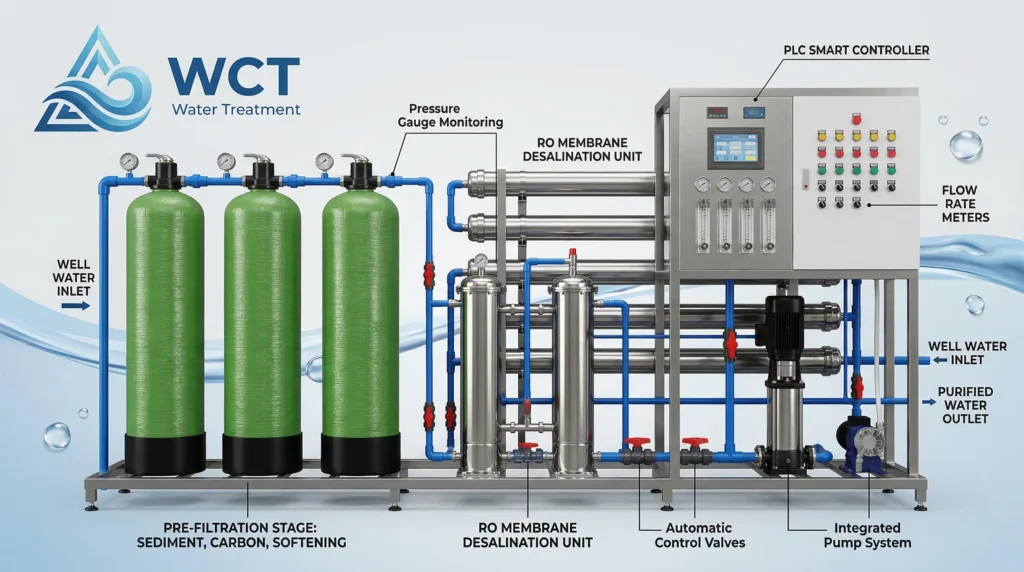
Well water eliminates the chlorine issue but introduces wild biological and mineral variables. Underground aquifers are notorious for high hardness, fluctuating iron levels, heavy silica, and potential microbiological activity. If you are sourcing a commercial POU RO system or a large-scale industrial rig for well water, your pre-treatment array must be heavily customized to handle these fluctuating mineral loads.
Step 2: Deciphering System Sizing & Real-World Fluid Dynamics
The Buyer Trap: Why Never to Source a Commercial RO System Strictly on GPD
When looking to source a commercial reverse osmosis system, many buyers fall into the trap of looking only at the Gallons Per Day (GPD) rating. A 10,000 GPD system does not mean you can pull 10,000 gallons whenever you want. That rating assumes the system runs continuously for 24 hours under perfect laboratory conditions. In the real world, relying solely on GPD to size your commercial RO water filter system leads to undersized equipment, dropped water pressure, and premature system failure.
The GPM Blueprint: Sizing Around Peak Flow Rates
To avoid operational bottlenecks, you must design your system around Gallons Per Minute (GPM) and peak flow dynamics. Calculate the maximum amount of water your facility requires during its busiest hour.
- Continuous Demand vs. Peak Demand: If your business needs 20 gallons per minute for a specific two-hour production window, a standard 10,000 GPD system will fail to keep up.
- GPM vs GPD Flow Dynamics: Always convert your daily volume needs into actual real-time GPM requirements to ensure the high-pressure pumps and membrane vessels can handle the immediate load.
The Temperature Correction Factor: Winter Feedwater Impact
Water temperature heavily dictates membrane filtration systems engineering. Standard RO membrane ratings are based on a baseline water temperature of 25°C (77°F).
As water temperature drops during winter months, its viscosity increases, making it harder to push through the membrane. For every 1°F drop in feedwater temperature, your permeate production can drop by about 1.5% to 2%.
| Feedwater Temperature | Expected System Output (% of Rated Capacity) | Impact on High-Pressure Pump |
|---|---|---|
| 25°C (77°F) | 100% (Baseline standard) | Optimal operating pressure |
| 15°C (59°F) | ~70% – 75% | Requires higher pressure to maintain flux |
| 5°C (41°F) | ~50% – 55% | Risk of severe flow reduction without adjustments |
If your source relies on a well water treatment system or surface water where seasonal temperatures plunge, we engineer your customized commercial RO systems with variable frequency drive (VFD) pumps or additional membrane surface area to compensate for this cold-weather flux drop.
Integrating Buffer Mechanics: Storage and Delivery
You do not want your ro water system commercial unit turning on and off every time a faucet opens. This cycling destroys pumps and ruins membranes. Integrating a proper atmospheric storage tank and re-pressurization delivery pump acts as a vital buffer.
This setup allows a smaller, highly efficient reverse osmosis equipment setup to run consistently at its optimal permeate recovery rate optimization level, storing pure water during low-demand hours so it is fully available during peak operation times.

Engineering the Pre-treatment Array: Maximizing Membrane Longevity
Sourcing a high-performance commercial reverse osmosis system requires looking beyond the RO skid itself. The raw feedwater will quickly destroy your membranes if it is not properly conditioned. Implementing a robust pre-treatment array is the single most effective way to safeguard your investment and ensure long-term operational efficiency.
The First Line of Defense
Before water ever reaches the high-pressure pump, physical debris must be eliminated. Raw water carries suspended solids, sediment, and silt that will mechanically clog the narrow spacer channels inside an RO membrane.
- Multimedia Filtration: Utilizes layered beds of anthracite, sand, and garnet to trap large particulate matter down to 10–15 microns.
- Microbial Control: For specialized applications processing heavy organic loads, implementing primary clarification step setups, such as dissolved air flotation for sewage disposal, can drastically reduce the particulate and biological burden before secondary filtration.
- 5-Micron Sediment Cartridges: Acts as the final sacrificial barrier directly upstream of the RO membranes to catch any remaining fine escape debris.
Protecting Polyamide Membranes
Modern customized commercial RO systems rely on thin-film composite polyamide membranes. While these membranes offer exceptional salt rejection rates, they have a critical vulnerability: chemical oxidants.
The Chlorine Threat: Free chlorine, commonly used in municipal tap water for disinfection, will irreversibly oxidize polyamide material, tearing holes in the molecular structure and ruining salt rejection capabilities.
To neutralize this threat, we engineer two primary defenses into our membrane filtration systems engineering workflows:
- Activated Carbon Filtration: Catalytically adsorbs free chlorine and organic compounds, protecting the membranes while eliminating taste and odor issues.
- Chemical Injection (Sodium Bisulfite): Precisely metered dosing systems that chemically reduce free chlorine into harmless chloride ions before the water enters the RO pressure vessels.
Mitigating Scaling and Fouling
As pure permeate water is forced through the membrane, the remaining waste stream becomes highly concentrated. If the concentration of dissolved hardness minerals exceeds saturation limits, these minerals precipitate out of solution, causing severe scale formation.
| Fouling Type | Primary Culprits | Prevention Mechanism |
|---|---|---|
| Mineral Scaling | Calcium Carbonate, Barium Sulfate, Silica | Industrial water softeners pretreatment (ion exchange) or continuous antiscalant chemical injection. |
| Organic Fouling | Humic acids, fulvic acids, tannins | Granular activated carbon (GAC) or specialized organic scavenging resins. |
| Biological Fouling | Bacteria, algae, extracellular polymeric substances (EPS) | Periodic non-oxidizing biocide dosing and scheduled clean-in-place (CIP) procedures. |
By properly neutralizing these threats in the pre-treatment phase, you directly lower the total cost of ownership of your commercial RO water filter system by extending membrane life from months to years and reducing emergency maintenance downtime.
Evaluating System Efficiency, Components & Customizations
Sourcing a commercial reverse osmosis system requires looking beyond the price tag to evaluate long-term operational efficiency and component quality. Balancing water output with system longevity is the key to minimizing the total cost of ownership.
Permeate Recovery Rate vs. Concentrate (Brine) Waste
The permeate recovery rate optimization determines how much product water you get versus how much goes down the drain as brine waste. While a higher recovery rate reduces wastewater, pushing a standard commercial RO water filter system too hard increases the risk of membrane fouling and scaling prevention issues.
- Standard Systems: Typically operate at a 50% to 75% recovery rate.
- High-Efficiency Skids: Can achieve up to 80%+ recovery using advanced staging, though this requires precise chemical dosing and high-quality feedwater.
Membrane Selection & Housing Material
The core of any customized commercial RO systems lies in its filtration media and pressure vessels. For standard tap water, low-energy polyamide membranes work best. For harsh or high-TDS water, heavy-duty brackish water desalination skids are required.
| Component | Standard Choice | Premium/Industrial Choice |
|---|---|---|
| Membrane Type | Cellulose Acetate (Rare) | Polyamide Thin-Film Composite (TFC) |
| Housing Material | PVC / Fiberglass (FRP) | 304 or 316 Stainless Steel |
| Pressure Rating | 150 – 250 PSI | 300 – 600+ PSI (For Brackish/High TDS) |
Controls and Industrial Automation
Modern reverse osmosis equipment must operate reliably without constant manual oversight. Integrating PLC automation control panels allows for real-time monitoring of flow rates, pressure drops, and product water quality. Automated systems can also trigger automated clean-in-place (CIP) procedures to wash away scale before it permanently ruins the membranes.
The Value of Modular, Pre-Piped Skids
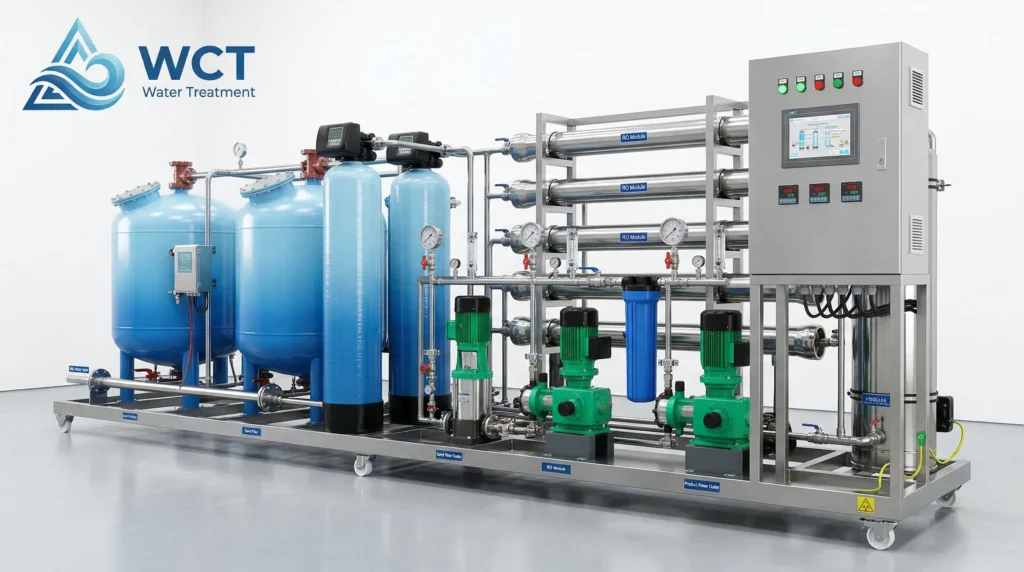
Choosing a modular, pre-piped, and pre-wired skid saves massive amounts of time and money during installation. As experienced commercial reverse osmosis system manufacturers, we engineer these systems for true plug-and-play setup. If you need custom water treatment manufacturing or specialized filtration setups, choosing an experienced OEM water filter manufacture partner ensures that the plumbing, electrical controls, and structural frames are fully integrated and tested before leaving the factory floor. This modular approach makes future capacity expansion simple and keeps your footprint compact.
Step 5: Vendor Selection Logic—Sourcing Direct vs. Sourcing from Brokers
When you are ready to invest in a commercial reverse osmosis system, choosing who you buy from is just as critical as the system specs. Navigating the supply chain requires understanding the distinct difference between working with direct commercial reverse osmosis system manufacturers and third-party brokers.
The Middleman Penalty
Sourcing reverse osmosis equipment through a broker or distributor often comes with hidden costs that go beyond the initial price tag. Brokers rarely have in-house engineering teams, which creates a disconnect between your actual water treatment needs and the final product delivered.
- Markup Inflation: You pay extra margins to cover the broker\’s commission.
- Communication Delays: Technical questions must be passed back and forth between you, the broker, and the actual factory.
- Cookie-Cutter Solutions: Brokers typically sell off-the-shelf models and struggle to deliver truly customized commercial RO systems.
The Factory Advantage with WCT
As a direct water treatment supplier and manufacturer, WCT eliminates the middleman to deliver high-performance, cost-effective solutions. We control the entire lifecycle of your commercial ro water filter system, from the initial design to final assembly.
| Feature | Sourcing Direct from WCT | Sourcing from Brokers |
|---|---|---|
| Pricing | Factory-direct; no hidden markups | Higher costs due to middleman margins |
| Customization | Tailored to your exact feedwater chemistry | Limited to standard, pre-built inventory |
| Engineering Support | Direct access to RO design engineers | Superficial sales support |
| Spare Parts | Ready access to matching components | Long lead times from third-party suppliers |
By bypassing the broker network, we ensure your ro system commercial setup achieves an optimal permeate recovery rate while keeping your total cost of ownership (TCO) water purification low. For a deeper understanding of how these manufacturing standards impact overall project execution, see our comprehensive water treatment guide.
Vetting Questions for Your Water Treatment Supplier
Before signing a contract for a commercial POI RO system or large-scale membrane filtration systems, put your potential supplier to the test. A reliable partner will answer these questions cleanly and transparently:
- \”Do you build the PLC automation control panels in-house, or is that outsourced?\”
- \”Can you modify the frame layout to fit my specific facility footprint?\”
- \”What is the expected recovery-to-waste ratio based on my specific feedwater TDS analysis?\”
- \”Do your brackish water desalination skids include integrated clean-in-place (CIP) procedures?\”
Choosing a direct manufacturer like WCT guarantees that your ro water system commercial investment is backed by genuine technical expertise, long-term component availability, and the rugged build quality required for demanding industrial environments.