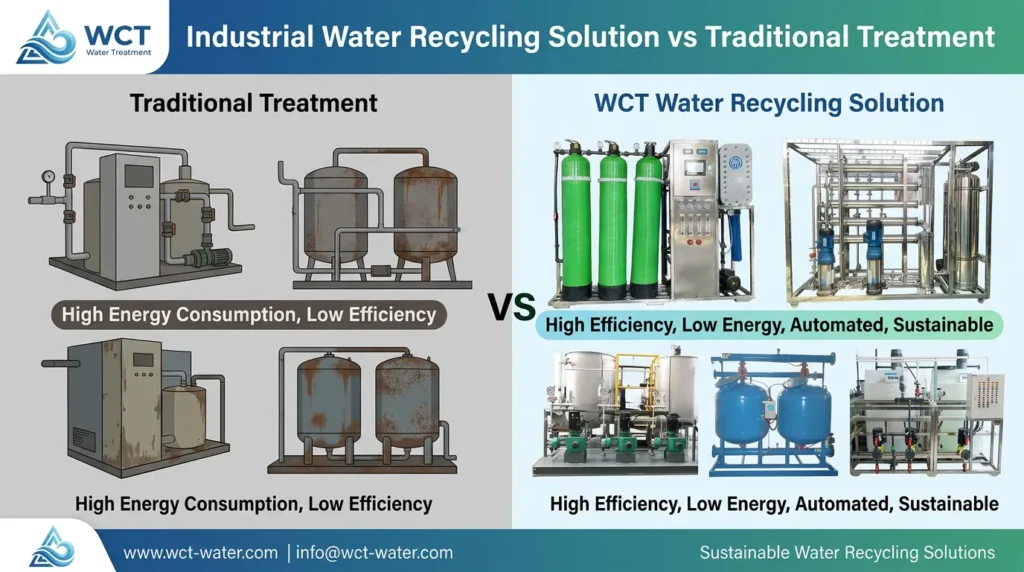
Are you struggling to decide between upgrading your facility\’s water management or sticking to the basics? Making the right choice can drastically impact your operational costs, regulatory compliance, and long-term sustainability.
You might already know that modern industries are shifting away from standard disposal toward circular water management, but how do the methods actually stack up?
Well, you\’re in for a treat because I\’ve put together a complete industrial water recycling solution vs traditional treatment comparison.
In this post, you\’re going to learn exactly how advanced membrane technologies and onsite reclamation compare to conventional physical and biological treatments. I\’ll break down the efficiency, energy consumption, and long-term economic benefits to help you select the best strategy for your specific industry.
So if you\’re looking to ensure water security, lower your operational costs, and crush your ESG standards, this guide is for you.
Let\’s dive right in.
Understanding Industrial Water Recycling and Traditional Treatment
In today\’s industrial landscape, managing water resources efficiently is a critical operational priority. Conducting a thorough industrial water recycling solution vs traditional treatment comparison reveals significant shifts in how modern facilities handle wastewater. As a trusted septic tank supplier and manufacturer, we engineer systems that bridge the gap between basic regulatory compliance and advanced resource recovery, ensuring businesses optimize their water usage.
Defining Traditional Wastewater Treatment Methods
Traditional wastewater treatment operates on a linear \”treat and discharge\” model. The primary objective is to reduce contaminants to legally acceptable levels before releasing the water into municipal sewers or natural water bodies.
Core characteristics of traditional systems:
- Primary Focus: Meeting local regulatory compliance for safe discharge.
- Process Flow: Strictly linear (Intake → Use → Treat → Dispose).
- End Product: Treated effluent that is safe for the environment but not purified enough for facility reuse.
The Evolution of Industrial Water Recycling and Reuse
Industrial water management has rapidly shifted from simple disposal to circular economy principles. Modern industrial water recycling solutions focus on capturing, purifying, and repurposing wastewater for continuous use within the same facility. This evolution is heavily driven by global water scarcity, rising municipal utility costs, and increasingly strict environmental regulations. Advanced filtration, membrane technologies, and upgraded biological systems now successfully transform what was once considered industrial waste into a highly valuable operational asset.
Key Differences in Water Management Objectives
The fundamental difference between these two approaches lies in their ultimate end goals. Traditional methods are designed for disposal, whereas recycling solutions are engineered for sustainability and resource recovery.
Objective Comparison Table:
| Management Feature | Traditional Treatment | Industrial Water Recycling Solution |
|---|---|---|
| Primary Goal | Safe environmental discharge | High-quality internal water reuse |
| Resource Model | Linear (Take-Make-Dispose) | Circular (Closed-loop system) |
| Economic Impact | Sunk operational cost | Long-term ROI and utility savings |
| Water Security | Relies entirely on municipal supply | Creates an independent onsite water source |
| Sustainability | Low (Consumes fresh water continuously) | High (Drastically reduces fresh water intake) |
Overview of Conventional Industrial Wastewater Treatment
Traditional wastewater treatment has long been the standard for industrial facilities. The primary goal of these systems is to remove enough pollutants to meet local discharge regulations before the water is sent to the municipal sewer or a nearby water body. Unlike a modern industrial water recycling solution, traditional treatment follows a linear \”use-treat-dispose\” model.
Physical and Chemical Treatment Processes
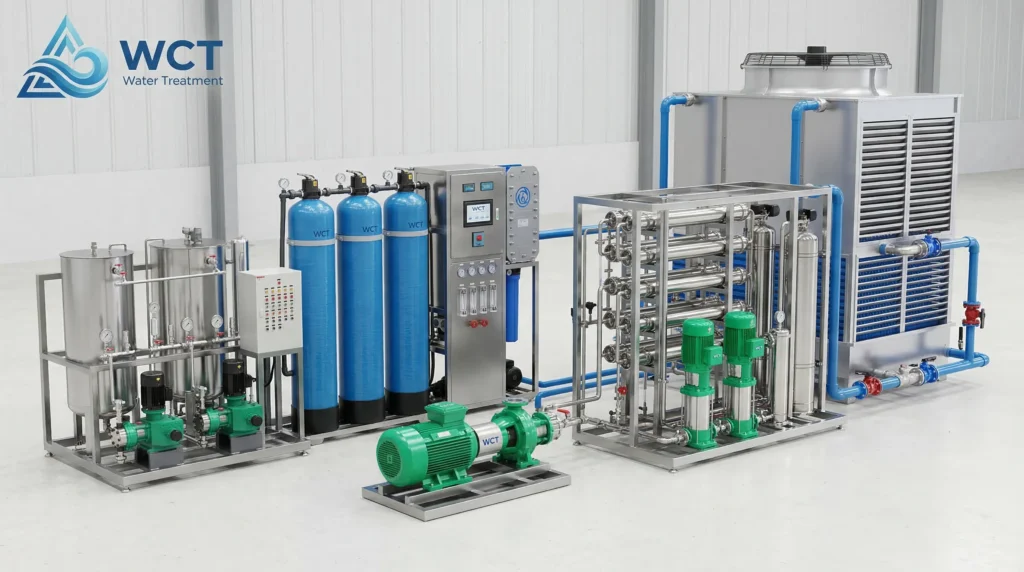
In our experience, the first line of defense in a traditional setup involves physical and chemical stages. We use screens and grit chambers to remove large debris, followed by more refined chemical intervention. To ensure the water is safe for discharge, a precise chemical dosing system for water treatment is used to adjust pH levels and facilitate coagulation and flocculation. This process forces small particles to clump together so they can be easily removed.
Biological Methods and Standard Sedimentation
After the chemical stage, we typically move to biological treatment. This is a critical part of the standard waste water treatment process, where microorganisms break down organic matter.
- Activated Sludge: Aeration tanks provide oxygen to bacteria that consume organic pollutants.
- Secondary Sedimentation: Large clarifiers allow the biological solids to settle at the bottom, leaving clearer water at the top.
- Disinfection: A final chlorination or UV step kills remaining pathogens before the water leaves the site.
Core Advantages and Limitations of Traditional Systems
While traditional systems are reliable and well-understood by operators, they come with specific trade-offs when compared to recycling-focused alternatives.
- Advantages:
- Lower Initial Capital: Generally cheaper to install than high-tech recycling plants.
- Simplicity: Easier to manage with standard technical training.
- Regulatory Compliance: Effectively meets basic environmental discharge permits.
- Limitations:
- Resource Waste: Thousands of gallons of water are lost to the drain every day.
- Rising Costs: Increasing municipal discharge fees make this \”linear\” approach more expensive over time.
- No Drought Protection: These systems do nothing to secure a facility\’s water supply during shortages.
Advanced Technologies in Industrial Water Recycling
Modern recycling systems have moved far beyond the basic settling tanks of the past. We focus on precision engineering to ensure that every drop of processed water meets the specific purity requirements of your facility. By integrating advanced filtration and chemical processes, we provide an industrial water recycling solution that outperforms traditional treatment in both consistency and output quality.
Membrane-Based Treatment and Reverse Osmosis
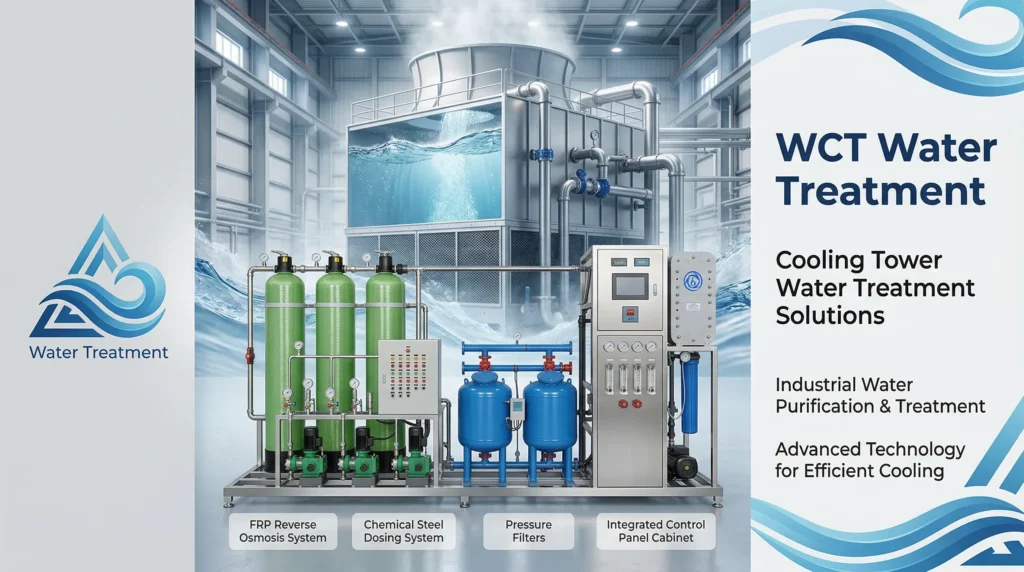
The shift toward high-efficiency recycling is driven by membrane technology. Unlike standard filtration, Reverse Osmosis (RO) and Ultrafiltration (UF) remove dissolved solids and microscopic contaminants at a molecular level. We utilize WCT MBR membrane bioreactor integrated equipment for waste water treatment to combine biological degradation with high-speed membrane separation. This setup ensures that the reclaimed water is often cleaner than the original source water, making it suitable for high-precision manufacturing.
Emerging Sustainable and Hybrid Solutions
Sustainability in water management now involves hybrid systems that combine the best of physical, chemical, and biological methods. We streamline these processes to reduce the footprint of the treatment plant while maximizing recovery rates.
- Advanced Oxidation Processes (AOP): Breaking down complex organic pollutants that traditional bacteria cannot digest.
- Enhanced Pre-filtration: Using specialized water treatment filter media to protect sensitive membranes from fouling.
- Smart Automation: Real-time sensors that adjust chemical dosing and flow rates based on incoming water quality.
Onsite Reclamation for Circular Water Management
The ultimate goal of a modern industrial water recycling solution is a closed-loop system. Onsite reclamation allows your facility to treat and reuse water within the same production cycle, drastically reducing the need for fresh water intake. This circular approach minimizes discharge fees and helps your operation stay resilient against local water shortages. We design these systems to be compact and scalable, ensuring they fit into existing industrial layouts without requiring a total infrastructure overhaul.
Comparative Analysis: Traditional vs. Recycling Solutions
When conducting a direct industrial water recycling solution vs traditional treatment comparison, the operational differences become obvious. Facilities must weigh upfront investments against long-term sustainability and operational independence. We break down exactly how these two approaches stack up in real-world applications.
Efficiency in Contaminant Removal and Water Quality
Traditional systems are built with a single goal: meeting minimum regulatory discharge limits. They rely on basic settling and standard water treatment chemicals to remove enough pollutants so the water can be legally released into municipal sewers or local waterways.
Recycling solutions operate on a completely different level. They utilize advanced membrane filtration and reverse osmosis to strip out microscopic impurities. The result is high-purity water that often exceeds the quality of your incoming municipal supply, making it perfectly safe for continuous reuse in your cooling towers, boilers, or production lines.
Energy Consumption and Operational Cost Evaluation
Cost structures differ significantly between the two methods. Because we are septic tank supplier and manufacturer partners as well as industrial water system designers, we constantly analyze these financial trade-offs for our global clients.
- Traditional Treatment: Features lower initial equipment costs and generally consumes less energy. However, you face a permanent cycle of paying for fresh water intake and municipal discharge fees.
- Recycling Solutions: Requires a higher upfront capital investment and uses more energy to push water through fine membranes. Yet, the long-term ROI is substantially better. By reusing your own water, you drastically slash your monthly utility bills and protect your business from rising municipal water rates.
Environmental Impact and Resource Recovery Potential
The environmental footprint is where modern recycling systems truly dominate. Traditional wastewater management treats used water as a liability—something to be cleaned just enough to throw away.
Recycling flips this model by treating wastewater as an asset.
- Closed-Loop Conservation: Recycling systems keep millions of gallons of water circulating within your facility, drastically reducing your draw on local freshwater sources.
- Valuable Extraction: Advanced recycling setups allow facilities to recover valuable byproducts from the waste stream, such as precious metals, salts, or agricultural nutrients, turning waste into a secondary revenue stream.
The Business Case for Industrial Water Reuse
Transitioning from a traditional \”treat-and-dump\” model to a circular water economy isn\’t just an environmental choice; it is a strategic financial move. When looking at an industrial water recycling solution vs traditional treatment comparison, the primary driver for most of our clients is the bottom line. Traditional systems are a constant drain on resources, while recycling transforms wastewater into a valuable asset.
Long-Term Cost Savings and Economic Benefits
While the initial setup for recycling technology might be higher, the operational savings quickly outweigh the costs. Traditional treatment requires constant spending on freshwater intake and heavy fines for high-volume discharge. By reusing water onsite, you slash utility bills and eliminate many of the surcharges associated with municipal sewer use.
| Cost Factor | Traditional Treatment | Recycling Solution |
|---|---|---|
| Freshwater Intake | High / Continuous | Low / Minimal |
| Discharge Fees | Expensive per m³ | Near Zero (ZLD) |
| Chemical Usage | High (for neutralization) | Optimized (for recovery) |
| ROI Period | N/A (Pure Expense) | 2–5 Years (Typical) |
Ensuring Water Security and Climate Resilience
Water scarcity is a real threat to production uptime. If your facility relies solely on local municipal supplies, you are vulnerable to seasonal shortages and price hikes. Implementing an onsite recycling system provides a closed-loop buffer. We often recommend integrating robust pre-treatment components, such as a high-quality septic tank guide for initial solids separation, to ensure the downstream recycling tech remains protected and efficient. This independence ensures your lines keep running even when local water levels drop.
Meeting Regulatory Compliance and ESG Standards
Environmental, Social, and Governance (ESG) criteria are now central to securing investment and maintaining a brand\’s reputation. Regulatory bodies are tightening the screws on \”Total Suspended Solids\” (TSS) and chemical oxygen demand (COD) levels in discharge.
- Zero Liquid Discharge (ZLD): Helps facilities meet the strictest environmental laws.
- Reduced Carbon Footprint: Less energy is used in transporting and pumping massive volumes of water.
- Sustainability Branding: Demonstrates a commitment to resource conservation to stakeholders.
By utilizing advanced floc water treatment methods within a recycling loop, you can achieve water purity levels that far exceed standard discharge requirements, making compliance a non-issue while boosting your green credentials.

Industry-Specific Applications and Case Studies
When evaluating an industrial water recycling solution vs traditional treatment comparison, real-world applications show exactly where modern systems outpace older methods. Different sectors face unique wastewater challenges, and tailored recycling setups provide targeted results.
Water Recycling in Food and Beverage Processing
In the food and beverage sector, water quality and hygiene are non-negotiable. Traditional treatment setups typically treat effluent just enough to meet local discharge limits before dumping it. Modern recycling systems take a different approach by capturing this water, treating it to near-potable standards, and routing it back for utility uses like cooling towers or facility washdowns. Understanding the complete process of industrial water treatment helps plant managers optimize their water footprint while maintaining strict food safety compliance.
Solutions for Petrochemical and Chemical Industries
Chemical plants handle complex, highly toxic wastewater streams that traditional biological methods often struggle to break down efficiently. Advanced recycling solutions tackle these aggressive pollutants head-on.
- Membrane Integration: Utilizes reverse osmosis and ultrafiltration to strip out dissolved solids.
- Heavy-Duty Equipment: Relies on durable components, such as high-pressure pumps for wastewater treatment, to force dense chemical wastewater through intensive filtration stages.
- Resource Recovery: Extracts valuable chemical byproducts from the water before it is reused in cooling cycles.
High-Volume Reuse in Mining and Metal Processing
Mining and metal processing operations consume millions of gallons of water daily. The presence of heavy metals and suspended solids makes direct discharge an environmental hazard. As an experienced equipment and septic tank supplier and manufacturer, we consistently see heavy industries shifting away from traditional settling ponds.
Instead, they implement closed-loop recycling systems that offer massive operational benefits:
- Dust Suppression: Reclaimed water is safely used for site-wide dust control.
- Mineral Processing: Treated water is continuously circulated back into the processing plant.
- Tailings Management: Advanced dewatering techniques recover water directly from waste mud, drastically cutting down raw freshwater intake and eliminating discharge fines.
Selecting the Best Treatment Strategy for Your Facility
Choosing the right approach requires a clear look at your facility\’s long-term goals. When we conduct an industrial water recycling solution vs traditional treatment comparison, the decision usually hinges on whether you want to simply \”get rid of waste\” or \”create a new resource.\” We focus on helping facilities transition from basic disposal to high-efficiency recovery.
Assessing Water Quality Needs and Discharge Standards
The first step is identifying your target water quality. Traditional treatment is often designed just to meet local environmental discharge permits. However, if you intend to reuse that water in boilers or cooling towers, you need a more robust setup.
- Influent Analysis: Test for heavy metals, oils, and TSS.
- Precision Control: Implementing a WCT chemical dosing system for water treatment allows for exact pH adjustment and coagulant delivery, ensuring the water meets the strict standards required for recycling.
- End-Use Requirements: High-pressure boilers require much cleaner water than simple floor washing or irrigation.
Infrastructure Scalability and Implementation Challenges
Traditional treatment plants often require a massive physical footprint and permanent concrete structures. In contrast, modern recycling solutions are frequently modular and scalable.
- Space Constraints: Recycling units can often be skid-mounted or containerized, fitting into existing layouts without major construction.
- Integration: We look at how new filtration stages plug into your current drainage.
- Initial vs. Lifecycle Cost: While recycling hardware has a higher upfront price tag, it eliminates the rising costs of raw water procurement and sewage surcharges.
Future Trends in Industrial Water Management Solutions
The industry is moving toward \”Zero Liquid Discharge\” (ZLD) and chemical-free disinfection. We are seeing a massive shift toward automated systems that require less manual oversight and provide better safety.
- Advanced Disinfection: To ensure recycled water is safe from pathogens without adding harmful chemicals, many facilities are integrating UV water treatment into their final polishing stages.
- Smart Monitoring: Sensors and IoT tracking now allow us to monitor water quality in real-time, preventing system failures before they happen.
- Circular Economy: The goal is no longer just treatment; it is the total recovery of water, energy, and even minerals from the waste stream.