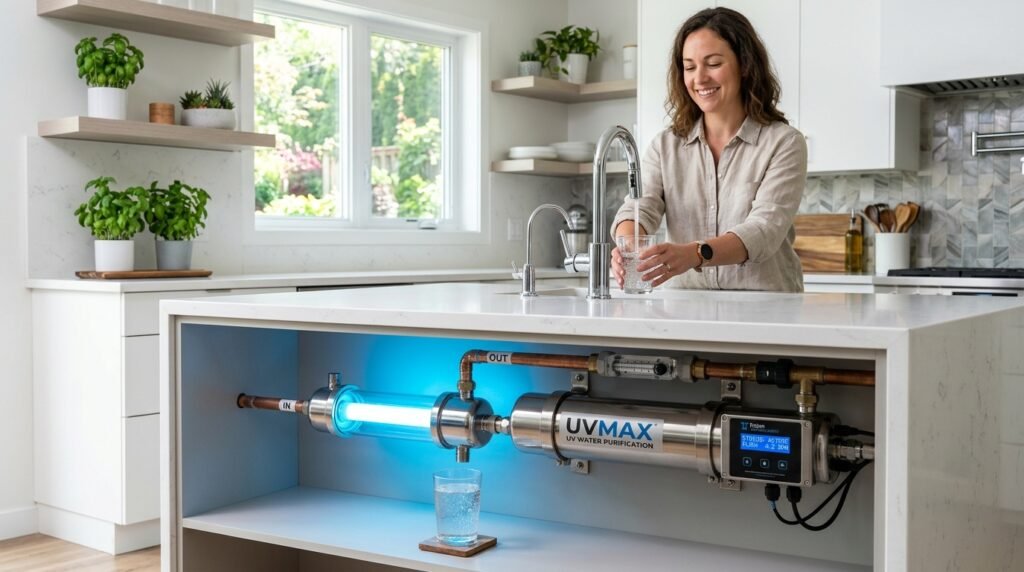
Are you concerned about hidden pathogens like bacteria and viruses lurking in your water supply?
Choosing the right uv water treatment system can be the difference between \”clear\” water and truly safe water. As a premier manufacturer, I’ve seen firsthand how ultraviolet water purification provides a powerful, chemical-free shield for homes and businesses alike.
In this guide, you’re going to learn exactly how this technology works, why it is the industry standard for well water treatment, and how to maintain a system for peak performance. If you are looking for expert guidance to ensure your water is biologically safe, you’re in the right place.
Let’s dive right in.
What is UV Water Treatment?
Are you concerned about invisible biological threats lurking in your drinking water? UV water treatment is one of the most reliable and advanced water disinfection methods available today. Simply put, it is a chemical-free water purification process that uses specialized ultraviolet light to neutralize harmful bacteria, viruses, and other pathogens before they reach your tap.
UV Treatment vs. Traditional Filtration
It is easy to confuse a uv water treatment system with standard water filters, but they serve entirely different purposes in protecting your home or business:
- Physical Water Filtration: Acts like a microscopic sieve. It physically traps and removes solid particles like dirt, rust, sand, and sediment from your water.
- UV Treatment Water: Does not physically remove solid particles. Instead, it targets the living, microscopic organisms that easily slip through standard filters, neutralizing them so they can no longer cause illness.
Think of physical filtration as sweeping up the debris, while water uv treatment acts as the ultimate biological security system.
The Power of the UVC Light Spectrum
The secret behind effective treatment uv water lies within the light spectrum. Not all ultraviolet light is the same. For water sterilization, we utilize a specific, highly concentrated band of light called UVC, precisely tuned to a wavelength of 254 nanometers (nm).
At this exact 254 nm wavelength, UVC light possesses incredible germicidal power. As water flows through the water treatment uv chamber, this intense light easily penetrates the cell walls of microorganisms. It immediately scrambles their DNA, rendering them completely harmless and unable to reproduce. It is a highly efficient, silent, and invisible shield that ensures your water is microbiologically safe.
How Does a UV Water Treatment System Work?
At the core of every uv water treatment system is a straightforward, highly effective process. We design these systems to neutralize biological threats instantly without relying on harsh chemicals.
The Core Mechanics
The physical setup is simple but robust. Water flows directly through a heavy-duty stainless steel chamber. Inside this chamber sits a specialized UV lamp that acts as a powerful water sterilizer system, emitting intense ultraviolet light to treat every drop that passes by.
The Science of Cellular Disruption
When water moves through the chamber, it is exposed to concentrated UVC light. Here is exactly what happens to the microorganisms in drinking water:
- Penetration: The UVC light easily pierces the cell walls of bacteria, viruses, and cysts.
- DNA Destruction: The light aggressively scrambles their genetic code.
- Neutralization: With their DNA destroyed, these pathogens are instantly rendered harmless and completely unable to reproduce.
UV Dose and Flow Rate
For treatment uv water to be consistently effective, timing and light intensity are everything.
- Flow Rate: Water cannot move too quickly through the chamber. We carefully match the system\’s capacity to your specific water demand to ensure proper exposure time.
- UV Dose: Every microorganism requires a specific intensity of UV light to be destroyed. Maintaining the correct balance between UV dose and flow rate guarantees complete sterilization.
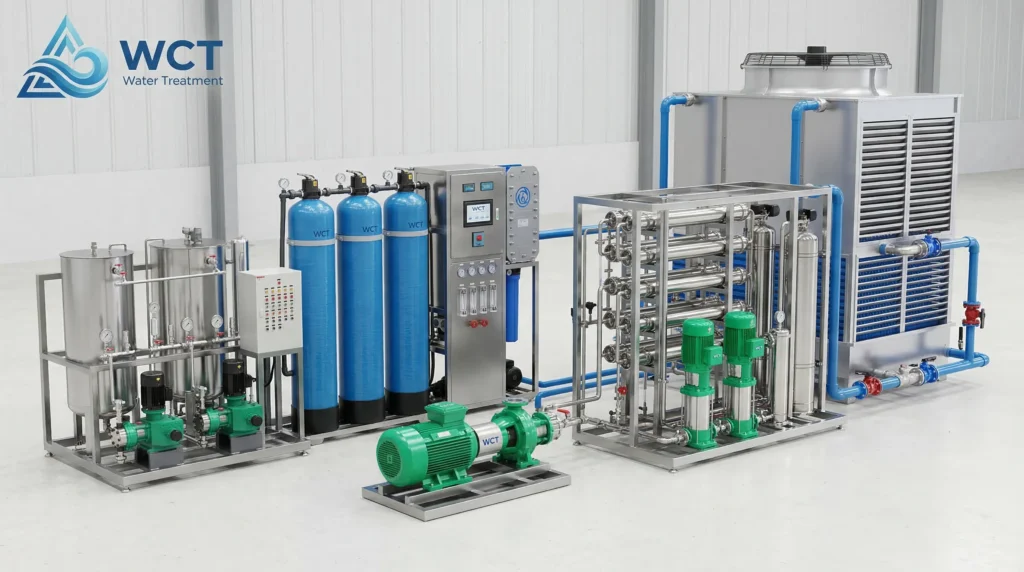
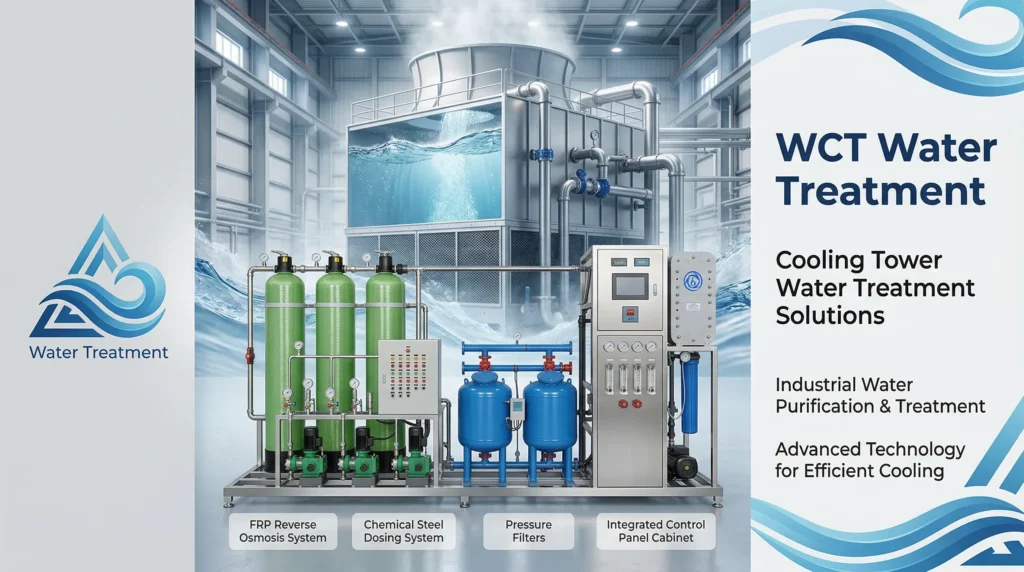
In comprehensive setups, controlling the flow and pre-treating the water is essential. Utilizing equipment like a reliable WCT 500 LPH RO System ensures the water entering the UV chamber is clear and moving at the perfect speed for maximum disinfection.
What Does UV Treatment Water Actually Target?
When we talk about uv treatment water capabilities, we are focusing on biological disinfection. This technology is designed to neutralize living organisms that traditional filters might miss. It is specifically engineered to destroy the genetic core of pathogens, making it impossible for them to infect anyone drinking the water.
Microorganisms Destroyed by UV
A high-quality uv water treatment system is incredibly effective at eliminating 99.99% of biological contaminants, including:
- Bacteria: E. coli, coliform bacteria, and Salmonella.
- Protozoa: Giardia and Cryptosporidium (which are often resistant to chlorine).
- Viruses: Hepatitis A, Norovirus, and Poliovirus.
What UV Does Not Remove
It is important to understand that uv water treatment is a sterilizer, not a mechanical filter. It does not improve the physical or chemical makeup of the water. It will not remove:
- Heavy metals (like lead or arsenic).
- Chlorine or fluoride.
- Volatile Organic Compounds (VOCs).
- Dissolved solids or minerals.
For these issues, we often recommend integrating other solutions such as activated carbon or specific water treatment chemicals to ensure comprehensive water safety.
The Necessity of Pre-Filtration
We always emphasize that a UV system should be the last stage of your water setup. For the UV light to work, the water must be crystal clear. If there are suspended solids or \”turbidity\” in the water, microorganisms can hide behind these particles. This is known as \”shadowing,\” where the bacteria are shielded from the UVC rays and pass through the system alive.
To prevent this, we use sediment and carbon pre-filters to catch physical debris. In larger industrial applications, we utilize honeycomb inclined tube packing in sedimentation tanks to clear the water before it ever reaches the UV chamber. Proper pre-treatment ensures that every drop of water is fully exposed to the light, guaranteeing total sterilization.
Top Benefits of Using Water UV Treatment
As a dedicated manufacturer and supplier, we consistently see the massive advantages our clients gain from upgrading their purification setups. When looking for a reliable way to secure your water supply, a uv water treatment system stands out as one of the most efficient and practical methods available today. Whether you are securing a private home or managing large-scale water plant treatment operations, the benefits of ultraviolet technology are unmatched.
Here is a quick breakdown of why uv water treatment is the preferred choice for modern water safety:
| Core Benefit | Key Advantage |
|---|---|
| Chemical-Free | Zero chlorine, zero harmful byproducts. |
| Taste & Odor Neutral | Maintains the natural, fresh taste of your water. |
| Highly Effective | Eliminates 99.99% of harmful microorganisms. |
| Cost-Effective | Uses the same energy as a standard light bulb. |
| Eco-Friendly | No chemical handling and zero wastewater generated. |
Why Water UV Treatment Outperforms Traditional Methods
100% Chemical-Free
Unlike traditional municipal disinfection methods, water treatment uv does not rely on adding chlorine or other harsh chemicals to your water supply. This delivers true chemical-free water purification, completely eliminating the risk of dangerous disinfection byproducts that can impact your health.
Taste and Odor Neutral
Because absolutely nothing is added to the water, uv treatment water retains its natural, clean profile. The process simply neutralizes biological threats without altering the water\’s physical properties, ensuring your drinking water never smells or tastes like a swimming pool.
Highly Effective Sterilization
A properly sized treatment uv water setup is ruthless against pathogens. It instantly destroys 99.99% of harmful microorganisms in drinking water, providing immediate, reliable protection against bacteria, viruses, and cysts that other filters might miss.
Cost-Effective & Low Energy
Running a water uv treatment unit is incredibly efficient. The system operates continuously but consumes roughly the same amount of electricity as a standard 60-watt light bulb. This keeps your daily operational costs extremely low while providing 24/7 protection.
Environmentally Friendly
Sustainability is a major priority for our global clients. Because there are no toxic chemicals to handle, store, or dispose of, this method is completely safe for the environment. Furthermore, the process generates absolutely zero wastewater, making it a highly responsible and sustainable choice for long-term water management.
UV Well Water Treatment: A Necessity for Private Wells
If you rely on a private well, you are solely responsible for the safety of your drinking water. Unlike municipal supplies, well water faces unique environmental risks that require a dedicated uv well water treatment setup to keep your household safe.
The Hidden Risks in Well Water
Groundwater is constantly shifting and changing. Without a reliable water treatment for well system, your home is vulnerable to several invisible threats:
- Agricultural Runoff: Pesticides, fertilizers, and livestock waste can easily seep into the local water table.
- Groundwater Contamination: Heavy rains, flooding, and melting snow wash surface bacteria directly into your well casing.
- Microorganisms in Drinking Water: Harmful pathogens like E. coli and coliform bacteria thrive in untreated well environments.
The Industry Standard for Well Safety
To combat these severe risks, a water treatment uv system is the recognized industry standard. Installing a whole house UV water filter guarantees that every drop entering your home is properly sterilized. It acts as an impenetrable firewall, neutralizing bacteria and viruses instantly without dumping harsh chemicals into your daily water supply.
Managing Seasonal Fluctuations
Well water quality rarely stays the same year-round. Spring thaws and heavy autumn storms can drastically alter the bacterial load in your groundwater. Using UV light for well water equipped with continuous monitoring features provides absolute peace of mind. Advanced sensors track the UV intensity 24/7, ensuring your water sterilizer system adapts to these seasonal changes and consistently delivers safe, clean water to every tap in your home.
Choosing the Best UV Water Treatment System
Selecting the right uv water treatment system requires more than just picking a model off a shelf. To ensure your water is actually safe, you must match the system’s capacity to your peak water usage and the specific chemistry of your water supply.
Sizing the System by Flow Rate (GPM)
The most critical factor is the flow rate, measured in Gallons Per Minute (GPM). This represents the maximum amount of water that can pass through the UV chamber while still receiving a lethal dose of UVC light. If the water moves too fast, the microorganisms won\’t be exposed long enough to be destroyed.
| Application Type | Typical Flow Rate (GPM) | Recommended Usage |
|---|---|---|
| Small Apartment | 1–5 GPM | Single faucet or point-of-use |
| Average Home | 8–12 GPM | 2–3 bathrooms and standard appliances |
| Large Home/Estate | 15–20 GPM | High-flow showers and multiple occupants |
| Commercial/Industrial | 30+ GPM | Restaurants, labs, or manufacturing |
Essential Water Quality Testing
Before installing any water treatment uv equipment, you must test your raw water. If your water is \”dirty\” or contains high mineral content, it can block the UV rays—a phenomenon known as shadowing. For a uv water treatment for bacteria setup to be 100% effective, your water should meet these minimum standards:
- UV Transmittance (UVT): Should be above 75%. This measures how easily UV light travels through the water.
- Hardness: Less than 7 grains per gallon (gpg). High hardness causes scale buildup on the quartz sleeve.
- Iron & Manganese: Iron should be below 0.3 ppm and manganese below 0.05 ppm to prevent staining the sleeve.
- Turbidity: Must be less than 1 NTU. Clear water is non-negotiable for UV success.
Key Features to Look For
We recommend looking for specific \”smart\” features that take the guesswork out of maintenance and ensure continuous protection:
- Lamp Countdown Timers: A digital display that tells you exactly how many days are left before the lamp needs replacing.
- Audible Alarms: The system should alert you immediately if the lamp fails or if the power goes out.
- High-Quality Quartz Sleeves: Ensure the system uses heavy-duty, high-transmittance quartz to protect the lamp from water contact.
- Stainless Steel Chambers: We use high-grade 304 or 316L stainless steel for our uv water treatment units to prevent corrosion and maximize light reflection.
Investing in a system with a built-in UV sensor is also a wise choice for those on high-risk wells, as it monitors the actual intensity of the light in real-time and can shut off the water flow if the disinfection level drops below the safety threshold.
Maintenance Requirements for Treatment UV Water Systems
Keeping your uv water treatment system running at peak performance requires a few simple, routine steps. We design our systems to be low-maintenance, but staying on top of these core tasks is essential to guarantee your water remains safe and fully sterilized.
Annual UV Lamp Replacement
UV lamps naturally lose their disinfection power over time. You must replace the UV lamp every 9,000 hours, which equals about 12 months of continuous use. Even if the lamp still emits a visible blue glow, the invisible UVC light required for a reliable treatment uv water setup has degraded and can no longer effectively neutralize bacteria.
Quartz Sleeve Maintenance
The quartz sleeve is the clear glass tube that protects the UV lamp from the water flow. Over time, minerals in the water build up on this sleeve, physically blocking the UV light from reaching the microorganisms.
- Inspect and clean: Check the sleeve every time you change the UV lamp.
- Remove scale: Use a mild acid or vinegar to gently wipe away hard water mineral deposits.
- Replace if damaged: A permanently cloudy or scratched sleeve reduces UV transmittance (UVT) and must be replaced to maintain system efficiency.
Pre-Filter Changes
Your uv water treatment setup relies heavily on crystal clear water. Sediment and carbon pre-filters catch dirt, rust, and debris before the water enters the UV chamber. If you skip pre-filter changes, particles will enter the chamber and create \”shadows,\” allowing bacteria to safely hide from the UV light. Whether you are running a residential well water unit or managing complex municipal water treatment systems, keeping pre-filters fresh is a non-negotiable step for effective sterilization.
Quick Maintenance Schedule
| Maintenance Task | Frequency | Purpose |
|---|---|---|
| Pre-Filter Replacement | Every 3 to 6 months | Prevents dirt and sediment from blocking UV light |
| Quartz Sleeve Cleaning | Every 6 to 12 months | Removes mineral buildup to ensure full UV penetration |
| UV Lamp Replacement | Every 12 months (9,000 hours) | Maintains optimal UVC intensity for complete sterilization |
| Quartz Sleeve Replacement | Every 2 to 3 years | Replaces permanently clouded or scratched glass |
Why Choose WCT for Your UV Water Treatment Needs?
As a premier uv water treatment manufacturer and supplier, we bring years of engineering expertise to the table. We don\’t just sell equipment; we provide reliable disinfection solutions built to last. Our production facility utilizes advanced manufacturing processes to ensure every uv water treatment system meets strict international safety standards.
Our Manufacturing and Quality Edge
We maintain total control over the production cycle. From the selection of high-grade stainless steel for the chambers to the precision of our electronic ballasts, every component is tested for durability.
- Rigorous Testing: Every unit undergoes high-pressure leak tests and UV intensity verification before shipping.
- Advanced Materials: We use premium 304 or 316L stainless steel to prevent corrosion and maximize UV reflection.
- Custom Engineering: We offer tailored treatment uv water solutions for unique flow rates and space constraints in both residential and industrial settings.
Comprehensive Solutions for Every Application
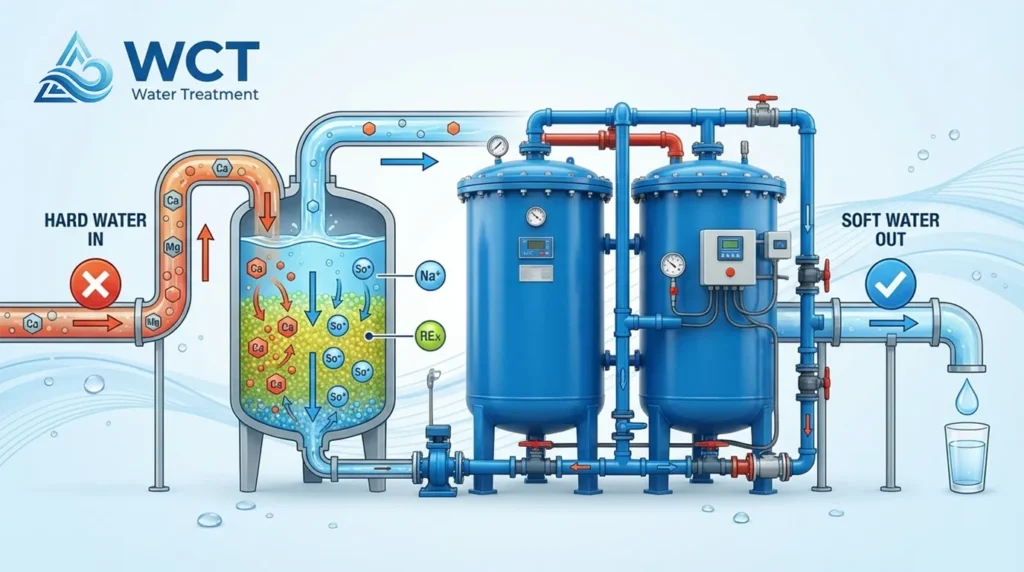
Whether you are looking for uv well water treatment for a rural home or a high-capacity water uv treatment setup for a factory, we have the hardware to match. We understand that UV is often one part of a larger system. For instance, to prevent mineral scaling on the UV sleeve, we frequently integrate our systems with hard water treatment modules to ensure the lamp maintains peak performance.
| Feature | WCT Industrial Standards |
|---|---|
| Chamber Material | Electropolished 304/316L Stainless Steel |
| Lamp Life | High-output lamps rated for 9,000+ hours |
| Applications | Residential, Commercial, and Industrial |
| Compliance | Built to meet 99.99% pathogen kill rates |
We take pride in being a trusted water treatment uv partner for global distributors. Our commitment to quality control means fewer maintenance headaches for you and safer water for your clients. By choosing us, you are investing in a system backed by a manufacturer that understands the science of light and the necessity of clean water.
FAQs About UV Water Treatment
Is UV water treatment safe for drinking water?
Yes, it is one of the safest and most reliable methods for disinfecting your supply. Because uv water treatment is a physical process rather than a chemical one, it does not change the water\’s chemistry or leave behind any toxic byproducts. It is highly effective at neutralizing 99.99% of pathogens, making it a preferred choice for a commercial UV water treatment system where water safety is non-negotiable.
Does UV treatment remove minerals from water?
No. A water treatment uv system is designed specifically to target biological contaminants like bacteria, viruses, and protozoa. It does not remove:
- Dissolved minerals (calcium, magnesium, etc.)
- Heavy metals (lead, arsenic)
- Chemicals (chlorine, VOCs)
If your goal is to address mineral content or \”hardness,\” you should pair your UV unit with a water softener or a reverse osmosis system.
Can I install a UV water system myself or do I need a professional?
While many handy homeowners successfully install a uv water treatment system as a DIY project, it does require basic plumbing skills. You need to be comfortable cutting pipes and installing bypass valves. For those using water treatment for well system setups, professional installation is often recommended to ensure the pre-filtration stages are correctly calibrated. Proper placement is vital; the UV unit must be the final stage of treatment to ensure no new contaminants enter the water before it reaches your tap.
- DIY Requirements: Basic plumbing tools, soldering or push-fit experience, and space for pre-filters.
- Professional Benefits: Guaranteed leak-free seals, optimized flow rate calibration, and verified electrical grounding.