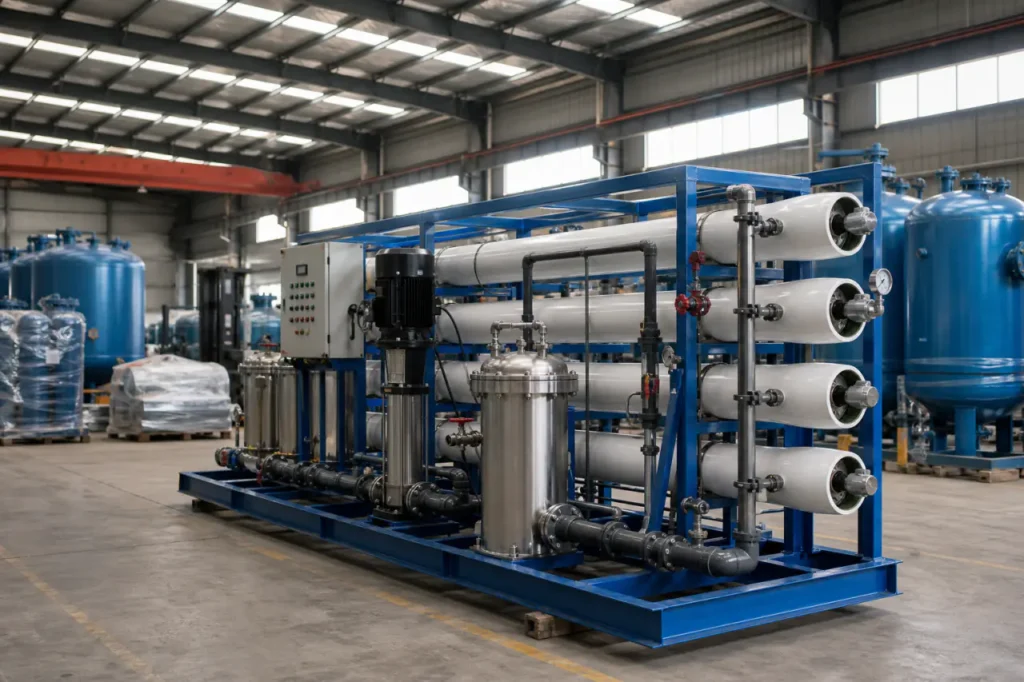
Finding a water treatment equipment exporter who can deliver a complete, compliant system to your site involves far more than a competitive price per cubic meter. Without verified engineering data and export logistics proof, you risk non-compliant equipment, customs delays, and a stranded asset.
Core Exportable Equipment Categories and Technologies
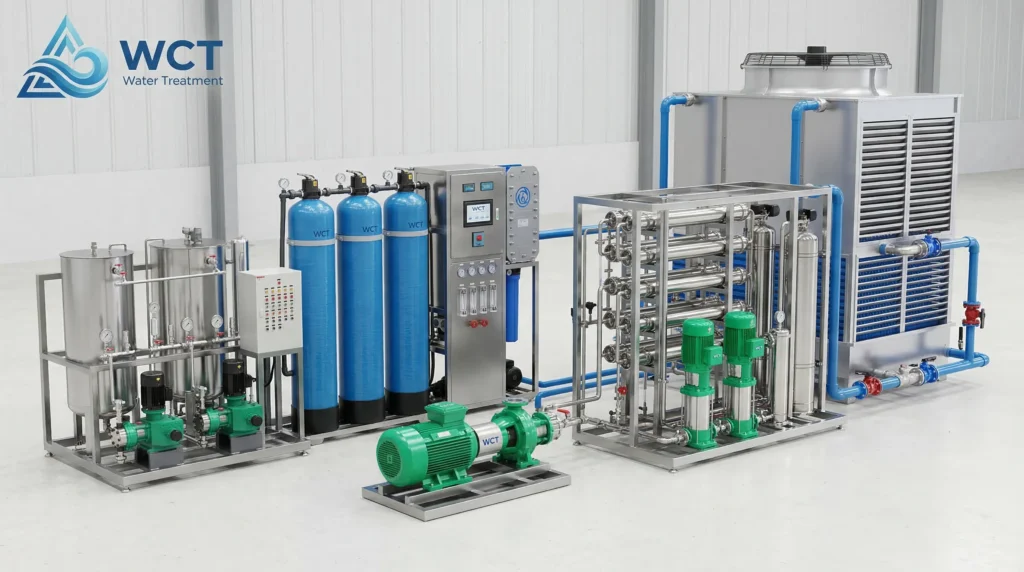
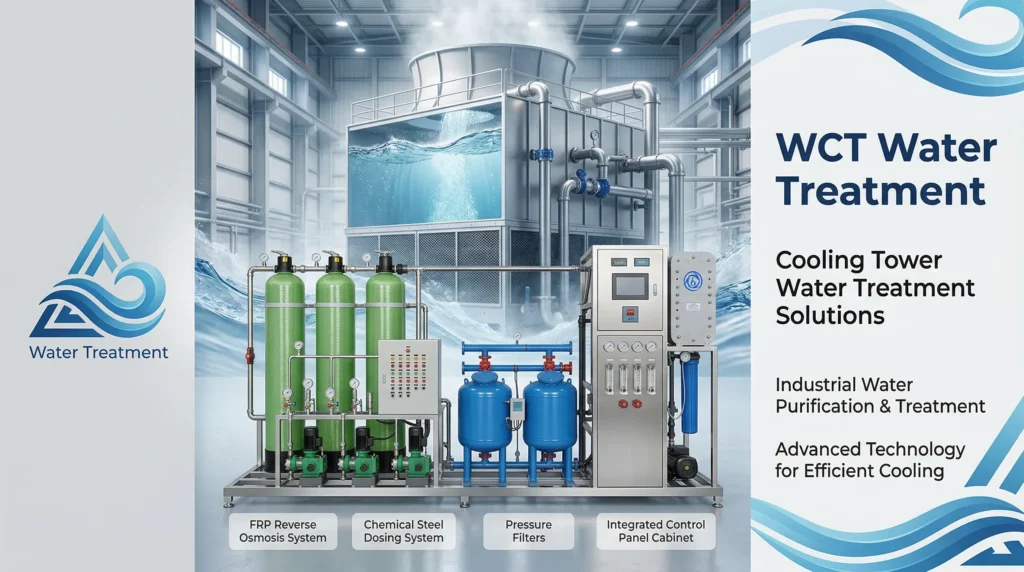
International sourcing makes the most sense for modular, skid-mounted, and turnkey water treatment systems that ship as pre-commissioned units.
For heavy industrial flows, buyers often prioritize commercial reverse osmosis equipment, ultrafiltration, and dissolved air flotation (DAF) skids that can be containerized for secure ocean freight.
| Equipment Type | Typical Industrial Application | Key Export Specification |
|---|---|---|
| Industrial Reverse Osmosis (RO) | Boiler feed water, food & beverage processing, pharmaceutical water | Skid dimensions, membrane type (brackish or seawater), recovery rate, power supply (380V/50Hz or 460V/60Hz) |
| Ultrafiltration (UF) / Nanofiltration (NF) | Pretreatment for RO, surface water treatment, dye wastewater | Membrane material (PVDF, PES), skid configuration, backwash automation |
| Dissolved Air Flotation (DAF) | Food processing wastewater, oil/water separation | Hydraulic loading rate, solids loading, chemical dosing integration, containerized option |
| Electrodeionization (EDI) | High-purity water for power plants, electronics manufacturing | Flow rate per module, electrical conductivity targets, stack design |
| Multimedia / Activated Carbon Filters | Pretreatment for turbidity and organic removal | Vessel material (FRP, carbon steel), media depth, backwash flow rate |
Buyers should specify exact voltage, frequency, and spatial constraints early. Even a 10-cm skid mismatch can delay installation and increase on-site rework costs at the destination.
- Verify that the exporter’s standard skid dimensions match your unloading door width and overhead crane capacity.
- Confirm membrane preservation method for sea freight: wet-tested sealed bags or nitrogen blanket.
- Check whether the control panel is pre-wired for your local voltage and includes motor protection class tags.
Pre-Treatment and Filtration Systems
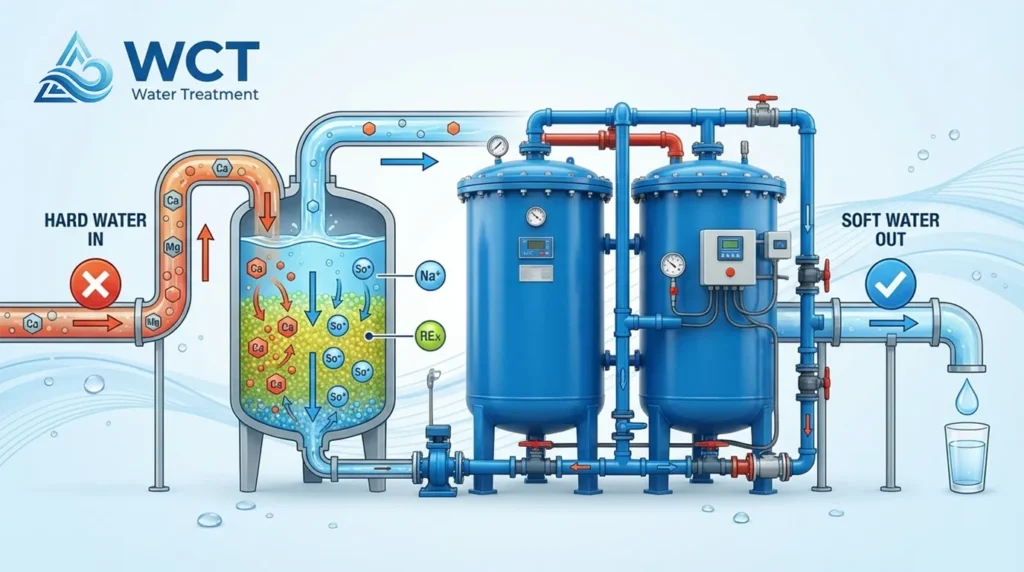
Multimedia filters, activated carbon vessels, and water softeners form the first line of defense against fouling and scaling. When designed as skid-mounted water treatment systems, these units reduce field piping and accelerate commissioning.
For export, insist on epoxy-coated carbon steel or FRP vessels rated for containerized transit. Also request hydrostatic test certificates and media loading height records.
- Make sure vessel linings are compatible with the pH range of your raw water.
- Ask whether media is loaded at the factory or on site; factory loading reduces startup time.
Advanced Membrane Solutions (RO, UF, NF)
Membrane systems demand precise pre-treatment and strict preservation protocols during shipping. Advanced membrane filtration systems – including UF, nanofiltration, and brackish or seawater RO – must ship with membrane elements either wet-tested and sealed or installed under a nitrogen blanket.
Verify that the exporter provides a full wet-test report from the factory before accepting shipment.
- Request permeate conductivity, specific flux, and pressure drop data from the factory wet test.
- Confirm that preservation chemicals are compatible with your intended membrane elements and will not degrade seals.
- Insist on a certificate that states the membrane elements were not allowed to dry out or freeze during transport.
Wastewater and Effluent Treatment (DAF, Clarifiers)
For oily wastewater, food processing effluent, or heavy-solids streams, DAF units and inclined plate clarifiers are frequent export candidates. Wastewater treatment equipment for EPC contractors often incorporates chemical dosing skids and sludge handling modules designed to operate as a single plug-and-play package.
Containerization protects the equipment during sea freight and allows outdoor installation at the project site. Before shipping, confirm the container’s interior layout includes lifting lugs and tie-down points that match your site crane plan.
- Verify that the DAF sludge scraper mechanism is locked or braced for transit to prevent misalignment.
- Ask whether the chemical dosing panel ships with calibration curves and injection quill spares.
Key Criteria for Evaluating a Water Treatment Equipment Exporter
A capable exporter does more than assemble components. You need evidence of in-house engineering, rigorous factory testing, and a support structure that works across time zones.
Engineering and Customization Capabilities
Request P&ID drawings and 3D CAD models during the proposal stage. These documents reveal whether the exporter understands hydraulic design, chemical dosing integration, and control logic.
A manufacturer that can provide custom water treatment equipment – for example, custom UF membrane systems with automated CIP – will also produce documentation that matches your local engineering review process.
If the exporter cannot explain how they adapt a standard skid for your site’s pipe routing or electrical bus, move on.
- What to ask: Can you supply a process flow diagram and a GA drawing within two weeks of receiving our water analysis?
- What to verify: Does the control panel logic include remote I/O for future SCADA integration?
- What to check: Are all instrument tags and cable schedules clearly labelled, with spare conduits for field devices?
Quality Assurance and Factory Acceptance Testing (FAT)
Factory acceptance testing is where you validate system performance before it leaves the manufacturer’s floor. A credible exporter will invite your representative – or an independent inspector – to witness a wet test at rated capacity.
You should receive a signed FAT report, a materials traceability dossier, and pressure-test certificates for all vessels. The mistake: treating a short loop test without actual raw water as a real performance guarantee.
Insist on a test that uses water close to your feed quality or a protocol that simulates your worst-case conditions.
- Confirm that the FAT includes a control logic check for all alarms, interlocks, and automatic shutdowns.
- Request that the test water be spiked to match seasonal high-TSS or high-silica episodes from your site.
- Verify that the FAT report lists serial numbers for all major components (pumps, membranes, instruments) for traceability.
Post-Installation Support and Spare Parts Availability
Cross-border support hinges on two things: remote diagnostic capability and spare-parts logistics. Look for exporters that ship systems with a VPN-enabled PLC and a set of critical spares – membranes, gaskets, dosing pump rebuild kits – packed inside the main shipment.
Ask whether they offer commissioning supervision via a factory-trained engineer, either on site or through a local partner. Without this, a pressure gauge failure can add weeks of downtime while you wait for a replacement.
Sourcing commercial RO equipment without a clear after-sales plan often leads to expensive membrane replacement and unplanned maintenance on the buyer’s side.
- Request a recommended spare parts list with lead times for each item from the exporter’s nearest warehouse.
- Verify that remote access software is pre-configured and tested on a separate VLAN before shipment.
Comparing Top Global Water Treatment Equipment Manufacturers
The global market splits between massive integrated solution providers and focused OEM exporters. Both have a place, but the right choice depends on your project’s engineering complexity and after-sale support expectations.
| Manufacturer / Brand | Core Specialties | Global Reach & Support Network | Notable Certifications |
|---|---|---|---|
| Veolia Water Technologies | Municipal, industrial water reuse, ZLD | Extensive direct presence in 50+ countries | ISO 9001, ISO 14001, ASME, local approvals |
| SUEZ (now part of Veolia) | Desalination, advanced membranes, chemical treatment | Strong in Europe, Middle East, Asia | ISO 9001, PED, NSF |
| Evoqua (Xylem) | Industrial process water, electrochemical treatment | North America, Europe, Asia Pacific | ISO 9001, ASME, UL |
| Xylem | Pumps, smart water meters, treatment components | Global distribution and service | ISO 9001, WRAS, ACS |
| WCT (Wuxi Watertech) | Custom turnkey RO/UF/DAF skids, global OEM water treatment factory | Asia, Middle East, Africa, South America; partner-supported commissioning | Designs to ASME/CE/PED; ISO 9001 |
A tier-1 conglomerate offers broad in-country service, but a specialized OEM exporter often moves faster on customization and direct engineering access. For projects where the local EPC contractor has strong integration capabilities, an OEM can deliver equivalent quality at a more competitive total cost.
- When comparing suppliers, ask: How many skid systems of this size have you shipped to our region in the last three years?
- Request references for similar water chemistry, not just flow rate, and ask about commissioning handover smoothness.
- Verify that the exporter’s warranty start date is tied to successful SAT, not bill of lading.
International Logistics, Compliance, and Commissioning
Export logistics can turn a well-built system into a non-functional asset if you overlook three things: local electrical standards, membrane preservation during transit, and on-site acceptance testing.
Meeting Local Regulatory and Electrical Standards
Voltage and frequency mismatches are the most common startup failure point. Specify your site’s exact power supply (400V/50Hz, 460V/60Hz, or others) and motor protection class before the manufacturer finalizes the electrical design.
Pressure vessels and piping may need to comply with ASME Section VIII, PED (Europe), or local boiler codes. Ask the exporter to submit vessel data reports and, if needed, arrange third-party inspection by a notified body before shipment.
- Check that cable sizing, earthing, and arc-flash labelling follow the destination country’s industrial electrical code.
- If your site requires explosion-proof motors for a classified area, confirm ATEX or IECEx certification on the drive nameplate.
Packaging, Shipping, and Incoterms
Membrane elements shipped dry can crack if exposed to freezing temperatures inside a container at sea. Responsible exporters specify a wet preservation solution or nitrogen blanket for membrane systems and use humidity-controlled packaging for electrical cabinets.
Clarify incoterms early – CIF, FOB, or DAP – so you know exactly when the risk transfers. Many first-time buyers discover too late that port handling charges, customs brokerage, and inland transport add 12-20 % to the landed cost.
- Before shipping, confirm: Are membranes pre-flushed and sealed? Is the control panel packed with desiccant and a shock recorder?
- Verify the bill of lading matches the packing list and proforma invoice exactly to avoid customs holds.
- Request that fragile instruments (flow meters, pH probes) be shipped in a separate shock-absorbing crate inside the main container.
Site Acceptance Testing (SAT) and Commissioning
FAT proves the system works at the factory; SAT proves it works at your site. With an international exporter, you need a clear SAT protocol agreed in the purchase order – including performance test duration, water quality sampling frequency, and acceptance criteria.
Some exporters include a factory engineer on site for commissioning; others train a local technician via video call. Negotiate this before signing.
Never accept a warranty that starts counting from the bill of lading date rather than from successful SAT.
- Typical SAT criteria: 72-hour continuous run, permeate flow within ±5% of design, product water quality met at all sampling points.
- Insist that the exporter provide a punch-list closure schedule before they demobilise, even if commissioning is remote.
What to Prepare Before Requesting an Export Quote
Expedite the sourcing process by providing comprehensive project data upfront. Suppliers that receive a complete technical package rarely need to pad their pricing to cover unknowns.
- Full raw water analysis report: Including pH, TDS, hardness, silica, iron, oil & grease, and any seasonal variation.
- Required treated water quality: In clear units (e.g., conductivity <10 µS/cm, SDI <3, turbidity <0.1 NTU).
- Design flow rate: Daily volume and peak hourly demand in m³/day or GPD.
- Site spatial constraints: Maximum available footprint for the skid or container, door/access dimensions, and weight limits for lifting equipment.
- Local electrical specifications: Voltage, phase, frequency, and whether a transformer or VFD is needed.
- Applicable codes and standards: Any mandatory certifications (ASME, CE, UL, local building code) the system must meet.
- Shipping and installation plan: Preferred incoterms and whether you need containerized or skid-mounted delivery.
Once you have this package, send it to our engineering team for a technical review and preliminary system sizing. We will return a detailed process proposal and a transparent export feasibility quote that matches your site constraints.
Frequently Asked Questions
How are warranties handled by international water treatment exporters?
Warranties typically cover manufacturing defects for 12-24 months. The buyer often covers freight for replacement parts unless a local service partner is established.
Always clarify whether the period starts from shipment, delivery, or SAT completion. Real support comes from a clear claim process, not a generous promise.
What is the typical lead time for custom industrial RO systems?
Expect 10 to 16 weeks from order confirmation to FAT for a custom, export-ready RO skid. This covers engineering, procurement of long-lead items, fabrication, wet testing, and packaging.
Ocean freight can add 4-8 weeks depending on the route, so plan your project schedule accordingly.
Should I buy a containerized system or a skid-mounted system for import?
Containerized systems ship inside a standard ISO container, giving secure transport and instant outdoor deployment. Skid-mounted systems fit into an existing building footprint and offer easier maintenance access.
If your site has no indoor space and needs rapid deployment, containerized is faster. If you have a process building with pipe racks, a skid-mounted unit may integrate more smoothly and cost less.