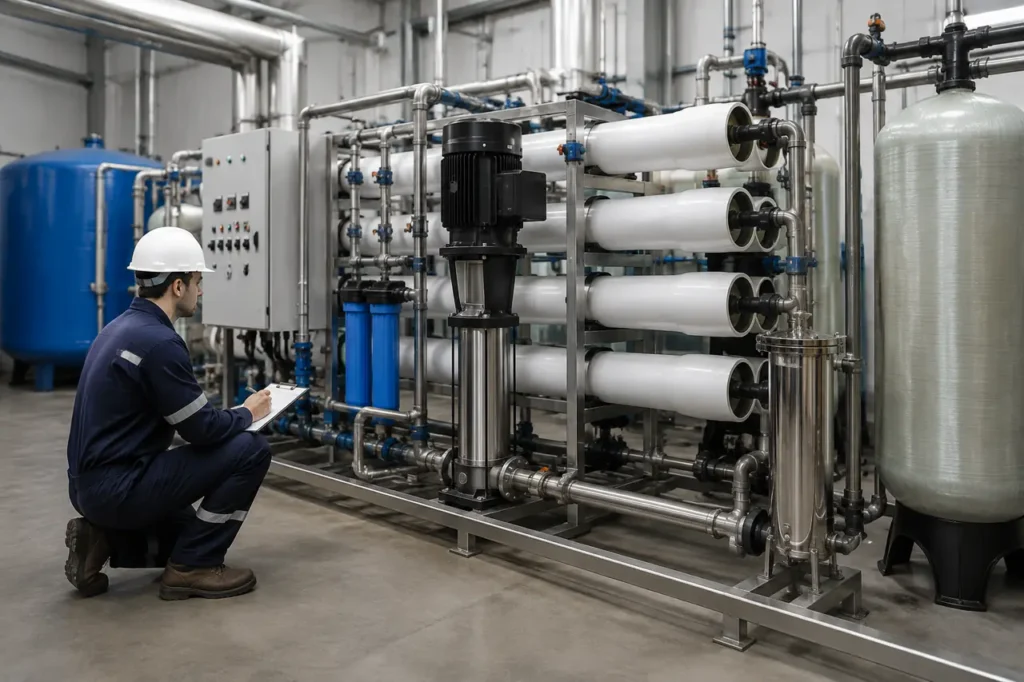
Specifying a commercial RO system requires balancing daily volume demands against feed water chemistry and target permeate purity.
Oversizing wastes capital, while undersizing forces high-pressure pumps to run beyond continuous duty limits, accelerating membrane degradation.
Establishing baseline water quality and peak hourly flow before selecting system hardware prevents operational bottlenecks across commercial facilities.
System Sizing and Capacity Breakdown (GPD)
Always size a reverse osmosis unit based on 70% to 80% of its maximum daily capacity. This operating buffer accommodates seasonal feed water temperature drops, which reduce membrane flux rate, while preventing continuous pump strain during peak production hours.
Commercial capacity is measured in gallons per day (GPD) or gallons per minute (GPM). Matching daily output to operational workflow ensures adequate water storage without forcing the system into frequent start-stop cycles.
Before selecting a tier, confirm the following operating points:
- Size continuous duty at 70% to 80% of rated daily GPD, not peak label output.
- Confirm peak flow in GPM during simultaneous draw periods.
- Match available power supply and floor footprint to the system tier.
Low-Flow Systems (200 to 2,000 GPD)
Low-flow units deliver between 0.14 and 1.38 GPM of purified water. These systems fit light commercial applications, such as specialty coffee shops, small laboratories, microbreweries, and commercial kitchens.
Most low-flow systems utilize wall-mounted frames or compact floor stands. They operate on standard 110V or 220V single-phase power and feature 2540 or 4040 membrane elements to fit limited mechanical spaces.
Mid-Flow Systems (2,000 to 10,000 GPD)
Mid-flow systems provide 1.38 to 6.94 GPM, serving commercial greenhouses, car washes, food preparation facilities, and light manufacturing plants. Reviewing a detailed guide on How To Source Commercial Ro Systems helps buyers compare mid-tier frame configurations and controller features.
These units generally utilize floor-mounted, open-frame skids housing multiple 4040 high-rejection membranes. They require 220V single-phase or 460V three-phase power to drive heavy-duty stainless steel booster pumps continuously.
High-Flow Industrial Systems (10,000 to 20,000+ GPD)
High-flow configurations handle continuous demand from 6.94 to over 13.8 GPM. They support industrial boiler feed water, pharmaceutical rinsing, large-scale hydroponics, and municipal water purification.
These industrial-grade platforms incorporate 8040 membrane elements inside multi-stage pressure vessels. Specialized builds, such as the Wct 1000 Gpd Ro System For Waste Water Treatment, demonstrate how targeted sizing handles demanding concentration and recovery requirements.
| Capacity Tier | Flow Rate Range | Footprint & Frame | Ideal Operating Duty | Target Applications |
|---|---|---|---|---|
| Low-Flow | 200 – 2,000 GPD (0.14-1.38 GPM) | Wall-mount or compact stand | Intermittent to 12 hrs/day | Restaurants, cafes, labs, small boilers |
| Mid-Flow | 2,000 – 10,000 GPD (1.38-6.94 GPM) | Floor skid (4040 elements) | 12 to 20 hrs/day continuous | Horticulture, food processing, car washes |
| High-Flow | 10,000 – 20,000+ GPD (6.94-13.8+ GPM) | Heavy skid (8040 elements) | 24/7 continuous operation RO | Power generation, pharma, industrial plants |
Selecting the right capacity tier prevents premature hardware fatigue. Systems operating near their upper GPD threshold suffer from frequent membrane scaling and pump overheating, leading to unplanned downtime and higher maintenance costs.
Industry-Specific Water Quality Requirements
Target permeate purity dictates whether a single-pass or dual-pass process train is necessary. Raw water total dissolved solids (TDS) must be reduced to specific threshold levels mandated by process requirements or industry compliance standards.
Selecting appropriate membrane chemistry and post-treatment polishing systems guarantees consistent product water quality. Downstream equipment remains protected from mineral deposition, biological contamination, and chemical degradation.
Food and Beverage Manufacturing
Food and beverage processing demands strict microbial control and consistent mineral profiles. Variable water chemistry alters product taste, clarity, and shelf stability across regional batch production.
High-rejection membranes remove organic compounds and dissolved minerals. Downstream sanitation requires a Commercial Uv Water Treatment System to eliminate bacteria without introducing chemical additives into the product stream.
Pharmaceutical and Laboratory Operations
Pharmaceutical manufacturing and clinical testing require purified water meeting USP standards. Conductivity must remain below strict microSiemens thresholds, with near-zero total organic carbon (TOC) levels.
Dual-pass reverse osmosis combined with continuous electrodeionization (EDI) provides high resistivity product water. Integrating Commercial Nanofiltration Systems upstream selectively removes divalent ions, lowering energy demand on the primary RO stage.
Commercial Horticulture and Hydroponics
Hydroponic growers and commercial greenhouses require low-TDS baseline water. Excess sodium, chloride, or boron disrupts plant nutrient absorption and damages root structures in closed-loop irrigation systems.
Standard high-rejection brackish water reverse osmosis units strip background minerals down to under 10 ppm. This clean base allows growers to engineer precise nutrient formulations without background water interference.
Industrial Boiler Feed Water
High-pressure boilers require low-silica, low-hardness feed water to prevent thermal scale build-up. Mineral scale on heat transfer surfaces reduces fuel efficiency and causes tube rupture risks.
Reverse osmosis reduces boiler feedwater blowdown requirements by removing over 98% of dissolved minerals. Lower blowdown frequency saves significant thermal energy, fuel costs, and water treatment chemicals.
| Industry Sector | Target Contaminants | Membrane Selection | Crucial Pre / Post Treatment |
|---|---|---|---|
| Food & Beverage | TDS, organics, chlorine, bacteria | High-rejection TFC | Carbon pre-filter / UV disinfection post-treatment |
| Pharmaceutical | Pyrogens, minerals, TOC, ions | Low-fouling / Dual-pass RO | Softener pre-treatment / EDI & UV polishing |
| Horticulture | Sodium, chlorides, heavy metals | Energy-saving brackish water | Sediment pre-filtration / Blending valves |
| Boiler Feed | Silica, calcium, magnesium, alkalinity | High-rejection polyamide | Water softener / Deaeration & chemical dosing |
Matching membrane specifications to process water targets ensures regulatory compliance. Operating standard commercial membranes on high-silica or high-bioburden feed water leads to rapid surface fouling and shortened element lifespan.
Core Component Specifications Checklist
System durability depends on component engineering quality. Evaluating frame construction, pump hydraulics, membrane flux rates, and controller capabilities ensures long-term operational stability under continuous industrial stress.
Cheaper commercial systems often compromise on hardware that directly affects service life.
- Pump metallurgy below 304/316 stainless steel.
- Pressure vessel ratings below maximum pump discharge pressure.
- Sensor precision that misreads TDS or conductivity.
Investing in high-grade hardware reduces total lifecycle costs by minimizing service calls and energy draw.
High-Pressure Pumps and Continuous Operation
The high-pressure pump drives solvent cross-flow filtration across the semi-permeable membrane. Stainless steel pump housings (304 or 316) resist localized pitting and corrosion caused by concentrated brine streams.
Continuous-duty multi-stage centrifugal pumps are preferred over light-duty rotary vane pumps for high-flow installations. Variable frequency drives (VFDs) optimize pump speed, reducing hydraulic shock during system startup cycles.
High-Rejection and Energy-Saving Membranes
Modern thin-film composite (TFC) membranes balance high salt rejection with reduced operating pressure. Low-energy membranes operate at lower feed pressures, cutting pump electrical consumption by up to 30%.
Evaluating membrane surface area and nominal permeate recovery rate prevents oversaturating the reject stream. Standard brackish water elements achieve 99.0% to 99.5% nominal salt rejection under baseline testing conditions.
Advanced System Controllers and Monitoring
Digital system controllers monitor operating parameters, including feed water TDS, permeate conductivity, operating pressures, and feed temperature. Following Best Practices For Industrial Water System Design ensures instrumentation panel layouts allow quick operator checks.
Automated fast-flush valves cleanse membrane surfaces with high-velocity water during shutdown, removing loose particulate matter. Alarm outputs protect hardware by triggering immediate shutdown upon detecting high pressure or low feed supply.
Key Hardware Verification Rules
- Confirm high-pressure pump housings use 304 or 316 stainless steel rather than brass or cast iron.
- Verify pressure vessels carry ASME ratings matching maximum pump discharge pressure.
- Ensure digital controllers feature temperature-compensated conductivity monitoring for accurate purity readings.
- Check that flow meters are installed on both permeate and concentrate lines to track recovery ratios.
- Validate that automatic low-pressure cutoff switches are present to protect pumps from dry running.
Pre-Treatment: Protecting the RO Membranes
Raw water contaminants degrade reverse osmosis membranes through scaling, fouling, or chemical oxidation. Unprocessed feed water causes permanent performance decline, requiring costly element replacement long before normal service life ends.
A properly engineered pre-treatment train acts as a protective barrier. Treating incoming water chemistry stabilizes flux rates, maintains salt rejection performance, and lowers overall membrane cleaning frequencies.
Hardness and Scale Control Systems
Dissolved calcium, magnesium, and silica precipitate out of solution as water concentrates on the brine side of the membrane. This mineral scaling blocks membrane pores, driving up feed pressure and reducing permeate flow.
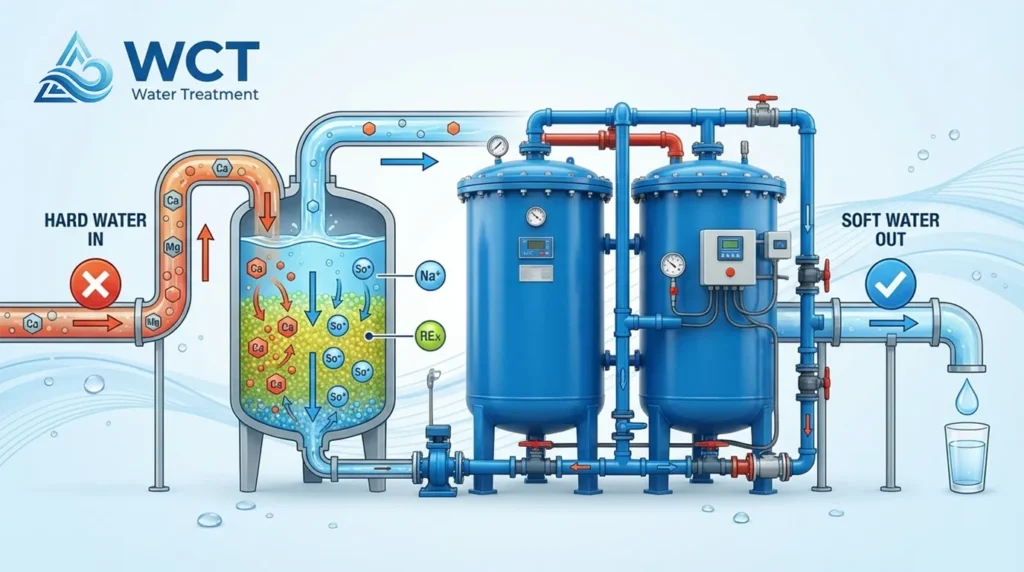
Water softeners exchange hard ions for sodium, eliminating scale risk completely. Alternatively, antiscalant chemical injection systems modify crystal growth, keeping minerals dissolved at higher concentration levels without softeners.
Chlorine Neutralization and Carbon Filtration
Thin-film composite polyamide membranes suffer permanent oxidative damage when exposed to free chlorine or chloramines. Exposure above 0.1 ppm breaks down polymer bonds, causing irreversible salt passage increases.
Activated carbon filters adsorb free chlorine and organic chemicals effectively. Chemical bisulfite injection systems provide an alternative continuous dechlorination method for high-flow industrial installations with footprint constraints.
Multi-Stage Pre-Filtration and Suspended Solids Removal
Suspended solids, silt, and colloidal iron physically clog membrane feed channels. Use the following pre-treatment checks:
- Measure Silt Density Index (SDI) before hardware installation.
- Lower turbidity with an Industrial Clarifier System or multi-media sand filters, followed by 5-micron depth cartridges.
- For bioburden or organic loads, use a Commercial Ozone Water Treatment System upstream to oxidize recalcitrant organics and iron complexes.
What to Prepare Before Requesting a System Quote
Accurate feed water and site utility data allows application engineers to configure an optimal membrane system. Incomplete data leads to misconfigured pre-treatment, incorrect pump sizing, or delayed delivery.
Essential Feed Water and Operating Inputs
Obtain a comprehensive water laboratory analysis taken within the last 30 days. Municipal supply chemistry shifts seasonally, while well water parameters vary based on local water table movement.
Identify required peak flow rates in GPM alongside overall daily volume demands. Understanding peak hourly usage prevents under-sizing storage tanks or over-specifying system booster pump outputs.
Facility Footprint and Electrical Checks
Before final configuration, verify facility fit with the following checks:
- Measure mechanical room floor space, doorway widths, and floor loading.
- Confirm voltage, phase, and amperage capacity.
- Verify drainage can handle continuous concentrate reject flow without backpressure.
- Consider pre-assembled Skid Mounted Water Treatment System equipment to reduce piping time.
Data Input Checklist for Engineering Review
- Complete water analysis report (TDS, pH, hardness, iron, manganese, silica, free chlorine, temperature).
- Required product water purity level (maximum acceptable TDS or conductivity in uS/cm).
- Daily water consumption requirement (GPD) and instantaneous peak flow rate (GPM).
- Available site power supply (voltage, single-phase vs. three-phase, frequency).
- Available installation footprint dimensions, ceiling clearance, and floor drain locations.
Engineers at WCT review these technical inputs to design energy-efficient commercial water purification systems. Submitting comprehensive feed water chemistry and site usage profiles allows our team to generate precise equipment specifications, flow schematics, and accurate project quotes tailored to your operational requirements.