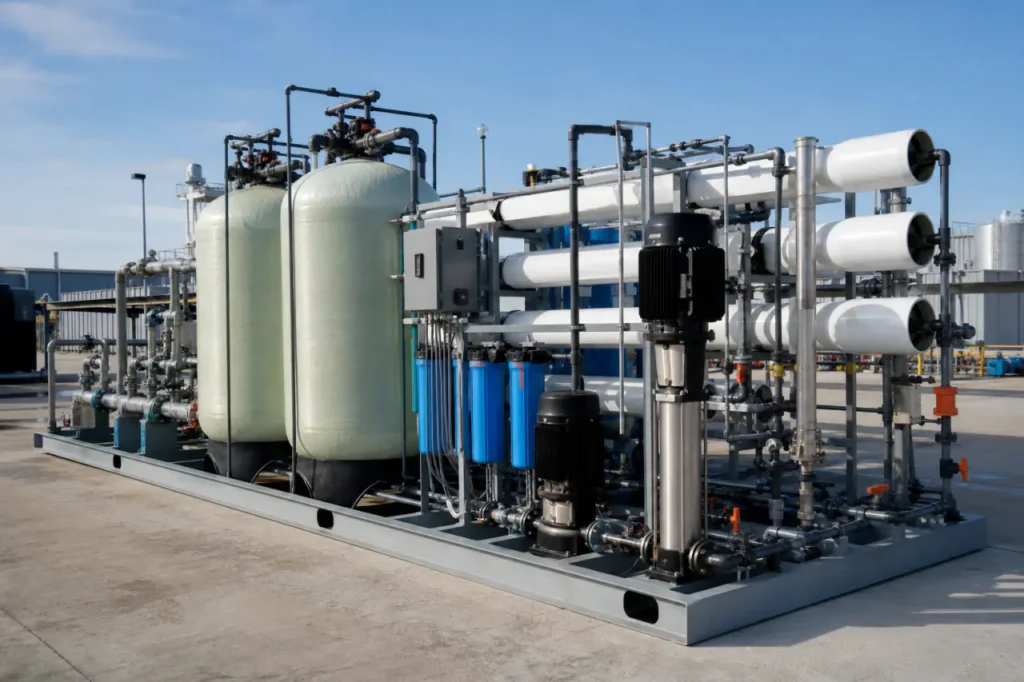
What is a Skid-Mounted Water Treatment System?
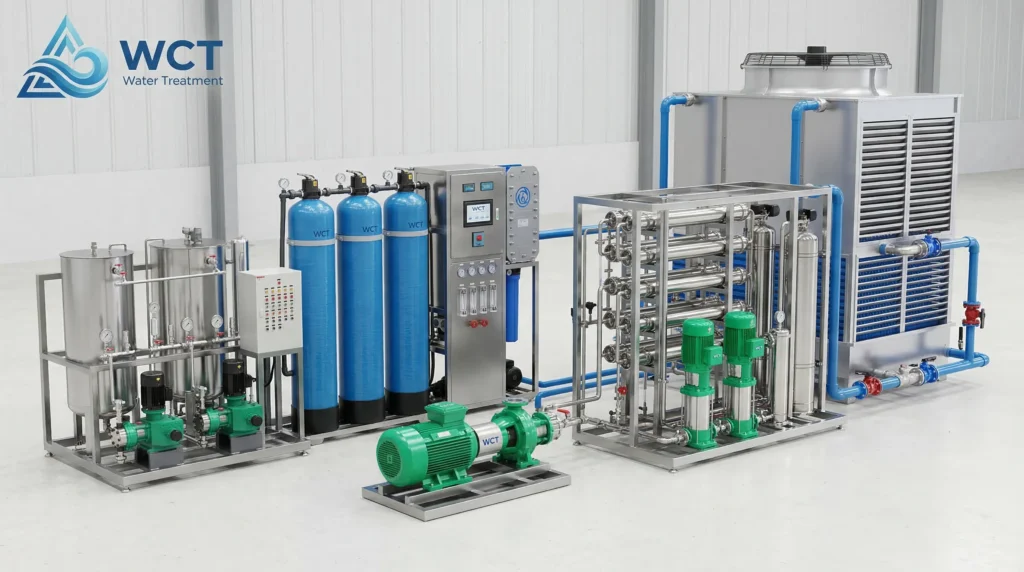
A skid mounted water treatment system is a complete, pre-assembled process unit built on a structural steel or fiberglass base.
It ships as one integrated module – pre-plumbed, pre-wired, and factory-tested – so the plant receives a ready-to-connect package rather than a collection of components that still need field assembly.
This approach moves most of the labour, engineering, and quality control into a controlled manufacturing environment. For an industrial facility, that translates to less on-site construction time and a water treatment train that starts up faster than a traditional site-built plant.
Many skid systems overlap with packaged water treatment plant designs, and they often serve as the core of a larger modular water filtration unit strategy.
Because the entire system leaves the factory as a single piece, it can be delivered as a turnkey pre-wired plumbing installation that only needs utility connections on site.
Key Components of a Water Treatment Skid
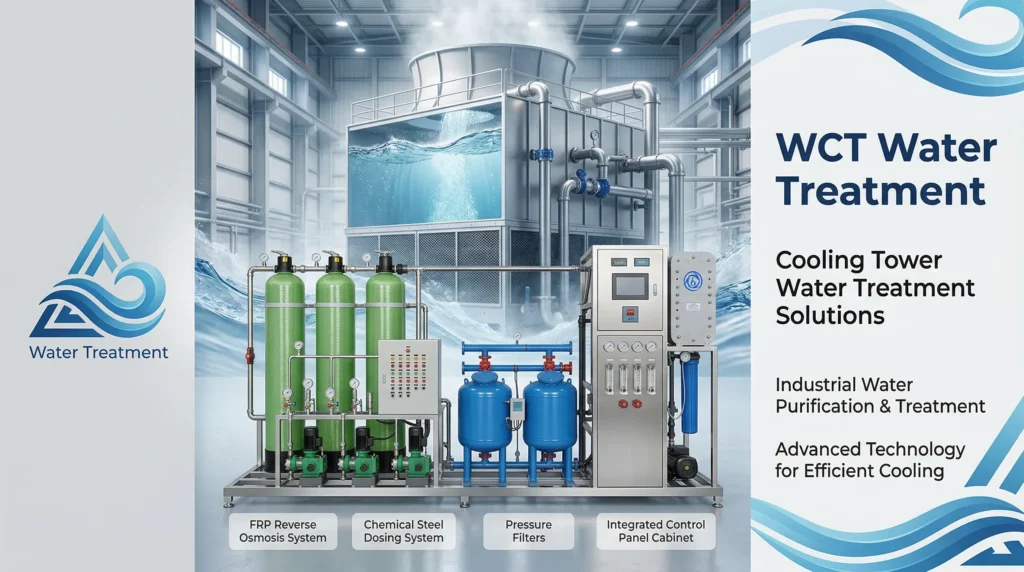
A well-engineered skid packs multiple treatment functions onto one compact frame. While the specific components depend on the process, most industrial skids include several core elements.
- Structural base frame: Designed for forklift or crane handling, with lifting points and corrosion protection for the operating environment.
- Process vessels and membrane housings: For RO membranes, media filters, softeners, or chemical reaction tanks, all mounted and inter-piped.
- Pumps and motors: High-pressure feed pumps, boosters, and recirculation pumps, sized to match the duty point and already wired to the control panel.
- Integrated PLC controls: A central panel with a touchscreen HMI that manages sequential operation, alarm handling, and remote monitoring.
- Instrumentation and valving: Flow meters, pressure transmitters, conductivity sensors, and automated valves, all calibrated and loop-checked at the factory.
- Chemical dosing skids (if required): Antiscalant, coagulant, or pH adjustment packages integrated into the same frame or supplied as a linked sub-skid.
Site-Built vs. Skid-Mounted Systems
The fundamental difference is where the engineering hours and construction risk land. A traditional site-built plant requires substantial field labour, whereas a skid-mounted system moves those activities to a factory floor with repeatable quality checks.
When evaluating a why skid-mounted water systems are popular argument, facility managers often point to three factors: available floor space, project schedule, and commissioning confidence. The table below lays out the comparison across key project metrics.
| Feature / Metric | Skid-Mounted System | Traditional Site-Built System |
|---|---|---|
| On-site engineering required | Minimal – connection points only | Extensive – field routing, support design, and inter-piping |
| Footprint / Space efficiency | Compact; could occupy as little as 35-85 ft² for a small wastewater skid | Larger; equipment spreads across multiple skids or platforms with separate walkways |
| Factory testing / Quality control | Full FAT before shipment; instruments calibrated, PLC sequence tested | Field-testing only; troubleshooting done on site during commissioning |
| Installation speed | Days to weeks; anchor the skid, connect utilities, and start up | Weeks to months; construction, wiring, and piping built sequentially |
| Overall capital cost | Often lower when factoring in reduced field labour and shorter schedule | Higher indirect costs from extended site work and potential rework |
For plants with tight turnaround requirements or limited on-site trade availability, the skid-mounted route typically yields a faster return to production.
Key Engineering Benefits & Advantages
The plug-and-play architecture of a factory assembled water treatment skid removes many variables that delay conventional water plant projects. The advantages go beyond speed – they also change how risk is managed during procurement and commissioning.
- Rapid deployment and reduced downtime: Because the skid arrives pre-tested, the facility can move from concrete pad to producing water in days instead of weeks.
- Compact, space-saving footprint: A skid packs pumps, vessels, and controls into a single dense layout. That matters when retrofitting inside an existing building or when floor space is scarce.
- Single-source accountability: One supplier engineers, builds, and tests the entire system. When a problem arises, there is no gap between the equipment vendor, the panel builder, and the field installer.
- Factory Acceptance Testing (FAT): The system runs on water at the factory before shipment. The owner can witness performance, check control logic, and confirm setpoints. That catches issues before they become site delays.
- Lower total installed cost: While the equipment price tag may look similar to a site-built bill of materials, the skid approach cuts field labour, scaffolding, welding permits, and schedule-related overhead.
- Easier future expansion: A modular skid can be duplicated or relocated more easily than a fixed concrete-and-rack plant. Additional capacity often arrives as a second skid that ties into the same headers.
Industrial & Commercial Applications of Skid Systems
Because skids are modular, they can be engineered around almost any commercial water or wastewater process. The technology choice depends on what the upstream process is putting into the water and what the facility needs to discharge or reuse.
The table below maps common treatment technologies to the industrial scenarios where they most often appear. A single skid may combine two or more of these functions when the water chemistry requires multiple barriers.
| Technology | Typical Industrial Application | Common Capacity / Flow Rates |
|---|---|---|
| Reverse Osmosis (RO) | Boiler feed water, process water, food & beverage ingredient water | 5-300 GPM; systems like a 15,000 GPD system capacity (≈10 GPM) are common for smaller plants |
| Ultrafiltration / Media Filtration | Pretreatment for RO, surface water clarification, cooling tower blowdown recovery | 10-500 GPM; often paired with automatic backwash |
| Metal Precipitation & Sludge Dewatering | Industrial wastewater with heavy metals (metal finishing, plating, electronics) | 5-100 GPM; a sludge dewatering skid handles the solids stream after precipitation |
| Centrifugal Separation / Mining Thickener Overflow | Tailings water recovery, mineral processing, aggregate wash water | 50-2000 GPM; a centrifugal separation skid removes fine suspended solids without filter media |
An industrial wastewater treatment system often pairs a metal precipitation skid with a downstream polishing step.
In the same way, a skid-mounted RO unit can be enclosed in a container for remote mining camps or temporary water supply.
The starting point is always a clear definition of feed water quality and effluent targets.
Selecting the Right Skid-Mounted Solution (Decision Checklist)
Before you ask a supplier for a quote, define the site conditions and treatment goals clearly. A properly scoped skid depends on a few non-negotiable data points.
The following checklist helps engineering teams prepare the inputs a manufacturer needs to design a skid that simply works on day one.
- Comprehensive water analysis: A recent lab report for the raw water covering pH, TSS, hardness, silica, iron, and any target contaminants. Without this, the pretreatment steps and membrane selection are guesswork.
- Required flow rate and production schedule: State the net treated water demand in GPM or GPD (including peak and average). Also confirm how many hours per day the system must run.
- Available floor space and access clearances: Measure the allocated pad area, ceiling height, and door or hatch width. A skid built to a 4-foot width cannot enter through a 3-foot door.
- Power supply: Voltage, phase, and available amperage. This sets the motor and panel configuration, and it is far cheaper to specify at design than to retrofit a transformer later.
- Effluent and regulatory targets: Know the discharge limits or reuse quality needed. A skid designed for industrial wastewater compliance may need different chemistry than one for boiler feed.
When the application calls for non-standard materials, special metallurgy, or a process that has never been packaged before, a custom water treatment equipment design can still follow the same skid-mounted philosophy – engineered around your constraints, not a catalogue drawing.
Request a Custom Water Treatment Skid Quote
Ready to move your facility’s water treatment from a construction headache to a plug-and-play module? A properly specified skid removes the guesswork from installation and hands you a system that has already proven itself on the test stand.
Gather your water analysis data, target flow rate, and floor layout. Then share those details with our engineering team.
We’ll map the appropriate treatment technology onto a pre-wired, pre-plumbed skid frame that matches your site constraints and your compliance requirements.
The goal is a system that arrives, connects, and delivers treated water under real operating conditions, on a schedule that respects plant production demands.