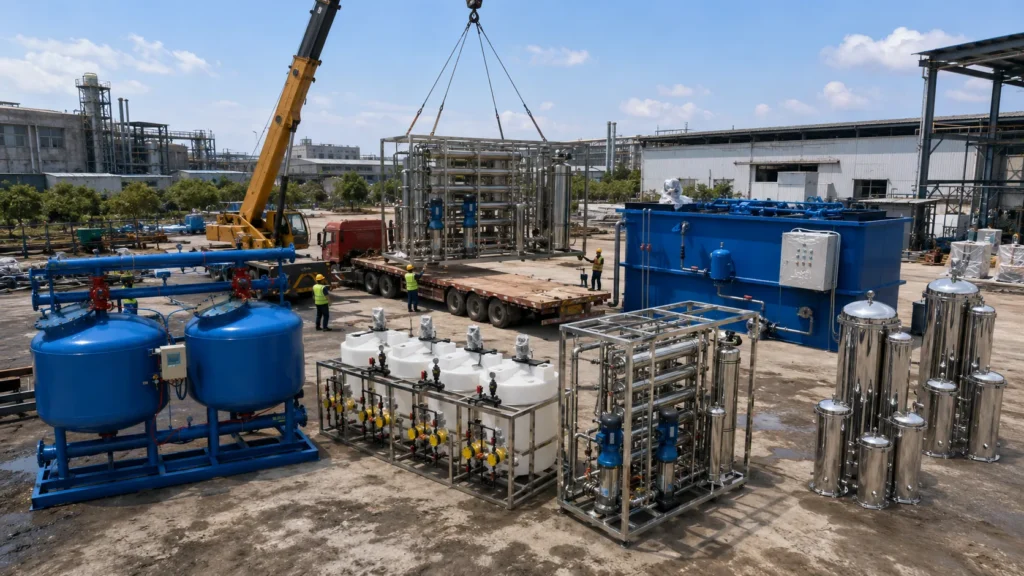
Choosing wastewater treatment equipment for EPC contractors is more than a spec line—it’s a project risk decision that shapes commissioning schedules, site integration, and long-term compliance. The wrong selection leads to field overruns, retrofitting costs, and a mismatch between treatment capacity and actual demand.
WCT provides a complete product range designed to eliminate these pain points. Our industrial wastewater equipment supports modular deployment, phased expansion, and efficient integration into complex project lifecycles.
The Modularity Mandate: Reducing EPC Project Risk
Modular equipment shifts site work to controlled factory fabrication, compressing project schedules and transferring significant construction risk away from the contractor.
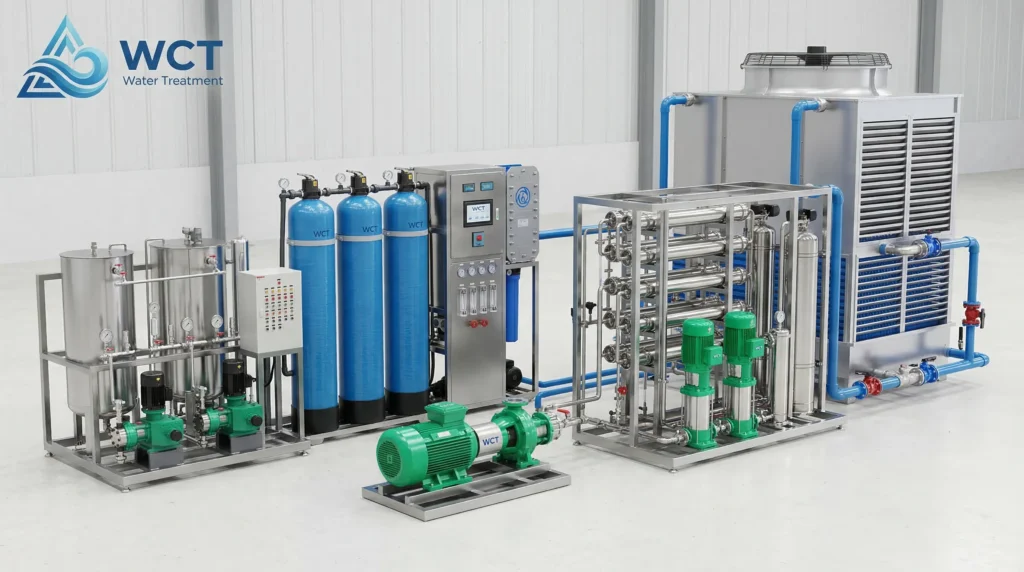
- Accelerated commissioning: Pre‑engineered skids and containerized systems arrive ready for quick interconnection, cutting weeks from on‑site assembly.
- Reduced site labor and civil costs: Factory‑built modules eliminate extensive field welding, concrete pours, and structural engineering, shrinking the contractor’s site footprint.
- Phased expansion without overbuilding: A modular water treatment system lets end clients add capacity incrementally, avoiding early overcapitalization.
- Higher quality control: Controlled shop conditions yield tighter tolerances and more consistent fabrication than remote field environments.
- Simplified logistics: Standardized skid dimensions and lifting points streamline transport and rigging, even in constrained urban or brownfield sites.
The result: predictable schedules and risk transfer that protect the critical path and regulatory milestones.
Technical Comparison: Technology Fit for EPC Project Specs
Choosing between SBR, MBR, and RO comes down to balancing effluent quality, footprint, and complexity. The table below offers a side-by-side look at how each technology fits typical EPC project requirements.
| Technology | Footprint | Effluent Quality (typical) | Integration Ease | EPC Suitability |
|---|---|---|---|---|
| SBR | Large; requires separate reactor basins | BOD <10 mg/L, TSS <10 mg/L (secondary standard) | Moderate; often needs field‑erected tanks and longer commissioning | Best for municipal projects with space available and forgiving biological operation |
| MBR | Compact; submerged membranes reduce footprint by up to 50% vs. SBR | BOD <5 mg/L, TSS <1 mg/L, high pathogen removal | High; pre‑assembled skid‑mounted units simplify mechanical and electrical tie‑ins | Ideal for high‑recovery industrial projects, tight footprints, and stringent discharge permits |
| RO | Compact; membrane racks fit within standard containers | TDS <50 mg/L (demineralized), removes dissolved solids | High for the RO unit itself; requires careful pretreatment integration | Critical for water reuse, ZLD goals, or polishing after biological treatment |
Performance ranges are typical; validate with project-specific feedwater data. Always request performance guarantees and factory acceptance test data from the supplier.
For high‑recovery industrial work where footprint and premium effluent are non‑negotiable, MBR often becomes the preferred starting point. For municipal growth where tolerance to load variations is key, SBR still offers a robust and forgiving platform.
Vendor Evaluation Criteria for Procurement Officers
Beyond hardware, an EPC‑friendly vendor should supply engineering documentation that reduces design hours and supply chain transparency that protects your budget. Use this checklist to qualify potential suppliers.
| Evaluation Category | What to Verify |
|---|---|
| Design Engineering Support | Availability of CAD/BIM models, P&IDs, structural drawings, and load lists for seamless handover to EPC design teams |
| Lead Time Transparency | Confirmed delivery schedules with detailed breakdown of long‑lead items (membranes, pumps, controls) and material sourcing plans |
| Compliance Documentation | Current ISO 9001, ASME, UL/CSA certifications, and regional environmental agency approvals relevant to the project jurisdiction |
| Field Commissioning Support | Scope of startup assistance, operator training, and remote troubleshooting; defined handover protocol with performance baselines |
| Performance Guarantees | Written process warranties with clearly defined liquidated damages or remedy clauses tied to effluent quality and uptime |
Confirm the vendor’s controls architecture supports open‑communication protocols needed by your SCADA integrator. Design for Integration saves costly site adaptations later.
Overcoming Procurement Bottlenecks: Lead Times and Documentation
Engage manufacturers early to lock in lead times and sync submittals with the master schedule. Waiting until detail design is complete can delay procurement by weeks.
Essential submittals to request during screening:
- P&IDs and process flow diagrams – reflecting the actual offered configuration.
- Electrical single‑line diagrams and load schedules – for switchgear sizing and site power planning.
- Performance guarantee datasheets – stated influent conditions, effluent targets, and operating ranges.
- Material certifications and weld procedures – especially for pressure components.
- Draft O&M manuals – early access helps training teams prepare startup plans.
To mitigate supply chain risks, order long‑lead components at award and favor pre‑engineered skids that reduce reliance on scattered field‑procured parts.
Compliance, Certification, and Performance Verification
Compliance must be verified before plant start‑up. Equipment must meet discharge permits, safety codes, and industry standards.
- Verify ASME pressure vessel codes for pressure‑containing skids.
- Confirm UL/CSA certifications for electrical panels and rotating equipment.
- Obtain local environmental agency acceptance letters for the technology.
- Request a detailed FAT plan—a documented factory test uncovers issues early and prevents commissioning delays.
FAT remains the single most effective risk‑reduction step: it converts performance promises into verified facts.
Optimizing High Recovery and Resource Reclamation Goals
Bids increasingly require 90%+ water recovery. Achieving that begins with equipment selection and process integration.
- Closed‑loop RO: Enables near‑zero liquid discharge (ZLD) by concentrating brine, supporting strict environmental permits.
- High‑recovery MBR + RO: Delivers a compact reuse solution—many factory wastewater systems now target 95%+ water reuse.
- Integrated process water treatment: An integrated water treatment for EPC approach converts recovered water into a process asset, strengthening Value Engineering.
- Resource reclamation: Beyond water, systems reclaim nutrients, heat, or solids, creating revenue streams that differentiate the bid.
When recovery rates are performance indicators, ensure manufacturer guarantees cover the full feed condition range, not just one design point.
Request a Technical Consultation for Your Project Bid
When you partner with a manufacturer that understands the full EPC lifecycle—from submittal to commissioning—you protect your schedule and margin. WCT delivers custom solutions with engineering data that feeds directly into your bid documents. Our team supplies RFQ‑ready specifications, performance guarantees, and lead‑time commitments early, whether you need one skid or a multi‑year phased program.
Contact our technical group to review your project’s treatment targets, footprint, and documentation requirements. We prepare submittal packages that align with EPC procurement workflows, so you can focus on winning and delivering the contract.
Frequently Asked Questions
What is the typical lead time for modular wastewater treatment units?
Lead times depend on customization depth, membrane or pump availability, and current fabrication queue. A standard pre‑engineered skid can ship in 12–16 weeks, while highly customized configurations may extend to 20 weeks or more. Early ordering of long‑lead components and selecting a supplier with established material agreements helps lock in reliable delivery windows.
How does modular equipment integrate with existing SCADA systems?
Most industrial‑grade skids include PLC controllers with open communication protocols (Modbus TCP, Ethernet/IP, or Profibus) that allow seamless integration into a plant‑wide SCADA architecture. During the design phase, the EPC integrator should receive a controls narrative and I/O list from the equipment vendor to map tag numbers and alarms before the skid arrives on site.
Can these systems be scaled after the initial EPC contract is complete?
Yes. Modular systems are built for phased expansion. Additional identical skids can be added in parallel to increase treatment capacity, or new process trains can be integrated with the existing controls backbone. This scalability allows the end client to grow treatment infrastructure in step with population growth or production increases, without expensive demolition or re‑engineering of the original installation.