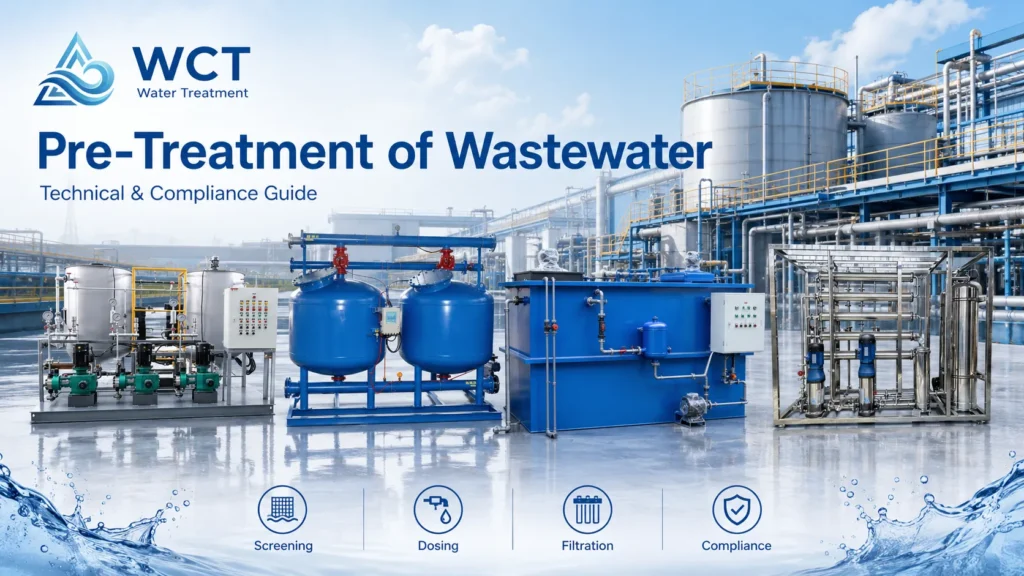
For industrial plants discharging to a municipal sewer, the line between a routine operational cost and a six-figure annual surcharge often runs straight through pre treatment of wastewater. We see facilities every year that pay surcharges for months before diagnosing a simple upstream deficiency—corrosive pH spikes that chewed through a clarifier mechanism, or a single Fats, Oils, and Grease (FOG) upset that triggered a permit violation and a consent order. Designing pre-treatment as an integrated production asset rather than an afterthought turns effluent from a liability into a controlled, predictable stream that protects both regulatory standing and downstream equipment.
In practice, the most cost-effective wastewater treatment plants are the ones that invest intelligently in the first 20 feet of the treatment train. That means matching mechanical screening, chemical conditioning, and solids handling to the specific waste profile—not just copying a neighbor’s system. If your facility is evaluating a new discharge permit, facing surcharge escalation, or planning a capacity expansion, this guide lays out the engineering logic we apply when specifying pre-treatment equipment for industrial customers.
The Role of Pre-Treatment of Wastewater in Industrial Operations
Engineering takeaway: Industrial wastewater pre-treatment is the process of removing high-load pollutants, corrosive substances, and debris from effluent streams at the source before discharging it into a municipal sewer system or downstream biological treatment stage. It serves as both a physical barrier and a chemical conditioning stage that prevents interference and pass-through at the publicly owned treatment works (POTW).
Protecting Publicly Owned Treatment Works (POTWs) and Municipal Infrastructure
Municipal treatment plants are designed for domestic-strength sewage with relatively predictable organic loads and hydraulic patterns. Industrial discharges that bypass proper pre-treatment introduce several failure modes: solids that settle and reduce sewer conveyance capacity, organic shock loads that deplete dissolved oxygen in biological reactors, and hazardous metals or solvents that can poison the microbial community or pass through the plant untreated. The U.S. EPA General Pretreatment Regulations specifically prohibit any discharge that causes interference—meaning it disrupts POTW operations—or pass-through, where a pollutant exits the POTW into receiving waters above permitted levels. For the industrial user, that translates into liability that can extend to third-party lawsuits and mandatory capital upgrades ordered by the control authority.
Minimizing Surcharges: Meeting Local Discharge Limits and Avoiding Penalties
Most POTWs impose surcharge fees when industrial users exceed local limits for Biochemical Oxygen Demand (BOD), Total Suspended Solids (TSS), or FOG. These fees are not flat penalties; they are calculated on concentration, volume, and a unit-cost factor that can make a high-strength discharge order-of-magnitude more expensive per thousand gallons than domestic sewage. A well-engineered pre-treatment system converts those surcharge dollars into capital amortization, chemical, and operations expense that typically yields a 12- to 36-month payback when surcharges are chronic. Beyond direct cost, meeting local limits avoids administrative enforcement actions that escalate from notices of violation to compliance schedules and permit revocation—each carrying its own disruption cost.
The Regulatory Landscape: EPA Standards and NPDES Pretreatment Permits
Compliance mandates that commercial facilities verify local limits and applicable categorical pretreatment standards established by state or federal regulators under the Clean Water Act’s National Pollutant Discharge Elimination System (NPDES) program. The obligation sits squarely on the industrial user, not the POTW, to characterize the discharge and maintain documented compliance.
Categorical Pretreatment Standards vs. Local Limits
Categorical standards are technology-based federal requirements that apply to specific industrial sectors—such as metal finishing, pharmaceutical manufacturing, or organic chemicals—and dictate maximum daily or monthly average concentrations for pollutants like cadmium, cyanide, or total toxic organics. Local limits, in contrast, are site-specific values derived by the POTW to protect its treatment processes, biosolids quality, and receiving water. They often regulate parameters not covered by categorical standards: BOD, TSS, FOG, and pH. For a facility falling under a categorical standard, the more stringent of the federal and local limit applies. Before designing any industrial wastewater equipment, we recommend obtaining the current sewer use ordinance and local limits table from the control authority and cross-referencing them against a recent composite sampling report. Don’t assume that a past permit condition still holds; many POTWs tighten local limits when they approach hydraulic or organic capacity.
National Pollutant Discharge Elimination System (NPDES) Compliance Requirements
Under the NPDES permit program, significant industrial users must meet specific discharge prohibitions, conduct periodic self-monitoring, report monitoring results via discharge monitoring reports (DMRs), and notify the POTW of any substantial process change that could alter effluent quality. Key compliance points we stress with clients:
- Self-monitoring frequency and parameters must match the permit’s exact language—quarterly for some, monthly for others, and sometimes continuous for pH.
- Sample collection must follow 40 CFR Part 136 procedures, typically involving 24-hour flow-proportioned composites rather than grab samples, to capture true daily loading.
- Process change notifications give the POTW the right to re-open the permit and impose new limits, so engineering modifications to the pre-treatment train should be reviewed for regulatory impact before commissioning.
Primary Mechanical Pre-Treatment of Wastewater: Physical Solid Separation
Mechanical pre-treatment prevents abrasive wear and physical blockages by screening out solids larger than 1 to 6 mm and separating dense materials like sand and metal fines before they reach pumps, chemical dosing systems, or biological reactors. This is the first line of defense, and its sizing directly affects every downstream unit’s reliability.
Coarse and Fine Screening Technologies
Bar screens—either manually cleaned or mechanically raked—remove large debris such as rags, wood, plastics, and production scrap. Coarse screens (typically 25–100 mm spacing) protect raw sewage pumps, while fine screens (1–6 mm) reduce solids loading on clarifiers and aeration basins. Decision rule: if flow exceeds 50,000 gallons per day or if the headworks is remote from the operator’s workstation, automatic self-cleaning screens pay for themselves in labor avoidance and consistent protection. For smaller plants with lower debris loads, a manual bar screen with a bypass basket may suffice, but surge flows during production shifts frequently overwhelm manual cleaning routines. Inline rotary drum screens and step screens offer finer removal at higher cost but reduce downstream BOD and TSS loads enough to lower chemical consumption—a trade-off we model early in the design process. A properly sized sand media filter for pre-treatment can further polish screened effluent when the downstream bioprocess requires very low solids loading.
Grit Removal Systems and Sedimentation Basins
Grit—sand, gravel, coffee grounds, eggshell fragments—settles rapidly and accumulates in aeration basins, digesters, and pipelines, causing mechanical wear and capacity loss. Aerated grit chambers, vortex grit separators, and horizontal-flow chambers each have operational trade-offs: vortex units offer a small footprint and low head loss but are sensitive to flow variation; horizontal chambers work well for larger plants but require more real estate. Following grit removal, primary sedimentation in a rectangular or circular clarifier reduces TSS and associated BOD by 50–70% on a well-operated system. For facilities with variable hydraulic loads, we often incorporate an inclined plate settler as a compact option that increases effective settling surface area without expanding the tank footprint.
FOG Management: Grease Traps and Dissolved Air Flotation (DAF) Systems
Fats, Oils, and Grease (FOG) present a unique challenge: they congeal, coat surfaces, and resist biological degradation, causing sewer blockages and mass transfer problems in aeration. Passive grease interceptors—essentially large-volume traps—work for relatively low-flow, low-temperature streams. For food and beverage processors or rendering operations with FOG concentrations exceeding 100–200 mg/L, we turn to Dissolved Air Flotation (DAF). In a DAF system, a pressurised recycle stream saturated with air releases micro-bubbles that attach to oil and grease droplets, floating them to the surface for mechanical skimming. The addition of chemical coagulants ahead of the DAF enhances separation by destabilizing emulsified oils. Buyer warning: undersizing a DAF based on average flow rather than peak hydraulic loading leads to carry-over of floatables into the next stage, which directly fouls downstream membrane systems.
Chemical Pre-Treatment Methods: pH Neutralization and Conditioning
Chemical pre-treatment neutralizes highly acidic or alkaline waste streams to a stable pH range—typically 6.0 to 9.0 for municipal discharge—and destabilizes suspended colloidal solids to accelerate settling. It is the engineering bridge between raw industrial chemistry and biological compatibility.
Automated Multi-Stage pH Neutralization Systems
Automated neutralization involves two or more stirred reactor tanks with pH probes controlling dosing pumps that inject concentrated acid (e.g., sulfuric) or base (caustic soda). A single-stage tank works for steady-state flows with low buffering capacity, but most industrial effluents—especially CIP washes or batch dumps—exhibit wide pH swings. A two-stage system with coarse and trim control keeps effluent within the 6.0–9.0 SU window even under shock loads. What to verify: the control system’s response time and the probe’s resistance to fouling or scaling in your particular chemistry. For waste streams containing dissolved metals, pH adjustment also precipitates metal hydroxides, making the neutralization stage a combined treatment step for heavy metals compliance.
Coagulation and Flocculation Chemical Dynamics
Coagulation uses inorganic metal salts—alum, ferric chloride, or polyaluminum chloride—to compress the electrical double layer around colloidal particles, neutralizing surface charges and allowing particles to agglomerate. Then flocculation introduces long-chain organic polymers that bridge micro-flocs into larger, fast-settling macro-flocs. The interplay between rapid mixing (for coagulant dispersion) and slow mixing (for floc growth) is critical; too much shear breaks flocs, while too little slows aggregation. We see many plants over-dose coagulant in an attempt to improve settling, not realizing they are simply shifting to a different charge destabilization regime that wastes chemical and increases sludge volume. Jar testing with the actual waste stream determines the right coagulant type, dose, and pH operating window—alum, for instance, works best between pH 5.5 and 6.5. For consistent results, a chemical dosing in pre-treatment system must include proportional flow pacing and periodic flush cycles to prevent line plugging.
Dewatering Systems: Handling Pre-Treatment Sludge and Residuals
Industrial facilities use sludge dewatering to separate water from treated solid residuals, generating a high-density “dry cake” that dramatically reduces hazardous and non-hazardous waste disposal costs. The water fraction—often in the range of 95–99% before dewatering—represents directly hauled weight, so reducing it by even a few percentage points cuts hauling invoices sharply.
Comparing Belt Presses, Centrifuges, and Chamber Filter Presses
| Technology | Typical Cake Dryness (% Solids) | Best For | OpEx Consideration |
|---|---|---|---|
| Belt Filter Press | 15–22% | High-flow, low-solids streams; continuous operation | High wash-water consumption; polymer conditioning critical |
| Decanter Centrifuge | 18–25% | Mixed sludge; oily or fibrous solids; small footprint | High energy and maintenance cost; requires skilled operator |
| Chamber Filter Press | 25–40% | Low-volume, high-solids; metal hydroxide sludges | Batch operation; labor-intensive plate shifting; lowest cake moisture |
Cake solids values are representative ranges; actual performance depends on sludge type, conditioning chemicals, and operating pressure. Buyers should verify with pilot-scale testing on their specific waste stream.
Maximizing Dry Cake Solids and Minimizing Hauling Costs
A dewatering filter press achieves the driest cake, often exceeding 30% solids, which is crucial if sludge is classified as hazardous and disposal costs run $300–$1,000 per ton. The trade-off is batch cycle time: a press may take 2–4 hours to complete a cycle, requiring multiple plates or a buffer storage tank upstream. For continuous throughput applications, a decanter centrifuge avoids the batch constraint but produces a wetter cake and demands more attention to polymer dosage. Our process design work weighs these trade-offs against the projected TSS loading from the upstream chemical-physical stage. If the pretreatment stage of wastewater generates high metal hydroxide sludge, the filter press delivers the most robust compliance for leachable metals in the cake, satisfying land disposal restrictions.
Operational Downstream Impacts: Protecting Secondary and Biological Systems
Inadequate upstream pre-treatment directly causes catastrophic membrane fouling and biological washouts, which can increase plant operating costs by 30–50% within a single quarter. The dividing line between stable operation and chronic failure often sits not in the bioreactor, but 50 feet upstream in the pre-treatment stage.
Preventing Membrane Fouling in Membrane Bioreactors (MBRs)
An MBR pre-treatment requirement is strict: fine screening to 1–2 mm is mandatory to prevent hair, lint, and plastic fragments from accumulating on membrane fibers. Silica, grit, and unsettled solids abrade membrane surfaces and reduce hydraulic flux. More commonly, we see plants that have adequate screening but still foul membranes because of FOG or polymer carryover from upstream DAF or flocculation units. Free oil coats membrane pores and requires aggressive chemical cleaning to restore permeability. Operating rule: maintain the silt density index (SDI) of the MBR feed below 3 and the oil & grease concentration under 10 mg/L to keep chemical cleaning intervals within the OEM’s warranty window.
Maintaining Biomass Health in Activated Sludge Basins
Biological nutrient removal depends on a healthy mixed-liquor biomass, and biomass health is directly tied to the consistency of the pre-treated wastewater fed to the aeration basin. Rapid pH swings—common when a pre-treatment neutralization system fails—kill nitrifying bacteria and can take weeks to recover. Toxic shock loads of heavy metals or solvents, if not captured upstream, can wipe out the activated sludge and require a complete reseed. A practical safeguard: monitor daily BOD/COD ratio and effluent TSS from the primary clarifier. A stable ratio (typically 0.4–0.6 for domestic sewage; lower for industrial streams) indicates consistent organic load; a sudden drop signals inert solids or recalcitrant compounds reaching the biology.
Technology Matrix: Selecting Pre-Treatment Strategies by Waste Stream Profile
Engineering teams should select a wastewater pre-treatment configuration by prioritizing the specific physical, chemical, and biological profile of their influent stream. The table below maps common industrial profiles to the most effective process combination, balancing CapEx and OpEx for each scenario.
Low-Solids Acidic Wash (Manufacturing and CIP Effluent)
Typical of clean-in-place (CIP) systems in dairy, pharmaceutical, and beverage plants, this stream features low TSS, high temperature, and pH extremes. The key is a two-stage neutralization system with corrosion-resistant tank linings and mixing, followed by flow equalization to dampen thermal and concentration spikes before discharge. Because solids are minimal, mechanical pre-treatment may be limited to a fine screen to catch occasional debris. Decision rule: if the stream contains emulsified FOG from cleaning agents, add a small DAF ahead of neutralization to avoid downstream pass-through.
High-TSS/High-BOD Organic Streams (Food and Beverage Processing)
These streams—meat processing, brewery, vegetable wash—deliver heavy solids and BOD loads that can exceed 10,000 mg/L. The logical sequence is bar screen, grit removal, primary clarifier for pre-treatment, and often a DAF for FOG polishing. Chemical coagulation and flocculation ahead of the clarifier improve TSS and BOD removal by 60–80%, reducing the load on any secondary treatment or municipal surcharge. The capital cost is higher than chemical treatment alone, but the operating savings in reduced surcharges and sludge handling typically produce a rapid return.
Heavy Metal and Toxic Effluent (Plating, Chemical Production)
This profile demands segregated waste streams to prevent interference between metal precipitation chemistries. Typically, pH adjustment precipitates metals as hydroxides, which are then settled in a lamella clarifier and dewatered in a filter press. Cyanide destruction and hexavalent chromium reduction require dedicated reaction tanks with ORP control. Buyer warning: combining metal-bearing wastes with organic streams without careful evaluation can form chelated metal complexes that resist precipitation and violate discharge limits. For facilities blending oily and metal streams, an oil water separator for pre-treatment upstream of metal precipitation prevents media fouling and improves sludge quality.
| Stream Profile | Recommended Pre-Treatment Technology | Primary Contaminant Target | Relative CapEx vs. OpEx |
|---|---|---|---|
| Low-Solids Acidic Wash | Two-stage pH neutralization, fine screen | pH, temperature, dissolved solids | Low CapEx; moderate OpEx for chemicals |
| High-TSS/High-BOD Organic | Screen + DAF + Chemical Coagulation/Flocculation + Primary Clarification | TSS, BOD, FOG | Moderate CapEx; high OpEx offset by surcharge savings |
| Heavy Metal/Toxic Effluent | Segregated pH adjustment, precipitation, lamella clarification, filter press | Metals (Cu, Zn, Ni, Cr), TSS | High CapEx; OpEx driven by sludge disposal and chemical cost |
Cost ratios are general indications; actual economics depend on flow, concentration, local utility rates, and disposal fees. A site-specific feasibility analysis is essential.
Design Your Wastewater Pre-Treatment System with Experienced Engineers
Building an efficient pre-treatment system requires far more than a one-size-fits-all equipment package. The difference between a system that runs reliably for a decade and one that generates constant compliance headaches is rooted in three disciplines: detailed waste characterization, data-driven pilot testing, and mechanical design that matches the actual production schedule and chemistry. We routinely start with a multi-day composite sampling campaign across all production shifts, then use that data to run treatability studies that pin down the optimal coagulant, flocculant polymer, and settling parameters long before selecting vessel dimensions.
If you are reviewing your discharge permit, evaluating surcharge reduction opportunities, or planning a plant expansion, consider walking through the following preparation steps before any equipment specification:
- Compile average and peak hourly hydraulic flow rates with weekly and seasonal variation notes—missed peak flows are a leading cause of clarifier and DAF carry-over.
- Map all chemical streams to source, including CIP cycles, batch dumps, and stormwater contributions that may be combined in the sewer.
- Obtain the current local POTW discharge limits and surcharge rate schedule—not the schedule from three years ago.
- Secure at least two 24-hour flow-proportioned composite samples analyzed for BOD, TSS, FOG, pH, metals, and any site-specific parameters listed in your permit.
When you’re ready to move from concept to engineering, our team can analyze the composite data, review local POTW requirements, and draft a preliminary process flow with projected chemical consumption and sludge production. We take that through to a full pre-treatment system design that integrates with your existing floor plan and utilities, ensuring the commissioning stays on schedule. For operations targeting closed-loop performance, we also evaluate how pre-treatment for water recycling can turn treated effluent into a reuse-quality stream, further shrinking your water footprint and discharge volume.
Frequently Asked Questions
What is the main difference between municipal and industrial wastewater pre-treatment?
Municipal pre-treatment focuses on protecting downstream biological treatment from large debris and grit, while industrial pre-treatment neutralizes chemical pollutants, removes specific toxic metals, and reduces extreme BOD/TSS/FOG loads to achieve legal compliance before public discharge.
How does pH adjustment affect chemical coagulant efficiency?
Coagulants have optimal pH operating windows—alum operates best between 5.5 and 6.5—and deviating from these ranges prevents proper charge neutralization, leading to incomplete solids settlement and excessive chemical waste.
What is a POTW surcharge fee and how is it calculated?
Municipalities charge surcharge fees when industrial discharges exceed baseline limits of BOD, TSS, or FOG. The fee is calculated as the wastewater volume times the concentration exceeding the limit times a regional unit-cost factor—making high-strength streams quickly expensive.
Why are automatic bar screens preferred over manual screens in modern plants?
Manual screens require constant labor, risk overflowing during surge flows, and create operator safety hazards around moving water. Automatic self-cleaning screens provide continuous debris removal, lower head loss, and consistent protection of downstream pumps.
Can pre-treatment processes recover valuable raw materials from wastewater?
Yes, processes like dissolved air flotation or fine filtration can reclaim fats, starches, or metallic particles that can be reused in manufacturing or sold as industrial feedstocks, further improving the economics of the pre treatment of wastewater.