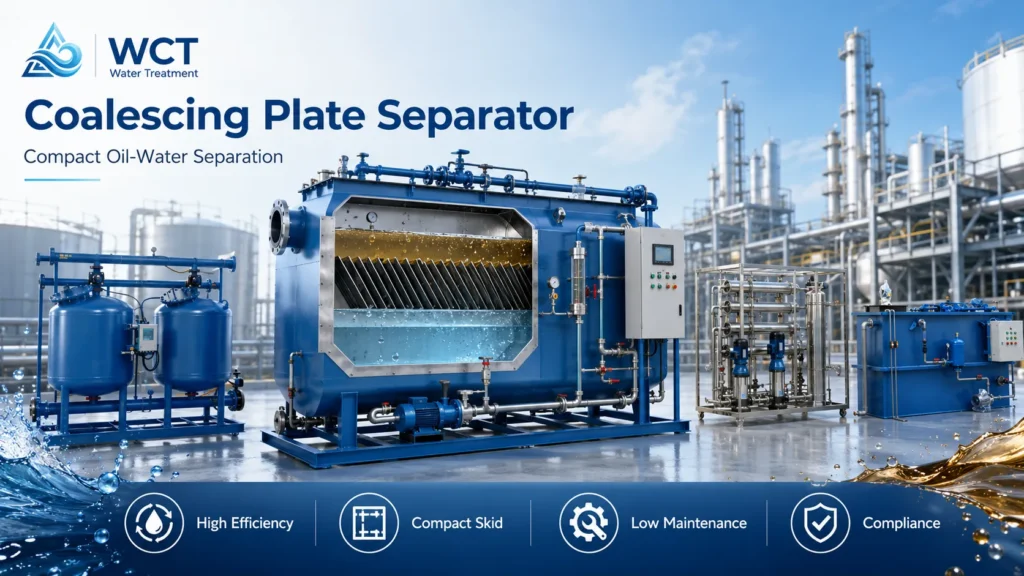
When a plant’s oil-water separator can’t hit the 10 ppm permit limit, the bottleneck is often simple: droplet rise distance. A coalescing plate separator reduces that distance to millimeters, turning a minutes-long separation into seconds.
We design these systems for facilities that can’t afford downtime, consumable filter media costs, or regulatory risk. If your current separator runs on open-tank gravity alone, you’re leaving separation efficiency on the table. The right plate pack geometry, material, and spacing change everything.
Below, we break down how to specify, size, and maintain a coalescing plate separator so you can make an informed procurement decision and avoid the operational traps we see most often.
What is a Coalescing Plate Separator and How Does It Optimize Oil-Water Separation?
A coalescing plate separator is a gravity-reliant oil-water separation device that uses tightly spaced parallel plates to shorten the vertical distance free oil droplets must travel before they contact a solid surface, coalesce, and separate from the water. The plate pack turns a sluggish, minutes-long rise into a rapid, seconds-long event.
The Physics of Coalescence: Stokes’ Law and Oil Rise Velocity
Every gravity separator follows Stokes’ law at its core. The rise velocity of a free oil droplet depends on the square of its diameter, the density difference between oil and water, and the fluid viscosity. But the single easiest variable to manipulate in an engineered system is the vertical rise distance (h).
- v = (g * d² * Δρ) / (18 * μ)
- v = rise velocity of the droplet
- g = gravitational acceleration
- d = droplet diameter
- Δρ = density difference between oil and water
- μ = dynamic viscosity of water
A traditional open-tank separator may require a droplet to rise several feet. By inserting plates with only 10–25 mm of vertical spacing, we slash the required rise distance by a factor of 100 or more. That directly translates to a much smaller required tank volume for the same design flow rate. The plates also provide a large surface area that turns random droplet collisions into deliberate coalescence events, growing small droplets into larger ones that rise faster and exit the water phase more predictably.
This physics is why plate pack separators routinely achieve removal efficiencies for free, non-emulsified oil droplets down to 20 microns under properly controlled laminar conditions.
Key Mechanical Components of a Coalescing Plate Pack
The plate pack itself is a removable, modular assembly built around individual corrugated or flat plates stacked vertically with controlled, adjustable gaps. Spacing is typically set anywhere from 6 mm to 40 mm depending on the solids load, oil viscosity, and the facility’s target separation performance. Wider gaps reduce fouling risk when solids are present; narrower gaps intensify coalescing action for cleaner process streams.
The pack is housed inside a rigid frame—often stainless steel or thick polypropylene—and positioned inside a tank that provides a stilling zone for flow distribution. This design operates on the same principle as an inclined plate settler but is purpose-optimized for oil-water separation. Adjustable weirs and oil collection troughs at the top of the tank ensure the separated oil is continuously skimmed, while settled solids drop into a lower sludge hopper.
How Coalescing Plate Separators Work: A Step-by-Step Mechanical Process
The system functions through a continuous three-stage phase-separation process. It uses strictly laminar flow to separate free oil and settleable solids from wastewater without chemical consumables, moving from high-energy turbulent influent to polished, low-oil effluent in a single pass.
Inlet Flow Distribution and Gravity Pre-Separation
Raw wastewater pre-treatment stream first enters a dedicated inlet chamber. In this zone, a diffuser or baffle arrangement dissipates turbulent energy so the flow transitions from pipe turbulence toward plug-flow conditions. Gross solids that are too heavy to remain in suspension settle immediately into the sludge collection cone. Simultaneously, large, free oil droplets—anything roughly 150 microns and above—rise directly to the surface within seconds.
We often size this pre-separation zone to handle the first 10–20% of the oil load before the water even reaches the plate pack. That significantly reduces the solids loading on the plates and extends maintenance intervals.
Laminar Flow, Droplet Coalescence, and Effluent Discharge
After pre-separation, the water enters the plate pack under strict laminar flow conditions. We typically design for a Reynolds number below 500 within the plate channels—well under the 2000 threshold where turbulence begins. Inside the narrow spaces, free oil droplets travel only a few millimeters before hitting the underside of an upper plate. Once a droplet contacts the plate surface, it attaches, and successive droplets merge with it until the buoyant force overcomes surface tension and the enlarged oil globule slides upward along the corrugated pathway.
Oil that reaches the top of the plate pack collects under a top oil dome and spills over an adjustable weir into a dedicated oil collection compartment. Clean water exits from the opposite end of the plate pack near the tank bottom, via a submerged outlet weir, preventing any floating oil from short-circuiting the separation zone.
A clear water treatment process diagram helps new operators visualize this three-zone movement: inlet pre-separation → plate pack coalescence → clean water discharge. Once the flow path is understood, troubleshooting performance problems becomes far more systematic.
Key Engineering Designs: Comparing Corrugated, Flat, and V-Plate Configurations
Selecting the right plate geometry—whether corrugated, flat, or V-plate—directly dictates the separator’s resistance to fouling and its ability to capture droplets smaller than 20 microns. The wrong choice for your solids load or oil viscosity can halve a system’s effective capacity within weeks.
Corrugated Plate Interceptors (CPI) and Cross-Flow Dynamics
The corrugated plate interceptor (CPI) is the most widely adopted design in heavy industrial applications for good reason. The wavy, sinusoidal plate profile creates parallel troughs that simultaneously guide rising oil upward along one angled surface and descending solids downward along the opposite surface. This cross-flow design essentially gives each phase its own exit lane: oil moves up and inboard toward collection troughs, while solids slide down and outward toward the sludge hopper. That physical separation of flow paths minimizes re-entrainment and makes CPIs far more tolerant of moderate solids loads than flat plates.
CPI packs are also inherently stronger because the corrugated shape adds structural stiffness without increasing plate thickness. For refineries and petrochemical plants dealing with variable, high-temperature oily wastewater, that extra mechanical robustness matters.
Flat Plate and V-Plate Geometries with Adjustable Spacing
Flat plates offer maximum simplicity and are the easiest to clean manually. Their performance, however, depends almost entirely on precise spacing and absolute laminar flow. Even a slight hydraulic imbalance can create dead zones where no coalescence occurs. V-plate designs address one specific weakness: sediment clearance. The inverted-V geometry lets solids slide down the steep-angled wings into collection troughs at the bottom of each V, reducing sludge buildup between plates.
Both flat and V-plate designs allow plant managers to modify plate spacing by swapping spacer rods or adjusting the frame. This adjustability is a major advantage when a facility’s influent characteristics change seasonally—for example, when a stormwater treatment system shifts from handling low-flow winter runoff to high-flow, high-solids summer storm surges. We frequently specify adjustable-gap flat plates in municipal stormwater applications for exactly that reason.
| Plate Type | Primary Advantage | Key Limitation | Best Application Fit |
|---|---|---|---|
| Corrugated / CPI | Self-clearing oil and solids pathways; robust structure | Higher manufacturing cost; spacing is not field-adjustable | Refineries, fuel terminals, heavy industry with moderate solids |
| Flat Plate | Simple, cleanable, lowest fabrication cost | Sensitive to flow imbalances; poor solids handling without wider gaps | Low-solids process water; adjustable-gap municipal applications |
| V-Plate | Excellent sediment shedding; resists plugging | Reduced effective coalescing area per plate compared to CPI | High-solids wash bays, mining run-off, construction dewatering |
Note: Performance data above reflects typical field observations and manufacturer design guidance. Buyers should request specific efficiency curves from suppliers for their target droplet size range.
Major Operational Challenges: Managing Solids, Fouling, and Maintenance
Active fouling mitigation is the primary operational challenge in coalescing plate separator systems. High solids loadings can choke narrow plate gaps within a single shift, causing water channeling that bypasses the entire coalescing zone. The design choices you make upfront—plate angle, spacing, and surface finish—directly determine whether your operators spend an hour a month on cleaning or an entire shift every week.
Mitigating Solids Accumulation and Media Fouling
When total suspended solids (TSS) exceed about 150–200 mg/L in a typical CPI unit, the risk of plate bridging rises sharply. Solids that don’t slide downward fast enough accumulate on plate surfaces, reducing the open cross-section for flow. The result? Local velocities increase, laminar flow breaks down, and the separator’s effective droplet cutoff size rises from a target of 20 microns to 60 microns or worse.
We deploy several design-based countermeasures:
- Steep plate angles (45–60 degrees) — promote solids slough-off under gravity, especially for V-plate packs.
- Smooth, low-friction plate surfaces — polished polypropylene or coated stainless steel reduces adhesion.
- Pre-separation chamber volume sizing — capturing the heaviest solids ahead of the plate pack.
- Upstream sand filtration or a dissolved air flotation stage for streams with chronic solids issues.
In-Place Maintenance Protocols vs. Media Replacement
Permanent coalescing media—whether corrugated polypropylene, PVC, or 316 stainless steel—is designed for decades of service, not periodic replacement. Cleaning frequency, not media lifespan, is the real cost driver. In low-fouling municipal stormwater applications, an annual inspection and rinse may suffice. In heavy petrochemical service, monthly or even weekly cleanings are common.
We classify cleaning protocols into two tiers:
- In-place flushing — High-flow water or hot-water rinsing through access ports without removing the pack. Effective for light oil coatings and loose solids.
- Pull-and-clean maintenance — Lifting the plate pack out for pressure washing or chemical soak. Required when heavy waxes, paraffins, or polymerized oil films bond to plate surfaces.
Decision rule: If operators can complete cleaning in-place in under 30 minutes, stick with a permanent plate pack. If cleaning requires pulling the pack and takes multiple shifts, investigate upstream solids reduction or wider plate spacing before considering a switch to consumable media.
Key B2B Applications: Environmental Compliance and Industrial Wastewater
Coalescing plate separators are critical environmental compliance tools for industries managing high-volume, oily process water. They reliably reduce free oil concentrations to well below the 15 ppm mark—and under ideal conditions, below 10 ppm—so that downstream polishing steps are not overloaded ahead of final discharge.
Heavy Industrial Processing: Refineries, Petrochemicals, and Marine
In oily wastewater treatment at refineries and petrochemical plants, the separator must handle process condensates, tank-bottom draws, and surface runoff all mixed together. Plate packs here typically see oil loads from 500 to 5,000 mg/L, along with occasional slugs of heavy solids. We often specify stainless steel construction and CPI geometry to handle the thermal cycling and moderate solids exposure. For produced water treatment in upstream oil and gas operations, a coalescing plate separator is frequently the first stage of wastewater treatment process, protecting downstream polishing filters from free oil breakthrough.
Marine applications, including shipyard bilge water treatment and offshore oil-water separation, impose additional constraints: space is extremely tight, and system weight matters. In those scenarios, we lean toward compact CPI packs with fiberglass-reinforced plastic (FRP) tanks to meet weight limits without sacrificing corrosion resistance.
Surface Runoff Management: Stormwater Facilities and Wash Bays
Stormwater treatment presents the opposite challenge: highly variable, surge-driven flow rates and low average oil concentrations, punctuated by first-flush spikes where oil concentrations can exceed 100 mg/L in minutes. Coalescing plate separators with generously sized pre-separation chambers and adjustable weirs handle these hydraulic swings far better than simple oil-water gravity tanks. Equipment wash bays and truck terminals represent a middle ground, with steady but moderate oil loading, where a flat plate or V-plate pack with wider spacing often provides the best balance of performance and low maintenance.
Sizing and Material Selection: Specifying the Right System for Your Facility
System sizing isn’t merely flow-rate math. The design flow rate must be paired with the specific gravity and temperature of the wastewater, because fluid viscosity directly impacts droplet rise velocity. A separator sized for 50°F water will underperform at 80°F if the colder, more viscous water wasn’t factored in, while a system sized for summer conditions may be oversized in winter. Both scenarios cost money.
Sizing Calculations: Flow Rate, Temperature, and Specific Gravity
We recommend verifying five input parameters before committing to a plate pack specification:
- Peak design flow rate (gpm or m³/h) — not average, but the highest sustained flow the separator must handle.
- Minimum operating temperature — colder water raises viscosity, which slows droplet rise and increases required plate area.
- Oil specific gravity — lighter oils (API > 30) separate faster; heavier, denser oils require more residence time.
- Target effluent oil concentration (e.g., < 10 ppm, < 15 ppm) — drives the droplet cutoff size assumption.
- Incoming TSS — influences plate gap selection and pre-separation volume.
Engineering takeaway: Warm, light oil (e.g., diesel at 80°F, SG 0.82) can require half the plate area of cold, heavy crude at 50°F. Always run sizing calculations at the worst-case (coldest) design temperature to avoid a system that can’t meet permit limits during winter months.
Material Selection: Stainless Steel, Fiberglass, and Engineered Plastics
Material choice comes down to three factors: temperature, chemical exposure, and weight. The table below captures the most common options we evaluate for new installations.
| Material | Max Continuous Temp | Key Resistance | Best-Fit Application |
|---|---|---|---|
| 304 / 316 Stainless Steel | Up to 1,400°F (beyond any practical water service) | Corrosion, thermal cycling, solvents | Refineries, steam condensate, high-temp process streams |
| Fiberglass (FRP) | Around 200°F depending on resin | Saltwater, acids, alkalis; light weight | Offshore platforms, marine bilge systems |
| PVC | 140°F | Most acids and alkalis; low cost | Municipal, general industrial below 140°F |
| Polypropylene | 180°F | Broad chemical compatibility; lighter than steel | Plating, chemical wash, moderate-temperature process water |
If operating temperatures exceed 140°F, then stainless steel or polypropylene must be specified over standard PVC. That single rule avoids a common procurement mistake we see in hot process water applications where PVC plates warp, soften, or collapse, causing total plate pack failure.
Coalescing Plate Separator Technical Comparison and Procurement Framework
A sound procurement strategy balances upfront capital expenditure with lifetime operating cost, focused specifically on whether the plate media is permanent or consumable. Systems with permanent, cleanable plates carry higher initial cost but eliminate recurring replacement media expenses. For a facility planning a 15-year operational life, the breakeven point often arrives in year three or four.
Total Cost of Ownership (TCO) Analysis: Permanent vs. Consumable Media
Consumable coalescing media—typically oleophilic mesh packs or replaceable cartridge elements—can look attractive on day one because the separator shell is cheap. But every media change introduces direct material cost, labor hours, and production downtime. In high-load applications where media must be swapped every three months, a $5,000 upfront savings can disappear entirely within the first year of operation. Permanent plate packs, whether polypropylene, PVC, or stainless steel, eliminate that recurring consumable line item entirely. The plate pack itself will last 10–20 years with proper cleaning.
Buyer warning: Request a 10-year TCO breakdown from any supplier who recommends consumable media. If they cannot provide one, assume the lifetime cost is higher than their initial quote suggests.
Pre-Purchase Technical Verification and Supplier Checklist
Before finalizing a purchase order, we recommend obtaining specific performance and design documentation for the exact plate pack configuration proposed. The following checklist covers the items that separate a well-engineered system from one that will underperform under real-world conditions:
- Experimental or CFD-validated droplet removal efficiency curves for the target droplet size range (20–60 microns).
- Certified hydraulic flow testing data showing residence time distribution and absence of short-circuiting paths.
- Structural load ratings for the plate pack frame, especially for offshore or seismic installations.
- Chemical compatibility statement for plate material against the specific solvents, acids, and base fluids present in the waste stream.
- Plate gap adjustability range and the exact adjustment mechanism (fixed spacer rods, modular slots, etc.).
- Documented cleaning procedure and estimated time for in-place flushing vs. full pack removal.
Partner with Wastewater Experts to Optimize Your Oil-Water Separation
Choosing the correct coalescing plate separator requires detailed engineering reviews of your unique wastewater chemistry and flow dynamics. Off-the-shelf sizing tables get you close; a process-specific evaluation locks in the plate geometry, gap spacing, and materials that will actually work for your operation.
We work alongside process engineers and facility managers to review stream compositions, daily flow profiles, and regulatory targets before recommending equipment. As a supplier and manufacturer of a full range of industrial wastewater equipment, we understand how the separator fits into the broader treatment train, not as an isolated component.
Before initiating a supplier conversation, have this data ready:
- Peak daily flow rate (gpm or m³/h) and typical minimum operating temperature.
- Oil specific gravity and estimated oil concentration range.
- Target effluent ppm limit per your discharge permit.
- Incoming total suspended solids (TSS) and any known chemical contaminants.
With that information, we can size and spec a system that balances separation performance, maintenance frequency, and total cost of ownership.
Frequently Asked Questions
What is the minimum droplet size a coalescing plate separator can remove?
Most commercial coalescing plate systems are designed to remove free, non-emulsified oil droplets down to 20 microns, though high-efficiency designs can sometimes capture droplets as small as 10–15 microns under ideal laminar flow conditions and with clean plates.
Can a coalescing plate separator break chemical emulsions?
No. These systems rely strictly on physical separation—gravity and surface coalescence. Chemically or mechanically emulsified oils require upstream chemical flocculation or emulsion-breaking agents; the plate separator alone cannot resolve stable emulsions.
What is the typical lifetime of permanent coalescing plate media?
Permanent media made from stainless steel, polypropylene, or PVC can last 10 to 20+ years when cleaned according to the manufacturer’s protocol. Unlike consumable oleophilic packs, there is no periodic replacement cycle.
How does total suspended solids (TSS) affect system performance?
High TSS concentrations foul plate surfaces and plug narrow gaps, causing channeling that bypasses the coalescing zone. Severe solids loads require either wider plate spacing, upstream sand filtration, or a dedicated pre-separation chamber to protect the plate pack.
How often do coalescing plates need to be cleaned?
Cleaning intervals for a coalescing plate separator depend entirely on the solid and oil loading of the influent. High-fouling industrial environments may require monthly cleanings, while low-demand stormwater installations often need only an annual inspection and rinse.