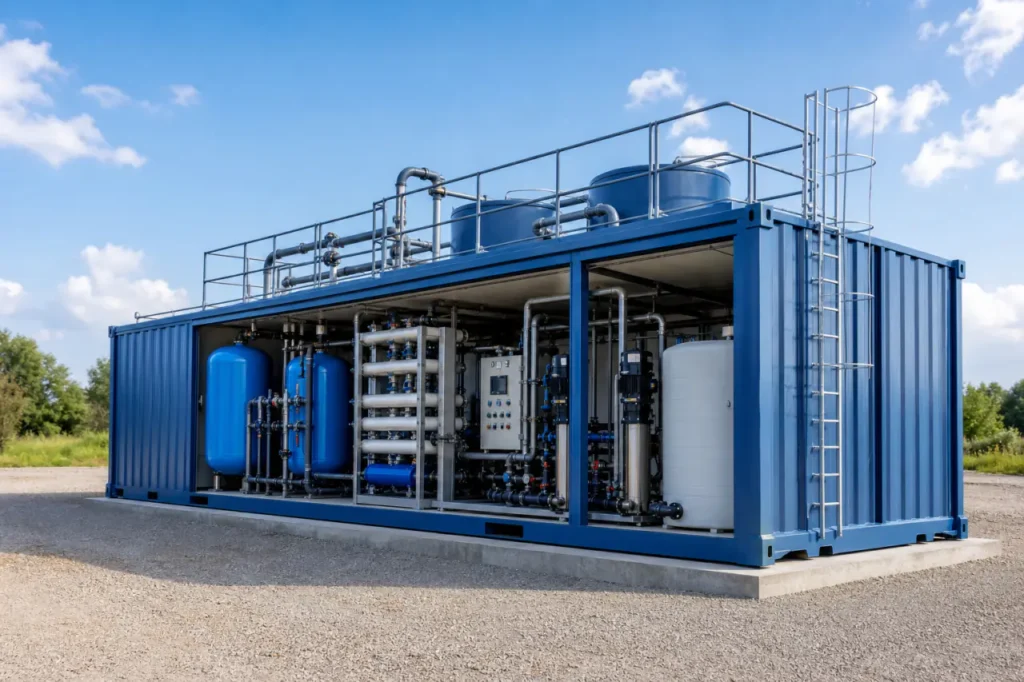
A prefabricated water treatment plant resolves the two pressures that traditional concrete infrastructure handles poorly: time and cost certainty.
When an industrial facility loses its discharge permit window or a small municipality faces a consent decree, waiting 18-24 months for a site-built plant is not an option.
Prefabrication shifts construction, assembly, and wet testing to a factory floor-delivering a complete, tested treatment system that arrives on-site ready for connection, cutting deployment time to weeks while removing weather delays and on-site rework from the critical path.
What is a Prefabricated Water Treatment Plant?
It is a fully integrated treatment system designed, built, and performance-tested under controlled factory conditions before being shipped to the point of use.
Unlike traditional concrete structures that are poured, cured, and commissioned on-site, a prefabricated plant arrives as a self-contained unit-often referred to as a packaged wastewater treatment plant or a packaged water treatment plant.
The approach decouples treatment capacity from major civil construction, letting engineers add treatment in parallel with site preparation instead of after it.
The Concept of Modular and Packaged Systems
The terms “modular” and “packaged” overlap but serve different engineering priorities. A modular system is built from standardized process blocks that can be combined to reach a target flow rate.
A packaged system is a pre-engineered unit that bundles multiple treatment stages-screening, biological treatment, clarification, disinfection-into a single structural envelope.
Both rely on factory assembly, but modularity offers easier phased expansion while packaged units excel as rapid, one-step capacity solutions.
Factory-Built Quality Control vs. On-Site Construction
Moving the build indoors removes the variables that drive cost overruns in field construction.
Welds, electrical panels, and pipe spools are fabricated on jigs under QA/QC protocols, not in a trench during a rain delay.
Every system is wet-tested before it leaves the plant, so the commissioning team is verifying site connections, not troubleshooting manufacturing defects.
For the specifying engineer, this means a repeatable, documented process rather than relying on the variable skill of each local crew.
Core Advantages: Prefabricated vs. Traditional Concrete Built-in-Place Plants
When comparing bids, the line-item that surprises most buyers is civil works-excavation, formwork, curing, and backfill can consume 30-50% of a traditional plant’s capital cost before a single process unit is installed.
Prefabricated systems reduce that load to a prepared slab and utility stubs. The table below summarizes the operational differences that drive total project economics.
| Parameter | Prefabricated Modular Systems | Traditional Site-Built Systems |
|---|---|---|
| Installation Time | 6-12 weeks (site-ready to online) | 12-24 months |
| Physical Footprint | Compact; 30-50% less space | Large; extensive tankage and structures |
| Capital Cost Profile | Front-loaded on equipment; low civil | Heavy civil, then equipment |
| On-Site Civil Work | Level slab, utility stub-ins | Deep excavation, cast-in-place concrete, curing |
| Expansion Flexibility | Add modules in parallel | Often requires new structures and hydraulic redesign |
| Relocation Capability | Relocatable; asset can be redeployed | Permanent; demolition cost if decommissioned |
This is why specifying engineers and utility directors increasingly look at the benefits of modular water systems when upgrade cycles shorten.
A module that meets today’s 250,000 GPD requirement can be joined by a second when the subdivision builds out, without disrupting existing treatment.
The budget becomes a series of smaller capital events rather than a single large bond issue that must be sized ten years ahead of actual demand.
Technical Form Factors: Skids, Containers, and Trailers
Prefabricated plants are packaged into specific structural formats depending on site access, permanence, and mobility requirements. Each format changes how the system integrates with existing infrastructure and how much site preparation is needed.
Skid-Mounted Treatment Packages
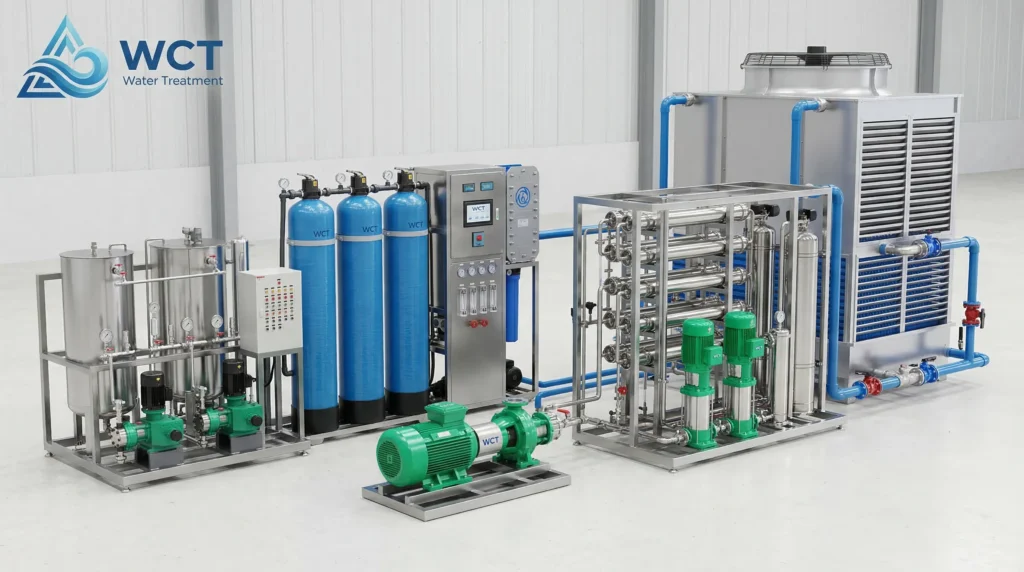
Skid-mounted water treatment systems are open-frame assemblies that bolt to a structural steel base. They are designed to be placed inside an existing building, under a canopy, or on a weather-protected pad.
This format works well when the site already has a process building with overhead crane access and a controlled environment.
- Typical applications: industrial process water, boiler feed polishing, small groundwater remediation treatment.
- Footprint can be customized to fit through a standard roll-up door or placed on a mezzanine.
- Modules are often linked with flexible hose connections, allowing rapid reconfiguration.
Containerized Treatment Plants
Containerized water treatment plants house the entire process train inside a modified ISO shipping container. The enclosure provides weather protection, security, and a standardized lifting frame for transport.
This is the preferred format for remote locations, temporary deployments, and applications where local labor for building erection is scarce.
- Standard 20-ft or 40-ft lengths; high-cube variants allow extra headroom for taller equipment.
- Integrated HVAC, lighting, and electrical distribution-arrive as a single plug-and-play unit.
- Rapid site preparation: a compacted gravel pad and a power drop are often sufficient.
Trailer-Mounted Mobile Water Services
Trailer-mounted plants are designed for the shortest possible deployment window. Everything is pre-piped, pre-wired, and mounted on a DOT-compliant chassis. They are towed to site, leveled, and connected within hours.
- Used primarily for emergency bypass, planned plant maintenance, construction dewatering, and pilot studies.
- Capacities typically range from 50,000 to 500,000 GPD, with multiple trailers linked for larger flows.
- Leasing is the dominant acquisition model, keeping the capital off the balance sheet.
Mapping Treatment Technologies to Modular Applications
The enclosure is only half the story. What matters is the treatment process inside it.
A containerized unit can house biological treatment, membrane filtration, or physical-chemical separation, depending on the contaminant profile and discharge objective. The table below maps common technologies to the modular applications they serve best.
| Technology | Primary Modular Application | Typical GPD Capacity Range | Target Contaminants |
|---|---|---|---|
| Membrane Bioreactor (MBR) | Municipal & high-quality industrial wastewater | 10,000-500,000 | BOD, TSS, nutrients, bacteria |
| Moving Bed Biofilm Reactor (MBBR) | High-strength industrial & decentralized municipal | 5,000-300,000 | BOD/COD, ammonia |
| Reverse Osmosis (RO) | Process water, boiler feed, reuse | 1,000-300,000 | TDS, dissolved salts, silica |
| Clarification / DAF | Pre-treatment, industrial solids/oil removal | 50,000-500,000 | TSS, FOG, heavy metals |
Biological and Membrane Integration
MBR and MBBR are particularly well-suited for modular footprints because they pack a high concentration of biomass into a small volume. An MBR skid replaces a conventional secondary clarifier with submerged ultrafiltration membranes, delivering tertiary-quality effluent from a single process tank.
When space is at a premium, these technologies reduce the number of unit operations that would otherwise need separate vessels and interconnecting pipe galleries.
Clarification and Filtration Packages
For applications where dissolved solids are not the primary concern but suspended solids, oil, or metals must drop below a permit limit, containerized RO systems may be overkill.
A packaged dissolved air flotation unit followed by multi-media filtration can be pre-plumbed on a single skid or inside a 20-ft container, targeting TSS and free-oil removal at flow rates up to 500,000 GPD.
These systems often serve as pre-treatment ahead of downstream membranes or discharge directly to surface water under an NPDES permit.
Key B2B Applications: When to Choose a Modular System
Modular systems fill gaps that centralized infrastructure leaves open. They work where the sewer doesn’t reach, where the timeline can’t wait, or where the budget can’t carry the civil burden of a concrete plant.
Remote Workforce Camps and Mining Operations
Camps hundreds of miles from municipal collection networks need self-contained treatment that arrives operational.
A turnkey water treatment solution that includes containerized treatment, a packaged lift station, and disinfection can be set on a prepared pad and started within a week.
Multiple modules handle fluctuating camp populations, and the entire system can be demobilized when the project ends.
- Rapid site readiness: no deep excavation; pad and power connection enough.
- Treatment tuned for high-strength domestic wastewater from camps and kitchens.
- Leasing models available for temporary exploration or construction phases.
Industrial Facilities and Power Plants
Process water demands change with production shifts. A plant expansion may need an additional 200,000 GPD of demineralized water, but tying into the central plant would require a shutdown and extensive pipe routing.
A skid-mounted RO unit adjacent to the new production line solves that friction point without interrupting existing operations.
- Proven in power generation for boiler feed and cooling tower blowdown treatment.
- Industrial wastewater compliance: MBBR or DAF modules treat batch dumps with variable loads.
- Modules can be moved if the production line relocates-preserving the asset.
Planned Plant Downtime and Emergency Overflows
Municipal plants scheduling a 6-week aeration basin repair cannot simply shut off the influent. Trailer-mounted or containerized temporary treatment keeps the plant in compliance and avoids sanitary sewer overflows. Once the permanent system is back online, the temporary units are demobilized.
- Avoids permit violations and associated fines during upgrades.
- Temporary systems sized for 50-100% of normal flow depending on storage capacity.
- Often leased for 3-12 months with an option to extend or purchase.
Decentralized Municipal Networks and Subdivisions
Instead of building a single large municipal water treatment system to serve an entire town, districts are placing smaller prefabricated plants at the load center.
This approach eliminates miles of interceptors and lift stations, reduces infiltration, and lets the utility add capacity incrementally as new phases are developed.
- Phased capital expenditure: buy the first module for Phase 1, add modules for Phase 2.
- Small footprint fits on a quarter-acre lot, avoiding costly land acquisition.
- Distributed model improves system resilience-one plant down does not mean zero treatment.
Evaluating Design Capacity and Flow Rates (GPD)
Prefabricated plants have long outgrown the notion of being “small-scale.” Modern systems can be linked in parallel to treat municipal-scale flows exceeding 2,000,000 GPD. The design challenge is not a capacity ceiling but managing hydraulic loading and redundancy across multiple modules.
Small-Scale Package Plants (Under 100,000 GPD)
At this scale, a single containerized or skid-mounted unit often handles all treatment. A typical package includes equalization, biological treatment, clarification, and tertiary filtration in one footprint.
Designers should verify diurnal flow peaks-if morning and evening demand spikes double the average flow, the equalization tank must be sized accordingly, or the biological process must handle the slug load.
Scaling Up: Decentralized Networks (Up to 2,000,000+ GPD)
When a community needs 500,000 GPD today but projects 1.2 million within a decade, four 300,000-GPD modules provide an N+1 layout that meets current demand with one unit in standby. As growth materializes, the utility commissions the standby module and orders the next.
Flow is split across trains at a common collection sump, and each module operates within its hydraulic sweet spot, avoiding the low-flow operational problems that plague oversized single-train plants.
Key verification points for parallel modules:
- Influent flow splitting must be balanced; passive weir boxes or actuated valves are common.
- Sludge handling must scale with the number of modules-centralized dewatering may be needed.
- Control logic should allow individual module isolation without disrupting the remaining trains.
Commercial Sourcing: Leasing vs. Purchasing Capital Equipment
How a prefabricated plant appears on the books matters as much as how it treats water. Organizations choose between a capital purchase for permanent installations and an operating lease for temporary needs or cash-flow preservation.
Capital Expenditure (Purchasing)
Outright purchase is the default when the plant is a long-term asset. The system is capitalized and depreciated over its 20-30-year service life. Buyers own the equipment and are responsible for installation, operation, and maintenance.
Purchasing makes sense for permanent municipal plants, industrial process water lines, and any site where the treatment need is not going away.
Operating Expenditure (Lease Plant Programs)
Leasing turns a large capital outlay into a predictable monthly payment. It is common for temporary construction-site treatment, emergency bypass during plant upgrades, and pilot studies where the technology is unproven for that specific waste stream.
Some suppliers offer lease-to-own structures that allow a municipality to operate the plant for 12-36 months and then apply a portion of the lease payments toward purchase.
This bridges the gap while a permanent plant is being designed or funded, without triggering a full capital appropriation process at the outset.
Frequently Asked Questions
How are prefabricated water treatment plants winterized for extreme climates?
Containerized and skid-mounted units integrate insulation, heat tracing on exposed piping, and electric or gas-fired unit heaters to keep the process space above the minimum required for biological activity.
Control panels monitor internal temperature and can trigger alarms if conditions approach freezing. In arctic applications, arctic-rated containers with double-wall insulation are specified.
Can a modular wastewater plant integrate with existing municipal SCADA networks?
Yes. Modern prefabricated plants ship with a localized PLC that communicates via standard industrial protocols such as Modbus TCP, Ethernet/IP, or Profinet.
The PLC data can be mapped to the central SCADA system using an existing fiber or cellular connection, allowing operators to monitor water quality, flow rates, and equipment status from the same HMI they use for the main plant.
Are prefabricated treatment plants considered permanent or temporary infrastructure?
Both. Trailer-mounted units are purpose-built for temporary deployment-weeks to months.
Skid-mounted and containerized systems anchored to a permanent concrete pad with hard-piped connections are designed for a 20-year service life and are treated as permanent assets.
Many are still operating after 25 years with routine membrane or media replacement.
What to Verify Before Requesting a System Design
An accurate feasibility study and a tight specification depend on having the right data upfront. Before reaching out to an application engineer or a wastewater treatment system integrator, compile the following:
- Daily flow rates: average and peak gallons per day (GPD); include seasonal variation if known.
- Influent characterization: BOD, TSS, ammonia, phosphorus, TDS, and any specific industrial contaminants (heavy metals, FOG, silica).
- Discharge permit limits: target effluent quality and any local reuse or surface-water discharge standards.
- Available site footprint and access: dimensions, weight-bearing capacity, door openings if indoors, and truck access for module delivery.
- Power and utilities: voltage, phase, available amperage, and whether a backup generator is required.
- Deployment timeline: required online date; any seasonal construction restrictions.
With these data points in hand, an application engineering team can produce a preliminary system footprint, a technology recommendation, and a budget estimate that aligns with actual site conditions-not assumptions.
For municipal buyers, this often becomes the basis for a feasibility study or a funding application before full design begins.