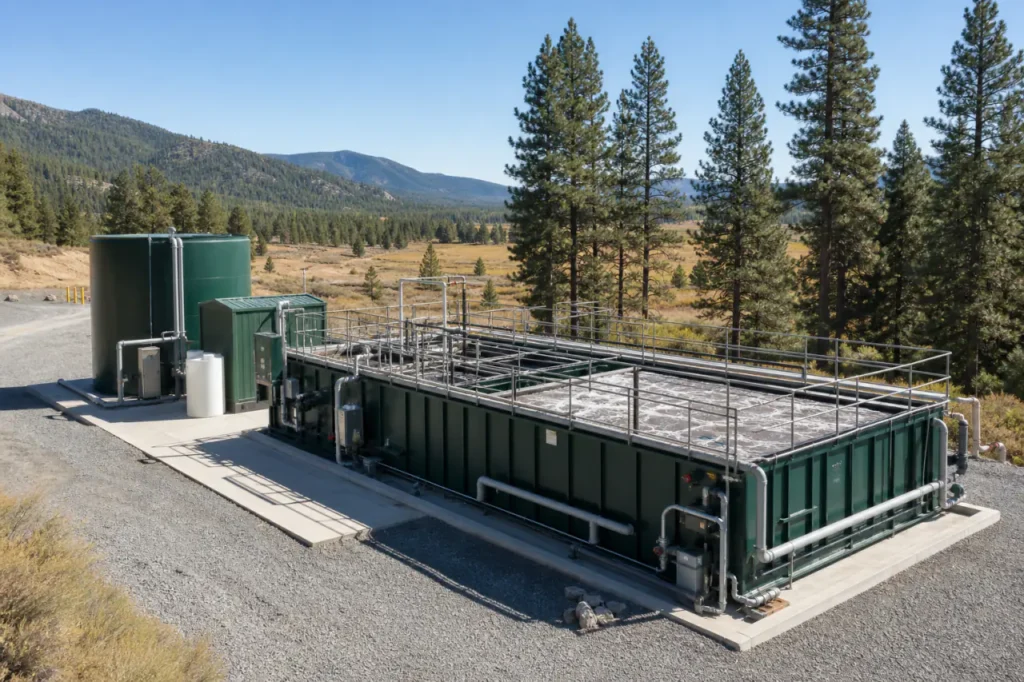
A packaged wastewater treatment plant is often the only practical path when a site needs commercial-grade biological treatment but has no sewer connection, limited construction windows, or a footprint that rules out a built-in-place facility. Before you compare specific models, confirm these three deployment anchors:
- Your estimated peak daily flow and expected load variation over the next 5-10 years.
- The effluent discharge limits you must meet-particularly BOD, TSS, and any nutrient parameters.
- Site access for delivery, crane placement, and whether the unit will sit on a concrete pad or a skid.
The Role of Decentralized, Modular Wastewater Systems
A pre-engineered treatment plant is a factory-built, skid-mounted or containerized system that arrives on site with the aerobic treatment process already integrated.
The core logic is to standardize the activated sludge biological treatment into a compact, repeatable module-one that can be dropped in, connected, and commissioned in weeks instead of months.
These systems are the backbone of a decentralized wastewater system strategy. Rather than piping raw sewage miles to a central plant, treatment happens at or near the point of generation. The effluent can then be discharged locally, reused for irrigation, or polished further.
This is not a residential septic tank.
Packaged plants operate at commercial, institutional, and municipal scales-typically anywhere from a few thousand gallons per day to over one million GPD-and they manage the full activated sludge loop: aeration, clarification, sludge return, and often biological nutrient removal.
Core Biological Treatment Technologies Compared
The treatment technology inside the package determines how much space the plant needs, how much operator attention it demands, and whether it will meet tighter effluent discharge standards. The following table maps the three most common configurations for B2B installations.
| Technology | Primary Mechanism | Best Use Case | Footprint / Maintenance |
|---|---|---|---|
| Extended Aeration | Long hydraulic retention time in a single aeration basin; low organic loading. | Stable-flow applications where simplicity is prized; small-to-medium communities, schools, remote resorts. | Larger basin footprint, but straightforward operation and low sludge yield. |
| Moving Bed Biofilm Reactor (MBBR) | Suspended plastic carriers in an aerated tank host attached-growth biomass. | Sites where footprint is tight or where incremental capacity adds are likely; industrial pretreatment, plant upgrades. | Compact reactor volume; needs screening to retain media. Moderate operator attention. |
| Sequencing Batch Reactor (SBR) | Fill-and-draw batch process; aeration and settling occur in the same tank in timed cycles. | Highly variable daily flows; applications needing strong biological nutrient removal in a single tank. | Small footprint but more complex controls and automation; requires reliable actuated valves. |
In practice, all three use an aerobic treatment process driven by the same biological principle-microorganisms consume organic matter in the presence of dissolved oxygen.
The difference is how the biomass is retained and how the system handles peak wet-weather surges.
If your permit demands biological nutrient removal, MBBR and SBR configurations can typically be configured with anoxic zones; extended aeration can also achieve nitrification but may need a separate anoxic stage for denitrification.
Sizing System Capacities: Gallons Per Day (GPD) Guidelines
System sizing is driven by reliable flow data, not just a rule-of-thumb per-bedroom number.
The starting point is the average daily flow (GPD), multiplied by a peaking factor that accounts for morning and evening spikes.
The table below gives a rough sizing envelope for common commercial and institutional applications.
| GPD Capacity Range | Approximate Population Equivalent | Typical Application Match |
|---|---|---|
| 3,000 – 15,000 GPD | 30-150 people | Small office park, roadside rest area, remote ranger station, small church. |
| 15,000 – 75,000 GPD | 150-750 people | Mid-size school, resort lodge, 50-100 room hotel, light industrial facility. |
| 75,000 – 250,000 GPD | 750-2,500 people | Large resort, 200-500 unit residential subdivision, commercial complex, work camp. |
| 250,000 – 1,000,000+ GPD | 2,500-10,000+ people | Large municipal expansion, institutional campus, multi-building industrial park. |
These ranges are a starting point, not a substitute for a formal flow estimate. A modular wastewater system approach helps here: you can install a base unit sized for near-term flow and add parallel trains later without replacing the original investment.
Typical Application Scenarios for Packaged Plants
Packaged plants show up wherever a concrete-and-pipe centralized plant is either too slow, too costly, or physically impossible. These four scenarios account for the bulk of commercial sewage treatment deployments we see.
Remote Work Camps and Mining Sites
Portable, skid-mounted units that can be moved when the job finishes. Leasing often makes sense here because the camp may only operate for 18-36 months. The system must be self-contained, with minimal operator intervention and rugged controls that tolerate temperature swings.
Resorts, Hotels, and Private Developments
Aesthetics matter: low-profile tanks, odour control, and quiet blowers. Treated effluent is frequently reused for landscape irrigation, so the plant must deliver consistent BOD and TSS removal plus disinfection. Extended aeration or MBBR are common choices for this category.
Municipal Plant Consolidation and Expansion
Towns use packaged plants as satellite facilities to relieve an overloaded main plant, avoiding massive interceptor sewer construction. The packaged unit can handle a portion of the flow right where the growth is happening, then integrate into the overall collection system.
Industrial Facilities
Either dedicated sanitary treatment for a large workforce separate from process water, or pretreatment ahead of discharge to a municipal sewer where surcharge fees are high.
The key is matching the right biology to the waste stream; an MBBR often fits because it can handle occasional organic shocks better than a pure suspended-growth system.
Procurement: Capital Purchasing vs. Plant Leasing
Because a packaged plant is a pre-fabricated asset, ownership isn’t the only option. This is one of the few wastewater treatment categories where leasing is genuinely common.
Purchase when the installation is permanent and you want long-term control: municipal infrastructure, a permanently occupied resort, a subdivision that will be in place for decades. Capital purchasing usually offers a lower total cost over the plant’s 20-plus-year life, especially when financing is available.
Lease when the need is temporary or cash-flow-sensitive: a 24-month construction camp, a bridge plant while a larger facility is being upgraded, or a developer who wants to shift treatment cost to an operating expense (OpEx) during the early build-out phase.
Leasing can also include maintenance and monitoring, reducing the operator burden on remote sites.
The decision often comes down to how you want to carry the asset on your books-CapEx versus OpEx-and whether the site’s flow will change significantly in five years.
Request a Custom Site Evaluation and Technical Quote
Selecting the right packaged wastewater treatment plant isn’t a browse-and-buy decision. It starts with your daily flow profile, the treatment limits you’re held to, and the site constraints you’re working around-including access, power availability, and discharge options.
Our applications engineering team works from your GPD estimates and site description to recommend a technology platform and a modular configuration that fits your project timeline.
Custom packaged wastewater treatment plants can be configured with the biological process, disinfection stage, and controls package your permit requires. Reach out with your flow data and location; we’ll help you build the spec.
Frequently Asked Questions
Are packaged wastewater treatment plants permanent or temporary?
They are designed to be permanent treatment solutions, but their skid-mounted or containerized construction means they can be relocated if needed.
Many facilities use them for decades; others move them to a new site when a temporary need ends. The choice depends on your operational plan.
How do decentralized systems differ from a centralized municipal plant?
A centralized plant treats sewage piped from a wide area; a decentralized wastewater system treats it near the source. The packaged unit skips the long collector network and is pre-engineered in a factory, not built from scratch on a concrete basin at the site.
Can a package plant be expanded if the community grows?
Yes. Most packaged systems are built on a modular frame. You can add parallel treatment trains-essentially another complete packaged unit running alongside the original-to double or triple capacity. The biological process stays the same, and the control system is updated to manage the additional flow.