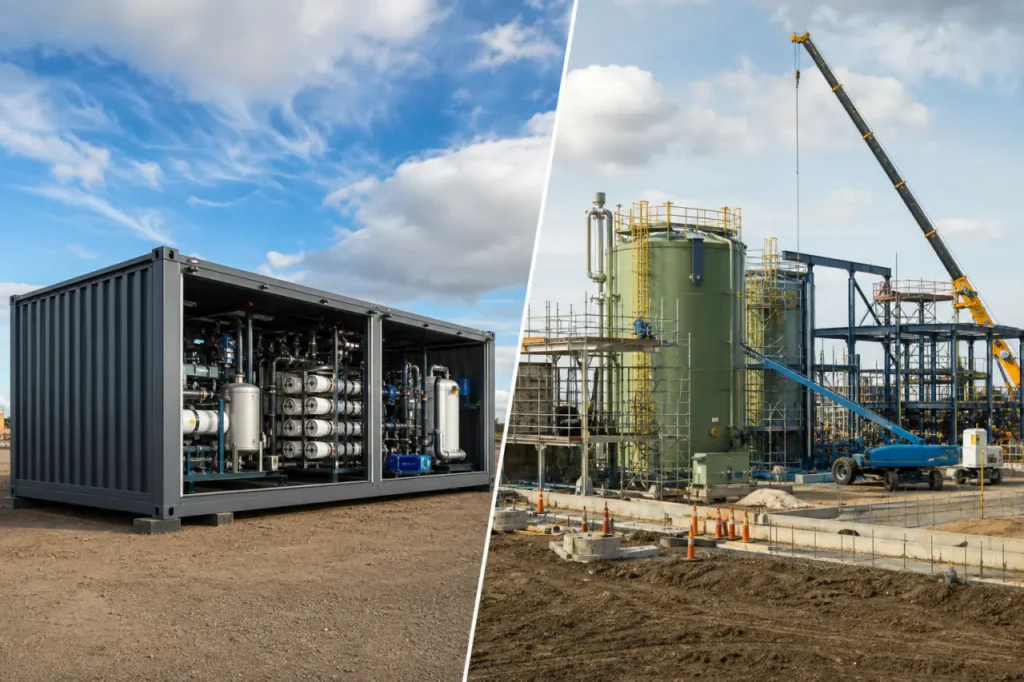
When a remote mining camp needs a reliable 500 m³/day water supply, building a traditional field-erected treatment facility rarely makes sense.
The permits, civil works, and on-site labor push critical timelines beyond what the project can absorb, and the budget can spiral before a single pump is installed.
Containerized treatment systems flip that equation. By housing proven water and wastewater processes inside standard ISO shipping containers, these plug-and-play units arrive pre-piped, pre-wired, and factory-tested, ready for rapid commissioning on a compact gravel pad or concrete slab.
Containerized Systems vs. Field-Erected Treatment Facilities
A mobile water treatment plant redefines project timelines.
The core advantage is moving construction from the project site to a controlled factory floor, which eliminates weather delays and reduces the amount of on-site skilled labor required.
This single shift changes almost every capital and operational metric.
| Parameter | Containerized System | Field-Erected Facility |
|---|---|---|
| Installation Speed | Weeks from delivery to commissioning; factory testing completed off-site | Months to years; sequential on-site construction, civil works, and commissioning |
| Capital Expenditure | Lower upfront spend; minimized civil and structural engineering costs | Higher initial investment; extensive concrete work, buildings, and site infrastructure |
| Physical Footprint | Compact; fits within 20- or 40-ft ISO container footprint | Large; requires separate process buildings, chemical storage, and office space |
| Weather Dependency | Minimal; container assembly inside factory; site work limited to pad and connections | High; rain, snow, and temperature extremes delay construction and concrete curing |
| Mobility/Relocation | Designed for transport; can be lifted, shipped, and recommissioned at a new location | Permanent structure; relocation is cost-prohibitive and rarely feasible |
This mobility makes containerized options particularly valuable for short-to-medium-term projects such as construction camps or life-of-mine operations, where the asset can be redeployed once a site closes.
For permanent installations, they serve as a fast-track alternative that avoids the permitting complexity of a new industrial building.
For facilities expecting future growth, modular water treatment systems let you add capacity incrementally without new civil works.
Key Industrial and Remote Applications
Containerized plants aren’t just smaller physical plants; they’re engineered for locations where conventional construction reaches its limits. The following use cases dominate demand.
- Remote Camps and Mining Operations – Man-camps and mine sites demand potable water and onsite wastewater treatment far from municipal infrastructure. A packaged wastewater treatment plant in a container handles decentralized flows without requiring permanent buildings.
- Emergency Response and Disaster Recovery – When municipal plants fail or natural disasters wipe out infrastructure, an emergency wastewater package or drinking water system can be trucked in and running within days.
- Industrial Process Water and Reuse – Factories that need supplemental treatment without a new building permit can place a containerized RO or filtration unit adjacent to the existing process line.
- Agricultural Irrigation – Decentralized brackish water desalination in skid-mounted treatment or container formats allows growers to use marginal water sources without laying extensive pipelines.
Standard Container Configurations: 20-Foot vs. 40-Foot Units
System capacity starts with the container footprint. While custom sizing exists, most industrial deployments use 20-foot or 40-foot high-cube ISO containers, maximizing internal height for equipment clearance.
| Specification | 20′ High-Cube | 40′ High-Cube |
|---|---|---|
| External Dimensions (L x W x H) | Approx. 6.06 x 2.44 x 2.90 m | Approx. 12.19 x 2.44 x 2.90 m |
| Est. Transport Weight (Dry) | 6,000-10,000 kg depending on equipment | 12,000-18,000 kg |
| Ideal Process Trains | Simple RO skids, media filtration, softeners, single-stage treatment | Multi-stage RO, MBR packages, full wastewater treatment trains with screening, biological treatment, and disinfection |
| General Flow Rate Limits | Up to ~250 m³/day for clean water RO; lower for wastewater | Up to ~1,000 m³/day for RO; 100-500 m³/day for MBR wastewater |
Both sizes feature insulated panels, corrosion-resistant flooring, and integrated HVAC to protect sensitive membranes and controls. In arctic or desert environments, these environmental controls are not optional – they’re what keep the plant online when ambient conditions would otherwise shut down a field-erected system.
Selecting the Right Treatment Process Train for Your Container
The container is the envelope; the real decision is the treatment process that fills it. Nearly any conventional or advanced water technology can be housed inside, provided the flow rate fits the footprint. Below are the most common process trains deployed in containerized form.
Reverse Osmosis (RO) and Desalination
Containerized reverse osmosis units combine pre-treatment (multimedia and cartridge filtration) with high-pressure membrane racks, all manifolded inside a single container.
They’re widely used for brackish water production, industrial process water, and even seawater desalination when two-pass RO and energy recovery devices are integrated.
A 40-ft container can comfortably deliver 500-1,000 m³/day of permeate, depending on feed salinity.
Membrane Bioreactor (MBR) for Wastewater
For sites that need high-quality effluent for reuse or tight discharge standards, a membrane bioreactor (MBR) package fits a 40-ft high-cube container.
Anoxic, aeration, and membrane zones are arranged sequentially, often with integrated coarse and fine bubble diffusion.
The result is a self-contained biological treatment plant that produces low-TSS, ultrafiltration-quality permeate ready for tertiary polishing or direct reuse.
Media Filtration and Ultrafiltration (UF)
When the goal is turbidity reduction, iron removal, or pre-treatment ahead of RO, a 20-ft container provides ample space for multimedia pressure vessels or hollow-fiber UF modules.
These systems often operate alongside a skid-mounted treatment unit if the site requires an even smaller footprint or rapid redeployment.
A centralized PLC panel with remote monitoring ties all unit processes into a single operator interface.
Site Preparation and Deployment Requirements
Even though the treatment system arrives pre-assembled, the receiving site must be ready. Neglecting these three areas turns a fast-track project into a slow, expensive site work exercise.
- Foundation – A level, reinforced concrete pad or compacted gravel platform capable of supporting the container’s operating weight. Drainage should slope away from the container doors.
- Utility Connections – Stub-ups for feed water, treated water, concentrate/waste streams, and electrical supply must be positioned within reach of the container’s external connection panel. Typically this means a single-point utility corridor on one side of the pad.
- Access and Lifting – A crane or heavy forklift must be able to offload the container from a flatbed truck and place it precisely on the pad. Verify overhead clearance and ground bearing capacity at the lift point before the container arrives.
Once set and connected, the plant can be commissioned in under two weeks, provided utility tie-ins are pressure-tested and the control panel has been pre-commissioned at the factory.
What to Verify Before Specifying a Mobile Water Plant
Every containerized system is sized around the feed water, not the site footprint alone. Before you request a quote, confirm these data points.
- Complete water analysis – pH, TDS, TSS, full ion profile (Ca, Mg, Na, Cl, SO₄, Fe, Mn, silica, etc.), plus any problematic contaminants like arsenic, boron, or high organics. RO membrane selection and pre-treatment requirements hinge entirely on this report.
- Flow requirements – Both peak daily flow and average daily flow. A container sized for average flow may trip offline during peak events, while one oversized for peak wastes energy.
- Effluent quality targets – Discharge permit limits or reuse standards. This determines whether single-pass RO is sufficient or if you need two-pass RO, MBR with disinfection, or additional polishing.
- Site constraints – Available space, proximity to the discharge point, and any height restrictions. If the container must sit beside an existing building, door swing and access clearance become critical.
Sending a complete raw water sample to a qualified lab is the single most valuable step in preventing costly mis-sizing and ensuring the container arrives with the right membrane array.
System Engineering and Custom Plant Design
Once you have the feed water data and site constraints, the conversation shifts to integrating the container into your overall operations.
At this stage, application engineers can provide a preliminary 3D CAD model of the container layout, a P&ID showing tie-in points, and a budget estimate that accounts for freight, commissioning, and startup support.
Because every site is different, specifying a custom containerized plant often means adjusting pipe routings, control logic, and safety interlocks to match your existing plant standards.
The goal is a true plug-and-play system, one whose only on-site requirement is connecting pre-marked utility flanges and switching on the main breaker.
To discuss a project-specific configuration, reach out to our application engineers with your water analysis and target capacity. We can provide a preliminary layout, budget estimate, and deployment schedule tailored to your site conditions.
Frequently Asked Questions
Can containerized treatment systems operate in freezing temperatures?
Yes. The containers are built with insulated wall panels and fitted with industrial-grade HVAC systems that provide heating and cooling. Heat trace is typically applied to exposed piping and sample lines, allowing continuous operation in temperatures well below -20°C.
How are the concentrate or sludge streams handled?
The container only houses the treatment process; waste streams must be managed externally. Brine from RO can be directed to an existing sewer, evaporation pond, or deep-well injection.
Wastewater sludge from an MBR is removed via sludge holding tank or a separate dewatering package located outside the container.
Can multiple containers be linked together for higher capacities?
Yes. Containers can operate in parallel to double or triple treatment capacity, or in series when a multi-step process train is needed-for example, a pre-treatment container feeding an RO container. This modular approach allows field expansion without new civil works or equipment foundations.