When a mine site’s discharge permit tightens from 2.0 mg/L to 0.1 mg/L for dissolved copper, the treatment gap becomes real. Mining wastewater treatment is not a single-technology fix. It is an engineered sequence of chemical, physical, and sometimes biological steps matched to an effluent chemistry that can swing from pH 2.5 to pH 10 in a single shift.
Three realities separate mining-influenced water from standard industrial effluent. First, extreme and variable acidity dissolves metals at concentrations rarely seen elsewhere. Second, high total dissolved solids (TDS) and sulfate loads push conventional systems past their solubility limits. Third, remote site constraints-power, chemical supply, operator availability-define what can actually run reliably.
Why Standard Effluent Systems Fail in Mining Environments
Municipal and light industrial treatment plants are designed for predictable, low-salinity streams. Mining wastewater breaks that assumption immediately. The failure mode is usually fast: media blinding, pH overshoot, or sludge that won’t dewater.
The Acid Mine Drainage (AMD) Challenge
AMD starts when sulfide minerals, primarily pyrite, are exposed to oxygen and water during excavation. The reaction produces sulfuric acid and free hydrogen ions that then dissolve heavy metals from surrounding rock. Once the reaction begins, it is self-sustaining and can persist for decades after closure.
Typical AMD chemistry ranges are not subtle:
- pH as low as 2.0-3.5, with acidity measured in thousands of mg/L CaCO₃ equivalent.
- Iron concentrations exceeding 500 mg/L, often accompanied by aluminum, manganese, zinc, and arsenic.
- Sulfate levels that can top 3,000 mg/L, well beyond most discharge thresholds.
A standard multimedia filter designed for neutral pH and low metals will clog within hours. The chemical demand alone, especially lime consumption during neutralization, often becomes the single largest operating cost on the water treatment line.
Fluctuating Effluent Volumes and Extreme Climates
Mine water flows are rarely steady, and seasonal snowmelt, monsoon rains, or pit dewatering campaigns can triple influent volumes overnight. Designing for peak flow creates oversized equipment that underperforms during dry-season low-flow periods. Temperature extremes and remote location add further complications.
- Coagulant kinetics slow dramatically in cold water, and biological systems can stall below 5°C.
- Remote sites limit chemical delivery frequency. A system needing weekly polymer deliveries fails if accessible only by ice road or during a short dry season.
Matching the Treatment Technology to the Contaminant Profile
Effective system design starts by categorizing the primary contaminants to establish a primary and secondary treatment train. Single-stage treatment rarely satisfies modern discharge permits for mining-influenced water.
| Contaminant Type | Primary Technology | Secondary / Polishing Technology |
|---|---|---|
| Heavy Metals (Fe, Cu, Zn, Ni, Pb) | Chemical Precipitation (Lime / Caustic) | Clarification + Sand Filtration or Ion Exchange |
| Sulfates (SO₄) | Chemical Precipitation (Barium / Ettringite) or SRB Bioreactors | Reverse Osmosis (RO) or Nanofiltration |
| Suspended Solids (TSS) | Coagulation / Flocculation + Clarification | Dissolved Air Flotation (DAF) or Media Filtration |
| Acidic pH (AMD/ARD) | Active Neutralization (Lime, NaOH, Limestone) | Passive Anoxic Limestone Drains |
| Cyanide / Selenium | Advanced Oxidation or Biological Reduction | Ferrihydrite Adsorption or RO |
This matrix is a starting point, not a final design. Real mine effluents contain multiple contaminant categories simultaneously. That’s why most compliant plants run a train of two to four technologies in series. The expensive mistake is specifying a membrane system without first solving the suspended solids loading upstream.
Conventional Treatment: Neutralization and Chemical Precipitation
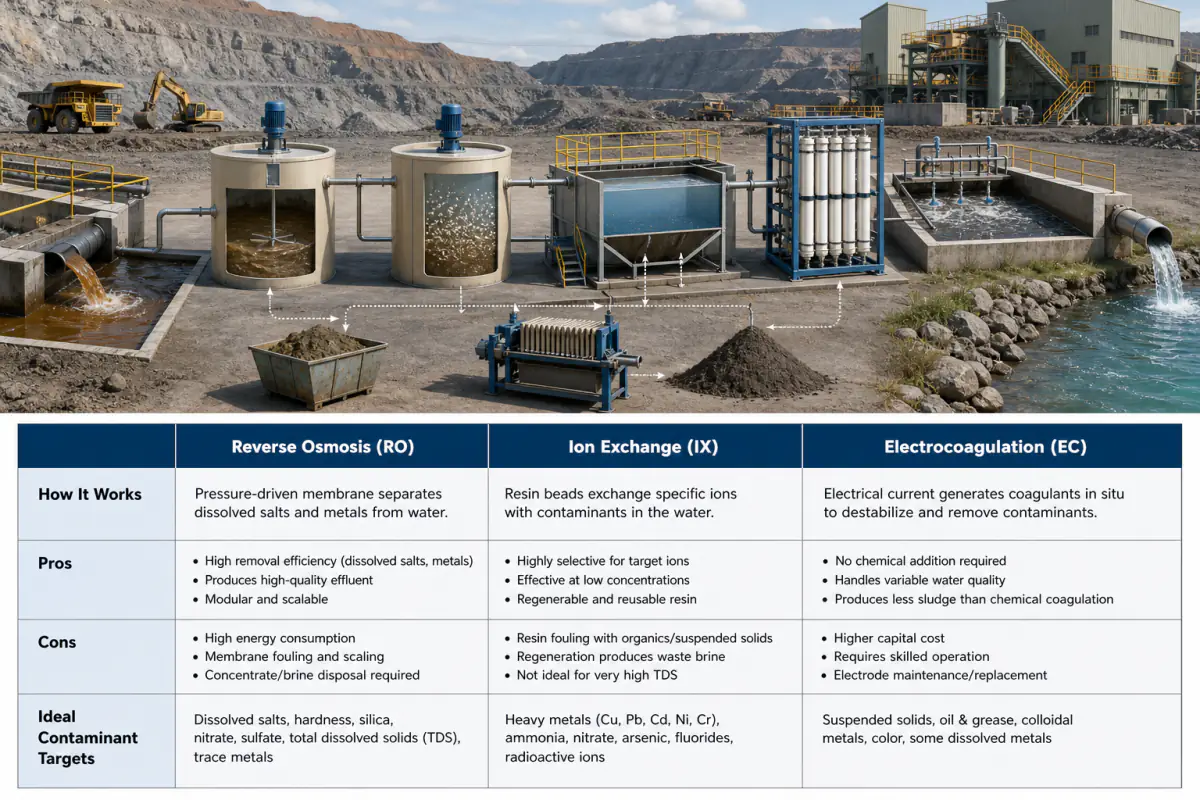
Chemical precipitation remains the most widely deployed method for neutralizing AMD and converting dissolved heavy metals into solid particles that can be settled and dewatered. It handles high flow rates and heavy metal loads that would overwhelm membrane or biological systems.
Active pH Adjustment Systems
The core reaction is straightforward: add an alkaline reagent to raise pH, forcing dissolved metals to form insoluble hydroxides. Lime (calcium hydroxide) is the standard choice because it is low-cost and provides both alkalinity and calcium for sulfate precipitation as gypsum.
Sodium hydroxide offers faster reaction kinetics and produces less sludge by volume but costs significantly more per tonne of acidity neutralized.
The operational trade-off is sludge volume. Lime neutralization of high-iron AMD can generate sludge at 5-10% of the total treated flow rate. That sludge must be thickened, dewatered, and disposed of, often in a tailings storage facility. Sludge handling becomes the dominant OPEX factor when acid loads are high.
Coagulation, Flocculation, and Clarification
Neutralization alone creates fine precipitates that settle slowly. Coagulants like ferric chloride or aluminum sulfate destabilize particle charges, while flocculant and coagulant dosing systems introduce long-chain polymers that bind microflocs into larger, fast-settling aggregates.
Once coagulated and flocculated, solids must be separated. Common equipment choices include:
- High-rate clarifiers for fast-settling metal hydroxides in active treatment plants.
- Dissolved air flotation (DAF) for light precipitates or when oil and grease from mobile equipment enter the water circuit.
- Gravity thickeners or tube settlers for tailings water with high-density solids.
The treated overflow from a well-tuned precipitation circuit can remove 95-99% of dissolved heavy metals. But achieving discharge limits below 0.1 mg/L for individual metals typically requires an advanced separation step downstream.
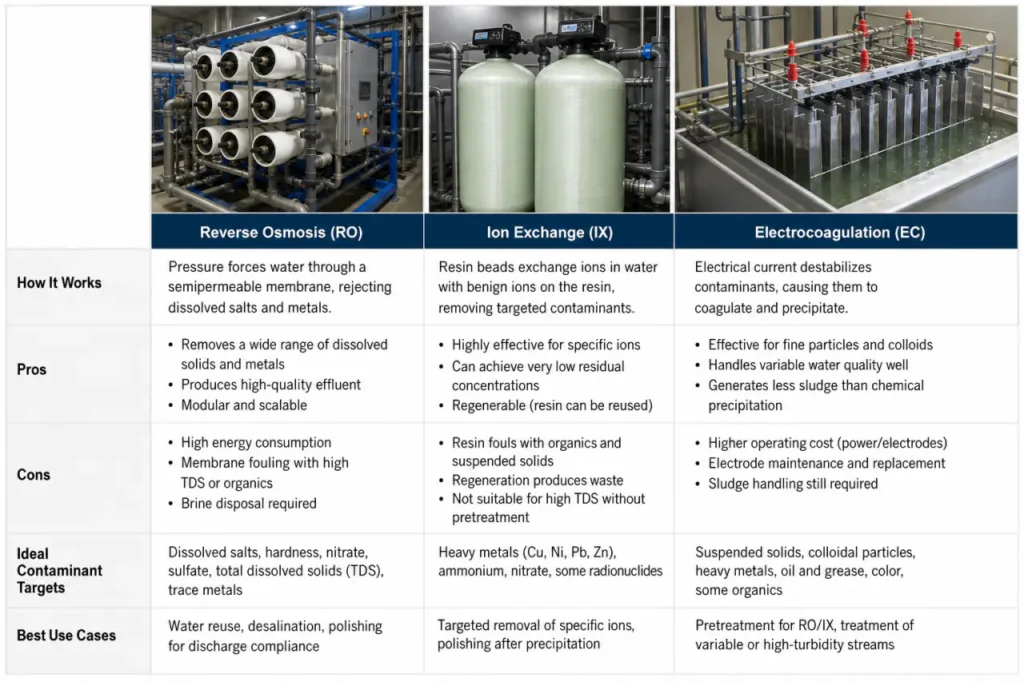
Advanced Separation: Membrane, Ion Exchange, and Electrocoagulation
When discharge limits are exceptionally tight or water reuse is required, conventional precipitation must be followed by advanced physical or electrochemical separation. These technologies increase CAPEX and complexity but deliver effluent quality that precipitation alone cannot reach.
| Technology | Ideal Contaminant Target | Key Advantages | Operational Limits / Cons |
|---|---|---|---|
| Reverse Osmosis (RO) | Dissolved salts, sulfates, metals, TDS | Highest effluent quality; enables direct reuse or ZLD feed | Requires extensive pre-treatment; membranes foul from silica, scaling, or TSS |
| Ion Exchange (IX) Resins | Specific dissolved metals (Cu, Zn, Ni); polishing | Selective removal; can recover metals from regenerant | Limited capacity in high-TDS streams; competitive ion interference |
| Electrocoagulation (EC) | Emulsified oils, heavy metals, TSS | Low chemical consumption; effective across wide pH range | Electrode passivation; conductivity-dependent; less proven at very high flow rates |
The table highlights why sequencing matters. An RO system cannot function as a standalone solution on raw mine water. The pre-treatment burden alone can double the system cost if it is not planned from the start.
Reverse Osmosis (RO) and Membrane Filtration
Reverse osmosis membrane treatment is the go-to technology when the target is near-zero discharge quality or sulfate compliance below 250 mg/L. Advanced membrane filtration for AMD rejects dissolved ions at the molecular level, producing a clean permeate stream suitable for reuse as process water or even potable supply after disinfection.
The limitation is the reject brine. A typical RO system recovers 70-85% of the feed as permeate. The remaining 15-30% becomes a concentrated brine containing all the rejected salts and metals. Disposing of that brine in inland mines often triggers the need for zero liquid discharge (ZLD) systems, which add thermal evaporation downstream.
Membrane fouling from silica, calcium sulfate, or residual iron is the most common operational failure. Proper pre-treatment with ultrafiltration, antiscalant dosing, and pH control is not optional. It is the difference between running membranes for three years and replacing them every six months.
Ion Exchange (IX) Resins
IX resins are best deployed as a polishing step, removing trace metals that survive precipitation at concentrations below 1 mg/L. Chelating resins can target specific metals like copper or nickel even in the presence of high background sodium or calcium. This selectivity makes IX valuable when metal recovery has economic potential.
The regenerant stream becomes a secondary waste that still needs treatment. In high-TDS mine water, the resin capacity gets consumed quickly by competing ions, and regeneration frequency drives operating costs. IX is rarely the primary treatment stage for high-strength AMD but excels as a guard bed before discharge or RO feed.
Electrocoagulation (EC)
EC applies a direct current through submerged electrodes, typically iron or aluminum, to generate coagulant species in situ. It simultaneously destabilizes suspended solids, breaks emulsions, and precipitates metals without the chemical storage footprint of conventional coagulation.
The technology handles wide pH swings and variable metal loads well. However, several operational factors limit its application:
- Electrode consumption and passivation require regular maintenance.
- Power availability at remote sites can constrain practicality.
- Fewer large-scale (>500 m³/day) mine water references compared to RO or IX.
Biological and Passive Treatment for Long-Term Compliance
Biological treatments offer low-OPEX, long-term solutions primarily used for post-closure site remediation or polishing specific contaminants like sulfate and selenium. These systems rely on naturally occurring microorganisms rather than continuous chemical inputs.
Sulfate-Reducing Bacteria (SRB) Bioreactors
SRBs thrive in anaerobic environments and use sulfate as a terminal electron acceptor, converting it to sulfide. The sulfide then reacts with dissolved metals to form highly insoluble metal sulfide precipitates. A single SRB bioreactor can simultaneously reduce sulfate concentrations and remove heavy metals in one process step.
The engineering limits fall into three categories:
- Carbon source cost: requires ethanol or lactate, adding ongoing operating expense.
- Sulfide toxicity: must be carefully managed to avoid gas-phase release.
- Temperature sensitivity: cold-water kinetics slow below 10°C, requiring larger reactor volumes or heating in cold climates.
Constructed Wetlands and Passive Permeable Barriers
These are the lowest-OPEX treatment options and are recognized in EPA guidance for mine site remediation. Constructed wetlands use plants, substrate, and microbial communities to neutralize acidity, remove metals, and filter solids passively over long retention times.
Passive permeable reactive barriers (PRBs) are installed in groundwater flow paths downstream of waste rock piles or tailings. They contain reactive media like limestone or zero-valent iron that neutralize acidity or immobilize metals as the contaminated groundwater passes through.
The trade-off is footprint. A passive wetland or PRB requires substantial land area and cannot handle the high flow rates or metal loads of active operations. They are best suited for closure-phase AMD where water volumes are moderate and time is on the operator’s side.
Moving Toward Zero Liquid Discharge (ZLD) and Resource Recovery
Regulatory trends in water-scarce mining regions, particularly Chile, Australia, and South Africa, are pushing operations toward complete water reuse. A ZLD wastewater treatment approach eliminates liquid discharge entirely, recovering both water and solid salts.
Evaporation and Crystallization Systems
Thermal evaporation becomes necessary when RO reject brine can no longer be discharged. Evaporators concentrate the brine further, and crystallizers produce a solid salt cake for disposal or potential reuse. These systems consume significant energy, typically 15-30 kWh per m³ of treated brine, and require robust materials to handle the corrosive, high-chloride environment.
The capital cost of a ZLD train is high, but in jurisdictions where discharge permits are effectively unavailable, ZLD becomes the only route to production expansion. Comparing ZLD with traditional treatment shows the economic crossover point shifts when water scarcity and regulatory risk are priced into the mine’s operating model.
Metal Recovery from Brine
The same RO reject brine or precipitation sludge that represents a disposal cost can also hold recoverable value. Copper, zinc, nickel, and increasingly lithium can be selectively recovered from mining brines using IX resins, solvent extraction, or selective precipitation.
Resource recovery does not usually pay for the entire treatment plant, but it can offset 10-30% of operating costs when the target metal is present at sufficient concentration.
System Specification: What to Verify Before Finalizing Design
Before requesting a system quote, site operators must prepare a comprehensive water characterization report and map utility constraints. The engineering quality of the final plant starts with the quality of the data provided upfront.
Water Characterization and Pilot Testing
A single grab sample is not enough. The water characterization report should include 24-hour composite sampling across multiple seasons. The minimum data set includes:
- Full metals scan including iron, aluminum, manganese, copper, zinc, nickel, lead, arsenic, and selenium.
- pH, acidity (mg/L CaCO₃), alkalinity, and oxidation-reduction potential (ORP).
- Total dissolved solids (TDS), total suspended solids (TSS), sulfate, chloride, and silica.
- Peak flow rate, average daily flow, and seasonal flow variability.
Pilot-scale testing on representative feed water is the only reliable way to validate chemical dosing rates, membrane flux, and sludge production before committing to full-scale equipment. A six-week pilot run can avoid a three-year operational problem.
CAPEX vs. OPEX Trade-offs
Lime-based precipitation has the lowest CAPEX but the highest sludge-handling OPEX. An RO plant with full pre-treatment has higher upfront cost but can reduce chemical consumption and sludge volume downstream. The cheapest system to build is rarely the cheapest to run over a ten-year mine life. Model these cost drivers alongside equipment pricing:
- Sludge handling and disposal costs across the entire mine life.
- Energy cost and power availability at the site.
- Chemical supply chain reliability and delivery intervals.
- Membrane or resin replacement frequency and cost.
An experienced wastewater treatment system integrator can provide a total cost-of-ownership comparison across competing treatment trains.
Regulatory Compliance and Future-Proofing
Design to the discharge limit that is likely to apply in five years, not the one that applies today. Effluent limits for sulfate, selenium, and conductivity are tightening across major mining jurisdictions. A plant sized only for current metals limits may need a complete retrofit when sulfate or TDS limits are introduced.
Sludge disposal pathways also face increasing scrutiny. Sludge dewatering in mining via filter press produces a stackable cake with lower transport costs and reduced leachate risk compared to wet sludge impoundment. Including a dewatering step in the initial design avoids costly downstream retrofits.
Engineering Consultation and Custom Mine Water Systems
No two mine effluents are identical. Off-the-shelf equipment rarely meets long-term discharge limits without custom engineering that accounts for local water chemistry, climate, and site logistics. The first step toward a reliable treatment plant is a treatability study on actual site water, not a generic design based on assumed influent quality.
When you are ready to move forward, our engineering team at WCT can provide mining effluent treatment solutions tailored to your site conditions. To begin, prepare the following for an initial review:
- A full water chemistry analysis covering at least two seasons of sampling.
- Influent flow data including daily average, peak, and seasonal projections.
- Current and anticipated discharge permit limits for all regulated parameters.
- Site utility information including available power, chemical storage capacity, and access constraints.
Mining wastewater treatment troubleshooting and system optimization are part of the long-term support we provide once the plant is commissioned. Reach out to discuss a treatability study or request an initial system design review based on your water characterization data.
Frequently Asked Questions
What is Acid Rock Drainage (ARD) vs. Acid Mine Drainage (AMD)?
Acid Rock Drainage (ARD) refers to the natural weathering process where sulfide-bearing rocks oxidize when exposed to air and water, producing acidic runoff. Acid Mine Drainage (AMD) is the same chemical process but accelerated by mining excavation, blasting, and increased surface area exposure. In practice, the terms are often used interchangeably, but ARD can occur without mining activity.
Why is alkalinity important in mining wastewater treatment?
Alkalinity acts as a pH buffer. In mining wastewater treatment, sufficient alkalinity is what keeps the pH stable after neutralization. If alkalinity runs low, the treated water can re-acidify downstream, causing precipitated metal hydroxides to re-dissolve. Maintaining an alkalinity residual of 30-50 mg/L CaCO₃ after treatment is a common operational target to prevent this post-treatment acidification.
Can reverse osmosis be used directly on mine water?
No. Raw mine water contains suspended solids, iron precipitates, silica, and scaling minerals that will foul or destroy reverse osmosis membranes within hours. RO requires substantial pre-treatment, typically including clarification, media filtration, antiscalant dosing, and often ultrafiltration, before the membrane stage can operate reliably. Skipping pre-treatment is the fastest way to destroy an RO membrane system.