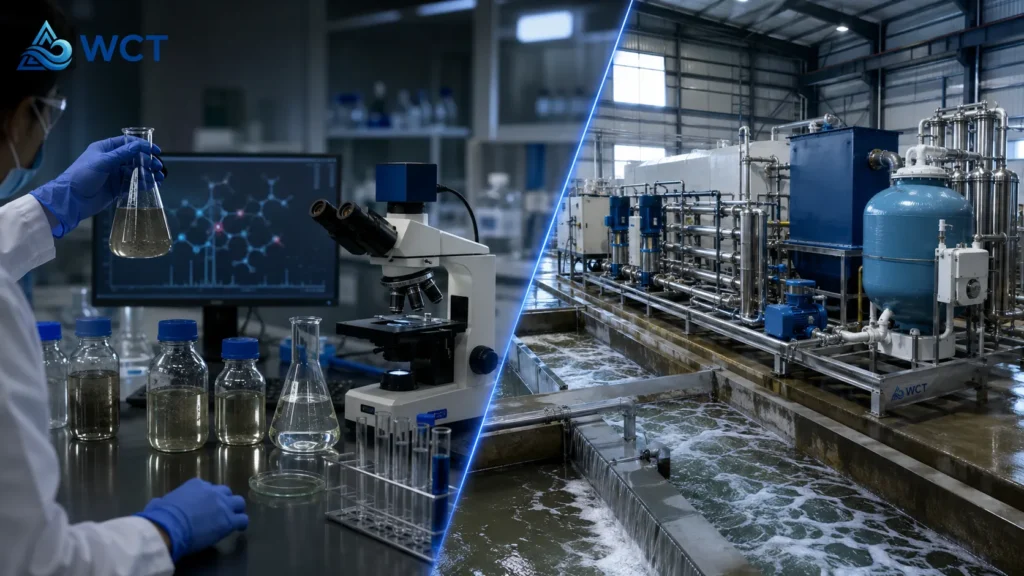
In the context of industrial and municipal systems, understanding what pcb means in wastewater treatment requires distinguishing between two vastly different scenarios: a legacy chemical pollutant regulated under the Toxic Substances Control Act, or a complex manufacturing effluent generated by modern electronics production. Your treatment strategy, compliance obligations, and industrial wastewater treatment equipment selection will change entirely depending on which one you are managing. This guide provides the technical framework for both pathways. The decision rule is simple: identify the source first, then choose the technology path.
The Dual Definition of PCB in Wastewater
PCB refers to either Polychlorinated Biphenyls—toxic organochlorine compounds banned decades ago—or Printed Circuit Boards—the backbone of electronics manufacturing whose fabrication generates a chemically aggressive waste stream. The table below clarifies which definition applies to your facility and why treatment methods diverge so sharply.
| Term | Chemical/Physical Nature | Primary Contaminants | Regulatory Driver | Common Treatment |
|---|---|---|---|---|
| Polychlorinated Biphenyls (chemical PCBs) | Hydrophobic organochlorine compounds; 209 congeners with varying chlorine content; persist in sediment and sludge | High-molecular-weight chlorinated hydrocarbons; often bound to particulates and biosolids | TSCA, 40 CFR Part 761; state water quality standards for legacy pollutants | Carbon adsorption, membrane filtration, enhanced sedimentation with sludge disposal controls |
| Printed Circuit Boards (manufacturing PCBs) | Composite laminate boards; wastewater generated during etching, plating, stripping, and rinsing | Copper, tin, nickel, lead, hexavalent chromium, high COD organics, acids, ammonia-based etchants | NPDES permits, local sewer discharge limits, categorical pretreatment standards (40 CFR Part 413) | Chemical precipitation, ion exchange, reverse osmosis, electrolytic recovery, VSEP membrane systems |
Pillar 1: Polychlorinated Biphenyls (Chemical PCBs)
When a treatment plant faces a PCB hit in its influent or biosolids, the root cause is almost never a new discharge. These chemicals were banned for most uses in 1979 under TSCA, yet they continue to enter wastewater collection systems through environmental cycling and legacy infrastructure.
Wastewater pre-treatment for PCBs is rarely designed as a standalone step; instead, removal occurs as a co-benefit of other unit processes.
Sources of Chemical PCBs in Wastewater Influent
Entry points are diffuse and often misattributed to industrial users. The most common pathways include:
- Urban stormwater runoff: PCBs adsorbed to soil and road dust wash into combined sewers, particularly in older industrialized watersheds.
- Former industrial sites: Residual Aroclor mixtures from transformer manufacturing, capacitor disposal, or carbonless copy paper production leach into groundwater and infiltrate sewers.
- Landfill leachate acceptance: Municipal plants that accept leachate from closed landfills can receive concentrated PCB loads, especially if the landfill accepted PCB-containing waste prior to 1979.
- Sediment resuspension in collection systems: Legacy PCBs that accumulated in sewer lines over decades can be remobilized during high-flow events.
- Inadvertent generation: Low-level PCB production can still occur as a byproduct of certain pigment and dye manufacturing processes, regulated under TSCA as “inadvertent PCBs.”
The Persistence of Legacy Organochlorines
PCB congeners resist biodegradation and hydrolysis, which means conventional secondary treatment does not destroy them—it merely transfers them from the water phase to the sludge phase. The compounds’ high octanol-water partition coefficients drive sorption onto organic solids.
In a typical activated sludge plant, over 95% of influent PCB mass partitions to primary and waste activated sludge. This behavior creates two compliance pain points:
- Meeting effluent discharge limits for dissolved PCBs at the part-per-trillion level.
- Managing biosolids contaminated above land application thresholds.
Engineering judgment must focus on solids handling, not just dissolved-phase polishing. If sludge is incinerated or landfilled, the PCB burden remains a permitting concern; if land-applied, state-specific PCB limits in biosolids often become the binding constraint.
In such cases, powdered activated carbon added to the aeration basin can reduce both effluent concentrations and sludge PCB content, but only when the carbon dose is matched to the congener profile—lighter congeners require higher dosing rates.
Pillar 2: Printed Circuit Board (PCB) Manufacturing Wastewater
Unlike the declining legacy chemical scenario, wastewater from printed circuit board fabrication is a growing challenge as electronics manufacturing expands. This is not a trace contaminant problem; it is a high-strength industrial effluent loaded with multiple regulated metals, corrosive etchants, and complex organic polymers that push treatment systems to their hydraulic and chemical limits.
A plant engineer looking at this waste stream will see total copper concentrations in the range of 50–200 mg/L, COD levels exceeding 1,000 mg/L, and pH swings from 2 to 12 in a single shift.
Characteristics of Fabrication Effluent
Fabrication begins with bare copper-clad laminate and proceeds through a series of wet chemical baths: developing, etching, stripping, and plating. Each step generates a distinct wastewater fraction that, when combined, creates a toxic cocktail. The key fractions are:
- Rinse waters from pattern plating: contain copper sulfate, sulfuric acid, and brightener additives; these are the highest-volume streams.
- Spent etching solutions: typically ammoniacal or cupric chloride etchants with dissolved copper exceeding 150 g/L; they contribute massive metal loading and high ammonia nitrogen.
- Concentrated stripping baths: organic solvent-based or alkaline solutions that remove photoresist and generate high Chemical Oxygen Demand (COD), often in the tens of thousands of mg/L.
- Electroless copper and nickel baths: contain chelating agents (EDTA, Quadrol) that tightly bind metals, making precipitation difficult.
- Hexavalent chromium rinse water: from chromic acid etching or chrome conversion coating, requiring reduction to trivalent chromium before precipitation.
Complex Waste Streams: Heavy Metals and COD
The real treatment challenge is not any single parameter but the interaction between them. Key interaction challenges include:
- Chelated copper precipitation failure: EDTA prevents hydroxide precipitation, leaving the complex soluble through a clarifier.
- High COD blinding and fouling: Organic strippers can rapidly blind ion exchange resins and foul reverse osmosis membranes.
- Ammonia interference: Ammonia in etching waste shifts the optimum pH for nickel hydroxide precipitation upward.
Chemical dosing for PCB precipitation must therefore be tightly controlled and often staged: a first stage to break chelates with strong oxidants or acid cracking, a second stage for metal hydroxide precipitation, and a final stage for COD polishing.
In facilities that plate gold or palladium, the economic incentive shifts to metal recovery; ion exchange can capture precious metals, and electrolytic recovery cells can plate out copper from concentrated etchants, reducing sludge generation.
When local sewer authorities enforce strict total toxic organics limits, zero liquid discharge for PCB wastewater becomes the default design target, combining evaporation, membrane concentration, and crystallizer technologies to eliminate liquid discharge entirely.
Comparing Treatment Technologies for PCB Removal
No single treatment train works for both definitions of PCB. The two waste types demand fundamentally different separation mechanisms: hydrophobic sorption for the chemical pollutant, and reactive precipitation plus membrane rejection for the manufacturing effluent. The technology split is driven by molecular size, solubility, and the regulatory endpoint.
Technologies for Chemical PCB Remediation
Removal of legacy Polychlorinated Biphenyls from wastewater leans heavily on the contaminants’ affinity for solid surfaces. The most reliable methods include:
- Activated carbon adsorption: Granular or powdered activated carbon effectively removes dissolved PCBs, especially higher-chlorinated congeners. Performance depends on empty bed contact time (typically 10–20 minutes) and the carbon’s iodine number. This is the standard polishing step for plants with low-level PCB detections in final effluent.
- Enhanced coagulation and sedimentation: Coagulants that produce a large floc surface area (e.g., ferric chloride with polymer) can capture PCB-laden colloids. This is the primary removal mechanism in conventional plants—PCBs sorb to primary sludge and waste activated sludge.
- Advanced membrane filtration: Membrane filtration for PCB removal using nanofiltration or reverse osmosis (RO) can achieve >99% rejection, but costs increase sharply when treating large municipal flows. Vibratory shear enhanced processing (VSEP) helps control fouling when the feed contains biosolids carryover.
- Sludge disposal pathway control: Since the bulk of PCBs end up in sludge, the treatment decision may be indirect: choosing between land application (with PCB testing), incineration, or landfill disposal based on local regulations.
A scenario that often trips up plant operators: a municipal facility with no known PCB dischargers suddenly exceeds its effluent limit during a rain event. The constraint is that the plant’s carbon filters were sized for dry-weather flow and are now hydraulically overloaded. We frequently see this pattern in plants with aging carbon beds or undersized contactors.
Install real-time turbidity and TOC monitoring downstream of secondary clarifiers to trigger carbon dose adjustments before dissolved PCBs break through. This is far more reliable than relying on quarterly grab samples.
Treatment Systems for Metals and Acids in PCB Manufacturing
Treating printed circuit board wastewater demands a multi-barrier approach that separates streams at the source. Industrial effluent treatment solutions for this sector usually include the following stages:
- Segregated collection and equalization: Chelated streams, acidic etchants, and alkaline developers must be stored separately. Mixing them creates unpredictable reactions and can precipitate solids in pipes.
- Chromium reduction: Hexavalent chromium must be chemically reduced to trivalent form using sodium metabisulfite or ferrous sulfate at pH 2–3, a step that must occur before general metals precipitation.
- Chemical precipitation: After reduction, pH is raised to 8.5–9.5 with lime or caustic soda to precipitate copper, nickel, and zinc as metal hydroxides. In the presence of chelators, ferrous sulfide or organosulfide precipitation may be necessary to break complexes.
- Ion exchange polishing: Strong acid cation resin can polish dissolved copper to below 0.5 mg/L, but only after most solids are removed. Chelated nickel often requires a specialized chelating resin bed.
- Membrane concentration: Reverse osmosis following ultrafiltration reduces dissolved salts and COD. VSEP membrane systems are particularly effective where conventional spiral-wound membranes foul rapidly due to high suspended solids or sticky organic polymers.
- Sludge dewatering and handling: Metal hydroxide sludge is classified as hazardous waste if it leaches toxic metals above TCLP limits. Filter presses produce a cake that minimizes disposal volume.
In our experience, piloting with actual rinse water reveals fouling dynamics that lab-prepared copper sulfate solutions miss.
For plants manufacturing high-reliability rigid-flex circuits, where rinse water volumes can reach 100,000 gallons per day, a combined ion exchange and RO recovery system often pays back in less than two years through reduced water and sewer fees and lower sludge hauling costs.
Regulatory Frameworks and Compliance Standards
The legal framework governing PCB in wastewater splits cleanly along the same dividing line: TSCA for chemical PCBs, and the Clean Water Act/NPDES for manufacturing effluent. Confuse the two, and you risk applying the wrong permit limits, missing a monitoring requirement, or misclassifying waste. Below is how each applies.
TSCA and Legacy Chemical Monitoring
Under the Toxic Substances Control Act, PCBs are regulated from cradle to grave, including their presence in wastewater and sludge. The key regulatory requirements for treatment plant operators are:
- 40 CFR Part 761 governs PCB concentrations in waste streams. For example, any solid waste containing ≥50 ppm PCBs is classified as PCB waste and must be disposed of in a TSCA-approved incinerator or chemical waste landfill.
- Inadvertent PCB generation: Plants that manufacture pigments or dyes must monitor for PCB byproducts and maintain concentrations below 25 ppm in products. This can affect upstream industrial users discharging to the sewer.
- Biosolids management: While there is no federal numerical PCB limit for biosolids land application under 40 CFR Part 503, individual states often set their own limits—commonly ranging from 0.2 to 2.0 mg/kg dry weight. A plant that exceeds state limits must alter its solids disposal route, often at significant cost.
- Monitoring protocol: The standard analytical method is EPA Method 608 (organochlorine pesticides and PCBs) or EPA Method 1668 for congener-specific analysis. The latter is used when permit limits are set on a per-congener basis or for TMDL compliance in PCB-impaired waterbodies.
NPDES and Local Limit Compliance for Manufacturers
Printed circuit board manufacturers are subject to the Electroplating and Metal Finishing Point Source Categories under 40 CFR Part 413 and Part 433. Most facilities are indirect dischargers and must comply with National Pretreatment Standards (PSES/PSNS) enforced by the local publicly owned treatment works (POTW). The parameters that most frequently drive treatment design are:
- Total copper: typical local limits range from 0.5 to 3.0 mg/L, requiring precipitation and filtration.
- Hexavalent chromium: categorical standard of 0.1 mg/L for existing sources.
- Total cyanide: applicable when cyanide-based plating baths are used, with a standard of 0.2 mg/L amenable to chlorination.
- Total toxic organics (TTO): a sum parameter for volatile and semi-volatile organic compounds from stripping and cleaning operations, limited to 2.13 mg/L.
Compliance is demonstrated through self-monitoring reports and periodic inspections. The most frequent violation seen in the field is failure to treat chelated metals adequately, resulting in copper or nickel spikes that exceed the local limit.
Solving this requires not just better chemistry but also effluent treatment for PCB contamination that can handle batch dumps without upsetting the clarifier.
Key Considerations Before Specifying a Treatment System
A treatment system purchase is not a catalog selection. Whether you are procuring for a municipal plant aiming to control legacy PCBs in biosolids or an electronics manufacturer facing stricter pretreatment limits, the following checklist will protect against overspecification, compliance gaps, and costly retrofits.
- 1. Characterize the waste stream’s true variability. Take composite samples over at least two production cycles (or seasonal wet/dry periods for municipal plants). Single grab samples misrepresent peak loads, especially for PCB fabrication where metal concentrations spike during bath dumps.
- 2. Define the regulatory endpoint explicitly. Is it a dissolved PCB effluent limit of 10 ng/L for a TMDL-driven permit, or a total copper pretreatment limit of 1.0 mg/L? The driving parameter determines whether you need carbon polishing, membrane rejection, or chemical precipitation as the core technology.
- 3. Map chelator and surfactant content. For manufacturing wastewater, ask the chemical suppliers for EDTA, Quadrol, and surfactant concentrations in process baths. If chelates exceed 50 mg/L as EDTA-equivalent, conventional hydroxide precipitation will likely fail without pre-oxidation or organosulfide addition.
- 4. Verify waste segregation is physically possible. Can the facility isolate chrome rinses from general metal rinses? If not, the chromium reduction step must be moved downstream, complicating pH control and sludge purity.
- 5. Assess space and retrofit constraints. Adding a membrane bioreactor or VSEP system to an existing treatment building requires checking floor loading, ceiling height, and crane access. This often rules out certain technologies even if they are chemically ideal.
- 6. Calculate whole-life cost, not just equipment price. Include sludge disposal costs (which can exceed 60% of total operating cost for hydroxide sludge), chemical consumption at real loading rates, membrane replacement every 3-5 years, and operator training. A seemingly low-cost clarifier can become the most expensive option if it produces a watery sludge that doubles hauling fees.
- 7. Pilot test with actual wastewater, not synthetic solutions. Advanced membrane systems for wastewater and ion exchange columns can perform perfectly on lab-prepared copper sulfate and fail within a week on real rinse water containing trace photoresist residues. Pilot testing at 1-10 GPM for at least 30 days reveals fouling rates and chemical cleaning frequencies that affect the final business case.
- 8. Plan for operational upset conditions. The system must handle a failed etching bath dump or a slug of PCB-laden stormwater without violating the permit. Equalization tank sizing and automated diversion valves are the first line of defense.
When standard modules fail to address all constraints, a comprehensive engineering review of your wastewater profile is the most reliable path to compliance.
Frequently Asked Questions
Are PCBs still being added to wastewater today?
Polychlorinated Biphenyls are no longer intentionally produced or discharged, but legacy residues persist and enter collection systems through stormwater, contaminated sediment, and aging infrastructure. In contrast, printed circuit board manufacturing actively generates PCB-laden wastewater as part of ongoing industrial production. So the “addition” depends entirely on which definition of PCB you are considering.
Can standard municipal plants remove chemical PCBs?
Conventional municipal treatment plants are not designed specifically for PCB removal, yet they often achieve over 95% elimination through adsorption onto primary and waste activated sludge. This is a co-benefit of solids separation, but the PCB mass is transferred to sludge rather than destroyed. Proper sludge disposal is then critical to avoid recontamination.
What is the most difficult metal to remove from PCB fabrication waste?
Chelated copper and nickel are typically the most challenging because strong complexing agents like EDTA prevent metal precipitation at normal hydroxide pH. Breaking the chelate requires aggressive oxidation or organosulfide precipitation, adding significant process complexity and cost to the treatment system.