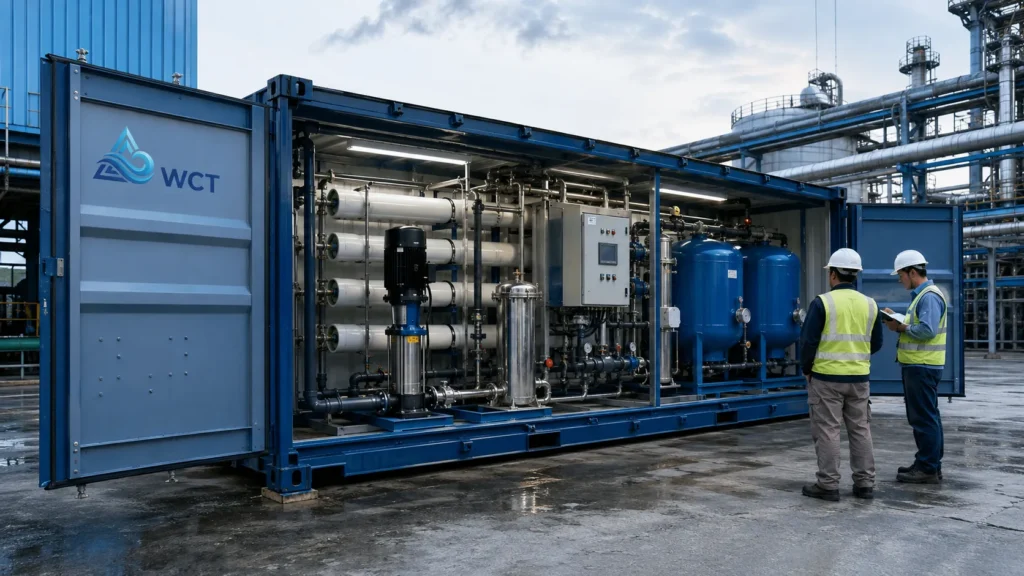
When a remote mining site sits 200 km from the nearest power line, a permanent water plant is months away. A containerized RO system arrives ready to connect. Before comparing suppliers, pin down these three variables:
- Raw water TDS and chemistry profile
- Target permeate flow rate (m³/day)
- Available site voltage and phase
The Architecture of a Mobile Water Treatment Plant
A containerized RO system is a turnkey water treatment plant fully integrated inside a standard ISO shipping container. It is not simply a skid bolted into a steel box. Every process stage — from raw water intake to permeate delivery — is pre-piped, pre-wired, and factory-tested so that site work is reduced to connecting flanges and a power cable.
- Multi-media filtration or ultrafiltration for pretreatment
- High-pressure stainless steel pump skids with VFD control
- Spiral-wound reverse osmosis membrane housings arranged in parallel or concentrate-staged arrays
- Integrated antiscalant and chemical dosing stations
- Pre-plumbed internal pipe runs with schedule 80 PVC or duplex stainless steel
- Hardwired instrumentation and a centralized SCADA/PLC control panel
Core Technical Specifications for Containerized RO
Capacities vary with feed salinity, temperature, and required recovery. A 20ft container typically handles brackish water at 50–200 m³/day, while a 40ft high-cube container can deliver over 800 m³/day for seawater desalination. Use the matrix below to align your feed quality and output target with the right frame size.
| Parameter | 20ft ISO Container | 40ft ISO Container | Custom High-Capacity |
|---|---|---|---|
| Nominal permeate flow | 50–200 m³/day (brackish) 30–100 m³/day (seawater) |
200–800 m³/day (brackish) 100–500 m³/day (seawater) |
Up to 2,000+ m³/day |
| Feed water TDS limit | Up to 10,000 mg/L | Up to 45,000 mg/L | Application-specific |
| Typical power requirement | 30–75 kW | 75–250 kW | 250+ kW |
| Standard membrane configuration | 2:1 array, 4–6 elements per vessel | 2:1 or 3:2 array, 6–7 elements per vessel | Multiple parallel trains |
Containerized RO vs. Permanent Treatment Plants
The choice hinges on mobility and speed versus site permanence. A containerized unit skips civil engineering entirely — the container slab is often all that’s needed — but sacrifices some long-term expandability that a built-in-place plant can offer. The comparison below highlights where the costs and timelines shift.
| Factor | Containerized RO System | Permanent Treatment Plant |
|---|---|---|
| Civil works required | Minimal; compacted gravel or concrete pad | Extensive; building, foundations, drainage |
| Deployment time | Days to weeks after delivery | Months to over a year |
| Scalability | Add parallel containers in phases | Expansion tied to building footprint |
| Footprint | 14.4–28.8 m² per container | Significantly larger for equivalent capacity |
| Relocation potential | Full; lift and transport as ISO cargo | Negligible; asset is fixed |
For operations that may shift camp locations over a few years, containerized systems preserve capital value. Where a permanent municipal plant is the end goal, a modular water treatment system can be the intermediate step. Many projects pair a containerized RO with skid-mounted ancillary equipment to balance mobility and capacity.
Environmental Hardening & Climate Control
RO membrane performance drops rapidly when feed water or ambient temperature swings outside the 5–35°C operating window. Electronics, high-pressure pump VFDs, and chemical dosing lines are equally sensitive. Hardening the container envelope isn’t optional for remote deployments — it’s what keeps permeate quality consistent and maintenance intervals predictable.
Thermal and Acoustic Insulation Standards
50–100 mm sandwich panels with polyurethane or rockwool cores are common. These panels provide structural rigidity while keeping internal temperatures stable. In sub-zero climates, spray-applied closed-cell foam eliminates condensation and cold bridges. Acoustic insulation inside the high-pressure pump compartment brings noise levels below 75 dBA at 1 metre, which matters when the container sits near accommodation units.
HVAC and Ventilation for Component Longevity
An undersized cooling load is the most frequent cause of premature VFD and membrane failure. At a minimum, specify a wall-mounted air conditioning unit sized for the heat rejection from all motors inside the container. In mining or petrochemical sites, upgrade to corrosion-resistant coils and pressurised ventilation that prevents dust ingress.
Where explosive atmospheres are a risk, ATEX- or IECEx-rated fans and sealed electrical panels must be specified.
Industrial Applications: Where Containerized Systems Excel
When there is no permanent infrastructure — no feed pipeline, no grid, no road other than a gravel track — a containerized RO becomes the primary water source. The ability to produce potable or process water within 24–48 hours of container touchdown is what makes these systems suitable for the sectors below.
Mining and Remote Resource Extraction
Camp drinking water, dust suppression, mineral processing, and brine management all depend on a local treatment plant that can be moved as the pit expands. The container’s structural base frame is certified for repeated lifting, so relocation is straightforward.
Industrial water treatment solutions in mining often require high-recovery designs to minimise concentrate disposal, which can be engineered directly into the container footprint.
Disaster Relief and Emergency Municipal Support
Standardised ISO dimensions mean a containerized RO system can be trucked, shipped, or airlifted into a flood-affected region within days. Units pre-loaded with multi-media filtration can handle high-turbidity surface water. Municipal support units typically include chlorine dosing and a clear-water tank inside the container, ready to feed a distribution truck fill station.
Construction Sites and Temporary Labor Camps
With project durations of 12–36 months, a lease or outright purchase of a 20ft containerized unit is often cheaper than trucking water daily. The plant can be connected to a nearby river abstraction point and operated by a single technician via the on-board PLC. Once construction ends, the container is demobilised and redeployed.
Pre-Deployment Checklist: Evaluating a Containerized RO Provider
Before signing a purchase order, confirm that the system is truly ready to operate — not merely assembled. These five checks separate factory-tested turnkey plants from containers with loose equipment.
- Factory Acceptance Test documentation: Request signed FAT reports showing flow, recovery, and permeate conductivity at the manufacturer’s facility.
- Membrane brand verification: Confirm the data sheets specify DuPont Filmtec, Hydranautics, Toray, or equivalent. Avoid unbranded elements with no traceable warranty.
- Plug-and-play readiness: Verify that raw-water inlet, permeate outlet, CIP connections, and power terminals are all brought to a single external panel with labelled flanges.
- Remote monitoring capability: Look for SCADA with at least Modbus TCP/IP or Ethernet/IP; satellite or cellular IoT options are a plus for sites with no fibre.
- Insulation and HVAC commissioning: Ask for temperature log data from a factory-run container under load to confirm the climate package works as specified.
Consulting with a System Engineer
The single most valuable document you can bring to a first call is a recent water chemistry report covering TDS, silica, iron, manganese, and temperature. Most standard containerized units handle common brackish water profiles without modification. If your raw water exceeds 10,000 mg/L TDS or contains hydrocarbons, a custom front-end pretreatment stage or energy recovery device is needed.
Share your target permeate quality, daily volume, and site location with our engineering team. They can adjust the membrane array, pump sizing, and climate package to match your project exactly. To source commercial RO systems that match these parameters, a specification review call often saves weeks of back-and-forth.
Frequently Asked Questions
How quickly can a containerized RO system be operational?
If the unit has been factory-commissioned and wet-tested, first water can be produced within 4–6 hours of site power connection. Full capacity verification usually completes within 24–48 hours after flushing the membranes and stabilising chemical dosing.
What is the maximum TDS capacity for containerized seawater systems?
Standard seawater RO membranes operate reliably up to 45,000 mg/L TDS. Above that, brine stream osmotic pressure increases significantly, requiring higher-pressure pumps and energy recovery devices that can still be accommodated inside a 40ft container.
Can these systems be expanded for higher flow rates?
Yes. The modular nature of ISO containers allows you to add a second unit in parallel, doubling permeate output without modifying the first plant. Common feed headers and shared SCADA make multi-container networks manageable from a single control interface.