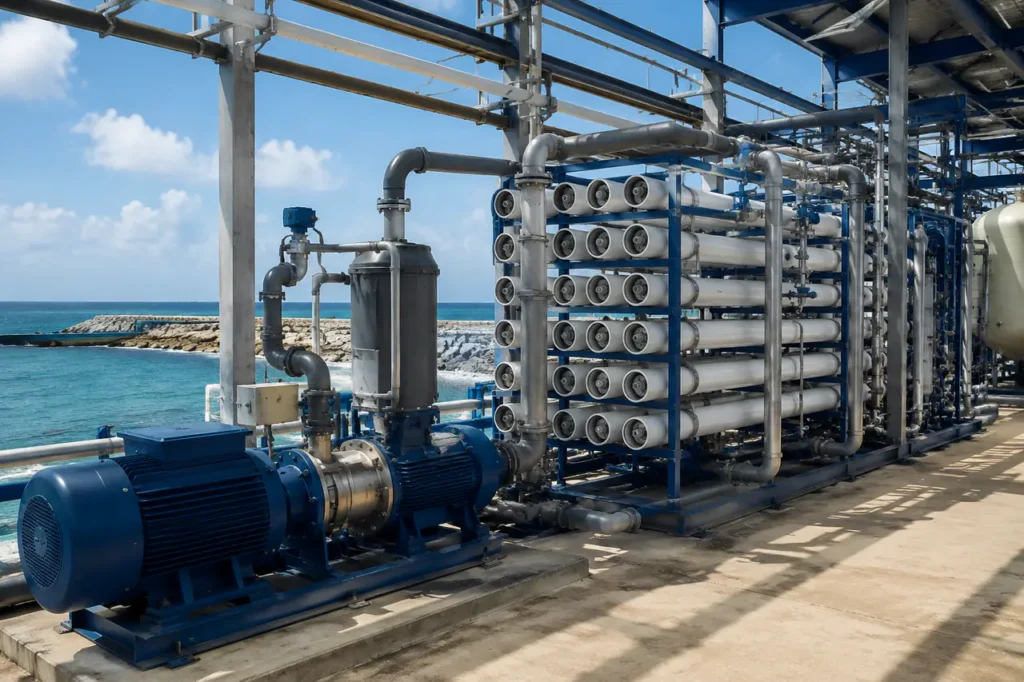
Coastal facilities, island resorts, and offshore vessels often lack municipal water and local groundwater.
A reliable commercial or industrial seawater RO system converts high-salinity seawater into potable, agricultural, or process water, but only when engineers balance feed water salinity, seasonal temperature shifts, metallurgy, and pre-treatment to prevent fouling and excessive power use.
Core Architecture of a Seawater Reverse Osmosis (SWRO) System
SWRO operates under much harsher conditions than tap-water or brackish-water RO. Typical ocean feed contains 35,000-45,000 mg/L TDS, so the system must exceed 800-1,000+ PSI to overcome osmotic pressure. A complete SWRO facility integrates several purpose-built assemblies:
- High-Pressure Pump Assembly: The mechanical core of the system, responsible for elevating feed water above osmotic threshold levels. Industrial systems rely on positive displacement pumps or multi-stage centrifugal units, such as specialized high-pressure pump assemblies engineered with corrosion-resistant metallurgy to handle raw high-chloride streams continuously.
- Semi-Permeable SWRO Membranes: High-rejection, thin-film composite (TFC) polyamide membranes engineered to operate at 800 to 1,200 PSI. These spiral-wound elements feature dense salt-separating barrier layers capable of rejecting 99.4% to 99.8% of dissolved sodium, chloride, boron, and trace minerals.
- High-Pressure Membrane Housings: ASME-certified fiberglass-reinforced polymer (FRP) pressure vessels rated for 1,000 to 1,200 PSI working pressures. Each vessel houses between 1 and 8 membrane elements in series, sealed with high-salinity EPDM or Viton O-rings.
- Energy Recovery Device (ERD): High-efficiency isobaric pressure exchangers or turbine-based energy recovery units. Because SWRO recovery rates typically range from 40% to 45%, up to 60% of the feed water exits the system as high-pressure reject brine. ERDs capture hydraulic energy from this concentrated brine stream and transfer it directly to incoming feed water, reducing net electrical power requirements by up to 50% to 60%.
- High-Grade Corrosion-Resistant Metallurgy: Due to extreme chloride concentrations under high pressure, standard 304 or 316 stainless steel suffers rapid crevice corrosion and pitting. High-pressure SWRO manifolds utilize Super Duplex stainless steel (such as UNS S32750 / 2507), Duplex 2205, or high-grade titanium, while low-pressure piping utilizes Schedule 80 PVC, PVDF, or FRP.
- Process Control and Instrumentation: Dedicated instrumentation arrays consisting of electromagnetic flowmeters, high-pressure transmitters, temperature sensors, online conductivity monitors (feed, permeate, and brine), and programmable logic controllers (PLCs). Incorporating an automatic water treatment system panel provides automated flush cycles, emergency shutdowns on high differential pressure, and chemical dosing modulation.
Pre-Treatment and Post-Treatment Process Trains
Raw seawater cannot be fed directly to SWRO membranes. Particulates, organisms, dissolved organics, and scaling minerals foul feed channels within hours, so stable installations rely on controlled pre-treatment and post-treatment trains.
Pre-Treatment Train
Pre-treatment lowers Silt Density Index (SDI) below 3.0 and turbidity below 0.2 NTU before membrane contact.
- Intake and screening: Raw seawater enters through primary intake screens or beach wells.
- Coagulation and multi-media filtration: Chemical coagulation followed by anthracite, silica sand, and garnet filtration removes suspended solids.
- Ultrafiltration: Pressurized or submerged UF hollow-fiber modules often replace conventional sand filters to handle seasonal algal blooms and red tides.
- Antiscalant dosing: Threshold scale inhibitors prevent calcium carbonate and barium sulfate precipitation.
- Dechlorination: Sodium bisulfite neutralizes residual chlorine before it reaches the chlorine-sensitive polyamide membrane.
- Final cartridge filtration: A 1-5 micron absolute melt-blown element provides the last particulate barrier before the high-pressure pump.
Post-Treatment Train
Because reverse osmosis removes mineral buffers, raw SWRO permeate is low-pH (5.5-6.5), weakly mineralized, and aggressive toward distribution piping if not stabilized.
- Remineralization: Calcite contact beds or lime/CO₂ dosing restore mineral balance, alkalinity, and LSI to a neutral, non-corrosive range.
- Potable disinfection: Chlorine or UV treatment protects drinking-water distribution.
- Industrial polishing: Boiler feed or electronics rinse water can be further treated through an ultrapure water treatment system using EDI.
Technical Specifications: Membrane Performance and Parameters
Membrane selection determines overall footprint, operating pressure thresholds, and final permeate purity. SWRO membrane elements are manufactured in standardized physical formats, ranging from compact 2.5-inch elements for marine vessels to industrial 8-inch elements designed for utility-scale desalination.
Membrane Format and Capacity Ranges
| Membrane Size / Dimensions | Nominal Active Area | Typical Permeate Capacity | Stabilized Salt Rejection | Standard Operating Pressure | Target Application Profile |
|---|---|---|---|---|---|
| 2.5″ x 21″ (Watermaker) | 12 – 15 sq ft | 150 – 300 GPD (0.57 – 1.14 m³/d) | 99.4% – 99.6% | 800 – 1,000 PSI | Sailboats, small fishing vessels, emergency lifeboats |
| 2.5″ x 40″ (Commercial) | 28 – 32 sq ft | 550 – 700 GPD (2.08 – 2.65 m³/d) | 99.6% | 800 – 1,000 PSI | Commercial yachts, island villas, coastal research stations |
| 4.0″ x 40″ (Light Industrial) | 80 – 90 sq ft | 1,500 – 2,200 GPD (5.68 – 8.33 m³/d) | 99.6% – 99.7% | 800 – 1,100 PSI | Offshore platforms, boutique coastal resorts, workboats |
| 8.0″ x 40″ (High Rejection) | 380 – 400 sq ft | 6,000 – 9,000 GPD (22.7 – 34.1 m³/d) | 99.7% – 99.8% | 800 – 1,200 PSI | Municipal plants, industrial power stations, large resorts |
| 8.0″ x 40″ (High Boron Rejection) | 400 – 440 sq ft | 7,500 – 11,000 GPD (28.4 – 41.6 m³/d) | 99.8% (93-96% Boron) | 800 – 1,200 PSI | Agricultural irrigation, municipal drinking water standards |
Temperature Correction and Replacement Checks
Feed temperature shifts pressure and rejection. Use these checks when specifying new membranes or replacing legacy elements.
- Cold-water check: At 15°C, higher feed pressure is required to maintain rated GPD because seawater viscosity increases.
- Warm-water check: At 25°C, required feed pressure drops, but salt diffusion increases slightly and rejection may decline.
- Legacy replacement: Match replacement elements by nominal size, model, and vessel array-not rated GPD alone.
Matching System Configurations to Industry Applications
The physical packaging, footprint, and modularity of a seawater RO system depend on local logistics, space limitations, and deployment timeframes. SWRO equipment is generally structured into four primary engineering configurations:
| System Configuration | Target Operating Environment | Key Mechanical & Structural Features | Typical Capacity Range |
|---|---|---|---|
| Compact Marine Watermaker | Yachts, commercial marine vessels, workboats | Split-frame or monoblock design, direct-drive booster pumps, 316SS/Duplex components | 0.5 – 15 m³/day (130 – 4,000 GPD) |
| Skid-Mounted System | Coastal resorts, beach hotels, industrial processing facilities | Factory-assembled open steel frame, centralized PLC, integrated CIP cleaning manifold | 20 – 1,000 m³/day (5,200 – 264,000 GPD) |
| Containerized RO System | Offshore oil rigs, island utility grids, mining camps | Insulated 20ft/40ft ISO container, integrated HVAC, pre-plumbed, weatherized | 50 – 2,500 m³/day (13,000 – 660,000 GPD) |
| Mobile Trailer System | Disaster response, seasonal construction, military outposts | Road-towable trailer, onboard diesel generation, quick-connect intake hoses | 10 – 250 m³/day (2,600 – 66,000 GPD) |
Configuration Fit by Site Condition
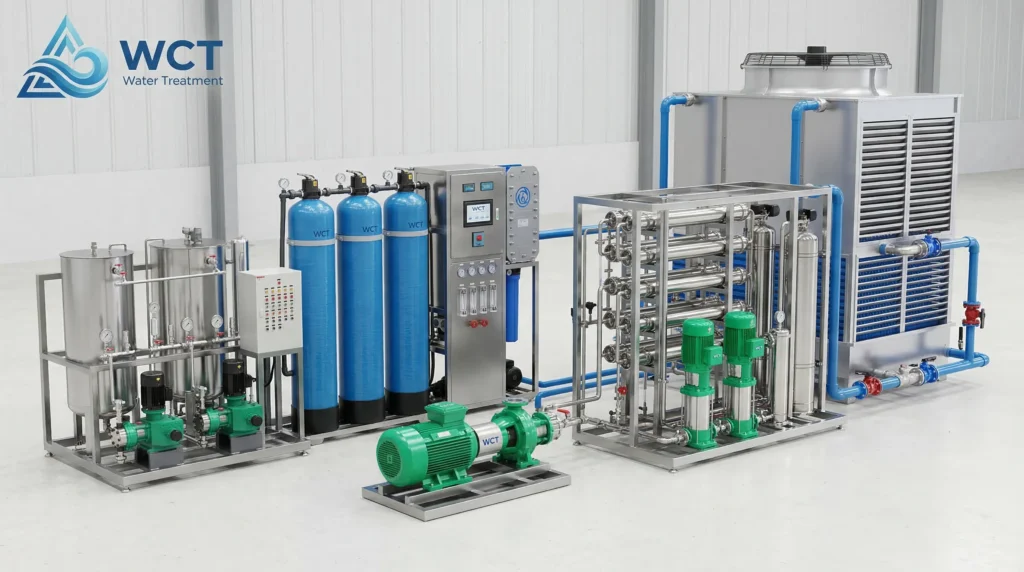
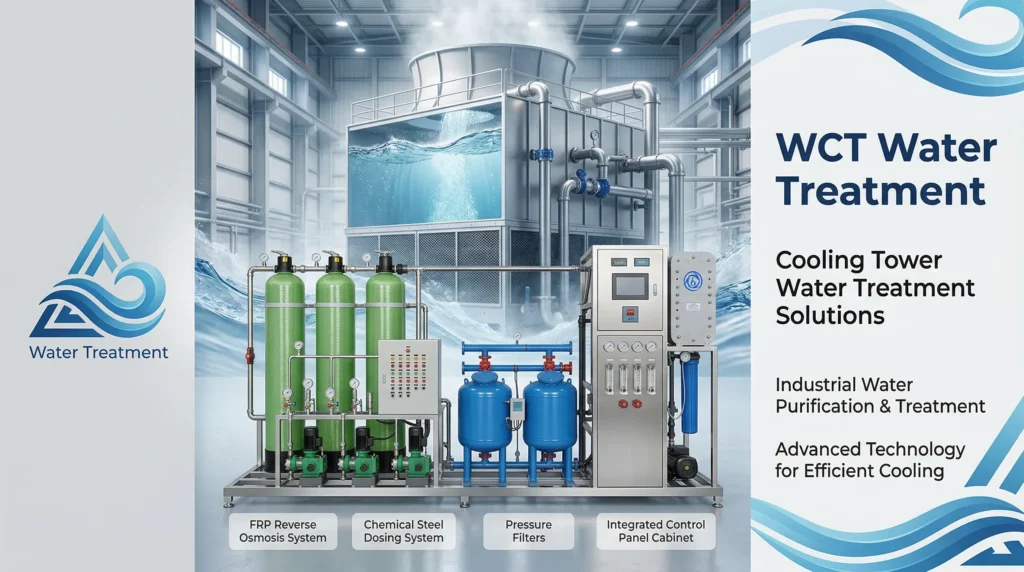
- Permanent coastal site with building space: A skid mounted water treatment system provides clear piping runs and 360-degree access to pressure vessels and pump couplings during membrane reloading or seal changes.
- Marine-exposed or infrastructure-limited site: A self-contained containerized RO system protects switchgear, VFDs, and dosing skids from corrosive salt fog while reducing on-site civil works to slab preparation and pipe hookups.
- Temporary or seasonal water demand: A mobile water treatment system or dedicated emergency water treatment system can be dispatched quickly before permanent infrastructure is financed.
- Large municipal development: Multi-rack turnkey water treatment system layouts support centralized intake pumping and automated backwash trains.
Advantages and Operational Challenges of SWRO
Understanding both the operational strengths and ongoing system demands helps facility managers establish realistic operational budgets and maintenance workflows.
Primary Operational Advantages
- Climate-Independent Reliability: SWRO systems provide a guaranteed freshwater supply unaffected by local rainfall variations, droughts, or municipal supply allocations.
- High Permeate Quality: Multi-layer polyamide membranes act as physical barriers against dissolved ions, microplastics, bacteria, cysts, and marine pathogens, consistently meeting international drinking water standards.
- Modular Scalability: Unlike large thermal desalination plants, membrane systems can be expanded by adding parallel pressure vessels or additional membrane skids as site demand increases.
Operational Challenges and Mitigations
- Specific Energy Consumption: Operating high-pressure pumps requires significant power, typically 2.5 to 4.0 kWh per cubic meter of permeate produced. Modern isobaric ERDs and variable frequency drives minimize electrical draw per gallon of treated water.
- Brine Disposal Management: Concentrated brine discharge, about 65,000 to 75,000 mg/L TDS, must be returned to the ocean without creating localized environmental dead zones. Facilities use engineered submerged multi-port diffusers to accelerate brine dilution via ambient ocean currents.
- Biofouling in Warm Waters: High marine biological activity in tropical waters accelerates biofilm formation on membrane surfaces. This requires structured Clean-In-Place (CIP) regimes and careful oxidation/dechlorination upstream of the RO racks.
What to Prepare Before System Design
To design an efficient, cost-effective seawater RO system, engineering teams need comprehensive feed water and site constraint data. Before requesting a system configuration or formal equipment proposal, compile the following operational parameters:
- Feed Water Quality Report: A laboratory analysis of the raw source water, including:
- Total Dissolved Solids (TDS) and electrical conductivity
- Cation/anion balance (chloride, sodium, calcium, magnesium, sulfate, bicarbonate)
- Total Organic Carbon (TOC), Biological Oxygen Demand (BOD), and Silt Density Index (SDI)
- Concentrations of silica, boron, iron, manganese, and hydrogen sulfide
- Temperature Range: Minimum, average, and maximum seasonal feed water temperatures, crucial for pressure pump sizing and membrane modeling.
- Required Daily Permeate Volume: Continuous demand in m³/day or gallons per day (GPD), along with peak hourly demand profiles.
- Permeate Quality Objective: Target application, such as WHO-standard drinking water, agricultural use with strict boron limits, or low-conductivity boiler feed.
- Available Electrical Power: On-site voltage, frequency, phase count, available power headroom, and source reliability.
- Footprint and Placement Constraints: Available floor area, indoor vs. outdoor containerized preference, ceiling clearance for membrane extraction, and weight capacity limits.
- Brine Discharge Method: Permitted ocean outfall options, gravity discharge lines, or coastal mixing zones.
Submitting a complete water analysis and operational brief allows WCT’s technical specialists to run detailed membrane projection models, establish recovery targets, and configure the high-pressure pump, ERD, and pre-treatment train for your site conditions.
Contact the engineering team to review your application requirements or request a custom SWRO system design.
Frequently Asked Questions
What is the typical life expectancy of a seawater RO system?
The frame, FRP pressure vessels, and Super Duplex high-pressure piping routinely last 15 to 20 years. SWRO membranes typically need replacement every 3 to 5 years, depending on pre-treatment consistency, silt load, and cleaning frequency.
How often do SWRO membranes require cleaning?
Clean-in-place maintenance is normally performed every 3 to 6 months. Start a CIP when normalized permeate flow falls 10% to 15%, salt passage rises 5% to 10%, or stage differential pressure rises 15% above baseline.
Can an SWRO system process brackish water?
An SWRO system can process brackish water under 10,000 mg/L TDS, but doing so is inefficient. Seawater membranes are built for 800+ PSI operation, while brackish-water RO elements operate at 150 to 300 PSI, reducing pumping power and cost.