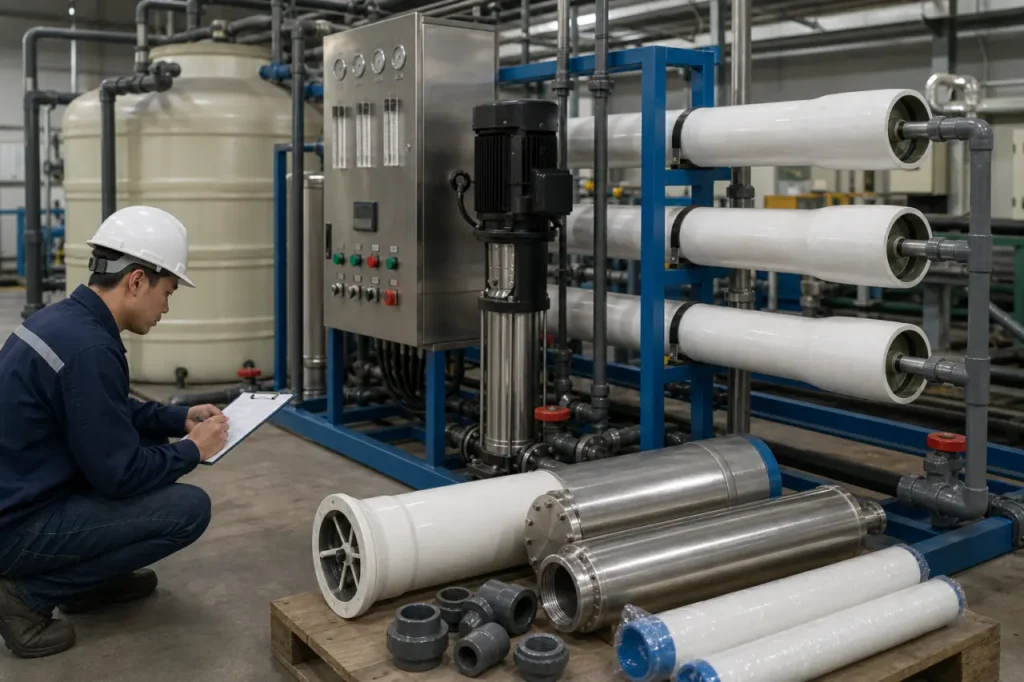
Differentiating Commercial vs. Light Residential RO Components
Commercial RO components supplier stock differs from a residential parts catalog in one essential way: duty cycle.
Light residential membranes and housings are built for intermittent use-a few gallons per day, low continuous pressure, and plastic fittings that handle clean municipal water.
Industrial-grade parts, by contrast, run 24/7 under 150-450 psi, often with aggressive feed chemistry.
Material choice makes the difference obvious. A residential pressure vessel might use injection-molded polypropylene; a commercial FRP membrane housing rated for 300 psi or 1000 psi is a different class of component entirely.
Likewise, pumps shift from diaphragm booster types to multistage centrifugal or positive displacement pumps designed for continuous operation.
What to verify before you mix part grades
- Confirm maximum continuous operating pressure, not just burst rating.
- Check wetted material compatibility with your specific antiscalant, acid, or cleaning chemicals.
- Compare flow rate specifications at realistic net driving pressure, not ideal lab conditions.
- Ask if the supplier provides complete material traceability and batch test reports.
A cheaper residential-grade pressure switch installed in a 10,000 GPD commercial skid will fail early-often within weeks. The upfront saving disappears in downtime and emergency freight costs. Always verify that every component in the bill of materials matches the system’s operating envelope.
Core Commercial RO Components & Technical Specifications
Smart procurement starts with understanding the components that most directly affect system reliability and operating cost. Missing a specification here often means the quote looks clean but the installation fails a field performance test.
Membrane Elements and Pressure Vessels
Membrane elements are the heart of the process. For commercial and industrial systems, 4-inch and 8-inch spiral-wound elements are standard.
Pay attention to active membrane area, salt rejection at standard test conditions (typically 99.0%-99.7%), and the allowed feed spacer thickness-critical when dealing with turbid or high-fouling waters.
Pressure vessels must handle the associated operating and surge pressures. FRP vessels with a 300, 450, or 1000 psi rating are common. Check for ASME code stamping where required by local regulation, and verify the permeate port design matches your manifold arrangement.
High-Pressure Pumps and Chemical Dosing
Selecting a pump involves more than just matching GPM against membrane array demand. Multistage centrifugal pumps are typical, but high-pressure positive displacement pumps may be required for high-recovery or seawater applications.
Look at NPSH requirements, material of construction (316 stainless steel, duplex stainless, or super duplex for seawater), and motor efficiency ratings.
Chemical dosing pumps for antiscalant, acid, or biocide must provide accurate, repeatable injection rates over the full turn-down ratio. Mechanical diaphragm metering pumps with PVDF or polypropylene liquid ends are widely used.
Verify that the stroke length adjustment range covers your actual dosing demand-many systems are oversized at commissioning, leading to poor control.
Control Valves, Flow Restrictors, and Instrumentation
These components are often undervalued in procurement but cause a disproportionate number of field service calls. Automatic multiport valves for FRP media filters must match backwash flow requirements.
RO concentrate flow restrictors must be sized precisely to maintain crossflow velocity. Flow meters, pressure transmitters, and conductivity sensors must have the correct range, wetted materials, and output signals for your control panel.
Request calibration certificates for instruments and ask the supplier if they pre-build and test skid-mounted instrumentation loops before shipment. This reduces commissioning time significantly.
| Component Category | Primary Materials | Standard Commercial Specs |
|---|---|---|
| RO Membrane Elements | Polyamide thin-film composite, polysulfone layers | 4″-8″ diameters; active area 80-440 ft²; salt rejection 99.0-99.7%; operating pressure up to 1200 psi for seawater |
| Membrane Pressure Vessels | FRP with epoxy or vinyl ester resin; 316 SS end caps | 300, 450, 600, 1000 psi ratings; 1-8 elements per vessel; side port or end port designs |
| High-Pressure Pumps | 316 SS, duplex SS, cast iron (limited use) | 10-500+ GPM; typical discharge 150-1000 psi; TEFC motors; NPSHr < 10 ft |
| Chemical Dosing Pumps | PVDF, polypropylene, PVC liquid ends; PTFE diaphragms | 0.5-50 GPH; max back pressure 100-250 psi; stroke frequency adjustment |
| FRP Filter Tanks | FRP with polyethylene liner; ABS or FRP internal hub | 8″-36″ diameters; operating pressure 150 psi; NSF/ANSI 61 certified liners |
| Cartridge Filter Housings | 304/316 SS, FRP, PVC | 1-100+ cartridge capacity; 150-300 psi; 1″-4″ NPT/BSP connections |
| Flow Meters & Sensors | PVC, 316 SS, PVDF bodies; Teflon floats | 0.5-200 GPM; accuracy ±2%; 4-20 mA outputs for remote monitoring |
The table above gives typical specification ranges, but each application drives its own priority. A food and beverage plant will care more about stainless steel instrumentation and FDA-compliant gaskets.
A brackish water municipal site may focus more on FRP tank liner certifications and pressure vessel ASME stamps. Always tie the spec sheet to the end-use site conditions.
Critical Certifications and QA Standards to Verify
Cost-driven component selection without proof of compliance is a frequent source of project delays. The short version: a test report is not a certification. Buyers need actual certificates of compliance, not just a manufacturer declaration.
Here are the documents you should request for water-contact components, pressure vessels, and manufacturing quality systems.
- NSF/ANSI 61 – for all wetted parts that contact drinking water. This is a toxicological safety standard, not a performance test. Confirm the specific component is listed, not just the supplier’s corporate certification.
- NSF/ANSI 58 – for complete RO system components where membrane performance and material safety are jointly certified. Relevant for membrane elements, housings, and storage tanks.
- ASME Section X – for FRP pressure vessels over certain dimensional limits; local codes often mandate this. Obtain U-Stamp or other regional equivalent where required.
- ISO 9001:2015 – indicates a documented quality management system at the manufacturing site. While not a product certification, it reduces batch variation risk.
- Material test reports – Mill certificates for stainless steel vessels, PU/FRP layup records, elastomer compound traceability. These matter when feed chemistry is aggressive.
A supplier who can quickly produce these documents typically has deeper manufacturing or sourcing control. If you get pushback or long delays, consider that a procurement red flag.
B2B Supplier Evaluation: Vetting Your Sourcing Partner
Comparing two lines of a BOM by unit price will mislead you. The supplier’s ability to support the order from sample approval through after-sales engineering is what determines the total cost of the procurement.
Inventory Availability and Supply Chain Logistics
Ask for actual on-hand stock numbers-not just “partner warehouse” language. For bulk buyers, this matters because lead times for 8-inch membranes or custom pressure vessels can stretch to 8-14 weeks during high demand periods.
A supplier with regional warehouse hubs can split bulk shipments and reduce partial shipment penalties.
Also verify packaging specifications: membranes must be shipped in sealed polyethylene bags with preservative solution; FRP vessels need protective end caps and proper crating to prevent damage during LTL or container transport.
Engineering Support and Custom Consultation
High-value sourcing relationships come from the supplier’s ability to help you avoid mis-application. When a wastewater plant needs to switch antiscalant chemistry, the pump wetted end material might need to change.
A transactional distributor will just quote the same pump; a true commercial partner will flag the material incompatibility.
Ask if the supplier has in-house application engineers who can review system P&IDs, recommend alternate replaceable components, or provide CAD drawings for custom FRP tank configurations. This kind of support reduces field rework and keeps project schedules intact.
Warranty, Returns, and After-Sales Support
Commercial component warranties should be clear on coverage period, what’s excluded (e.g., chemical attack, freezing), and who pays freight for returns. Clarify the RMA process before the first order. For critical spares, ask about consignment stock agreements that can cut emergency lead times.
| Evaluation Criterion | Transactional Distributor | Value-Added Commercial Partner |
|---|---|---|
| Minimum Order Quantities | Often rigid; per model MOQs, no flexibility | Negotiable; mixed pallets, project-based volume tiers |
| Lead Times | Reliant on manufacturer’s schedule; limited visibility | Shared stock insight; can expedite from alternate warehouses |
| QA & Testing Availability | Pass-through manufacturer COA; no in-house testing | Incoming QC inspection; batch sampling; optional full assembly testing |
| Engineering/Consulting | Basic cross-reference support | Application reviews, material compatibility checks, commissioning support |
| Custom Components | Standard catalog only | Custom FRP tank port positions, private labeling, pre-assembled skids |
| After-Sales Response | Email-based; standard return policy | Technical hotline; on-site field service coordination; spares consignment |
The contrast becomes most apparent when a project deadline tightens. If you’ve only ever paid for a part number, the supplier can do very little to help.
If the supplier already understands your system layout and past maintenance history, a same-day technical call can prevent a shutdown.
Preparing Your RFQ: Final Checks Before Ordering
A well-prepared RFQ cuts quote turnaround time and reduces back-and-forth on technical details. Before you contact a commercial RO components supplier, assemble the following variables into a single document.
- System design capacity: permeate flow in GPM or GPD, plus any future expansion requirements.
- Feed water analysis: TDS, hardness, iron, silica, pH, temperature range, and any known organic or oxidizing agent presence.
- Operating pressure envelope: typical feed pressure range, maximum design pressure, and required test pressure for vessels.
- Target recovery rate: this determines concentrate flow and pump selection.
- Materials of construction: specify where stainless steel, duplex, super duplex, or specific elastomers are mandatory.
- Required certifications: list which components need NSF/ANSI 61 or 58, ASME stamping, or FDA-compliant gaskets.
- Packaging & shipping terms: incoterms, destination, any crating or container-loading requirements, delivery urgency tier.
- Quantity & delivery schedule: initial batch size, ongoing replacement volumes, and any phased delivery needs.
Send this along with your current BOM or system PID where possible. Even a partial set of data allows the supplier to flag mismatches and return a technically accurate quote faster.
If you’re building a new system, ask for sample components-particularly membranes or metering pumps-to validate compatibility during pilot testing before placing a full production order.
When you’re ready to move beyond catalog search and need a technically accountable partner, our engineering team can review your specifications and provide a tailored quotation for your commercial RO component requirements. Request a bulk quotation or wholesale account to get started.