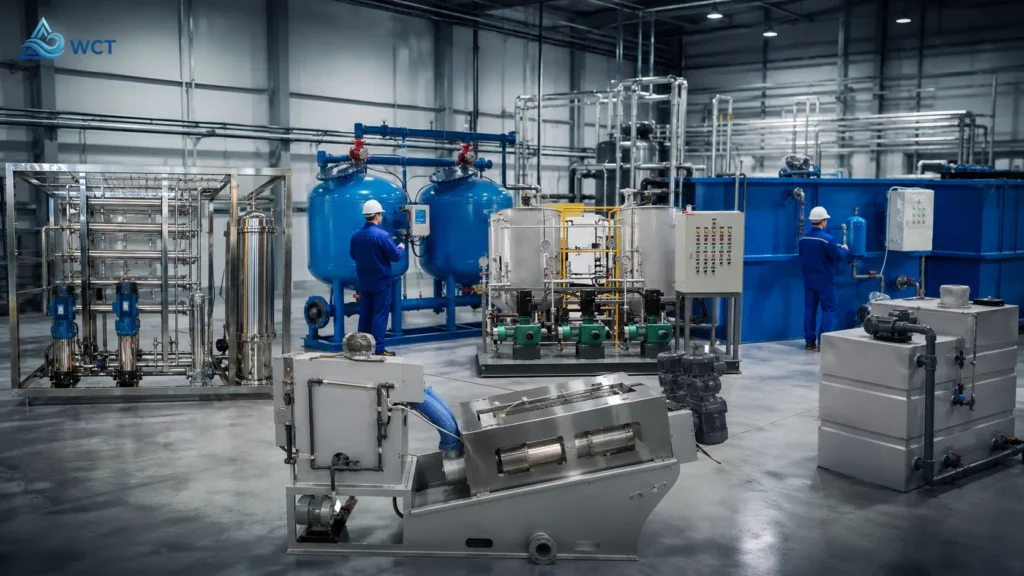
Chemical wastewater treatment uses reagents to alter, neutralize, or precipitate dissolved industrial pollutants that mechanical or biological methods cannot handle. When effluent carries heavy metals, extreme pH, or emulsified oils, chemical intervention is the only practical path to compliance.
The Mechanics of Chemical Wastewater Treatment
Physical treatment relies on gravity, screens, or filters to remove suspended solids. It works well for particles large enough to settle or be strained out. It does nothing for dissolved ions, stable emulsions, or soluble organics.
That is where chemical mechanisms become necessary. A reagent is introduced into the waste stream to drive a targeted reaction. The goal is to convert dissolved contaminants into insoluble solids or harmless compounds that physical separation can then capture.
The core principle is straightforward: change the contaminant’s chemical form so it becomes separable. This usually means one of three things:
- Precipitate the contaminant as an insoluble solid.
- Neutralize its corrosive or toxic character.
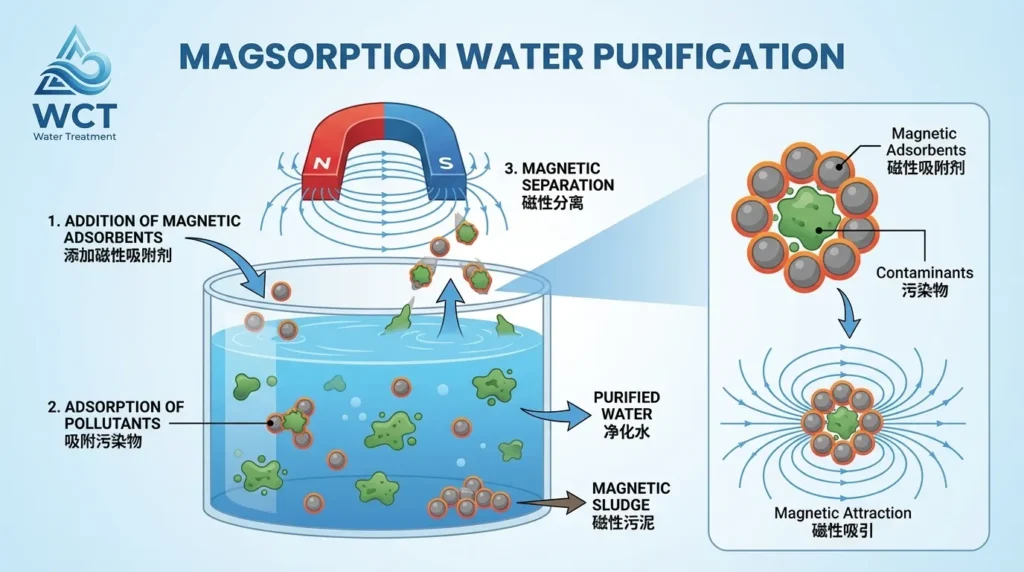
- Adsorb it onto a surface that can then be filtered out.
A facility with zinc or copper in its rinse water cannot simply settle those metals out-the ions stay dissolved. Adding a hydroxide source raises the pH, forcing the metals to form solid hydroxide particles. Those particles are removed by clarification or filtration.
That sequence-pH adjustment, precipitation, solids separation-is the fundamental pattern behind most industrial effluent treatment solutions.
Chemical vs. Biological Treatment: Where Each Method Fits
Biological treatment uses microorganisms to consume organic waste. Chemical treatment uses reagents to force out inorganic, toxic, or non-biodegradable pollutants. Neither method is universally superior. The effluent profile determines which one works, or whether both must run in sequence.
| Factor | Chemical Treatment | Biological Treatment |
|---|---|---|
| Target contaminants | Heavy metals, dissolved inorganics, pH extremes, toxic organics, emulsified oils | Biodegradable organics, BOD/COD loads, nitrogen, phosphorus |
| Treatment speed | Minutes to hours (rapid reaction) | Hours to days (organism-dependent) |
| Sensitivity to toxic shock | Low; chemistry tolerates variable loads | High; toxins can kill the biomass |
| System footprint | Compact; mainly tanks and dosing skids | Larger; aeration basins, clarifiers, return sludge systems |
| Sludge characteristics | Often classified as hazardous; disposal costs higher | Typically non-hazardous; more volume but lower disposal cost per unit |
| Operating cost driver | Reagent consumption and sludge disposal | Energy for aeration and biomass management |
When chemical treatment is the clear first choice
Industrial streams carrying cadmium, chromium, lead, or nickel require chemical precipitation. There is no biological pathway to remove dissolved metals. Trying to send that stream through a biological reactor poisons the biomass and collapses the entire process.
Extreme pH values also demand chemical neutralization before any biological step. A pH below 4 or above 10 will kill most microbial communities within hours. Chemical correction must happen first.
Where biological and chemical treatment work in series
Many large facilities run chemical treatment upstream of biological polishing. The chemical stage removes the inorganic load and breaks difficult emulsions. The biological stage then handles residual BOD and nutrients without the toxicity risk.
This is common in metal finishing, petrochemical, and food processing plants where both organic and inorganic loads are present.
Precise chemical dosing systems make this combined approach viable. Overdosing carries coagulant into the biological stage and can interfere with microbial activity. Underdosing leaves metals in solution and risks permit violations downstream.
The 4 Critical Stages of the Chemical Treatment Process
Chemical treatment is rarely a single-step operation. Most industrial systems run a sequence of four distinct stages, each with a specific chemical job. The order matters. Skipping or reordering stages usually means rework, wasted reagent, or incomplete removal.
Coagulation and Flocculation
Suspended solids and colloidal particles carry negative surface charges that repel each other. They stay dispersed and never settle. Coagulation neutralizes that charge, allowing particles to approach each other. Flocculation then gently mixes the destabilized suspension so particles collide and bind into larger aggregates called flocs.
The common mistake is confusing the two jobs. Each demands a very different mixing regime:
- Coagulation requires rapid, high-energy mixing to distribute the reagent evenly within seconds.
- Flocculation requires slow, gentle mixing so the forming flocs do not shear apart.
Running both at the same speed produces poor solids removal and wastes reagent. Coagulant selection depends on the wastewater chemistry. Alum and ferric chloride are standard choices. The right dose is determined by jar testing on the actual effluent, not by rule of thumb.
Chemical Precipitation
Precipitation is the primary mechanism for heavy metal removal. The goal is to convert dissolved metal ions into insoluble solid particles that can be settled or filtered out. Hydroxide precipitation, using lime or caustic soda, is the most common industrial method.
Each metal has a specific pH range where its hydroxide solubility is lowest. Operating outside that range leaves metals in solution.
Cadmium precipitates best near pH 11. Zinc works around pH 9 to 10. If multiple metals are present, the target pH becomes a compromise. A single setpoint rarely captures every metal at its minimum solubility.
Sulfide precipitation offers a tighter removal profile for metals like mercury and cadmium, but it demands careful dosing. Excess sulfide creates its own toxicity problems. The reagent choice is a trade-off between removal efficiency, sludge volume, and operational safety.
Neutralization (pH Adjustment)
Neutralization corrects the effluent pH to a range acceptable for downstream processes or final discharge. Industrial waste streams often arrive at extreme values. Acid pickling baths run below pH 2. Alkaline cleaning solutions push above pH 12.
Neutralization is usually placed early in the treatment train. It protects downstream equipment from corrosion and sets the correct pH window for the precipitation stage that follows.
Two-stage neutralization systems are common when influent pH swings widely. The first tank does rough adjustment; the second trims to the final setpoint.
This stage is also where pre-treatment for chemical wastewater connects to the overall plant design. Screening, equalization, and oil-water separation ahead of neutralization reduce the chemical load and improve pH control stability.
Ion Exchange and Adsorption
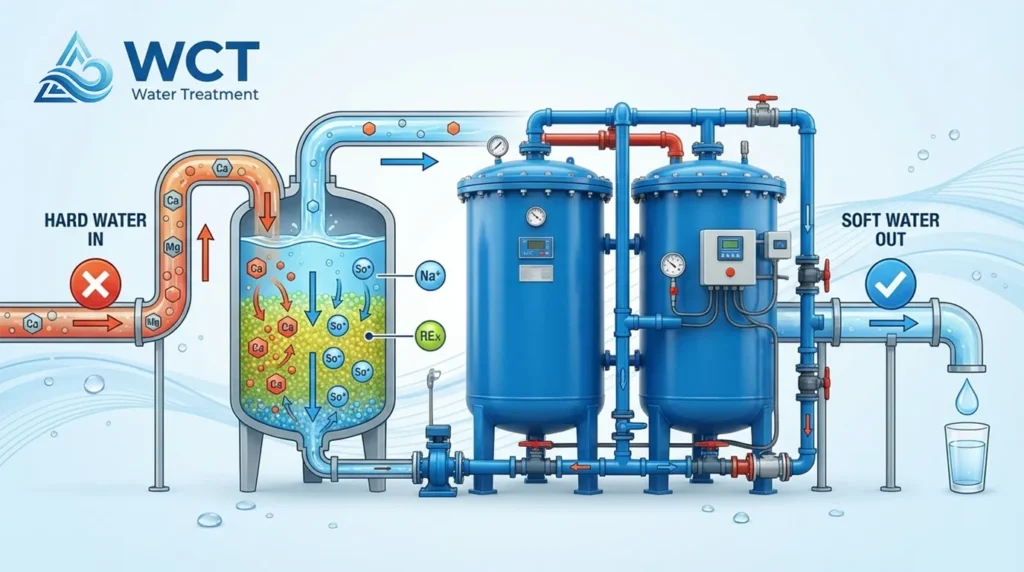
When discharge limits are too tight for precipitation alone, ion exchange or adsorption provides the final polish. Ion exchange resins swap undesirable ions for harmless ones, such as replacing heavy metal cations with sodium or hydrogen ions. It is effective for trace metal removal but requires periodic resin regeneration.
Activated carbon adsorption targets dissolved organics, color bodies, and residual chemicals that pass through earlier stages. It is common in pharmaceutical and textile wastewater treatment where effluent must meet both chemical and aesthetic standards.
Neither method replaces coagulation or precipitation. They are finishing steps, applied when the main treatment train cannot quite reach the required discharge number.
Selecting the Right Reagents: Categories and Functions
Reagent selection starts with a full water analysis. Guessing based on industry type alone leads to overdosing, underdosing, or choosing a chemical that reacts poorly with the actual effluent matrix. The table below covers the main categories and their industrial roles.
| Category | Common Chemicals | Primary Function | Typical Application |
|---|---|---|---|
| Coagulants | Alum, Ferric Chloride, PAC | Neutralize surface charge, destabilize colloids | Suspended solids removal, turbidity reduction |
| Flocculants | Polyacrylamide (PAM), polyelectrolytes | Bridge particles into larger flocs | Sludge thickening, DAF pre-treatment |
| pH Adjusters | Sulfuric acid, Caustic soda, Lime | Raise or lower pH to target range | Neutralization, precipitation pH control |
| Precipitants | Lime, Sodium sulfide, TMT | Convert dissolved metals to insoluble solids | Heavy metal removal from plating, mining effluent |
| Oxidants/Disinfectants | Chlorine, Ozone, Hydrogen peroxide | Destroy pathogens, break down cyanide or organics | Disinfection, cyanide destruction, odor control |
| Adsorbents | Activated carbon, Zeolites | Capture dissolved organics and trace contaminants | Pharma, textile, and refinery polishing |
Dosing control and the cost of getting it wrong
Reagent cost is only part of the story. The larger expense often hides in sludge disposal. The true costs of poor dosing add up quickly:
- Overdosing coagulant creates excess sludge volume, raising haulage and disposal fees.
- Overdosing acid or caustic drives up downstream neutralizer consumption.
- Underdosing leaves contaminants untreated and risks permit violations.
A well-tuned chemical reagent dosing system pays for itself in reduced chemical waste and lower haulage costs.
Jar testing is the standard method to establish correct dosage. It should be repeated whenever the production line changes chemistry, not just during commissioning. The reagent that worked for one batch of effluent may be wrong for the next.
Industry-Specific Chemical Treatment Applications
The chemical treatment principles are the same across industries, but the pollutant profile changes the system architecture. Three sectors show how different the practical application can be.
Oil and Gas Extraction and Refining
Produced water and refinery effluent carry free oil, emulsified oil, dissolved hydrocarbons, and high total dissolved solids. Chemical treatment breaks the emulsion so mechanical separation can work.
Dissolved air flotation (DAF) systems are the standard next step. Coagulant and flocculant are injected ahead of the DAF unit. The chemicals destabilize the oil-water emulsion, and the air bubbles float the resulting floc to the surface for skimming.
Refineries also face sulfide and ammonia loads that require targeted oxidation or stripping. Chemical treatment alone rarely produces a direct-discharge effluent. It is usually the first stage, with biological treatment or deep-bed filtration following.
Metalworking and Heavy Manufacturing
Metal finishing, electroplating, and surface treatment lines generate rinse water loaded with dissolved metals, acids, and cleaners. Hexavalent chromium, nickel, copper, and zinc are common. Chemical precipitation with hydroxide or sulfide is the standard removal path.
These streams often arrive in segregated batches. The cleaner rinse water can sometimes be treated and reused. The concentrated bath dumps demand dedicated treatment. A single combined treatment tank rarely handles both efficiently. Batch treatment with holding capacity for peak dumps is the safer design choice.
Pharmaceutical and Chemical Manufacturing
Pharma effluent contains active pharmaceutical ingredients, solvents, and complex organic intermediates. Many of these compounds resist biological degradation. Chemical oxidation using ozone, hydrogen peroxide, or Fenton’s reagent breaks the molecular structure and reduces toxicity.
The challenge is the extreme variability. Different drug campaigns produce entirely different waste profiles within the same week. The chemical treatment system must handle that swing without constant retuning.
Equalization capacity and automated PAC and PAM dosing systems become critical. Manual adjustment cannot keep up with a campaign-based production schedule.
Effluent Quality and Compliance: What to Verify Before System Design
A chemical treatment system is only successful if it meets discharge limits under real production conditions. The design must account for peak flows, not just average daily volume. A system sized for the average will fail every time production runs at full capacity.
Before finalizing a system design or signing a reagent supply contract, verify these points:
- Peak vs. average flow rates. Confirm the system can handle the maximum hourly flow, not just the 24-hour average. Chemical dosing must scale with flow in real time.
- Sludge classification and disposal path. Chemical sludge often classifies as hazardous waste. Confirm the disposal route, cost, and paperwork before committing to a reagent that generates more sludge than expected.
- Local discharge limits for TSS and heavy metals. Municipal limits vary. A system that meets federal guidelines may still violate a local sewer-use ordinance with tighter metal thresholds.
- Production variability. If the plant changes products or processes seasonally, the treatment system must handle the full range of effluent chemistries. A single jar test from one production run is not enough.
- Equalization capacity. Adequate tank volume ahead of the chemical treatment system smooths out pH and concentration spikes. Undersized equalization forces the dosing system to chase a moving target.
- Operator skill and automation level. Manual chemical treatment works for small, stable streams. Larger or variable streams demand automated pH control and flow-paced dosing to stay compliant.
For facilities considering a complete system, wastewater treatment plant sizing and integration with existing infrastructure should be evaluated early. Retrofitting chemical treatment into an already crowded plant floor is costlier than planning the layout upfront.
Next Steps: Treatability Studies and System Engineering
Before ordering bulk reagents or finalizing a system design, the single most valuable step is a treatability study on the actual effluent. A bench-scale jar test reveals the correct coagulant type, the optimum pH window, the required contact time, and the expected sludge volume.
Without it, system design relies on assumptions that rarely survive contact with real wastewater.
A proper treatability study should include:
- Full water analysis covering metals, TSS, BOD/COD, oil and grease, and pH
- Jar testing at multiple coagulant and flocculant doses
- Sludge production estimates at the selected dose
- Confirmation that the treated effluent meets the target discharge limits
With these results in hand, the engineering conversation shifts from guesswork to specification. Tank sizing, dosing pump selection, and reagent supply contracts can all be based on measured data rather than generic assumptions.
Our engineering team at WCT provides effluent analysis and bench-scale testing to define the chemical treatment approach before any equipment purchase. We design custom chemical wastewater treatment systems that match the actual effluent profile, not a textbook case. Contact us to schedule a treatability study and discuss the right treatment architecture for your facility.