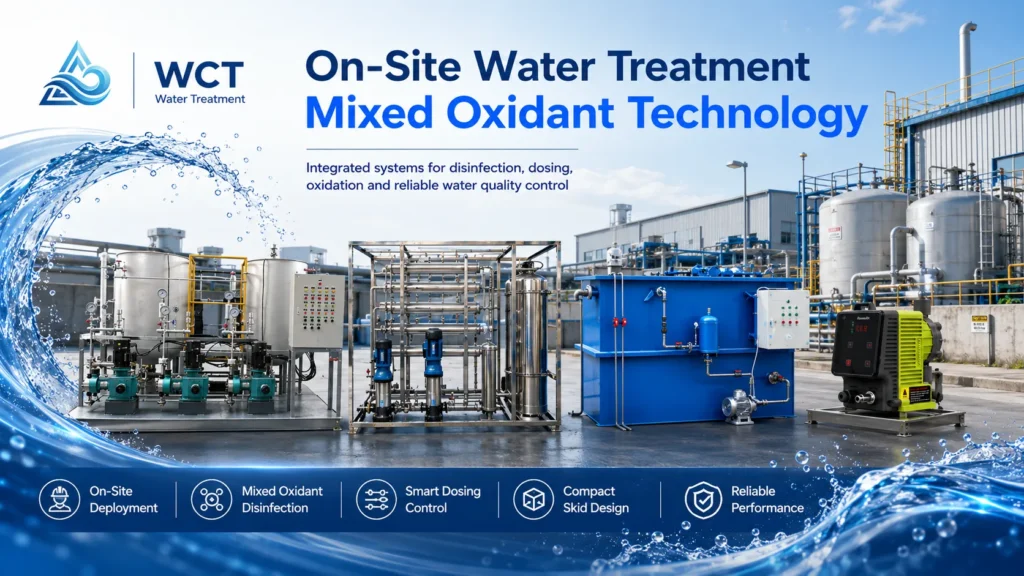
Most commercial facilities we audit still pay a premium for the privilege of storing thousands of gallons of degrading sodium hypochlorite. That math no longer works. On-site water treatment with mixed oxidant technology eliminates the bulk chemical supply chain and produces a stronger disinfectant from salt, water, and electricity — right when it’s needed.
For cooling towers, municipal plants, and commercial real estate, the switch isn’t just about safety. It’s about consistent biocidal performance against biofilm and regulatory pressure to reduce disinfection byproducts. Our engineering team has seen a 24‑month payback become the rule, not the exception, when facilities move to on‑site generation.
Understanding Mixed Oxidant Solution (MOS) and On-Site Generation
A mixed oxidant solution (MOS) isn’t just dilute bleach. It’s a blend of free chlorine, chlorine dioxide, hydrogen peroxide, and other short‑lived reactive oxygen species produced simultaneously in an electrolytic cell. This cocktail gives MOS a much higher oxidation potential than plain sodium hypochlorite at the same chlorine residual, which directly translates to faster kill rates and better biofilm penetration.
We recommend on‑site generation over delivered chemicals whenever the daily oxidant demand exceeds 10‑15 pounds of chlorine equivalent. Below that threshold the capital recovery stretches too far; above it, you’re leaving money on the table.
The Electrolytic Reaction Process
An on-site generation (OSG) system starts with three commodities: high‑purity salt, treated water, and electricity. A brine solution is fed into an electrolytic cell where a DC current drives chloride oxidation at the anode, producing chlorine gas that immediately hydrolyzes into hypochlorous acid, while the cathode generates sodium hydroxide and hydrogen. In parallel, other reactions create trace quantities of ozone, hydroxyl radicals, and hydrogen peroxide. Those trace co‑oxidants are what separate a true mixed oxidant generator from a simple sodium hypochlorite generator.
The exact oxidant profile depends on cell geometry, current density, and whether the cell uses a diaphragm membrane. That last variable matters more than any other for long‑term maintenance, which we cover next.
Membrane vs. Membraneless Electrolysis Cells
Membrane cells separate the anode and cathode compartments with an ion‑exchange membrane, preventing the hydroxide ions generated at the cathode from mixing with the acidic anolyte. This keeps brine conversion efficiency high but introduces a bottleneck: the membrane itself. Hardness ions precipitate on the membrane surface, lowering current efficiency and requiring more frequent acid washes. A tear in the membrane can take the cell offline entirely.
Membraneless cells eliminate the diaphragm. They swap the ion‑exchange separator for a clever flow pattern that maintains pH gradients hydrodynamically. The result is lower component count, lower pressure drop, and far greater tolerance for low‑grade salt or water with moderate hardness.
| Attribute | Membrane Cell | Membraneless Cell |
|---|---|---|
| Scale sensitivity | High — membrane fouling is the #1 maintenance trigger | Low — can tolerate up to 20 mg/L hardness without derating |
| Power consumption | 4.0‑4.5 kWh/kg Cl₂ | 4.5‑5.2 kWh/kg Cl₂ |
| On‑site maintenance skill | Medium — cell rebuilds require training | Low — typically automated acid wash cycles |
| Best fit | Operations with in‑house electrolysis experience or guaranteed soft water | Most commercial and industrial facilities without dedicated chemists |
All values are representative for continuous‑duty cells operating at 30‑35°C; facility‑specific water chemistry always shifts these numbers. Verify with the OEM for your feed water profile.
Operational Advantages: Why Commercial Facilities Are Replacing Bulk Chemicals
Bulk chemical handling carries hidden costs that never show up on the purchase order. On‑site generation addresses them from the first day of commissioning, and for many facility managers that alone justifies the CapEx.
Eliminating Hazardous Chemical Storage and OSHA Compliance
When you replace 12.5% sodium hypochlorite tankers or one‑ton chlorine cylinders with a salt pile and a skid‑mounted generator, the regulatory paperwork collapses. Facilities that fall under OSHA Process Safety Management (PSM) or EPA Risk Management Plan (RMP) thresholds — typically 1,500 lbs of stored chlorine or 10,000 lbs of sodium hypochlorite above 10% concentration — can drop below those thresholds permanently. No more secondary containment inspections, no more hazmat shipping manifests, no more community right‑to‑know filings.
From an insurance standpoint, we’ve helped clients cut property premiums by 5‑8% simply by removing on‑site bulk hazardous inventory. That drops straight to the bottom line.
- No off‑gassing of chlorine compounds into pump rooms or corridors
- No risk of a bulk tank failure flooding a containment area with oxidizer
- No degradation of stored chemical that forces operators to over‑dose to compensate for lost strength
Superior Pathogen and Biofilm and Pathogen Control
The mixed oxidant advantage plays out where it matters most: inside a biofilm matrix. Standard hypochlorite attacks the outer layer of polysaccharides, but mixed oxidants carry smaller, more reactive species that penetrate deep into the extracellular polymeric substance. Our field data from cooling tower side‑streams shows a 1.5‑2.0 log improvement in sessile Legionella counts within the first 30 days after switching to on‑site mixed oxidants — without changing the bulk chlorine residual target.
For multi‑family and commercial plumbing systems, that kind of kill rate translates directly into Legionella risk reduction and fewer hot water recirculation upgrades. In cooling tower disinfection applications, the savings from reduced biocide and biodispersant purchases often exceed the generating system’s lease cost.
Disinfection By-Product (DBP) Reduction and Water Quality Improvements
Facilities operating under a DBP consent order or a municipal Stage 2 Disinfectants and Disinfection Byproducts Rule will find mixed oxidants consistently outperform liquid bleach. The mechanism is straightforward: less chlorine is consumed by side reactions because the oxidants are more selective, so the formation of disinfection byproducts (DBPs) drops even while maintaining a higher overall ORP.
Minimizing Trihalomethanes (THMs) and Haloacetic Acids (HAAs)
THM and HAA formation correlates with the total mass of chlorine dosed, not just the residual measured at the tap. Because mixed oxidant systems deliver a stronger kill at the same residual, operators routinely reduce the total chlorine applied by 20‑30% while still hitting CT requirements. That lower mass input cuts TTHM formation proportionally. In chilled water loops where organics accumulate from open‑air contact, we’ve logged TTHM reductions from 65 µg/L down to 18 µg/L within three months.
Ozone‑based treatment also reduces DBPs, but it requires on‑site gas handling and contact vessels. Mixed oxidants give you a comparable oxidation potential without leaving a gaseous residual to scavenge before distribution.
Eliminating Industrial Odors and Improving Palatability
The “pool smell” that offends tenants and hotel guests isn’t chlorine — it’s chloramines formed when free chlorine reacts with ammonia. On‑site mixed oxidants break ammonia bonds earlier in the reaction sequence, keeping combined chlorine fractions below 0.2 mg/L. The finished water tastes and smells neutral, which matters enormously in Class A office towers and luxury residential where water quality complaints drive operational costs. A hydrogen peroxide‑based oxidant can achieve a similar sensory result, but lacks the durable residual needed for distribution system protection.
Assessing the Total Cost of Ownership (TCO) of On-Site Generation
Total cost of ownership (TCO) for an OSG system breaks into three fixed buckets — capital, salt, and power — against two variable ones: maintenance labor and cell replacement. The mistake we see most often is comparing the cost of a gallon of 12.5% bleach to the cost of producing an equivalent chlorine equivalent on site. That ignores freight, storage, spill response, over‑dosing, and regulatory drag.
Feedstock Logistics: Salt, Water, and Power Requirements
A modern membraneless generator consumes roughly 3.5‑4.0 lb of solar‑grade salt and 4‑5 kWh of electricity to produce one pound of mixed‑oxidant chlorine equivalent. That puts the raw material cost at $0.30‑$0.45/lb Cl₂, compared to $0.90‑$1.50/lb for delivered 12.5% bleach in many regions. Salt storage is dense, non‑hazardous, and shelf‑stable; a single sack shelf can hold a month’s worth of feedstock without any inventory spoilage risk.
Water quality matters. Hardness above 15 grains requires a softener upstream of the brine tank, which adds roughly $0.03‑$0.05/lb Cl₂ to operating cost and must be factored into the site assessment.
Operational ROI and Maintenance Overhead
We generally see payback periods between 18 and 36 months for facilities consuming more than 30 pounds of chlorine per day. The table below models a representative 200‑ton cooling tower plant moving from bulk 12.5% bleach to a 25‑lb/day membraneless OSG.
| Cost Factor | Bulk Sodium Hypochlorite | On‑Site Mixed Oxidant |
|---|---|---|
| Delivered chemical cost (annual) | $26,000 | — |
| Salt + power + softener salt (annual) | — | $8,200 |
| Freight and fuel surcharges | $3,200 | $0 |
| Cell replacement reserve (annualized) | — | $2,400 |
| Insurance & compliance burden | $1,800 | $400 |
| Total annual OPEX | $31,000 | $11,000 |
Data based on U.S. Gulf Coast region pricing, 2024. Actual numbers vary with local salt and power rates. Always request a site‑specific pro forma from the vendor.
In this scenario, a $45,000 installed system recovers its capital in roughly 27 months. After year two, the facility saves $20,000/year in unescalated dollars — and the bleach price keeps climbing while salt stays flat.
Engineering and System Integration in B2B Operations
An on‑site generator is a chemical production plant in miniature. Its real value shows when it gets tied into the facility’s control architecture, not just wired to a start‑stop switch.
Scalability Across Multi‑Unit and Large‑Scale Facilities
Modular cell‑stack designs let us scale from a single 50‑gpm cooling tower loop to a municipal water disinfection plant producing 2,000 lb/day of chlorine equivalent. The building blocks are the same — 10‑slot or 20‑slot cell racks with common rectifiers — so a multi‑site commercial real estate portfolio can standardize on a single platform and adjust cell count per building. That keeps spare parts inventory lean.
For industrial water treatment applications where flow rates fluctuate widely, we design the system for peak‑day demand but operate it at turndown ratios up to 5:1 by modulating current density. No chemical dealer can match that kind of on‑demand production without a call‑ahead.
Automated Monitoring and Remote System Controls
Every generator we specify today should talk to the BMS or SCADA network over Modbus TCP or BACnet/IP. Operators need to see cell voltage, brine flow, salt level, and amperage from a central dashboard. Alarm‑out for high stack temperature or low brine prevents a midnight wet‑floor call. With the right programming, the system can automatically throttle production based on ORP or free‑chlorine readings, just like a chemical metering pump — only without the fluctuating feed strength of degrading bleach.
A UV disinfection system can supplement the residual, but UV leaves no downstream protection. Mixed oxidant, with its stable hypochlorite backbone, retains a measurable residual that confirms dose adequacy all the way to the furthest outlet.
Regulatory Compliance and Procurement Verification Guidelines
Buying an on‑site generator is a capital asset decision, not a commodity chemical rebid. The compliance landscape varies by state and country, but there are universal items every procurement team must verify.
Evaluating Local Environmental and Safety Ratings
Start with the obvious: confirm the generator and its wetted components carry NSF/ANSI 61 certification if you’re treating potable water. For global projects, look for DWI Regulation 31 acceptance (UK/Commonwealth) or equivalent. These aren’t optional; they’re gatekeeping documents for the commissioning sign‑off.
Also check whether your jurisdiction treats the generator as a minor source under air quality rules. Some electrolytic cells produce trace hydrogen that vents to atmosphere; most codes exempt it, but a high‑capacity array may require a simple hydrogen sensor and dilution fan. That’s a few thousand dollars to add, not a deal‑breaker, but it must be in the bid scope.
Vendor Evaluation Checklists for Commercial Implementations
We always recommend buyers request these three items before short‑listing an OSG vendor:
- Reference sites with matching water chemistry. A plant treating soft Lake Michigan water won’t prepare you for a well‑fed system with 300 ppm silica. Ask for two reference sites within 50 miles with similar raw water.
- Pilot‑run data. A two‑week trial with a rental unit can validate cell duty cycle and salt consumption against the vendor’s pro forma. If the supplier won’t offer a pilot, walk away.
- A full lifecycle service agreement (LSA) proposal. The LSA should cover cell acid washes, replacement electrode stacks, and remote monitoring — not just a warranty that excludes wear parts.
Integrating on‑site water treatment solutions into a facility is a partnership, not a transaction. Our engineers typically spend two days on site before a quote, measuring water quality, electrical capacity, and salt storage logistics.
Designing a Custom On-Site Disinfection Program
No two water systems are identical, and the right oxidant dose can’t be guessed from a spec sheet. Before you contact any technology provider, gather a handful of data points that define your facility’s operational envelope.
We suggest preparing a one‑page brief that includes your daily peak and average water flow, current monthly chemical spend (all‑in, including hazmat charges), a recent raw‑water analysis for pH, TDS, and hardness, and a floor‑plan sketch showing available square footage for a skid‑mounted unit and salt storage pallet. That information lets a supplier return a preliminary sizing and budget within a week.
Once the basic economics are clear, the next step is a short‑term pilot. At that stage, you’ll validate the cell production rate against actual chlorine demand, adjust the programming to your BMS setpoints, and confirm that the DBP or biofilm‑reduction targets you set are achievable. Our product line includes fully instrumented rental units specifically for this kind of pre‑purchase validation, so the risk of deployment stays on our side.
Frequently Asked Questions
How does mixed oxidant technology differ from standard liquid bleach?
Standard liquid bleach degrades quickly in storage, losing concentration within weeks. On‑site generated mixed oxidants are produced fresh on‑demand, maintain consistent efficacy, and contain trace co‑oxidants that destroy biofilm far more effectively than sodium hypochlorite alone.
What feedstocks are required for on‑site mixed oxidant generation?
The process requires only clean water, electricity, and high‑purity salt (sodium chloride). No hazardous chemical precursors are needed.
Can on‑site mixed oxidant systems handle high‑demand industrial wastewater?
Yes. These systems are highly scalable and can be configured with large‑capacity electrolytic cells to meet the high biological oxygen demand (BOD) and sanitization requirements of industrial and municipal wastewater plants.
How often do the electrolytic cells require maintenance?
Maintenance typically involves periodic acid‑washing (de‑scaling) of the cells, which can be automated or done manually depending on raw water hardness and system design. High‑quality systems use self‑cleaning cells to minimize manual touchpoints.
Is on‑site generation of mixed oxidants safe for drinking water systems?
Yes, it is widely used for potable water systems. Procurement teams should verify that the specific generator and components meet local drinking water standards (e.g., NSF/ANSI Standard 61 or local regulatory listings) for their market.