Understanding Membrane Fouling Mechanisms
Are you constantly battling permeate flux decline and unexpected downtime in your industrial water purification systems? Effective ultrafiltration fouling control starts with dissecting the exact mechanisms degrading your filtration media. At WCT, we know that accurately diagnosing the root cause is the critical first step toward stabilizing operational metrics and extending the lifespan of your hollow fiber membranes.
Categorizing the Threat: Reversible vs. Irreversible Fouling
Membrane degradation operates on a distinct spectrum, directly impacting your water treatment plant operational costs:
- Reversible Fouling: This surface-level accumulation can be efficiently managed and dislodged using standard physical cleaning methods, such as backwash optimization techniques and targeted air scouring.
- Irreversible Membrane Fouling: A severe, costly threat where foulants embed deep within the membrane pores. Removing this requires aggressive chemical interventions, like a chemically enhanced backwash (CEB), and persistently degrades overall membrane bioreactor (MBR) efficiency over the system\’s lifecycle.
Core Types of Ultrafiltration Fouling
To engineer precise membrane cleaning protocols, we must systematically categorize the contaminants aggressively targeting your system:
- Organic Fouling: Driven by natural organic matter (NOM) adsorbing and attaching to the membrane surface.
- Inorganic Scaling: The precipitation of dissolved salts and minerals (such as calcium and magnesium) that form hard, stubborn crystalline scale.
- Colloidal Fouling: The dense accumulation of fine, suspended non-biological particles like clay, silt, and silica that physically block pore channels.
- Biofouling: The aggressive proliferation of bacteria and robust biofilms. Implementing stringent biofouling prevention strategies is mandatory, as this represents one of the most resilient challenges in industrial water treatment.
Transmembrane Pressure (TMP) Monitoring for Early Detection
Waiting for a catastrophic drop in clean water production is a reactive, expensive mistake. Transmembrane Pressure (TMP) monitoring is the ultimate diagnostic tool for early detection. As foulants accumulate, the pressure required to force feed water through advanced hollow fiber membranes inherently spikes. By rigorously tracking TMP fluctuations, operators can pinpoint the exact moment fouling begins. This data-driven approach allows facilities to deploy preemptive cleaning protocols long before reversible build-up escalates into irreversible structural damage.
Material Science Innovations in UF Membranes
To master ultrafiltration fouling control, we have to start at the material level. The physical makeup of the membrane dictates how easily foulants stick to it and how efficiently the system operates over time. By pushing the boundaries of material science, we are creating filtration barriers that actively resist degradation and extend operational lifespans.
Upgrading to Advanced Hollow Fiber Membranes
Hydrodynamics play a massive role in system efficiency. We utilize advanced hollow fiber membranes designed to optimize water flow and reduce the physical stress on the membrane structure. This specific architecture minimizes dead zones where foulants typically accumulate, directly supporting long-term stability. Constantly updating our industry knowledge ensures these hollow fiber designs meet the rigorous demands of modern industrial water purification systems.
Innovations in Surface and Matrix Materials
We tackle the root causes of fouling through targeted material upgrades:
- Hydrophilic Membrane Surface Modifications: We engineer ultra-hydrophilic surfaces that naturally attract water while actively repelling stubborn organic foulants. This material shift significantly slows down permeate flux decline.
- Nanocomposite UF Membranes: By embedding advanced nanomaterials directly into the polymer matrix, we give the membranes inherent antimicrobial properties. This neutralizes bacterial growth on contact, shutting down biofouling before it can compromise the system.

Operational Innovations for Smarter System Management
Upgrading membrane materials is only half the battle; how you run the system dictates its actual lifespan. As a manufacturer of advanced water purification systems, we integrate operational innovations that actively prevent ultrafiltration fouling control issues before they escalate.
By moving away from rigid, traditional operating parameters, we help facilities implement smarter, dynamic controls:
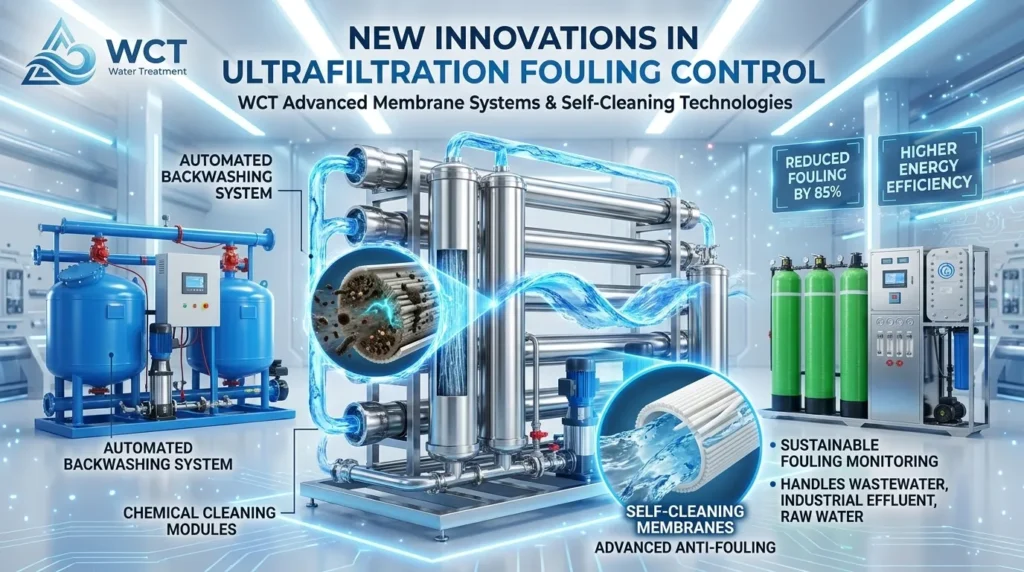
- Real-Time Backwash Optimization: Modern backwash optimization techniques analyze incoming feed water quality in real time. Instead of flushing the system on a strict timer, backwashing only occurs exactly when needed. This preserves permeate flux, saves clean water, and drastically reduces water treatment plant operational costs.
- Upgraded Fluid Dynamics: By fine-tuning air scouring and cross-flow filtration hydrodynamics, we create the ideal level of physical turbulence. This targeted agitation efficiently lifts organic foulants and particulates right off the hollow fiber membranes without putting excess mechanical stress on the fibers themselves.
- Eco-Friendly CEB Upgrades: A routine Chemically enhanced backwash (CEB) is critical for dissolving stubborn biological and inorganic buildup. However, we are now shifting toward eco-friendly CEB upgrades. By sourcing sustainable, lower-toxicity cleaning agents through a trusted water treatment chemical distributor, facilities can maintain pristine membranes while easily meeting strict environmental discharge regulations.
Digital Integration: AI and Predictive Maintenance
The future of ultrafiltration fouling control relies on digital intelligence. We are moving beyond reactive maintenance into an era where artificial intelligence and smart sensors dictate system operations, ensuring maximum uptime and efficiency.
Real-Time Transmembrane Pressure (TMP) Monitoring
Relying on manual gauge readings is no longer sufficient for modern facilities. We equip our systems with IoT sensors for continuous Transmembrane Pressure (TMP) monitoring.
- Instant Data Transmission: Sensors stream live pressure data directly to centralized control dashboards.
- Early Anomaly Detection: Micro-fluctuations in pressure trigger automated alerts long before permeate flux declines drastically.
- Cost Efficiency: Catching fouling in its infancy significantly lowers overall water treatment plant operational costs by reducing unplanned downtime and extending membrane lifespan.
Predictive Analytics and Smart Membrane Cleaning Protocols
Machine learning algorithms analyze historical and real-time TMP data to predict exactly when a membrane will foul. Instead of running backwashes on a rigid, inefficient schedule, predictive analytics trigger preemptive membrane cleaning protocols based on actual system needs.
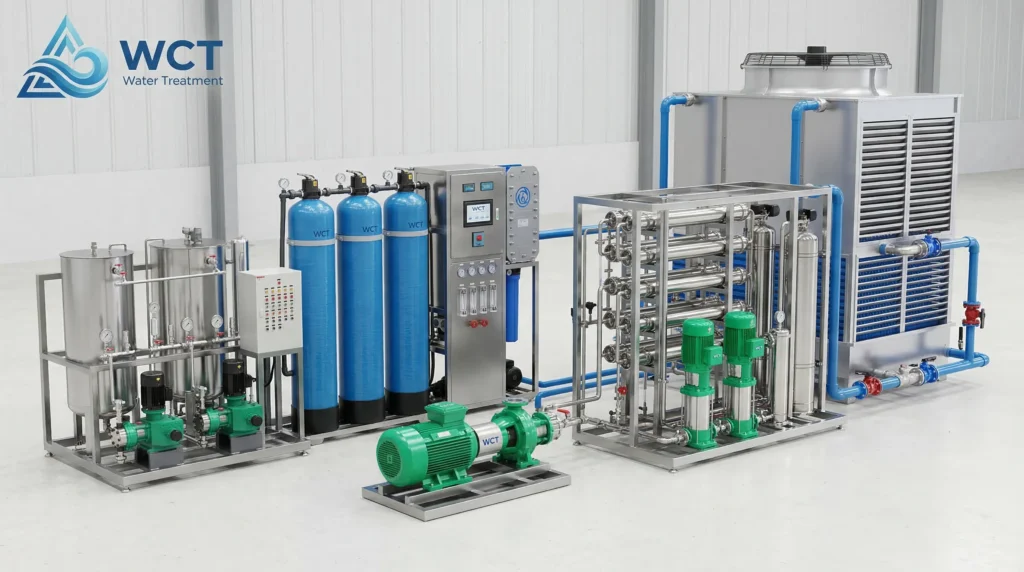
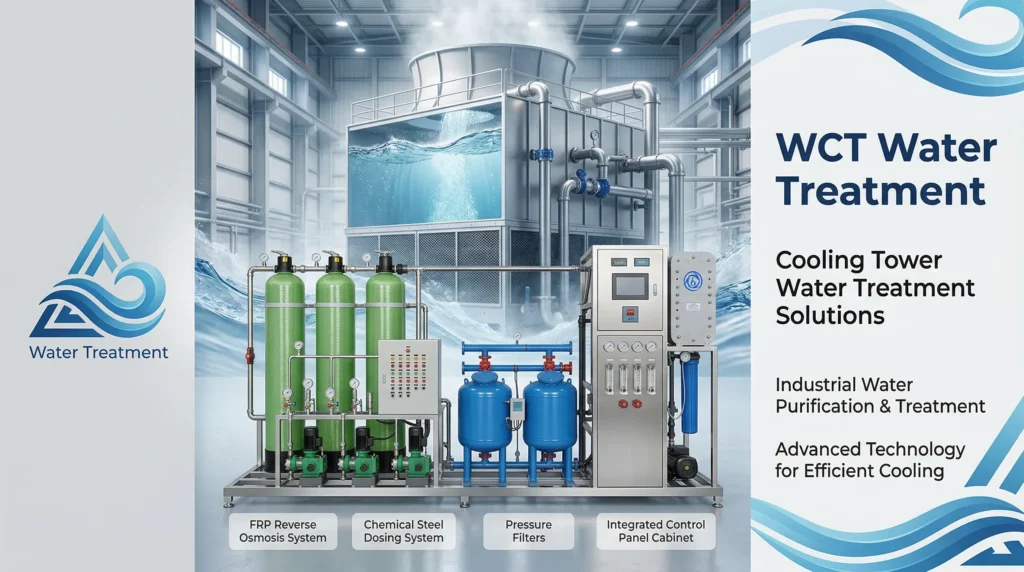
When the AI initiates a smart cleaning cycle, automated and accurate chemical delivery becomes the most critical step. Our predictive setups integrate seamlessly with robust dosing hardware. For example, utilizing a durable WCT Chemical Dosing Tank with PE/304 Stainless Steel ensures that the exact required volume of cleaning agents is safely stored and ready for immediate deployment. Coupled with precision electromagnetic diaphragm metering pumps, the system automatically executes flawless chemical dosing, effectively neutralizing organic foulants and halting irreversible membrane fouling before it starts.

The WCT Advantage in Fouling Mitigation
As a dedicated water treatment supplier and manufacturer, we tackle membrane performance issues head-on. Our approach to ultrafiltration fouling control focuses on practical, long-lasting solutions tailored to keep your operations running smoothly without unnecessary downtime.
We deliver concrete results through targeted engineering and high-quality materials:
- Proprietary System Integration: We seamlessly integrate advanced hollow fiber membranes into our robust industrial water purification systems. This specific combination enhances hydrodynamics and maintains a stable permeate flux, even in demanding environments.
- Customized Feed Water Engineering: There is no one-size-fits-all in water treatment. We engineer and customize every setup based on the exact municipal or industrial feed water profiles you are dealing with. By understanding the specific organic or inorganic load, we effectively prevent irreversible membrane fouling before it starts.
- Built for Reliability: Our focus remains on lowering overall water treatment plant operational costs. By matching the right membrane technology to your specific water profile, we maximize the lifespan and efficiency of your entire filtration setup.
FAQs on Ultrafiltration Fouling Control
What is the most effective way to prevent biofouling in UF systems?
When deploying biofouling prevention strategies, relying on a single method is rarely enough. The most effective defense starts at the material level by utilizing advanced hollow fiber membranes designed with an ultra-hydrophilic membrane surface. This specialized surface naturally repels organic foulants and prevents microorganisms from anchoring to the membrane. Pairing these advanced materials with precise pre-treatment and routine, optimized chemically enhanced backwash (CEB) cycles ensures that biological contaminants are neutralized and flushed out before they can multiply and restrict flow.
How does backwash optimization reduce water treatment plant operational costs?
Implementing modern backwash optimization techniques directly protects your facility\’s bottom line. Traditional systems run on fixed timers, often executing backwash cycles when the membranes are still clean. This wastes valuable clean water, energy, and cleaning chemicals. By adjusting backwash frequency and intensity based on real-time water quality and fouling conditions, facilities drastically reduce unnecessary downtime and chemical consumption. This data-driven approach significantly lowers overall water treatment plant operational costs while easily integrating into various industrial water treatment processes to maintain high continuous output.
Can AI predictive maintenance completely stop irreversible membrane fouling?
While no technology can completely halt the physical aging of materials over years of use, AI predictive maintenance dramatically reduces the occurrence of irreversible membrane fouling. Instead of reacting to a sudden permeate flux decline, AI systems use continuous Transmembrane Pressure (TMP) monitoring to detect microscopic flow restrictions.
- Early Intervention: The AI flags potential fouling buildup hours or days before it becomes a serious issue.
- Targeted Cleaning: It triggers precise membrane cleaning protocols based on the exact type of fouling detected.
- Asset Protection: By acting preemptively, it stops reversible fouling from hardening into permanent blockages, ultimately extending the service life of your ultrafiltration modules.