Are you worried about what is actually lurking in your tap or well water?
You might already know that traditional chemical disinfection leaves behind bad tastes, odors, and harmful byproducts…
But what is the safest, most effective alternative?
Well, you\’re in for a treat because I\’m going to break down everything you need to know about UV light water treatment.
As water quality experts, we know that investing in the right ultraviolet sterilization system is a massive game-changer for your health and peace of mind—especially if you rely on private well water.
In this guide, you\’re going to learn exactly how chemical-free water disinfection works, step by step.
We will cut through the technical jargon, explore the proven science behind UV-C water purification, and show you exactly how to choose the perfect whole house UV water filter for your needs.
So if you\’re looking for safe, crystal-clear water without the harsh chemicals, this guide is for you.
Let\’s dive right in.
What is UV Light Water Treatment?
Are you constantly worrying about unseen bacteria lurking in your family\’s drinking water, or dealing with the stress of frequent municipal boil-water advisories? You are not alone. When people ask me for a reliable, chemical-free way to secure their water supply, I always point them toward UV light water treatment.
A Simple Definition
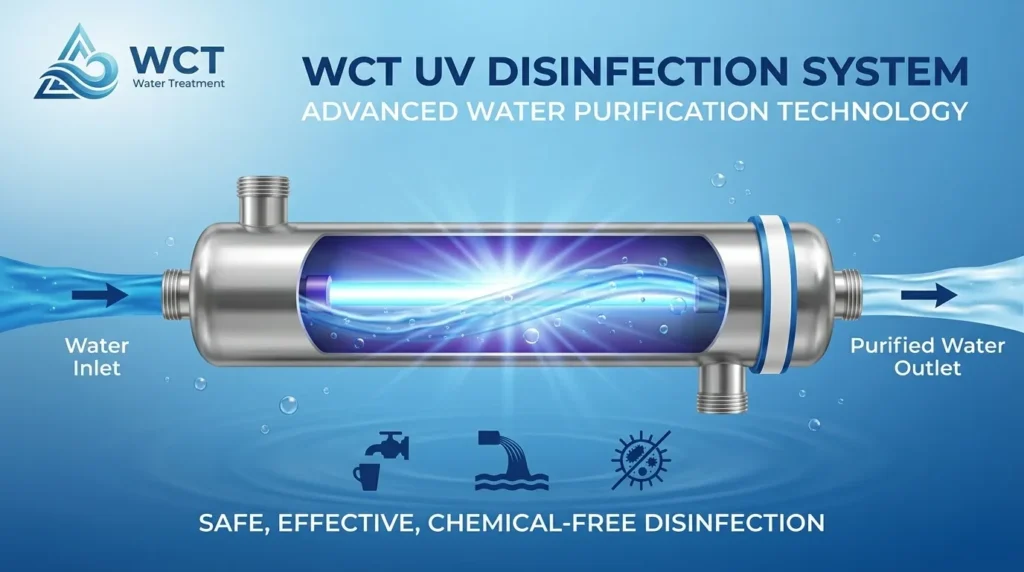
At its core, UV-C water purification is exactly what it sounds like: using a specific, powerful type of light to make water safe to drink. Instead of dumping harsh chemicals like chlorine into your plumbing, an ultraviolet sterilization system simply exposes water to concentrated light rays. This light acts as a microscopic shield, instantly neutralizing harmful bacteria, viruses, and parasites as the water flows through the chamber. It is clean, silent, and highly effective.
From City Plants to Your Home
While it might sound like space-age technology, UV disinfection has been a cornerstone of global public health for decades.
- The Early Days: Originally, this technology was heavily relied upon in massive, large-scale municipal water treatment plants to protect entire cities without altering the water\’s taste.
- Today\’s Accessibility: Thanks to modern engineering, we have scaled this exact same commercial-grade technology down. Today, highly efficient and compact UV systems are widely accessible for everyday use.
Whether you are managing a small commercial facility or just want to protect your home\’s private well water, you can now get that same municipal-level protection right at your own faucet.
The Science Behind UV Light Water Treatment
At the core of an effective ultraviolet sterilization system is invisible light. We specifically utilize the UV-C spectrum, dialing into the exact 254 nm wavelength. At this frequency, the light carries the perfect amount of energy to neutralize microscopic threats in your water supply.
Here is exactly how the process protects your water:
- Cell Wall Penetration: The high-intensity UV light pierces directly through the outer cell walls of waterborne pathogens.
- DNA Disruption: Once inside the cell, the UV energy attacks and scrambles the organism\’s DNA.
- Complete Neutralization: Without intact DNA, these organisms are instantly deactivated. They cannot reproduce or cause illness, guaranteeing reliable E. coli and coliform removal.
Sterilization vs. Physical Filtration
It is important to understand that UV-C water purification deactivates biological threats rather than physically filtering them out. The neutralized microbes safely pass through the system completely harmless.
However, because the UV light must physically \”see\” the bacteria to destroy its DNA, the water needs to be clear of dirt, rust, or sediment. Shadows created by floating debris can hide bacteria from the light. This is why we always pair a UV chamber with a reliable precision filter for water treatment to catch physical particles and ensure the water is crystal clear before it is sterilized.
Pros and Cons of UV Water Purification
When I talk to customers about UV light water treatment, I always emphasize that it is highly effective, but it is not a cure-all. Understanding its exact strengths and weaknesses is the only way to build a system that actually protects your home or business.
The Advantages: Safe and Efficient
The benefits of UV-C water purification make it a top choice for modern water safety. It is a clean, straightforward technology.
- Chemical-free water disinfection: Unlike traditional municipal processes or a heavy-duty chemical dosing system for water treatment, UV relies entirely on light. You are not adding chlorine, chloramines, or any other chemicals to your daily water supply.
- Preserves natural taste: Because no chemicals are added during the process, your water tastes and smells exactly as it naturally should.
- Zero wastewater: The system does not flush or reject any water down the drain, making it highly eco-friendly.
- Low energy consumption: A standard whole house UV water filter operates continuously but uses roughly the same amount of electricity as a standard 40-watt light bulb.
The Limitations: What UV Cannot Do
To get the best results from your setup, you need to be realistic about where ultraviolet sterilization systems fall short.
- Requires constant electricity: The system relies entirely on power. If the electricity goes out, the UV lamp turns off, and any water flowing through the chamber is no longer treated.
- Demands clear water: High water turbidity is the enemy of UV treatment. If the water contains sediment, dirt, or cloudiness, pathogens can hide behind those physical particles, effectively shielding themselves from the light.
- Does not remove physical contaminants: UV deactivates living organisms like bacteria and viruses. It does absolutely nothing to extract heavy metals, dissolved solids, salts, or man-made chemicals from the liquid.
Because of these limitations, running raw, unfiltered water directly through a UV chamber is never a good idea. You must ensure the water is physically clean before it gets sterilized.
The Crucial Role of Pre-Filtration in UV Systems
While UV light water treatment is highly effective, it simply cannot work alone. Ultraviolet light requires a completely clear path to reach and deactivate pathogens. If the water entering the system isn\’t visually clear, the purification process will fail.
The Problem of \”Shadowing\”
When water contains suspended particles, dirt, or high turbidity, bacteria and viruses can literally hide behind these tiny solids. This \”shadowing\” effect blocks the ultraviolet rays, allowing dangerous microorganisms to pass right through the chamber unharmed. Managing water turbidity and pre-filtration is an absolute must.
Essential Pre-Treatment Filters
To guarantee your sterilization system performs perfectly, you must physically clear the water before it ever enters the UV reactor.
- Sediment Filters: Remove the dirt, rust, and sand that cause shadowing.
- Carbon Filters: Strip out chlorine, bad odors, and chemicals.
- RO Systems: For the absolute highest level of water purity, combining reverse osmosis and UV is the industry standard. Running the water through a robust setup, such as a 500 LPH RO system for water treatment, ensures only crystal-clear water reaches the UV light.
Hard Water and Glass Scaling
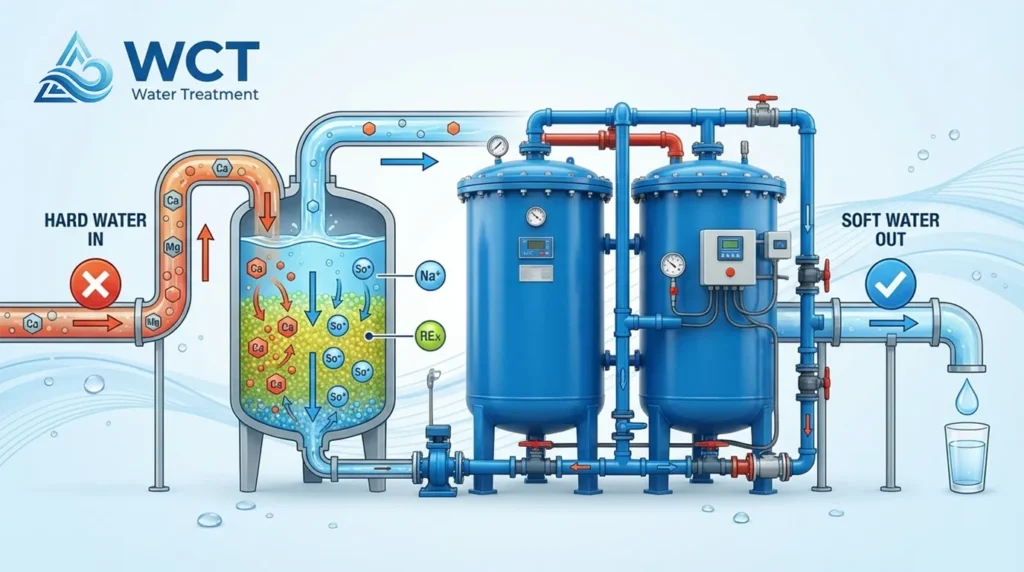
Inside the chamber, the UV lamp is protected by a clear glass tube called a quartz sleeve. If you run hard water through the system, calcium and magnesium will quickly bake onto this glass, forming a cloudy white scale. This scale effectively acts as a blindfold, blocking the UV light from penetrating the water stream. If your source water is hard, installing a water softener beforehand is critical to prevent this buildup and reduce the need for constant quartz sleeve maintenance.
Do You Need a UV Light Water Treatment System?
Determining if your property requires UV light water treatment usually comes down to your primary water source. Both private and municipal supplies have unique vulnerabilities that ultraviolet light solves perfectly.
Private Well Water Treatment
If your home relies on a private well, installing a UV system is not just an upgrade—it is a necessity.
- No Chemical Safety Net: Unlike city water, well water lacks municipal chlorination. You are entirely responsible for eliminating bacteria and waterborne pathogens.
- Groundwater Vulnerability: Aquifers and wells are susceptible to environmental changes. Heavy rainfall, snowmelt, or nearby agricultural runoff can introduce harmful microorganisms into your supply overnight. An ultraviolet sterilization system acts as a constant, reliable firewall for your home.
Municipal Water Security
Even though city water undergoes chemical disinfection at the plant, a UV system provides crucial secondary protection at your tap.
- Boil-Water Advisories: Aging infrastructure and unexpected pipe breaks frequently compromise city water. A UV setup ensures your drinking water remains safe, even when the local grid fails.
- Chlorine-Resistant Cysts: Standard municipal chlorine treatments often struggle to deactivate resilient threats like Giardia and Cryptosporidium. UV light destroys these hard-to-kill pathogens instantly.
Whether you are securing a rural homestead or fortifying a suburban home, browsing our complete range of high-performance water treatment products is the smartest step toward securing a flawless water supply.
Choosing Your UV Light Water Treatment Setup: Whole-House vs. Point-of-Use
When investing in a UV light water treatment system, the right setup depends entirely on your daily water usage and where you need protection most. We generally break these down into two main configurations:
Whole-House (Point-of-Entry)
If you rely on a private well or manage a commercial property, a whole house UV water filter is the safest choice.
- Complete Property Coverage: Installed directly where the main water line enters the building.
- Every Tap Secured: Ensures that water from the kitchen, shower, and bathroom sink is completely sterilized before it ever reaches you.
Under-Sink (Point-of-Use)
If you are on municipal water and only want to guarantee the safety of your drinking and cooking water, a compact under-sink UV purifier is highly efficient.
- Targeted Protection: Installs directly under a specific, dedicated faucet.
- The Ultimate Combo: This setup is almost always paired with reverse osmosis. By running the water through a high-quality ULP series RO membrane first, you remove the dissolved solids and sediment, ensuring the water is perfectly clear so the UV light can do its job flawlessly.
Sizing Matters: Match Your Flow Rate
You cannot just pick a UV unit off the shelf. The speed at which water travels through the system is critical for deactivating pathogens.
- Calculate Your Peak Demand: You must know your maximum flow rate in Gallons Per Minute (GPM).
- Ensure Proper Exposure: The UV dose and flow rate (GPM) dictate the exact size of the UV reactor needed. If water flows too quickly through the chamber, microorganisms will slip by without getting a lethal dose of UV light. We always recommend sizing your system to slightly exceed your peak household or commercial water demand.
UV Light Water Treatment Maintenance
To keep your system neutralizing waterborne pathogens, regular upkeep is completely non-negotiable. Whether it is a home setup or one of our large-scale water treatment projects, sticking to a strict schedule is the only way to guarantee safe, clean water year-round.
Here is what you need to track to keep your system running at peak performance:
UV Lamp Replacement
- The 12-Month Rule: You must replace the bulb every 9,000 to 10,000 hours (roughly one year of continuous use).
- The \”Blue Light\” Myth: Just because the lamp still visibly glows blue does not mean it is actually working. After a year, the invisible UV-C intensity drops significantly, meaning it no longer has the power to deactivate bacteria.
- Action: Swap the bulb annually to maintain the correct UV dose for safe water.
Quartz Sleeve Maintenance
- Function: This clear glass tube houses and protects the UV lamp. It must remain 100% transparent for the light to do its job.
- The Threat: Hard water minerals, scale, and iron can easily cloud this glass, physically blocking the UV rays from penetrating the water.
- Action: Inspect and carefully clean the glass with a mild acid (like white vinegar or a dedicated scale remover) every time you change the bulb. If the sleeve becomes permanently frosted or scratched, replace it immediately to maintain maximum light transmittance.
Why Trust WCT for Your UV Light Water Treatment Solutions?
When investing in a system to protect your water supply, reliability is non-negotiable. At WCT, we understand the critical nature of clean water. We are committed to designing and producing water treatment products that deliver consistent, safe, and effective results.
Here is exactly why global customers rely on us for their water purification needs:
- 12 Years of Proven Experience: We bring over a decade of hands-on industry expertise to the table. We have spent years refining our UV light water treatment systems to ensure they meet the demands of real-world applications.
- ISO9001 Certified Quality: We do not guess when it comes to manufacturing. Our production facilities operate under strict ISO9001 international standards, guaranteeing that every unit we ship is built for safety and durability.
- Driven by Innovation: Our systems are backed by a dedicated team of over 20 R&D engineers who continuously push the boundaries of water purification technology.
- Patented Technology: With more than 30 patents to our name, our commercial and consumer products stand out for their advanced engineering, ensuring high-performance chemical-free water disinfection.
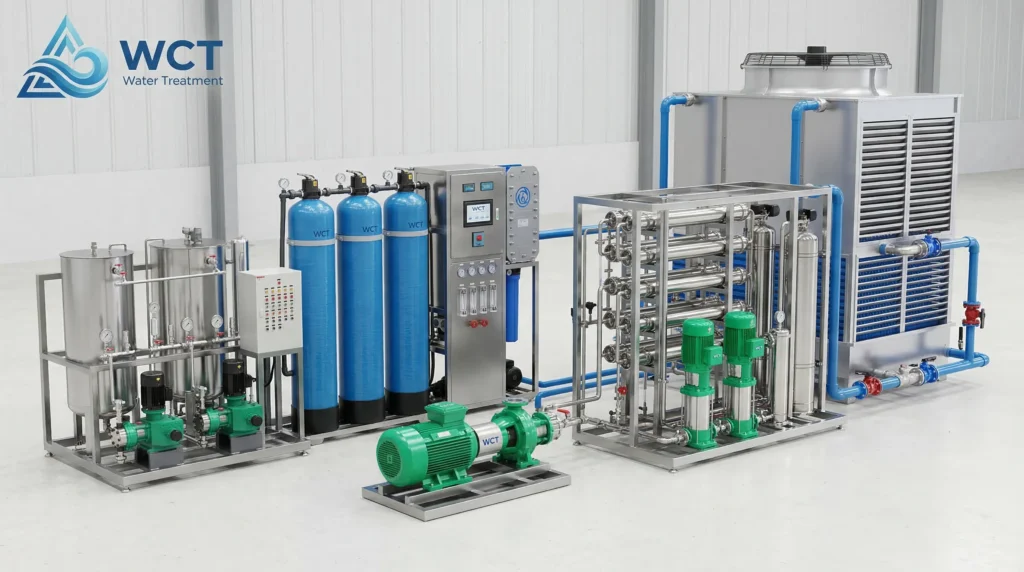
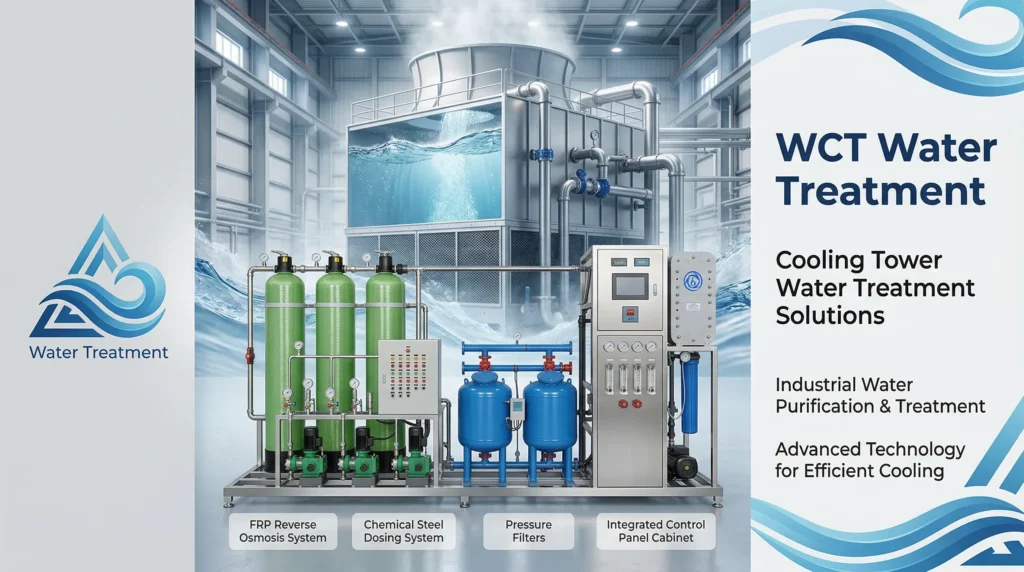
- Tailored, One-Stop Solutions: We do not just sell standalone filters; we provide complete systems engineered for your specific environment. Whether you require a specialized residential setup or comprehensive industrial water sterilization complete with high-precision electromagnetic diaphragm metering pumps and reliable chemical dosing tanks, we design exactly what you need to get the job done right.
Whether you are securing a private well or scaling up a commercial operation, our mission remains the same: delivering high-quality, dependable solutions that give you total confidence in your water quality.