Total suspended solids in water are that fraction of particulate matter large enough to stay in the water column rather than dissolving.
An engineer’s first practical cutoff is simple: if a particle is bigger than 2 microns and can be captured on a standard glass fiber filter, it counts as TSS.
Below that threshold you are usually measuring turbidity or total dissolved solids, and the treatment approach changes.
Technical Definition and Particle Size Thresholds
Total suspended solids are defined operationally. Anything that passes through a 2-micron filter is considered dissolved or colloidal, not suspended.
That 2-micron boundary is what separates TSS from turbidity as a laboratory endpoint. In the field, turbidity probes can approximate suspended solids, but the reference method remains the filter.
Not all large particles stay suspended. Settleable solids drop out under quiet conditions within an hour, while suspended solids can remain distributed for much longer.
This distinction matters when sizing a clarifier or sedimentation basin. A sample with 200 mg/L TSS but only 10 mL/L settleable solids tells you the particles are light, organic, or colloidal, pushing the design toward chemical coagulation rather than simple gravity.
TSS vs. TDS vs. Turbidity: Key Parameter Differences
These three water clarity parameters are frequently mixed up in monitoring reports. Total suspended solids measure dry mass of filterable particles. Turbidity measures light scatter and is a surrogate, not a direct mass value.
Total dissolved solids capture ions and small organics that will never settle or filter out on a 2-micron media. Knowing which parameter matters depends on what the downstream process will punish you for.
| Parameter | Definition | Particle Size Range | Typical Unit | Standard Analytical Method |
|---|---|---|---|---|
| TSS | Dry weight of particles retained on a glass fiber filter | >2 microns | mg/L | Gravimetric, EPA 160.2 / SM 2540 D |
| TDS | Dissolved ions and small organic molecules | <2 microns (pass through filter) | mg/L | Gravimetric after evaporation, or conductivity conversion |
| Turbidity | Optical measurement of light scattered by suspended particles | Colloidal to large suspended | NTU (Nephelometric Turbidity Units) | Photometric, EPA 180.1 / ISO 7027 |
When you weigh a filter after drying, you get TSS mass. When you shine a light through the sample, you get turbidity intensity.
A photometric reading can correlate with TSS for a given water source, but the relationship shifts with particle size distribution and color. Therefore, sedimentation for TSS removal rarely relies on turbidity alone for process control.
Standard Measurement and Calculation Methods
Laboratory Filtration and Drying Process
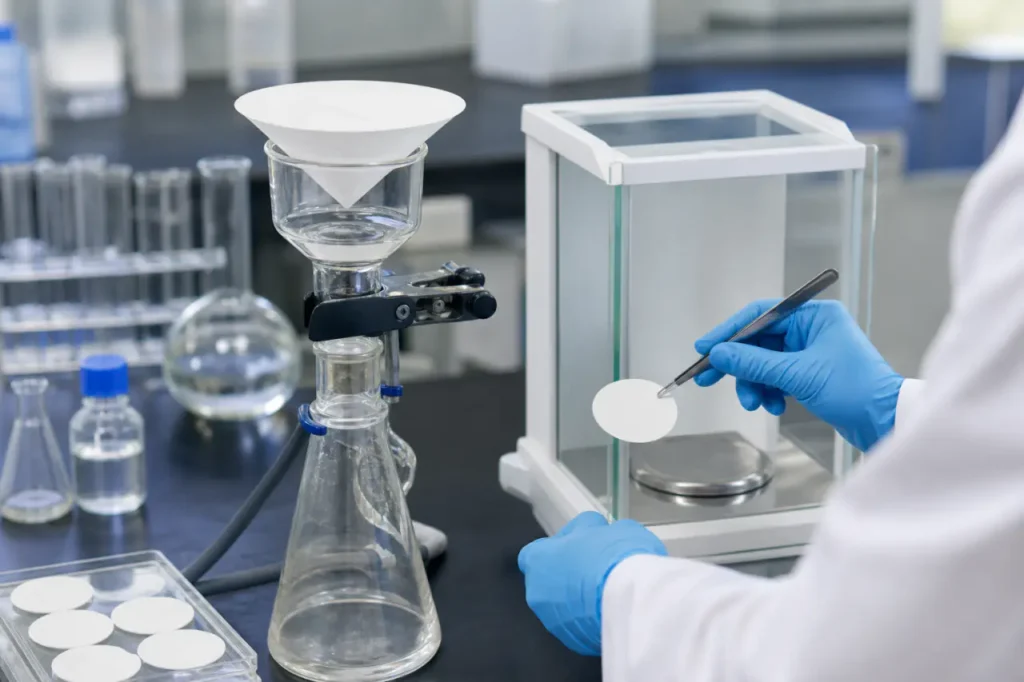
The reference method is gravimetric, and almost every discharge permit is built around it. The standard laboratory procedure includes:
- Use a pre-weighed glass fiber filter (typically 1.5-micron pore size) and filter a known volume of well-mixed sample under vacuum or pressure.
- Dry the filter to constant weight at 103-105°C in a laboratory oven.
- Cool in a desiccator and weigh on an analytical balance with 0.1 mg resolution.
- Calculate TSS from the weight difference and sample volume.
Field sampling matters as much as lab technique. A grab sample that misses the coarse, fast-settling fraction will under-report TSS.
Typical practice is to shake the sample container vigorously, pour a measured volume into the filtration apparatus, and rinse the graduated cylinder with deionized water to capture all solids.
Incomplete rinsing or a filter that was not properly desiccated before weighing are common data-quality failures in many plants.
The TSS Calculation Formula
The calculation itself is a dry-weight difference over sample volume, but units must be handled carefully to match regulatory reporting. The standard formula is:
TSS (mg/L) = [(Weight of filter + dried residue in grams) – (Weight of empty filter in grams)] / Volume of sample filtered in liters
To convert to mg/L when the sample volume is in milliliters, multiply by 1,000. A common workflow is to filter 100 mL of sample for typical municipal influent and use a microbalance sensitive to 0.0001 g.
For very clean effluent, filter 1 liter to obtain a weighable residue. The critical quality-control step is ensuring the blank correction from filter handling and drying is below 0.5 mg.
Primary Causes and Sources of Elevated TSS
High TSS readings in a treatment plant or receiving water point to a handful of predictable sources.
The split between inorganic and organic drivers changes the treatment logic: settling works well for sand and silt; coagulation helps with clay; biological treatment or dissolved air flotation handles the rest.
Inorganic Sources
- Silt and clay from construction site runoff, agricultural fields, and streambank erosion.
- Gravel and sand mobilized during high-flow storm events or dredging operations.
- Industrial particulate from mining, quarrying, and metal finishing that adds abrasive mineral solids.
Organic Sources
- Algae blooms that raise TSS rapidly during warm, nutrient-rich conditions.
- Decaying plant matter and leaf litter washed into intake structures after seasonal turnover.
- Bacterial flocs and waste-activated solids escaping secondary clarifiers in wastewater treatment process for TSS.
Environmental and Industrial Consequences of High TSS
Environmental Impacts
In natural water bodies, TSS levels above about 25-50 mg/L begin to limit light penetration and suppress photosynthesis. The resulting cascade includes:
- Reduced dissolved oxygen from inhibited plant growth.
- Increased water temperature due to absorbed solar radiation.
- Smothering of benthic habitat as particles settle out.
- Discharge limits (often 30 mg/L monthly average for secondary treatment) that trigger compliance actions when exceeded.
Industrial Consequences
For industrial operations, suspended solids become a direct cost driver:
- Abrasive wear on pump impellers and clogging of spray nozzles.
- Fouling of downstream reverse osmosis membranes, reducing capacity.
- Accelerated scaling and biofilm attachment in heat exchangers and cooling towers.
- Premature loading on 2-micron filters in high-purity water systems, increasing replacement costs.
Monitoring Chain and Next Steps
Before a discharge violation occurs or a membrane warranty is denied, review the entire TSS monitoring chain:
- Sampler location-ensure it captures representative solids, not just supernatant.
- Filter pore size-confirm it matches the reference method specification.
- Drying oven calibration and balance accuracy.
If your treatment system operates near its effluent discharge limits for TSS, it may be time to reevaluate whether the existing pretreatment, screening, or clarification equipment matches seasonal solids load variation.
A site-specific TSS profile built from laboratory gravimetric data-not just a turbidity correlation-is often the missing step in keeping treatment equipment within its operating envelope.