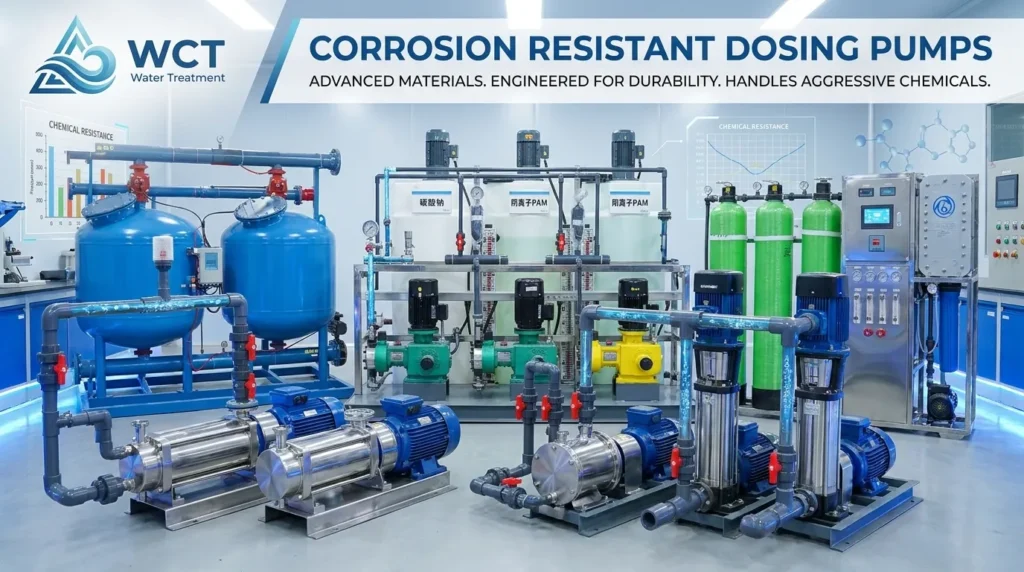
Understanding Aggressive Media in Water Treatment
When selecting corrosion resistant dosing pumps, the first step is knowing exactly what you are pumping. In the water treatment industry, aggressive media handling is a daily reality. We routinely see industrial metering pumps fail prematurely not because of mechanical flaws, but because the specific chemical makeup of the fluid was misunderstood.
Common Corrosive Chemicals in the Industry
Water purification and wastewater treatment rely heavily on reactive and corrosive substances to balance pH, coagulate solids, and disinfect water. Some of the most common aggressive fluids we design systems for include:
- Sodium Hypochlorite (Bleach): Essential for water disinfection, but notoriously difficult to handle due to off-gassing and its highly oxidative nature. Reliable sodium hypochlorite dosing requires specific pump head materials and venting capabilities.
- Sulfuric Acid: Heavily utilized for industrial pH adjustment. A sulfuric acid injection pump must be built to withstand extreme corrosivity, as this chemical aggressively attacks standard metals and plastics.
- Hydrochloric Acid: Highly volatile and corrosive, requiring specialized thermoplastic fluid paths to prevent rapid degradation.
- Ferric Chloride: A standard coagulant that is both acidic and heavy, known to quickly destroy unprotected pump components.
The Impact of Temperature and Concentration
Knowing the chemical name only tells half the story. Fluid corrosivity is drastically altered by two critical operational factors:
- Chemical Concentration: The chemical attack rate changes exponentially with concentration levels. For example, a pump material that safely handles dilute sulfuric acid might melt or become brittle when exposed to a 98% concentrated solution.
- Operating Temperature: Heat acts as a catalyst, accelerating chemical reactions and degradation. A fluid that remains perfectly stable with standard plastics at room temperature can rapidly destroy those same materials at 120°F (49°C).
Evaluating both the exact concentration percentage and the maximum fluid temperature is an absolute necessity before sizing and configuring your chemical dosing system.
The Anatomy of a Corrosion Resistant Dosing Pump
Focusing on the \”Wet End\”
When we talk about selecting corrosion resistant dosing pumps, the conversation always starts with the \”wet end.\” Also known as the liquid end, this is the section of the pump that makes direct contact with the aggressive media. The survival of your chemical injection system design depends entirely on how well these specific parts tolerate the fluids passing through them. If the wet end materials are incompatible, the pump will quickly fail, leading to leaks, downtime, and safety hazards.
When evaluating equipment, particularly precision devices like an electromagnetic diaphragm metering pump, we strictly evaluate four critical components:
- Pump Heads: This is the primary chamber where the fluid is drawn in and pushed out. We strongly recommend PVDF pump heads for their superior resistance to harsh chemicals like sulfuric acid and sodium hypochlorite.
- Diaphragms: The diaphragm acts as the heart of the pump, flexing back and forth to move the liquid. A PTFE pump diaphragm is the industry standard here, offering unmatched chemical inertness and long-lasting flexibility.
- Check Valves: These ensure the corrosive liquid moves in only one direction. Valves must be perfectly matched to the chemical to prevent sticking or degradation.
- O-rings and Seals: Often the smallest parts of the pump, seals are usually the first point of failure if incorrectly specified. Choosing the right elastomer (like FKM or EPDM) prevents hazardous leaks and maintains the system\’s pressure integrity.
Every single part touching the fluid matters. A robust pump material selection guide will always prioritize these wet end components to ensure long-term reliability in your aggressive media handling operations.
Material Selection: Consulting the Chemical Compatibility Chart
When selecting Corrosion Resistant Dosing Pumps, guessing is not an option. You must always cross-reference your specific fluid with a reliable chemical compatibility chart. This fundamental step prevents catastrophic leaks, premature wear, and costly system downtime. Proper aggressive media handling requires precision, and a comprehensive chart will tell you exactly how a specific pump material reacts to your chemical at various concentrations and operating temperatures.
Why PVDF Pump Heads Are the Industry Standard
In our extensive experience manufacturing water treatment equipment, PVDF pump heads stand out as the undisputed gold standard. They offer exceptional chemical resistance against a massive range of harsh acids, alkalis, and strong oxidizers. Beyond pure chemical resistance, PVDF provides outstanding mechanical strength and thermal stability. This ensures the pump maintains its structural integrity and accuracy over time, which is why it is often the default choice in high-performance equipment like the AD-Z series mechanical diaphragm metering pump.
Alternative Materials for Specific Applications
While PVDF is incredibly versatile, a complete pump material selection guide must account for the entire wet end. Depending on your specific application and budget, other materials play crucial roles:
- PTFE (Teflon): The top choice for a PTFE pump diaphragm due to its nearly universal chemical resistance and excellent fatigue life.
- PVC and PP (Polypropylene): Highly cost-effective alternatives for lower-temperature applications and moderately aggressive chemicals.
- Ceramic: Ideal for valve balls, offering extreme hardness and superior wear resistance, especially if the fluid contains abrasive particles.
- FPM and EPDM: The go-to materials for O-rings and seals. FPM (Viton) is typically used for strong acids, while EPDM is better suited for caustics and alkalis.

5 Critical Factors for Selecting Corrosion Resistant Dosing Pumps
Getting your dosing pump sizing and calculation right is non-negotiable when dealing with aggressive media handling. Even the best PVDF pump heads will fail if the pump isn\’t properly matched to your system\’s demands. When integrating chemical dosing pumps into your facility, understanding how water treatment plants work ensures you align the pump\’s capabilities with your specific process requirements.
Here are the five critical factors we prioritize when sizing industrial metering pumps for our clients:
| Critical Factor | Selection Guidelines |
|---|---|
| Flow Rate & Capacity | Match the pump\’s maximum output to your system\’s daily chemical demand. Never operate constantly at 100% capacity. |
| Operating Pressure | The pump must generate enough force to easily overcome the system\’s inherent backpressure at the injection point. |
| Fluid Characteristics | Account for high viscosity or off-gassing. Sodium hypochlorite dosing, for example, requires specific designs to prevent vapor lock. |
| Control & Automation | Select the right control mode—manual, analog, pulse, or advanced digital controls for seamless SCADA integration. |
| Maintenance Access | Prioritize designs that offer rapid access to PVDF pump heads, PTFE pump diaphragms, and valves to minimize downtime during wear part replacements. |
Evaluating these factors ensures your chemical injection system design operates efficiently, safely, and with minimal interruptions.
Best Practices for Handling Aggressive Media
Integrating your chemical dosing pumps into a complete waste water treatment process requires more than just picking the right materials. Proper aggressive media handling relies on a smart chemical injection system design to protect both the equipment and your facility.
To maximize the lifespan of your setup and ensure safe operation, we highly recommend implementing these standard installation practices:
- Install Pulsation Dampeners and Pressure Relief Valves: Positive displacement dosing pumps naturally create a pulsating flow. Installing pulsation dampeners smooths out this flow profile, significantly reducing mechanical stress on the piping and the pump head. Additionally, pressure relief valves are mandatory safety features to protect the system from dangerous over-pressurization if a line blockage occurs downstream.
- Ensure Proper Flooded Suction: Cavitation will quickly destroy even the most durable corrosion-resistant materials. To prevent this, always design your system with a proper flooded suction setup. By keeping the chemical storage tank fluid level above the pump inlet, gravity ensures the pump head remains fully primed. This eliminates air gaps, prevents vapor lock, and guarantees accurate, consistent dosing.
Why Choose WCT for Your Chemical Dosing Needs?
When selecting corrosion resistant dosing pumps, partnering with a proven water treatment pump manufacturer makes all the difference. At WCT, we specialize in advanced corrosion-resistant technologies designed specifically for aggressive media handling in industrial applications.
Whether you need reliable standalone units or are integrating pumps into an automated powder-liquid dosing system for wastewater treatment, our manufacturing expertise ensures your equipment withstands the harshest chemicals without fail.
Premium PVDF Pump Head Technology
Our industrial metering pumps are built to survive. We utilize premium PVDF pump heads across our core product lines, providing exceptional durability and resistance to highly corrosive chemicals. By prioritizing top-tier materials, we eliminate the guesswork from your pump material selection guide.
The WCT Advantage
| Feature | Benefit to Your Operations |
|---|---|
| Strict Quality Testing | Every dosing pump undergoes rigorous pressure and flow testing to ensure flawless performance before leaving our facility. |
| Custom Configurations | We tailor pump materials, seals, and control modes to align perfectly with your specific chemical compatibility chart requirements. |
| Comprehensive Support | From initial chemical injection system design to dedicated after-sales support, we partner with you to keep your operations running smoothly. |
Our commitment is straightforward: delivering reliable, high-precision dosing solutions that protect your operations from chemical degradation and costly downtime.
FAQs on Selecting Corrosion Resistant Dosing Pumps
What happens if I choose the wrong pump material for aggressive media?
Choosing the wrong material for corrosive liquid metering pumps leads to rapid degradation. The aggressive chemicals will eat through the wet end components, causing dangerous leaks, destroyed seals, and sudden system failures. This results in costly downtime and severe safety hazards for your operators.
How do I know if my dosing pump can handle sodium hypochlorite?
You must consult a reliable chemical compatibility chart. Sodium hypochlorite dosing is particularly challenging because it is highly corrosive and prone to off-gassing. To handle it safely, we ensure the pump is equipped with a PVDF pump head, a PTFE pump diaphragm, and specialized degassing valves to prevent vapor lock and maintain accurate flow rates.
Why are PVDF pump heads preferred over standard plastics?
PVDF pump heads are the gold standard in chemical injection system design because they offer exceptional, broad-spectrum chemical resistance. Unlike standard PVC or PP plastics, PVDF maintains its mechanical strength and thermal stability even when exposed to highly aggressive media like concentrated sulfuric acid or harsh solvents.
How does fluid viscosity affect pump selection?
Viscosity directly impacts how easily a fluid flows through the pump. Thick, viscous liquids create higher resistance and require more suction power. If you use a standard pump for high-viscosity fluids, the pump will struggle to draw the liquid into the chamber, leading to cavitation, poor efficiency, and totally inaccurate dosing. You must adjust your dosing pump sizing and calculation based on the specific thickness of the fluid being pumped.