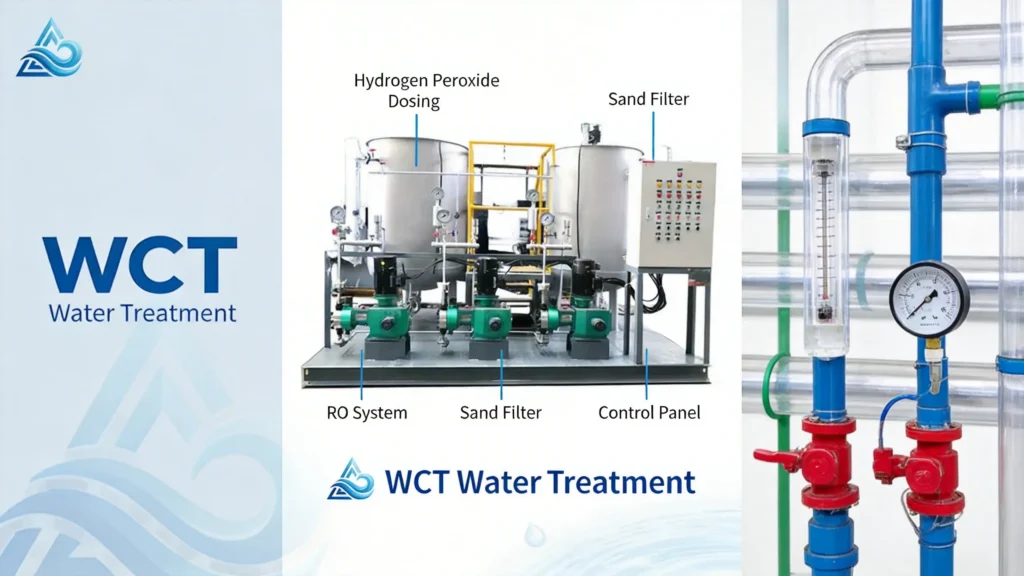
You might already know that chlorine is the \”old school\” method for sanitizing well water…
But is it actually the best?
When it comes to eliminating that \”rotten egg\” sulfur smell or stubborn iron stains, hydrogen peroxide water treatment is the superior, eco-friendly powerhouse.
However, getting the chemistry right requires more than just pouring liquid into a tank. It demands precision.
As a manufacturer of industrial dosing systems, I’m going to show you exactly how to implement an oxidation system that actually works.
From calculating the perfect H2O2 dosage to selecting the right metering pumps, this is the engineering-led guide you’ve been looking for.
Let’s dive right in.
The Rotten Egg Smell and Iron Stains: Why You Need H2O2
Identifying the Symptoms: Sulfur Odors and Orange Staining
If you turn on your tap and are immediately hit with the unmistakable stench of rotten eggs, you are dealing with hydrogen sulfide gas. It’s not just unpleasant; it’s a clear signal of contamination that makes water unusable for domestic or industrial purposes. Alongside the smell, you might notice stubborn orange or reddish-brown stains on fixtures, laundry, and equipment. This is the hallmark of dissolved iron. These aren\’t just cosmetic issues—they are aggressive contaminants that foul plumbing, ruin expensive machinery, and degrade water quality instantly.
Why Standard Filtration Often Fails Against Gas and Dissolved Iron
Many facility managers and homeowners assume a standard sediment filter or a basic softener will fix these issues, but they are often disappointed. Standard mechanical filtration is designed to catch solids, but hydrogen sulfide is a gas, and ferrous iron is dissolved in the water—meaning they pass right through typical mesh or sand filters. Without a chemical oxidant to physically change the state of these contaminants, physical barriers are useless. This is where hydrogen peroxide water treatment becomes essential. It doesn\’t just filter; it fundamentally alters the water chemistry to force these invisible impurities out of solution so they can be removed for good.
The Science: How Hydrogen Peroxide Water Treatment Works
Hydrogen peroxide (H2O2) isn\’t magic; it is simply one of the most powerful oxidizers available for water quality management. Unlike passive filtration methods that hope to catch debris, hydrogen peroxide water treatment actively attacks contaminants at a molecular level. At WCT, we design our dosing systems to harness this volatility safely, ensuring the reaction happens exactly where it needs to—inside the contact tank, not in your finished water.
Understanding the Oxidation Reduction Potential (ORP)
The effectiveness of any chemical treatment boils down to its Oxidation Reduction Potential (ORP). Think of ORP as the voltage or \”muscle\” the chemical has to steal electrons from contaminants. Hydrogen peroxide has a significantly higher ORP than chlorine or potassium permanganate. This high potential means it reacts faster and more aggressively. When we engineer a chemical dosing system for water treatment, we are essentially providing a controlled delivery method for this high-energy oxidation, allowing the H2O2 to neutralize impurities almost instantly upon contact.
The Chemical Reaction: Turning Dissolved Contaminants into Solids
The primary goal of injecting H2O2 is to change the physical state of the pollutants. Many contaminants, like iron and manganese, exist in a dissolved state—they are invisible to the naked eye and pass right through standard mechanical filters.
When hydrogen peroxide is introduced via a precision metering pump (like our AXB Series), it triggers an immediate oxidation reaction. It forces these dissolved elements to release electrons, converting them from a liquid solution into solid precipitates (particles). Once these contaminants are solid, they can be easily physically removed by backwashing filters or multimedia filtration beds further down the line.
Targeting the \”Big Three\”: Hydrogen Sulfide, Iron, and Manganese
In both industrial and domestic applications, we see three main adversaries that hydrogen peroxide water treatment handles exceptionally well. Understanding how water treatment plants work helps visualize how we target these specific elements:
- Hydrogen Sulfide (Rotten Egg Smell): This gas is notorious for its odor. H2O2 oxidizes the gas into solid sulfur or dissolved sulfate, eliminating the smell immediately without leaving the chemical aftertaste associated with chlorine.
- Iron: The iron oxidation process is critical for preventing orange staining. H2O2 converts ferrous iron (clear water iron) into ferric iron (rust particles) which are then easily filtered out.
- Manganese: Often found alongside iron, manganese causes black slime and staining. It is harder to oxidize than iron, but the high ORP of hydrogen peroxide makes short work of it, preventing the buildup of black residue in plumbing.
Hydrogen Peroxide vs. Chlorine: The Technical Showdown
In the process of water treatment, selecting the right oxidizer is critical for operational efficiency. While chlorine has been the industry standard for decades, hydrogen peroxide water treatment is superior for modern industrial applications requiring speed and environmental safety.
Comparing Reaction Speeds: Why H2O2 is Faster
Hydrogen peroxide (H2O2) is a significantly stronger oxidizer than chlorine. When injected into a water line, it reacts almost instantly with contaminants like iron, sulfur, and manganese. Chlorine, by contrast, requires a longer \”contact time\” to achieve the same results, often necessitating large, expensive retention tanks.
By using our precise chemical dosing systems, operators can leverage this rapid reaction speed to treat high volumes of water without the bottleneck of slow oxidation.
The pH Advantage and Environmental Impact
Chlorine is highly sensitive to pH levels; as water becomes more alkaline (higher pH), chlorine loses a significant amount of its oxidation power. Hydrogen peroxide remains effective across a much wider pH range, eliminating the need for additional acid-feed equipment to balance the water chemistry.
Furthermore, the environmental footprint is vastly different. Chlorine can react with organic matter to form Trihalomethanes (THMs), which are known carcinogens. Hydrogen peroxide decomposes cleanly into oxygen and water, making it the ideal choice for facilities aiming for zero discharge or strict environmental compliance.
Quick Comparison: Chlorine vs. Hydrogen Peroxide
| Feature | Chlorine | Hydrogen Peroxide |
|---|---|---|
| Oxidation Strength | Moderate | Very High |
| Reaction Speed | Slow (Requires contact time) | Rapid (Almost instant) |
| pH Sensitivity | High (Less effective at high pH) | Low (Effective across wide range) |
| Byproducts | Trihalomethanes (THMs), Salts | Oxygen and Water |
| Odor | Chemical/Bleach smell | Odorless |
Building Your Hydrogen Peroxide Water Treatment System
Setting up a robust hydrogen peroxide water treatment system requires a specific chain of equipment working in perfect harmony. The goal is straightforward: inject the oxidizer, give it time to react, and filter out the resulting solids.
Here is a breakdown of the essential equipment chain you need to get the job done right.
Static Mixers and Retention Tanks
Once your peroxide injection system introduces H2O2 into the water line, it has to be blended thoroughly.
- Static Mixer: This inline device disrupts the water flow, forcing the chemical to mix perfectly with the raw water.
- Retention Tank: After mixing, the water enters a contact tank. Achieving the correct contact tank retention time is non-negotiable. This holding period gives the hydrogen peroxide the minutes it needs to fully oxidize dissolved iron, manganese, and sulfur gases into solid, filterable particles.
Integrating these components into a complete well water treatment system ensures that heavily contaminated groundwater gets the exact processing time it requires before hitting the filters.
Post-Oxidation: Catalytic Carbon Filters
After the oxidation phase, those newly formed solid contaminants are suspended in the water. To deliver clean water to your taps, we route it through a catalytic carbon filter.
This stage handles three critical jobs:
- Mechanical Filtration: The granular media physically traps the oxidized rust, manganese, and sulfur particles.
- Residual Removal: Catalytic carbon is highly reactive. It instantly neutralizes any leftover hydrogen peroxide in water treatment, ensuring zero chemicals pass into your plumbing.
- Automated Backwashing: To prevent clogging, the filter control valve is programmed to automatically backwash every few days. This process lifts the media bed, flushes the trapped dirt and debris down the drain, and resets the system for the next cycle.
The Heart of the System: Chemical Dosing Pumps
For any hydrogen peroxide water treatment system to actually do its job, you need exact chemical dosing. The chemical dosing pump is the beating heart of your entire setup.
Why Precision Matters
Precision isn\’t just a nice feature; it is required.
- Too little H2O2: The rotten egg smell stays, and iron continues to stain your fixtures.
- Too much H2O2: You waste expensive chemicals and push excess oxidizers into your plumbing.
Your peroxide injection system relies entirely on this pump delivering the perfect amount of liquid based on your water flow.
Spotlight: AXB Series Features
When building out a reliable system, the equipment you choose matters. I consistently look to the WCT-AXB Series Mechanical Diaphragm Metering Pump for handling strong oxidizers. It is built specifically for the demands of hydrogen peroxide well water treatment.
Key advantages include:
- Corrosion Resistance: Built to handle high-strength H2O2 without breaking down.
- Pinpoint Accuracy: Allows you to dial in the exact dosage rate.
- Continuous Duty: Engineered to run smoothly even during heavy water usage periods.
Peristaltic vs. Diaphragm Pumps: Durability Showdown
When selecting a pump for water treatment hydrogen peroxide, you generally choose between peristaltic and diaphragm styles. Here is how they stack up against each other for long-term durability:
- Peristaltic Pumps: These operate by squeezing a flexible tube with a roller. While they are common Stenner pump alternatives, they have a major flaw. The constant squeezing wears the tube out quickly, leading to leaks and requiring frequent tube replacements.
- Mechanical Diaphragm Metering Pumps: These use a tough, flexible membrane that pulses to move the liquid. Because there are no rollers grinding against a tube, wear and tear are drastically reduced. For long-term reliability in hydrogen peroxide water treatment, a diaphragm pump is the clear winner for durability and lower maintenance.
Storage and Safety: Chemical Dosing Tanks
When you are dealing with concentrated hydrogen peroxide for water treatment, safety isn\’t just a suggestion; it is the foundation of your entire setup. H2O2 is a powerful oxidizer, which makes it incredibly effective at cleaning water, but it also means it demands respect during storage. You can\’t just throw it in any old plastic bucket and hope for the best.
Handling strong oxidizers requires equipment built to withstand chemical aggression. The material of your storage vessel is critical. While standard polyethylene tanks are common for weaker solutions, for long-term durability and safety, we often look towards more robust materials. PE304 Stainless Steel Chemical Dosing Tanks are excellent for specific industrial applications where structural integrity and resistance to external physical damage are paramount. Stainless steel offers a level of security that gives facility managers peace of mind, knowing the tank won\’t degrade or crack under pressure like cheaper alternatives might.
Beyond the tank material, you must consider the environment around the tank. Proper venting is non-negotiable. Hydrogen peroxide naturally decomposes into oxygen gas and water over time. If you seal a tank completely tight, that gas builds up pressure, turning your storage tank into a potential hazard. A proper venting system allows that oxygen to escape safely. Additionally, containment strategies—like bunding or secondary containment pallets—are essential. If a leak does happen, you want it caught in a tray, not spreading across your plant floor.
For a complete safety setup, integrating high-quality components is key. You might need specialized WCT filter nozzles for water treatment in your downstream processing or robust tanks to ensure your chemical dosing system remains a closed, safe loop.
H2O2 Dosage Calculation: Getting the PPM Right
Achieving the perfect balance in hydrogen peroxide water treatment is not a guessing game; it is a precise mathematical requirement. If you under-dose, the iron and sulfur remain active; over-dose, and you are wasting operational budget on excess chemicals. Precision is the only way to ensure efficiency and water quality.
Standard Concentrations: Residential vs. Industrial
The strength of the peroxide solution dictates your equipment setup. Residential systems typically utilize a safer 7% concentration, whereas large-scale operations often require industrial-grade 35% hydrogen peroxide. Handling these higher concentrations demands robust hardware. We recommend using chemical dosing tanks constructed from durable materials like PE304 stainless steel to ensure safety and longevity when storing strong oxidizers.
The Golden Formula: Dosage Based on Contaminants
The calculation generally follows a strict ratio based on the Parts Per Million (PPM) of the contaminants you are targeting. You must measure the exact levels of iron and hydrogen sulfide in the feed water to determine the injection rate.
- Iron: Requires a specific ratio of H2O2 to oxidize completely into a filterable solid.
- Sulfur: Often demands a slightly higher dosage relative to iron to eliminate odors effectively.
- Flow Rate: The dosage must be adjusted dynamically based on the gallons per minute flowing through the system.
For complex water profiles, consulting our industry knowledge resources can help clarify how different variables impact these ratios in specific applications.
Dialing in with Residual Testing
Theoretical math only gets you close. The final step is verifying the \”residual\”—the tiny amount of peroxide left over after the oxidation process is complete. This confirms that all contaminants have been neutralized. Once the target dosage is determined via testing, maintaining that precision relies entirely on the pump. Our AXB Series Mechanical Diaphragm Metering Pumps are designed exactly for this purpose, allowing you to lock in the flow rate so the calculated PPM is delivered consistently, ensuring your hydrogen peroxide water treatment system operates at peak efficiency.
Industrial Applications: Advanced Oxidation Process (AOP)
When we step up from residential systems to the factory floor, hydrogen peroxide water treatment evolves into a powerhouse solution known as the Advanced Oxidation Process (AOP). In industrial settings, we aren\’t just removing smells; we are breaking down complex chemical structures that threaten environmental compliance.
Scaling Up: Industrial Wastewater Oxidation
Industrial wastewater oxidation requires more than just a simple injector. It demands a calculated approach to handle high volumes of effluent containing hard-to-degrade organic pollutants. By utilizing AOP, we leverage the high reactivity of hydrogen peroxide to fracture these pollutants at a molecular level.
To ensure these large-scale biological and chemical processes run without interruption, we often integrate MBR membrane bioreactor equipment alongside the oxidation stage. This combination effectively separates sludge and treated water, ensuring the final output meets rigorous environmental standards.
Zero-Discharge Goals and Recycling
Modern manufacturing is moving toward zero liquid discharge (ZLD), where every drop of water is treated and reused. Achieving this requires equipment that can withstand aggressive chemical environments and continuous operation.
- Complex Pollutant Removal: AOP effectively destroys phenols, pesticides, and solvents that traditional filters miss.
- Cost Efficiency: Recycling treated water reduces the need for fresh water intake.
- System Durability: We utilize robust CDLF+CDH high-pressure pumps to maintain the necessary flow rates through these intensive treatment cycles, ensuring the recycled water is delivered back to the production line reliably.
FAQ: Common Questions About Hydrogen Peroxide Treatment
Is hydrogen peroxide safe for drinking water systems?
Yes, hydrogen peroxide water treatment is safe for potable water when managed correctly. Unlike chlorine, it does not leave behind chemical tastes or harmful byproducts like trihalomethanes. However, safety relies entirely on precision. You cannot simply guess the amount; the dosage must be exact to oxidize contaminants without leaving dangerous excess levels. This is why we utilize high-precision metering pumps in our plants for water treatment, ensuring the injection rate is perfectly calibrated to your water\’s flow and contamination levels.
How does temperature affect the oxidation process?
Temperature is a critical variable in any chemical reaction. In warmer water, hydrogen peroxide reacts faster, speeding up the oxidation of iron and sulfur. Conversely, in colder environments, the reaction time slows down significantly. If your facility operates in low temperatures, we may recommend increasing the retention time or adjusting the dosage concentration to ensure the water treatment hydrogen peroxide process completes fully before the water reaches the tap.
Can I replace my chlorinator directly with a peroxide system?
Technically, the hardware is very similar, but the operation is different. Both systems use a chemical feed pump and a storage tank. However, because hydrogen peroxide is up to seven times stronger than chlorine, you cannot just swap the liquids. You must recalibrate the pump settings to account for the higher potency. We often help clients retrofit existing lines with our AXB Series pumps, which are specifically designed to handle the unique properties of peroxide.
How often does the injector pump require maintenance?
Reliability is key in hydrogen peroxide water treatment systems. While our pumps are built for industrial durability, routine maintenance ensures longevity.
- Check Valves: Inspect every 6–12 months for clogging, especially if your water has high mineral content.
- Diaphragms: These are wear parts. We suggest a preventative replacement schedule annually to avoid unexpected failures.
- Gas Locking: Peroxide can release oxygen gas; ensure your pump head is kept clean and lines are properly bled to prevent air-locking.