What is UV Water Treatment and How Does it Work?
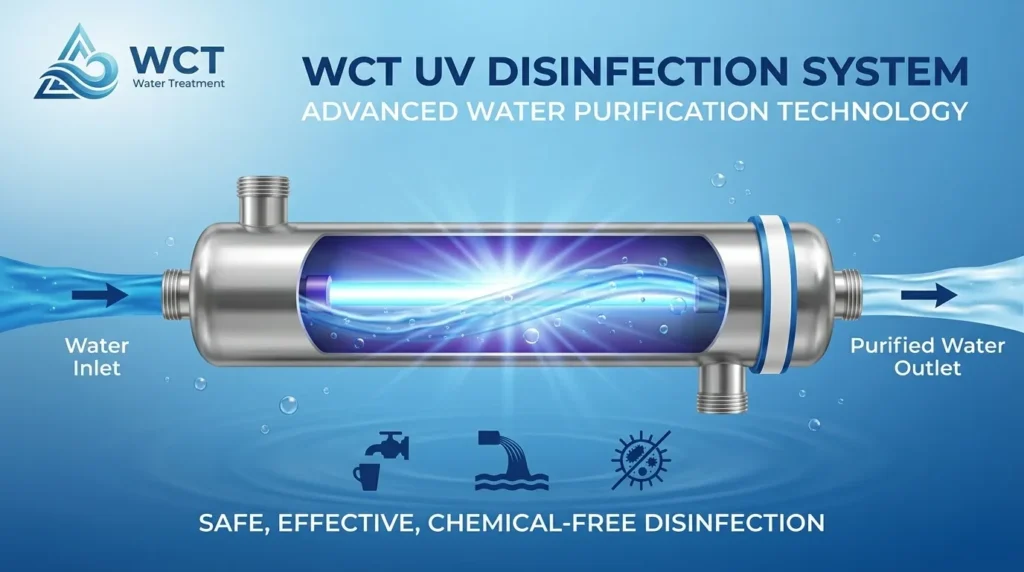
At WCT, a leading water treatment products supplier and manufacturer, we engineer systems that utilize UV treatment for water to deliver safe, clean, and reliable hydration to the global market. Unlike traditional chemical dosing methods, UV for water treatment is a purely physical process. It uses specialized ultraviolet light lamps to instantly neutralize harmful microorganisms as water flows through a protective chamber, ensuring comprehensive purification without altering the water\’s natural composition.
The Science Behind UV Disinfection
The core of UV treatment of water relies on short-wavelength ultraviolet light (UVC). When water passes through the system, it is exposed to UVC light at a specific germicidal wavelength of 254 nanometers.
- Cellular Penetration: The intense UV light penetrates the cell walls of microorganisms present in the water supply.
- DNA Disruption: The UVC energy damages the nucleic acids, scrambling the DNA and RNA of the pathogens.
- Total Inactivation: Once their genetic code is disrupted, the microorganisms are instantly killed or rendered completely unable to reproduce and cause infection.
What Pathogens Do UV Filters Kill?
A correctly sized UV water purifier provides a formidable defense against a wide spectrum of biological contaminants.
| Pathogen Category | Specific Microorganisms Targeted |
|---|---|
| Bacteria | E. coli, Salmonella, Legionella, Cholera, Streptococcus |
| Viruses | Hepatitis, Rotavirus, Norovirus, Poliovirus |
| Protozoa & Cysts | Giardia, Cryptosporidium (highly resistant to standard chlorination) |
Is UV-Treated Water Safe to Drink?
Yes. UV-treated water is exceptionally safe for human consumption. Because the process relies entirely on light energy, it adds zero chemicals, byproducts, or toxins to your drinking water. The treatment strictly attacks biological threats, meaning it completely preserves the natural taste, odor, and pH level of your water. When paired with proper pre-filtration, UV systems guarantee microbiological safety for residential, commercial, and industrial applications alike.
Advantages and Disadvantages of UV Water Purifiers
As a trusted WCT(water treatment products supplier and manufacturer), we always ensure our global clients understand both sides of the coin. While uv treatment for water is one of the most reliable disinfection methods available, knowing its specific pros and cons helps you build the most effective filtration setup.
Key Benefits of Chemical-Free Disinfection
The standout feature of using uv for water treatment is its completely chemical-free process. It neutralizes 99.9% of harmful microorganisms instantly upon contact. Because nothing is added to the water, it never alters the taste, smell, or pH balance of your supply, ensuring clean and natural results.
Limitations and Disadvantages to Consider
UV light only targets living organisms; it does not physically remove particles from the water. If your water supply suffers from harsh minerals, heavy metals, or strong rotten-egg odors, you will need a dedicated sulfur water treatment system or a reverse osmosis unit first. UV systems also require clear water to function properly, as sediment can cast shadows that shield bacteria from the light. For complex commercial applications dealing with heavy non-biological contaminants, we often pair UV setups with a precise chemical dosing system for water treatment to achieve complete purification.
Quick Comparison:
| Advantages of UV Systems | Disadvantages to Keep in Mind |
|---|---|
| 100% chemical-free disinfection | Requires a constant electricity supply |
| Instant, on-demand purification | Does not remove heavy metals or chemicals |
| Highly cost-effective over time | Requires pre-filtered, clear water to work |
| No change to water taste or odor | UV lamps require annual replacement |
Eco-Friendly Aspects of UV Treatment
When looking for sustainable solutions, uv treatment of water leads the industry. Unlike traditional chlorination methods, UV leaves behind absolutely zero harmful disinfection byproducts (DBPs) in the water. Furthermore, a standard UV system uses about the same amount of energy as a low-wattage light bulb, making it an incredibly green, low-impact way to protect public health and local ecosystems.
Common Applications for UV Disinfection Systems
UV technology is incredibly versatile. Because it works without chemicals, we see it used everywhere from small rural homes to massive city infrastructure. Here is a look at where this technology shines the most.
Residential Whole-House and Well Water Systems
If you rely on a private well, keeping your water free from harmful bacteria is a daily priority. As a WCT (water treatment products supplier and manufacturer), I consistently see the life-changing impact of adding UV treatment to homes. Integrating UV technology directly into a well water treatment system ensures that every tap, shower, and appliance in the house receives perfectly safe water.
- Whole-house protection: Delivers safe water for drinking, brushing teeth, and bathing.
- Well water safety: Instantly neutralizes bacteria, viruses, and cysts commonly found in ground sources.
- Set it and forget it: Operates continuously with just a simple, once-a-year lamp replacement.
Commercial and Industrial UV Treatment
Businesses cannot afford to take risks with water quality. Whether running a bustling restaurant, managing a hotel, or operating a manufacturing plant, scaling up the UV treatment of water makes perfect business sense. It easily handles high flow rates without slowing down daily operations or altering the taste of the water.
- Food and Beverage: Keeps beverages tasting natural without any chemical taints or odors.
- Hospitality: Ensures safe, high-quality water for guests across resorts and hotels.
- Manufacturing: Protects sensitive equipment and maintains strict product integrity during production.
Municipal Drinking Water Purification
City water facilities are increasingly adopting this technology. Municipal plants use large-scale UV for water treatment as a powerful, fast-acting barrier before pumping water into your neighborhood. It helps towns meet strict health guidelines while cutting down on the heavy chemical loads they used to rely on.
- Parasite control: Effectively targets tough, chlorine-resistant parasites like Cryptosporidium and Giardia.
- Reduced chemical byproducts: Lowers the amount of harsh chlorine needed in city pipes.
- Massive scalability: Seamlessly treats millions of gallons of water per day for entire communities.
UV Treatment vs. Other Water Filtration Methods
At WCT, as an experienced water treatment products supplier and manufacturer, we know that no single technology does it all. Understanding how uv treatment for water compares to other common filtration methods helps you build the right purification setup for your specific needs.
UV Systems vs. Reverse Osmosis (RO)
People often confuse these two technologies, but they serve entirely different purposes. In fact, they work best when combined.
- UV Systems: Designed specifically to target and destroy living microorganisms like bacteria and viruses. They do not remove heavy metals, salts, or chemicals.
- Reverse Osmosis (RO): Pushes water through a tight membrane to strip out dissolved solids, metals, and chemical contaminants. However, it does not consistently kill biological threats.
Pairing an RO unit with a high-quality ultraviolet water treatment system ensures your supply is both chemically pure and completely biologically safe.
UV Disinfection vs. Chlorination
When looking at uv for water treatment compared to traditional chemical methods, the advantages are clear:
| Feature | UV Disinfection | Chlorination |
|---|---|---|
| Method | Uses light energy to destroy pathogen DNA | Adds chemical agents to the water supply |
| Speed | Works instantly | Requires contact time to react |
| Taste & Odor | Completely neutral | Leaves a noticeable chemical taste and smell |
| Byproducts | Creates zero waste or byproducts | Can form harmful disinfection byproducts (DBPs) |
For modern facilities and homes, the uv treatment of water is widely preferred because it is a clean, instant, and chemical-free process.
Why You Need a Sediment Pre-Filter Before UV
UV light only works if the rays can actually reach the pathogens. If your water contains suspended dirt, rust, or debris, those physical particles act as shields. They cast \”shadows\” in the water, allowing bacteria and viruses to hide safely from the UV light and pass straight into your plumbing.
- The 5-Micron Rule: Water must pass through at least a 5-micron sediment filter before entering the UV chamber.
- Crucial for Ground Water: Heavy sediment is incredibly common in rural and underground supplies. If you operate a well water treatment system, installing proper mechanical pre-filtration right before your UV lamp is an absolute requirement to guarantee the system works effectively.
How to Choose and Maintain the Right UV System
Getting the best results from your uv treatment for water comes down to proper sizing, correct setup, and staying on top of basic upkeep. As an experienced WCT(water treatment products supplier and manufacturer), we always remind customers that a UV system only works if it is tailored to your specific water flow and kept clean.
Sizing Your UV Water Filter Correctly
You must match the UV system to your peak water flow rate, measured in Gallons Per Minute (GPM). If water moves past the lamp too quickly, the UV dose drops and pathogens can survive.
- 1-3 GPM: Ideal for a single under-sink faucet.
- 8-12 GPM: Standard for an average 1 to 3-bathroom home.
- 15+ GPM: Required for large homes, heavy well water usage, or commercial setups.
Installation Requirements
Your UV system should always be the last piece of equipment on your water line before the water reaches your taps. It needs a dedicated, grounded electrical outlet to keep the lamp running 24/7. Because UV light cannot penetrate cloudy water or floating particles, you absolutely need a pre-filter. We highly recommend installing a reliable WCT precision filter for water treatment right before the UV chamber to catch dirt, rust, and sediment.
Replacing UV Lamps and Routine Maintenance
Maintaining uv treatment of water is extremely simple but critical. The UV lamp naturally loses its germ-killing intensity over time, even if it still emits a visible blue light.
Basic UV Maintenance Schedule
| Component | Action Required | Frequency |
|---|---|---|
| UV Lamp (Bulb) | Replace to ensure full disinfection power. | Every 12 months (9,000 hours) |
| Quartz Sleeve | Clean with vinegar to remove cloudy mineral buildup. | Every 6 to 12 months |
| O-Rings | Replace during lamp changes to prevent leaks. | Every 12 months |
Pro Tip: Always keep a spare lamp on hand so your uv for water treatment never has to face unprotected downtime.