You already know that scale and corrosion are the silent killers of industrial efficiency.
But is your current strategy for the treatment of boiler water actually working, or is it just delaying a breakdown?
Managing steam purity requires more than guesswork; it demands a precise engineering approach combining pre-treatment technologies like Reverse Osmosis and exact chemical conditioning.
In this guide, we’re cutting through the noise to show you exactly how to optimize your feed water chemistry, extend equipment life, and automate the process with the right hardware.
Let’s protect your assets.
Are unexpected tube failures and spiking fuel costs threatening your plant\’s bottom line? When we evaluate industrial steam systems, poor boiler feed water quality is almost always the root cause of these expensive headaches. Effective treatment of boiler water isn\’t just routine maintenance; it is a critical engineering requirement to protect your heavy assets.
The \”Big Three\” Enemies of Boiler Efficiency
Without precise water treatment of boiler systems, three destructive forces will rapidly degrade your equipment. We design our solutions to aggressively manage these threats and keep your operations running safely.
Scaling and Deposits: The \”Insulator Effect\”
When hard minerals precipitate out of the water, they bake directly onto the heat transfer surfaces. We refer to this as the \”insulator effect.\”
- Thermal Obstruction: Even a fraction of an inch of scale severely restricts heat transfer.
- Wasted Fuel: Your burners are forced to work harder, burning significantly more fuel just to push heat through the mineral barrier.
- Tube Ruptures: Localized overheating caused by scale accumulation leads to blistered and ruptured boiler tubes. Proactive water hardness removal is non-negotiable to prevent this.
Pitting Corrosion Prevention
Metal degradation is relentless if left unmanaged.
- Oxygen Pitting: Dissolved oxygen in the feedwater chemically attacks carbon steel, creating deep, highly localized pits. Left untreated, these pits can bore straight through a thick boiler tube in a matter of weeks.
- Structural Failure: Corrosion weakens the boiler\’s structural integrity and introduces destructive iron oxide sludge into the system. Continuous, aggressive dissolved oxygen scavenging is our primary line of defense.
Steam Purity and Carryover
High TDS (Total Dissolved Solids), organic matter, and excess alkalinity create a highly volatile water surface inside the boiler.
- Foaming and Priming: These impurities cause the boiler water to foam, physically pushing liquid water and dissolved solids up into the steam header.
- Downstream Destruction: This carryover contaminates your steam supply, depositing abrasive and corrosive solids directly onto downstream valves, delicate heat exchangers, and expensive turbines.
Phase 1: External Treatment Strategies
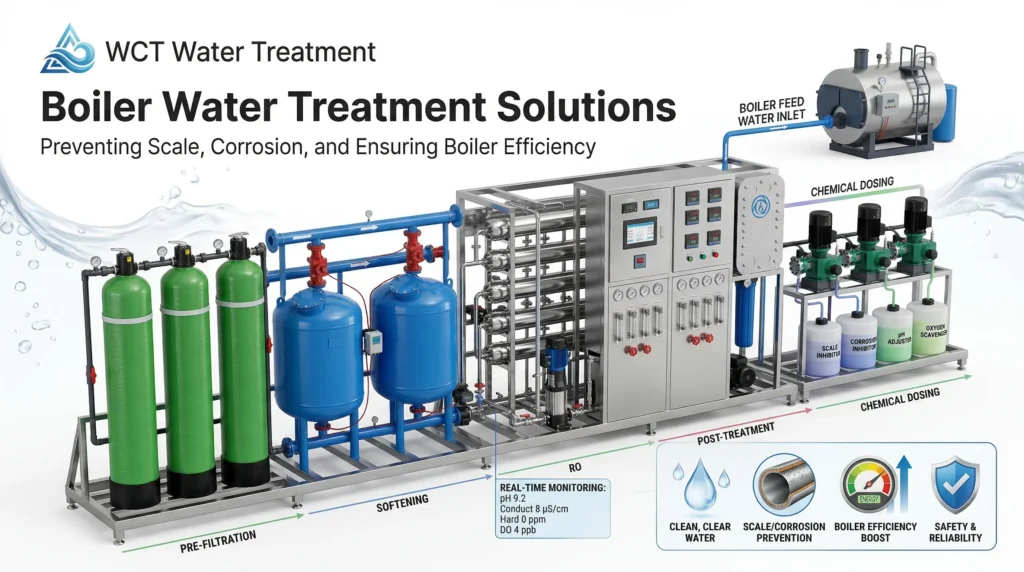
Before water ever reaches the boiler, we have to prepare it. Effective treatment of boiler water starts entirely outside the system. This external phase is designed to secure top-tier boiler feed water quality, stopping scale and corrosion before they enter your equipment.
Filtration for Suspended Solids
We start by removing the visible debris. Basic filtration targets suspended solids like dirt, rust, and organics. By passing feed water through multi-media filters, we ensure only physically clean water advances to the more delicate chemical treatment stages.
Water Hardness Removal
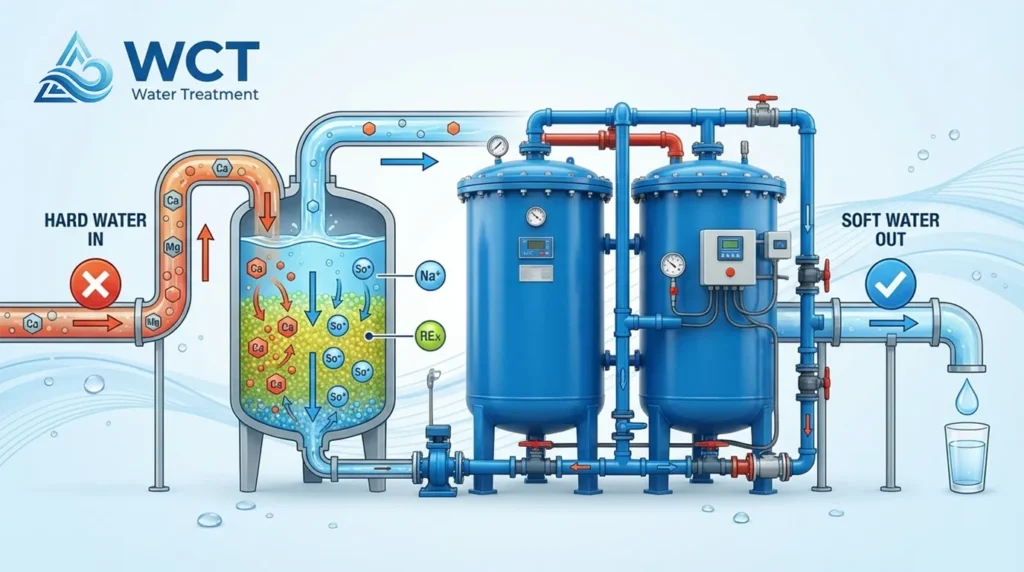
Hard water destroys boiler efficiency. Calcium and magnesium cause rapid, severe scaling. Using advanced softening and demineralization techniques, we strip out these heavy minerals through targeted ion exchange. If your facility struggles with heavy mineral scaling, implementing a robust hard water treatment system is critical to prevent costly equipment failure.
Industrial Reverse Osmosis System
When it comes to the water treatment of boiler systems, Reverse Osmosis (RO) is the absolute gold standard for feed water preparation.
- Total Purity: An industrial reverse osmosis system strips out up to 99% of dissolved impurities.
- Cost Savings: High-purity RO water drastically reduces the frequency of your boiler blowdown procedure, saving energy and water.
- Asset Protection: Creates a baseline that actively prevents caustic embrittlement and scaling.
Mechanical Deaeration
Dissolved gases are silent killers. Oxygen and carbon dioxide will rapidly eat through your boiler\’s metal components. We rely on mechanical deaeration to heat the feed water and physically vent these destructive gases. This process is the heavy lifter for dissolved oxygen scavenging, bringing gas levels down to near-zero and preventing aggressive pitting corrosion inside the boiler tank.
Phase 2: Internal Treatment (Chemical Conditioning)
Even with top-tier pre-filtration, the ongoing water treatment of boiler systems relies heavily on internal chemical conditioning. This phase manages the impurities that inevitably slip through, protecting the metal surfaces operating under extreme heat and pressure.
Core Chemical Strategies
- Dissolved Oxygen Scavenging: Free oxygen causes aggressive, rapid pitting corrosion in metal. We utilize specialized oxygen scavenging chemicals to actively bind and neutralize residual dissolved oxygen before it can attack boiler tubes.
- Scale Inhibition: Heat transforms dissolved minerals into hard, insulating scale that destroys energy efficiency. Proper scale inhibition involves polymer sludge conditioners and phosphates that keep mineral solids suspended in the water so they can be safely flushed away.
- Boiler Water pH Levels: Acidic water corrodes steel, while excessive alkalinity leads to foaming and dangerous caustic embrittlement. Strict alkalinity control is mandatory to maintain stable, protective pH levels at all times.
Precision Chemical Dosing
Internal treatment of boiler water only works if the application is perfectly measured. Manually guessing chemical volumes either leaves the boiler vulnerable or wastes expensive additives. To guarantee accurate, continuous delivery, integrating a high-quality automatic chemical dosing pump into your infrastructure is absolutely critical. This equipment ensures the exact concentration of protective chemicals is injected in real-time, matching your system\’s dynamic operational load.
The Role of Blowdown in Water Treatment
Even with the most advanced external filtration and chemical dosing, impurities will inevitably accumulate inside a boiler. As pure steam evaporates, dissolved solids remain behind, increasing the concentration of contaminants. Effective treatment of boiler water requires a strategic blowdown procedure to remove these concentrated impurities before they cause scale or carryover. Without this controlled removal, Total Dissolved Solids (TDS) levels will rapidly exceed safe operating limits, jeopardizing the entire system.
Surface Blowdown vs. Bottom Blowdown
To maintain optimal boiler feed water quality, we typically employ two distinct types of blowdown, each targeting specific contaminants:
- Surface Blowdown (Continuous): This process removes dissolved solids from the top of the boiler water where their concentration is highest. It is often automated to maintain a specific conductivity or TDS level. When designing comprehensive plants for water treatment, we prioritize precise control here to prevent foaming and carryover.
- Bottom Blowdown (Intermittent): This is a manual or timed high-pressure flush designed to remove heavy sludge and sediment that settles in the mud drum or bottom of the shell. It is essential for preventing blockages and removing suspended solids that chemical conditioners have precipitated.
Heat Recovery Opportunities
Blowdown water is extremely hot and chemically treated, representing a significant loss of energy and resources if simply drained. In modern industrial setups, we focus on efficiency. By utilizing heat exchangers or flash tanks within the blowdown system, you can capture up to 90% of the heat energy from the wastewater. This recovered heat can be transferred back to preheat the incoming feedwater, significantly lowering fuel consumption and improving the overall thermal efficiency of your operation.
Monitoring the Treatment of Boiler Water
Consistent monitoring is the backbone of our maintenance strategy. Without daily checks, even the best water treatment of boiler systems will eventually fail, leading to costly downtime and equipment damage. We rely on strict daily routines to keep everything running smoothly and efficiently.
Daily Tests: Boiler Water pH Levels and TDS Control
Tracking specific metrics every day is non-negotiable for the effective treatment of boiler water. We focus on three main parameters to catch potential issues before they escalate into major problems like scaling or pitting corrosion.
| Parameter | General Target Range | Purpose in Boiler Feed Water Quality |
|---|---|---|
| pH Levels | 8.5 to 10.5 | Maintains an alkaline environment to prevent system corrosion. |
| TDS (Total Dissolved Solids) | Varies by system (often <3000 ppm) | Essential for strict TDS control, ensuring steam purity and carryover prevention. |
| Hardness | As close to zero as possible | Verifies effective water hardness removal to completely stop scale formation. |
Automatic Chemical Dosing Pumps and Systems
Manual testing and chemical addition leave too much room for human error. We always integrate automation into our facilities to maintain absolute, precise control over the chemical balance.
- Real-Time Tracking: Automated sensors monitor water quality 24/7, instantly detecting spikes in dissolved solids or drops in pH.
- Precision Delivery: Utilizing an automatic chemical dosing pump guarantees that oxygen scavengers and scale inhibitors are injected at the exact right concentrations.
- System Reliability: Upgrading to automated chemical dosing systems completely eliminates the guesswork from your daily operations, reducing chemical waste and protecting the physical integrity of your boiler.
This automated approach directly lowers long-term maintenance costs and extends the operational lifespan of the entire steam generation system.
Why Choose WCT for the Treatment of Boiler Water?
When it comes to the treatment of boiler water, you need reliable equipment that protects your assets and keeps operations running without sudden downtime. At WCT, we build systems designed specifically for the rigorous demands of industrial facilities globally.
Engineering Expertise and R&D
Our engineering team focuses heavily on improving boiler feed water quality. Through continuous R&D, we develop solutions that tackle the hardest industry problems, from advanced pitting corrosion prevention to precise TDS control. We don\’t just assemble parts; we engineer water management systems that actively extend the life of your heating equipment and maximize fuel efficiency.
Customization Capabilities
No two raw water sources are identical, which means off-the-shelf equipment rarely hits the mark. We design tailored setups to match your exact site requirements. Whether your facility needs a compact 500 LPH RO system for water treatment to handle essential water hardness removal, or a fully integrated setup utilizing an automatic chemical dosing pump, we customize the capacity, footprint, and technical specifications to fit your operational needs perfectly.
Quality Assurance and Global Experience
We have successfully deployed heavy-duty systems for the water treatment of boiler networks across the global market. Our stringent quality control ensures every component performs flawlessly under continuous pressure, giving you peace of mind no matter where your plant is located.
The WCT Advantage at a Glance:
| Core Strength | What It Means For Your Facility |
|---|---|
| Advanced R&D | Superior scale inhibition and long-term boiler protection. |
| Full Customization | Equipment sized right for your specific condensate return system and feed rates. |
| Global Standards | Rigorously tested reliability for continuous, heavy-duty industrial usage worldwide. |