When a pump station fails overnight or a pH excursion goes unnoticed for hours, the financial and environmental cost can escalate fast.
Remote monitoring water treatment closes the blind spots left by manual sampling, giving plant operators continuous visibility into critical parameters and the ability to act before a deviation becomes a permit violation.
Key Components of a Remote Monitoring Architecture
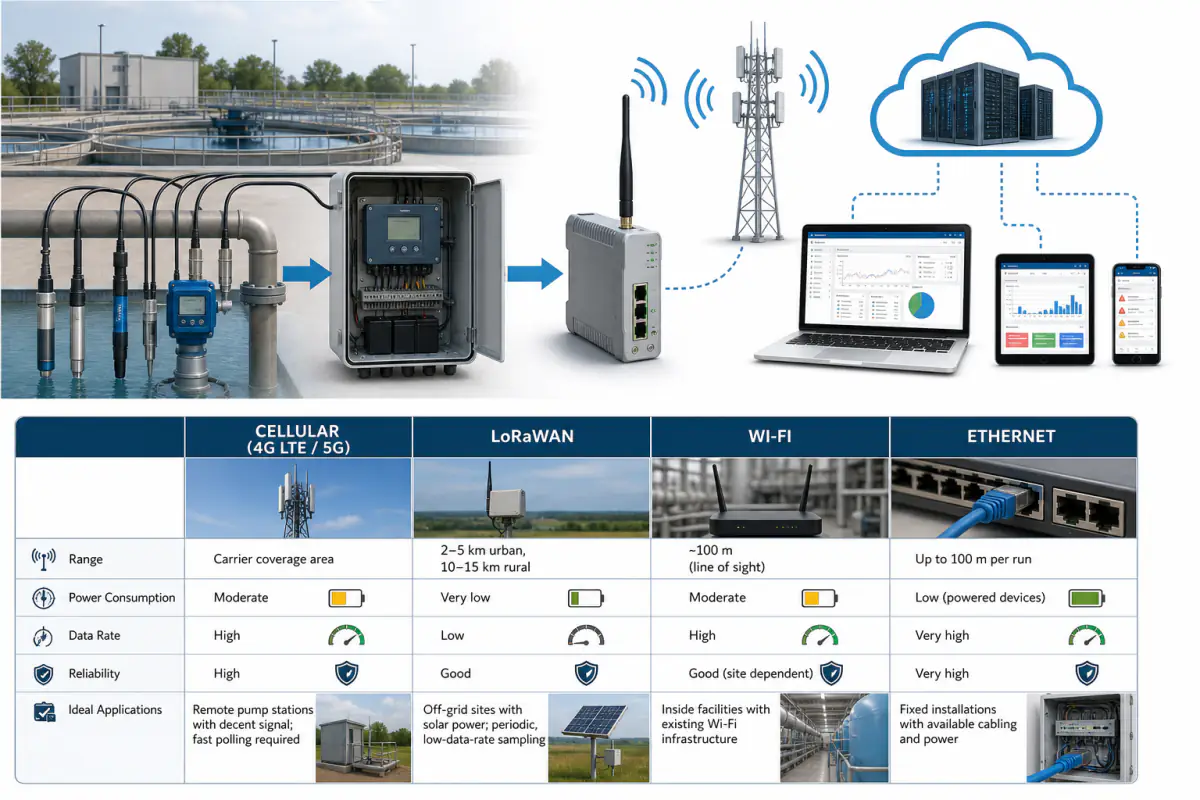
A robust remote monitoring system rests on four layers: data acquisition, local transmission, cloud or SCADA integration, and the user interface. Each layer must match the facility’s physical layout and the data resolution needed for process control.
- Inline sensors and probes – pH, ORP, conductivity, turbidity, chlorine residual, and flow meters. Their accuracy under fouling conditions determines the value of the entire chain.
- Data loggers and remote terminal units (RTUs) – Devices that digitize analog sensor signals and time-stamp readings. An RTU can also execute local control logic when connectivity drops.
- Gateways and telemetry – Cellular IoT gateways or Ethernet modems push data from the RTU to the cloud or plant SCADA. The gateway choice affects sampling frequency and remote-site power draw.
- Cloud dashboard and mobile alerts – The operator interface that converts raw data into actionable alarms. A well-designed cloud-based water dashboard highlights threshold breaches and long-term drift, not just instantaneous values.
Key Monitored Parameters by Treatment Type
Sensor packages must align with the regulatory and process demands of the influent or effluent stream. The table below maps essential parameters to treatment application and monitoring goal.
| Treatment Application | Key Parameters | Primary Monitoring Goal |
|---|---|---|
| Drinking Water | Free chlorine residual, turbidity, pH, UV254 (organics) | Disinfection compliance, filter breakthrough detection |
| Municipal Wastewater | Ammonia, nitrate, phosphate, TSS, pH, dissolved oxygen | Effluent permit limits, nutrient removal performance |
| Industrial RO & Cooling Water | Conductivity, pH, ORP, silica, hardness, corrosion inhibitors | Scale prevention, membrane protection, corrosion control |
Continuous parameter logging also enables automated chemical dosing. When the system detects a rising phosphate trend, it can adjust the dosing pump stroke directly, reducing lag time and chemical waste.
Comparing Connectivity Options for Remote Plant Sites
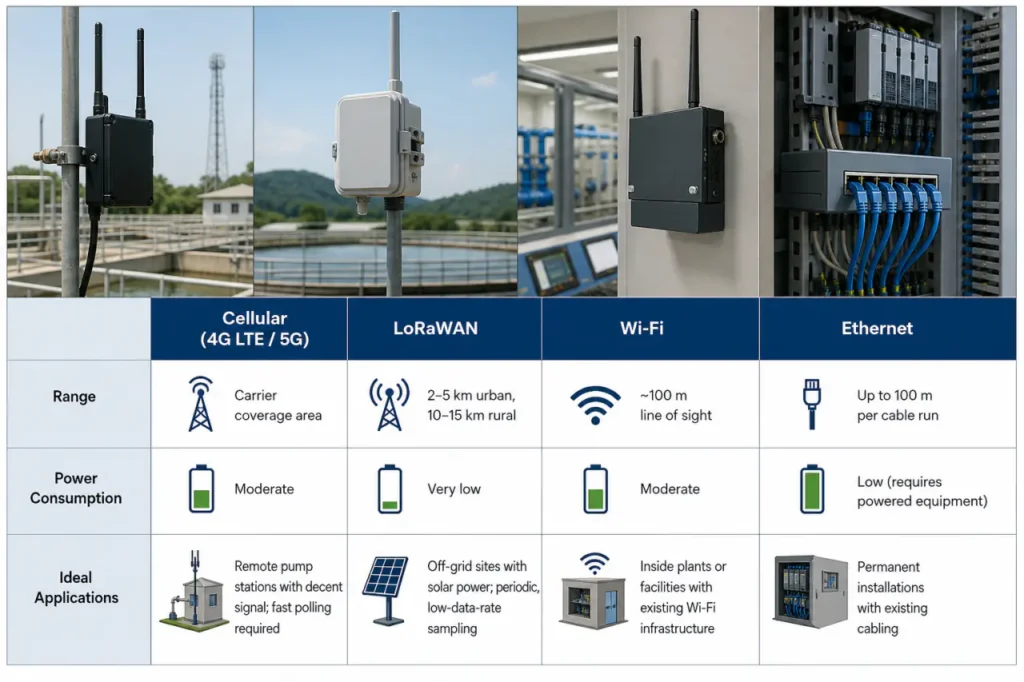
Selecting the right telemetry protocol depends on site isolation, power availability, and data polling frequency. Concrete walls, underground vaults, and rural locations all constrain the viable choices.
| Protocol | Range | Power Consumption | Best Use Case |
|---|---|---|---|
| Cellular (4G LTE / 5G) | Carrier coverage area | Moderate | Remote pump stations with decent signal; fast polling required |
| LoRaWAN | 2-5 km urban, 10-15 km rural | Very low | Off-grid sites with solar power; periodic, low-data-rate sampling |
| Wi-Fi | ~100 m line of sight | Moderate | Inside treatment buildings where existing IT infrastructure exists |
| Ethernet / Hardwired | Cable distance limit | Low (PoE) | Fixed SCADA panels in control rooms; highest reliability |
Overcoming Signal Attenuation in Remote Enclosures
A common mistake is mounting a cellular gateway inside a metal enclosure without an external antenna. To avoid dead zones:
- Test signal strength with the enclosure closed and all cabling in place
- Consider an external antenna if the link budget margin is below 10 dB
- Perform a site walk test before finalizing panel location
Industry-Specific Application Scenarios
Municipal Wastewater Treatment & Pump Stations
At municipally owned facilities, the most expensive failure is often an undetected lift station pump trip. A remote pump station monitoring system with immediate high-level float alerts prevents overflows and the associated regulatory penalties. Operators also track ammonia and nitrate trends to prove biological nutrient removal performance for municipal wastewater compliance.
Many cities now require automated effluent monitoring reports. A continuous data stream reduces the burden of manual chain-of-custody sampling and provides an audit trail that satisfies state environmental agencies.
Manufacturing and Process Water
In manufacturing, even a brief excursion in water quality can cause batch rejection, boiler scaling, or corrosion. Automatic water treatment systems rely on real-time telemetry to hold conductivity and pH within the narrow bands required by the process.
The specific parameters depend on the water’s role in the process:
- Boiler feedwater: dissolved oxygen and hardness
- Industrial effluent: heavy metals, total suspended solids, and pH
Trending these values over weeks reveals when a pretreatment step is drifting and needs maintenance before a violation occurs.
Data Center Cooling Water
Cooling towers for data centers demand zero-downtime operation. High conductivity or pH drift can accelerate scaling on heat exchanger surfaces, reducing cooling efficiency and raising energy costs.
Continuous remote monitoring provides the data to prevent performance loss:
- Tracks conductivity, inhibitor levels, and makeup water flow
- Enables central adjustment of bleed rates and biocide dosing
- Prevents even minor drops in heat rejection that could cause server throttling
This turns the monitoring system into a direct contributor to uptime guarantees.
Operational Benefits and Regulatory Compliance
Shifting from periodic grab samples to continuous remote monitoring delivers immediate operational savings.
Faster Incident Response and Chemical Savings
Real-time data lets you respond to parameter excursions instantly:
- Precise adjustment of dosing pumps cuts chemical overfeed by 10-20% in typical municipal and industrial applications.
- Operators spend less time on site checks, freeing them for predictive maintenance.
Immediate alerts for pH spikes or chlorine residual drops prevent excursions from becoming reportable events.
Compliance Audit Trail
Immutable data logging builds a defensible compliance record. During an EPA or local audit, the system can produce a time-stamped history that demonstrates permit adherence without relying on handwritten logs. This alone often justifies the investment in integrated wastewater treatment system monitoring.
System Implementation Checklist
Deployment goes smoother when you validate a few critical items before hardware installation. This pre-installation walk-through reduces false starts and rework.
- Confirm the required parameters and regulatory limits for each discharge or process point.
- Measure cellular signal strength at the intended panel location with the enclosure closed and all cabling in place.
- Select sensor bodies and wetted materials that tolerate the expected fouling, temperature, and chemical attack.
- Decide whether the site needs local display and control or a headless RTU with cloud-only interface.
- Configure alarm thresholds and escalation logic before powering up, including after-hours contact lists.
- Plan a monthly visual inspection of sensors for fouling and a quarterly calibration check, even with remote diagnostics.
When Off-the-Shelf Panels Are Not Enough
Standard monitoring panels often fail to address site-specific challenges like difficult connectivity, aggressive water chemistries, or existing SCADA protocols. A custom-configured system, designed after a review of your plant layout and compliance drivers, ensures every parameter that matters is captured correctly.
If you need a quote for a monitoring panel, help selecting turbidity sensors, or a demo of how a cloud dashboard would present your plant data, contact the engineering group. A configuration with a bill of materials and a connectivity plan can be ready within a few days.
Frequently Asked Questions
Can remote monitoring systems integrate with existing SCADA networks?
Yes. Most RTUs and gateways speak standard industrial protocols such as Modbus TCP, MQTT, or OPC-UA. This allows the remote monitoring data to flow into the plant’s current SCADA screens without rip-and-replace of the existing control system.
How are remote water quality sensors powered in off-grid locations?
Low-power sensor loops paired with a small solar panel and battery backup are the most common solution. LoRaWAN or cellular LTE-M radios can run for years on a modest battery, making monthly site visits unnecessary for power alone.
How often do inline sensors require calibration?
Calibration frequency depends entirely on the sample matrix. Clean water applications can often go three months between calibrations. Wastewater with high solids or grease may require monthly cleaning and verification. Even with remote diagnostics, periodic physical checks remain essential to maintain data integrity.