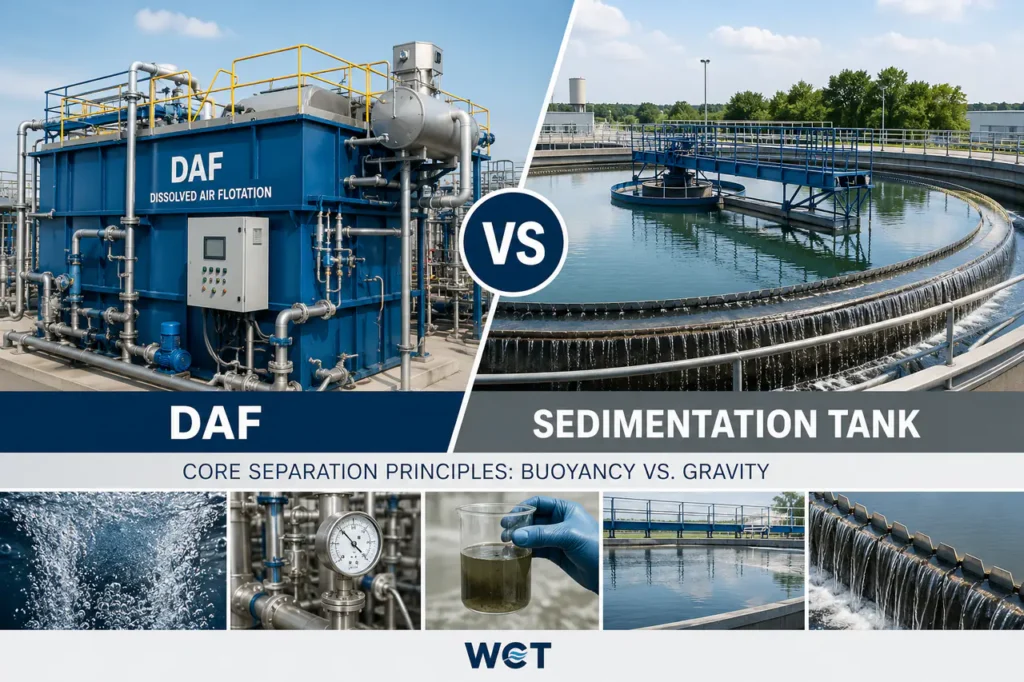
Evaluating a DAF vs sedimentation tank comes down to particle density and site space: choose dissolved air flotation when removing light, buoyant, or oily particles on a tight footprint, and select gravity sedimentation when managing dense mineral solids in high-volume baseline flows.
While sedimentation tanks rely on simple gravity settling, DAF uses pressurized microbubbles to float suspended matter. The right selection balances civil construction costs against long-term electrical and chemical requirements.
Core Separation Principles: Buoyancy vs. Gravity
The primary distinction between dissolved air flotation and conventional gravity settling lies in the directional vector applied to target particles. Both processes achieve solid-liquid separation, but they exploit opposing physical forces to isolate solids from the water column.
How Dissolved Air Flotation (DAF) Works
DAF systems introduce microbubbles ranging from 20 to 50 microns into the incoming wastewater stream. These tiny air bubbles are generated by dissolving pressurized air into recycled clean effluent at 4 to 6 bar inside a saturation vessel.
When this supersaturated stream passes through specialized release nozzles into the flotation tank, the drop to atmospheric pressure releases billions of microbubbles. These bubbles attach to hydrophobic or flocculated particles, reducing their effective density below that of water.
The bubble-particle agglomerates float rapidly to the surface, forming a concentrated sludge blanket. Continuous surface skimmers push this float layer into a discharge trough, while clarified water exits from the bottom of the basin through underflow baffles.
How Conventional Gravity Sedimentation Works
Conventional Sedimentation Water Treatment relies strictly on gravity to draw suspended particles downward out of suspension. The process is governed by Stokes’ Law, where particle settling velocity depends directly on liquid viscosity, particle diameter, and density differential.
Wastewater enters a settling basin designed to maintain low hydraulic velocity and minimal turbulence. As water travels horizontally or vertically through the tank, suspended solids denser than water sink to the bottom floor.
A rotating or traveling scraper mechanism sweeps the settled sludge into a central hopper for discharge. Clarified effluent flows over weir troughs at the surface to downstream treatment stages.
Target Contaminant Profiles: When to Use Which System
Choosing between buoyancy and gravity separation depends primarily on the physical characteristics of the target contaminants. Matching fluid chemistry and particle density to the correct separation mechanism prevents operational bypass and excessive chemical consumption.
Ideal Influent for DAF Systems
DAF excels when wastewater contains low-density particles that resist natural gravity settling or naturally float on the water surface.
- Fats, Oils, and Grease (FOG): Emulsified and free-floating lipids from food processing, rendering, or industrial washdown operations.
- Algal Cells: Microscopic cyanobacteria and algae in surface water or lagoon effluents that naturally float due to internal gas vacuoles.
- Fibrous Solids: Fine cellulose fibers from paper mill white water or textile processing that trap air and resist settling.
- Fine Total Suspended Solids In Water: Light, low-density organic flocs created during secondary biological pre-treatment or chemical coagulation.
Ideal Influent for Sedimentation Tanks
Gravity clarifiers are designed for high-density, heavy-particle influents where gravitational force easily overcomes liquid resistance. A robust Waste Water Treatment Tank using gravity settling is often the most economical choice for inert, mineral-heavy waste streams.
- Heavy Mineral Suspensions: Silt, sand, clay, and ore tailings from mining, quarrying, and gravel washing plants.
- Metal Hydroxides: Heavy metal precipitates generated during industrial metal finishing, plating, and acid mine drainage neutralization.
- Grit and Scale: Mill scale, iron filings, and coarse inorganic grit from steel production and heavy manufacturing.
- High-Concentration Primary Sludge: High-TSS municipal wastewater where heavy organic and inorganic solids settle rapidly without chemical additions.
Technical Specification Comparison (DAF vs. Clarifiers)
Comparing hydraulic and physical operating parameters helps engineering teams evaluate how each technology fits into an industrial treatment flow sheet.
| Design Parameter | Dissolved Air Flotation (DAF) | Conventional Gravity Sedimentation |
|---|---|---|
| Primary Separation Mechanism | Microbubble-assisted buoyancy | Gravitational settling (Stokes’ Law) |
| Surface Loading Rate (SOR) | 8.0 – 15.0 m3/m2/h | 1.0 – 2.5 m3/m2/h |
| Hydraulic Retention Time (HRT) | 15 – 30 minutes | 2.0 – 4.0 hours |
| Typical Float / Sludge Dry Solids | 3.0% – 6.0% dry solids | 1.0% – 3.0% dry solids |
| Equipment Footprint | Small to moderate (15% – 25% of clarifier) | Moderate to very large land footprint |
| Power Consumption | Higher (0.03 – 0.08 kWh/m3) | Lower (0.005 – 0.015 kWh/m3) |
| Tolerance to Heavy Grit Shock Loads | Moderate (requires bottom scraper option) | High (absorbs heavy solids and hydraulic spikes) |
The higher surface loading rates of DAF allow plants to process equivalent wastewater volumes in a fraction of the tank volume. While conventional clarifiers require hours of retention time, DAF systems complete separation in under thirty minutes, resulting in dramatic site area savings.
Operational Footprint, CAPEX, and OPEX
Capital expenditure and ongoing operational costs follow contrasting profiles between flotation and settling systems. Evaluating total lifecycle cost requires balancing initial civil structural expense against long-term power and chemical requirements.
Space and Footprint Requirements
Because DAF operates at surface loading rates up to six times higher than conventional clarifiers, its basin footprint is significantly smaller. Facilities with limited real estate or retrofitting inside existing buildings often favor DAF to eliminate expensive land acquisition.
Where space is restricted but gravity settling is preferred, engineers install Wct Honeycomb Inclined Tube Packing For Sedimentation Tank modules. Tube settlers increase the effective settling area per unit ground footprint, allowing smaller basins to match the hydraulic throughput of larger conventional tanks.
Energy and Chemical Usage
- Sedimentation: Minimal power use from low-power drive motors for scrapers. Ideal for continuous high-volume flows where electrical cost must remain low.
- DAF: Continuous power draw from high-pressure recycle pumps (4-6 bar) and air compressors. Additional chemical cost for uninterrupted polymer and coagulant dosing to maintain effective micro-floc formation and bubble attachment.
Sludge Handling and Dewatering Costs
- Float sludge from DAF: 3-6% dry solids, directly reduces dewatering equipment size and hauling volume.
- Underflow sludge from sedimentation: 1-2% dry solids, requiring larger dewatering systems and higher liquid disposal.
- Lifecycle savings: Lower decanter centrifuge runtime, fewer filter press cycles, and reduced polymer consumption from handling thicker DAF sludge.
Application Suitability Matrix by Industry
Industry-specific effluent traits dictate whether buoyancy or settling is the standard engineering choice across industrial sectors.
| Industry Sector | Recommended Technology | Primary Target Contaminant | Key Selection Rationale |
|---|---|---|---|
| Meat & Poultry Processing | DAF | FOG, proteins, blood solids | Floating grease rapidly blinds gravity collectors; DAF yields concentrated sludge. |
| Mining & Aggregates | Sedimentation Tank | Ore dust, clay, quartz silt | Heavy inorganic particles settle rapidly; microbubbles cannot lift dense mineral solids. |
| Pulp & Paper Manufacturing | DAF | Wood fibers, filler clays | Light cellulose fibers float easily; DAF enables high fiber recovery for reuse. |
| Metal Finishing & Electroplating | Sedimentation Tank | Heavy metal hydroxides, scale | High-density metal precipitates settle reliably in gravity thickeners without aeration. |
| Municipal Algae Pre-Treatment | DAF | Microcystis, planktonic algae | Low-density algal cells resist settling and float naturally when exposed to air microbubbles. |
Verification Before Final Industry Selection
While the matrix guides standard practice, conditions vary. Before committing, verify these points:
- Composite sample lab testing: Measure full-range particle size distribution, FOG, and settleable solids to confirm the primary contaminant type.
- Seasonal load variance: Check if peak production times shift contaminant density (e.g., slaughterhouse season increases FOG load).
- Pilot treatability study: For borderline cases, run bench-scale DAF jar tests and settling column tests to compare real separation efficiency.
- Existing infrastructure: Assess whether there is room for chemical pre-treatment and sludge storage that the recommended technology demands.
In food processing and slaughterhouse operations, grease and protein solids coat surfaces and resist gravity settling. A specialized DAF system harvests this material cleanly from the water surface while preventing septic conditions in the basin bottom.
Conversely, in heavy mining or metal preparation plants, installing a durable Water Treatment Tank structured for continuous gravity thickener operation provides simple, low-maintenance separation without the mechanical risk of nozzle clogging from abrasive grit.
Understanding the full Water Treatment Sedimentation Process helps plant operators establish whether upstream grit traps or grease interceptors are needed to protect downstream equipment.
Pre-Treatment Dependencies: Coagulation and Flocculation
Neither DAF nor gravity sedimentation performs at peak efficiency without optimized chemical pre-treatment. Proper coagulation and flocculation condition raw wastewater, destabilizing particle charges and clumping micro-solids into treatable agglomerates.
Pin-Floc Dynamics in DAF Systems
Flotation processes rely on small, tight flocs called pin-flocs. Coagulants neutralize surface charges, while lightweight polymers bind particles into compact structures with high surface area.
Microbubbles easily attach to or entrap within these small pin-flocs. Large, heavy flocs should be avoided in DAF systems, as excessively heavy structures can break away from microbubbles and sink to the tank bottom.
- Coagulant type: Low-molecular-weight metal salts (alum, ferric) or polyaluminum chloride to create small, charge-neutral flocs.
- Mixing intensity: Rapid mix for coagulant dispersion, followed by gentle flocculation to grow pin-flocs without shearing.
- Floc size target: 50-100 µm to maximize bubble attachment surface area.
- Avoid over-dosing: Excessive polymer can create large buoyant flocs that trap air and rise too fast, causing uneven float blankets.
Large Floc Formation for Gravity Settling
Gravity clarifiers require large, dense flocs with high settling velocity. Flocculation tanks upstream of sedimentation basins use longer retention times and gentle multi-stage mixing to build macro-flocs.
Adding high-molecular-weight anionic polymers increases floc density and size. If flocs are sheared by high-velocity transfers or under-dosed chemicals, settling performance drops rapidly, causing pin-floc carryover into the clean water effluent.
- Polymer type: High-molecular-weight anionic polyacrylamides to bridge fine particles into dense macro-flocs.
- Flocculation staging: At least two- or three-stage flocculators with decreasing mixing energy to avoid shearing formed flocs.
- Floc size target: >500 µm for settling velocities above 1 m/h.
- Diagnostic check: Measure effluent turbidity daily; sudden increase often indicates under-dosing or sheared flocs.
Final Selection Checklist and Engineering Consultation
Selecting between a DAF unit and a gravity sedimentation tank requires systematically matching raw wastewater chemistry to site constraints and operational budgets.
- Characterize Influent Particle Density: Measure oil and grease concentration, total suspended solids, and settleable solids via Imhoff cone testing.
- Calculate Available Footprint: Determine if plant real estate allows for large-basin civil works or requires a compact, modular steel package unit.
- Evaluate Operational Costs: Balance the higher electrical power and polymer costs of DAF against the higher civil construction and land cost of gravity clarifiers.
- Review Downstream Sludge Handling: Assess whether your facility benefits from the thicker float sludge generated by flotation systems.
Before finalizing equipment specifications, verify system hydraulics and separation efficiency with bench-scale jar testing and bench flotation trials.
Send your wastewater quality data, target flow rates, and site constraints to our application engineering team at WCT. We provide customized design calculations, pilot testing units, and complete system quotes tailored to your industrial treatment goals.