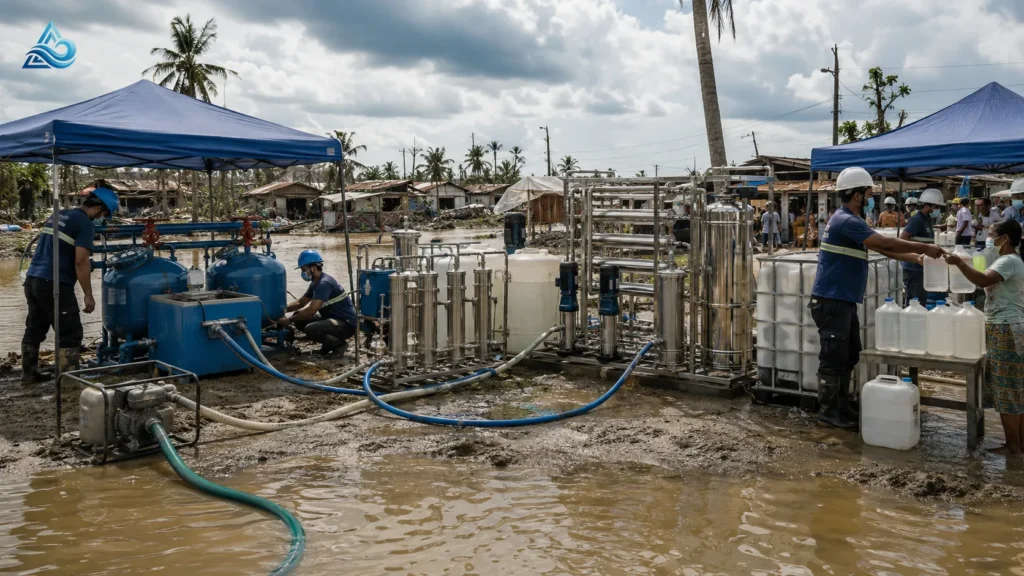
When a supply chain breaks or a flood compromises the municipal supply, the question is not if you need an emergency water treatment system but whether your selection holds up under sustained group use.
The gap between a personal straw filter and a community-scale unit is measured in gallons per hour and pathogen log reduction. Before comparing hardware, get clear on three baselines:
- The worst water source you expect to treat-clear well water, turbid floodwater, or surface water with chemical runoff.
- Total daily potable and hygiene water for the entire group, not just individual drinking targets.
- Power availability: no electricity, intermittent grid, or vehicle-based 12 V DC.
This guide walks through the technical selection criteria, system architectures, and verification steps that decide whether an emergency water treatment system keeps people safe or becomes a point of failure when it matters most.
Defining Your Requirements: Capacity, Source, and Contaminants
A system spec sheet means nothing until it is matched to a real worst-case day. Start with the group size and source water risk, then work backward to the micron rating and log reduction you actually need.
The daily volume that breaks most plans
Drinking water alone is around 1 gallon per person per day. Add hygiene, sanitation, and light medical use, and a realistic emergency allocation jumps to 3-5 gallons per person per day for a household. A community field clinic or aid station can demand 10-15 gallons per person daily after a disaster.
- Small family group (4-6 people): target 20-30 gallons per day total output.
- Extended household or small shelter (10-20 people): target 50-100 gallons per day.
- Community distribution point (50-200+ people): target 250-1,000+ gallons per day, which moves the requirement well beyond gravity drip filters.
If the system cannot deliver that volume within a reasonable operating window-typically 4-6 hours of daily run time-logistics fall apart fast.
Clear or turbid: how your source water changes the whole design
A system rated for “clear water” will clog within minutes on floodwater containing silt and suspended solids. Turbidity pre-filtration is not optional; it is the first-stage insurance that keeps downstream membranes alive.
- Turbid floodwater or standing surface water: requires a sediment pre-filter stage (20-50 micron) before any fine membrane.
- Clear well or municipal tap water (offline supply): can often feed directly into a 0.1-0.02 micron ultrafiltration or RO stage.
- Water with visible color or odor: points to dissolved organics or chemicals, which hollow-fiber membranes alone will not remove. An activated carbon stage becomes necessary.
Pathogen risk: why “virus-grade” is the disaster response baseline
Bacteria removal is the floor, not the ceiling. Flood events, sewage cross-contamination, and disrupted sanitation introduce viruses like Hepatitis A and rotavirus. Standard microfiltration around 0.2 microns stops bacteria and protozoa but passes viruses.
Look for a system that explicitly claims virus reduction to EPA Guide Standard P231 levels-typically a 4-log (99.99%) reduction for viruses-or NSF P231 certification. This is the virus-grade purification standard that separates emergency response equipment from camping filters.
Comparing System Architectures: Which Technology Fits Your Site?
Every type of emergency water treatment system makes a trade-off between throughput, power independence, and pathogen breadth. The table below helps you map real site constraints to the right architecture.
| System Type | Typical Flow Rate (GPH) | Power Required | Filter Lifespan (Approx.) | Pathogen Coverage | Best When… |
|---|---|---|---|---|---|
| Gravity-fed bag/ceramic drip | 0.5 – 2 | None | 500-3,000 gallons | Bacteria, protozoa; viruses with added element | Power outage, stationary shelter, low tech skills, small groups |
| Manual pump (0.1-0.02 micron UF) | 15 – 40 | None (hand/lever) | 1,000-5,000 gallons | Bacteria, protozoa, viruses (if rated) | Vehicle kit, mobile response, rapid deployment, turbid source |
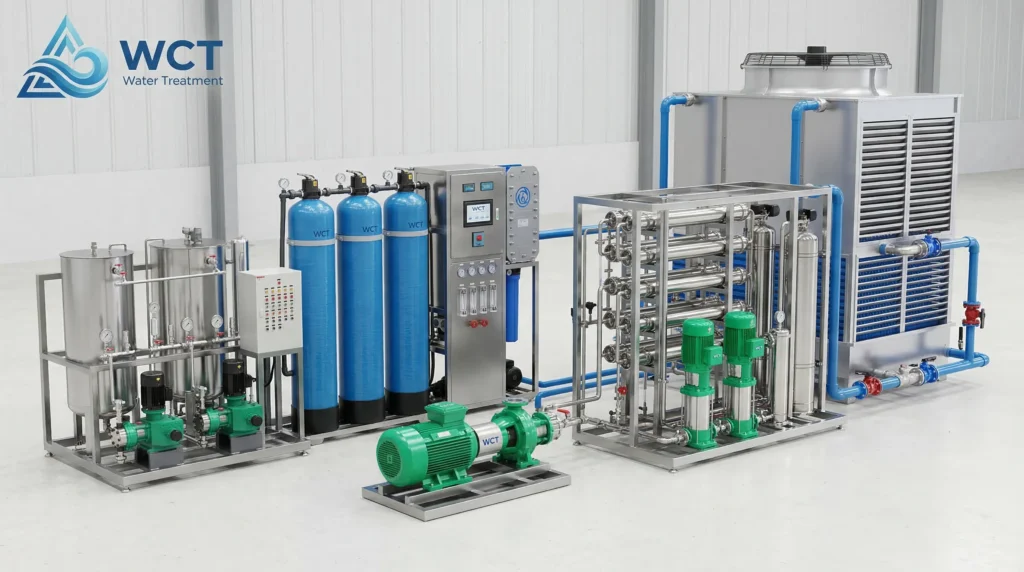
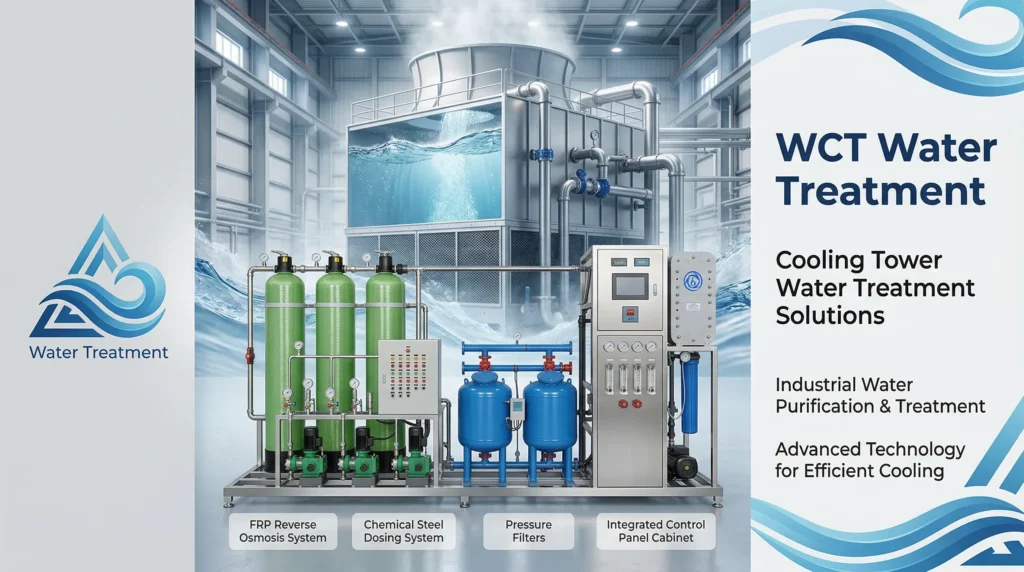
| Powered multi-stage cart (pump + UF/RO + UV) | 60 – 300+ | 110-240 V AC / 12 V DC / generator | 5,000-50,000 gallons on key membranes | Full: bacteria, viruses, chemicals (with carbon/RO) | Community sites, temporary clinics, centralized distribution |
| UV-C reactor only (post-filtration) | 2 – 12 (flow-through) | Electric (12 V or mains), battery | Lamp life 8,000-12,000 hours | Excellent on bacteria/viruses in clear water; no particulate removal | Polishing step after sediment/carbon, clear source only |
Where gravity-fed systems reach their ceiling
Gravity units are simple and power-free, but their low flow rate and drop-by-drop output make them impractical for more than a handful of people. They also struggle to maintain virus-rated performance unless the filter media is specifically designed for it-check for an NSF P231 rating rather than just a “purifier” label.
Manual pump systems: the middle ground that works for mobile teams
Lever or hand-pump ultrafiltration systems produce water fast enough for cooking and small-group hydration. Many now integrate a turbidity pre-filtration stage and can handle turbid source water better than a gravity dripper. Downtime is zero if you have a spare filter pack.
A common mistake is assuming a 1,000-gallon filter cartridge will last that long in silty water; turbidity cuts filter life by 50-70% in the field.
Powered carts: when you need both volume and virus-proof water
Mobile treatment carts combine a pump, sediment pre-filter, membrane stage-often membrane filtration for virus-grade purification-and sometimes UV finishing. Flow rates from 1 to 5 gallons per minute become achievable, making them the standard for temporary clinics and evacuation centers.
The trade-off is that they require trained operators to change pre-filters, monitor pressure, and sanitize the system. This is a system, not a gadget.
Reverse Osmosis vs. Ultrafiltration in emergency contexts
Ultrafiltration (UF) handles bacteria, protozoa, and many viruses plus turbidity, without electricity in manual pumps. Reverse Osmosis (RO) adds dissolved solids removal including salt, pesticides, and heavy metals, but requires pressure and typically electric pumps.
In disaster response, Reverse Osmosis vs. Ultrafiltration is not about better or worse; it is about whether the source water has chemical contamination or salinity. If you are pumping fresh floodwater, UF is lighter and faster. If the only water source is a saline estuary or agricultural runoff, RO becomes the only viable barrier.
Understanding Filtration Standards: EPA P231 and NSF 53/58
One of the most expensive mistakes a buyer can make is trusting “filters down to 0.1 micron” without a test standard behind it. We look for independently verified microbial reduction numbers, not marketing language.
The log-reduction gap that catches unprepared teams
“Removes 99.9%” sounds impressive, but a 3-log reduction leaves 1,000 pathogens out of a million. For virus-laced floodwater, that is not safe. The EPA Guide Standard P231 for microbiological water purifiers requires 6-log (99.9999%) reduction for bacteria and 4-log (99.99%) for viruses.
A system that only hits 3-log bacteria and 1-log virus is a personal camping filter, not a disaster response tool.
What NSF 53 and 58 really cover in an emergency
NSF 53 addresses health-related aesthetic contaminants like lead cysts and some VOCs but is not a virus standard. NSF 58 covers RO systems for TDS reduction but not necessarily emergency pathogen claims unless specifically tested.
The practical rule is: for an emergency water treatment system, demand proof of P231 or equivalent virus removal data, not just a general NSF certification number.
What to request from the manufacturer before buying
A test summary that checks these three boxes separates a serious supplier from a reseller:
- Test organism: MS2 bacteriophage for virus reduction claim.
- Log reduction value: minimum 4-log virus reduction.
- Test water challenge: turbid water with organic load, not just clean lab water.
Ask for the full test report from an ISO 17025 accredited lab if you are making a procurement decision for a team or facility. We provide these on request for our advanced membrane systems.
The Logistical Reality: Shelf Life and Ready-State Maintenance
An emergency system stored in a crate for five years can be as dangerous as having no system if the membranes have dried out and cracked or the UV lamp has slowly degraded. Shelf life and maintenance cycles are not afterthoughts; they are part of the readiness audit.
Sealed vs. open: storage profile dictates replacement intervals
A factory-sealed UF filter pouch stored in a cool, dry room may stay viable for 5-7 years. Once opened or wetted, that same element typically needs replacement within 12-24 months, and sooner if biological growth takes hold. Activated carbon stages have a shorter shelf life of 2-4 years even sealed, as they can passively adsorb contaminants from the air.
- Sealed dry membranes: count on 5+ years, but verify with batch date.
- Wetted or flush-tested systems: schedule a membrane swap every 1-2 years regardless of use.
- UV lamps: output decays; replace every 12 months of cumulative on-time or per manufacturer’s interval, whichever is shorter.
The “dry-out” failure mode few inventory plans catch
Certain hollow-fiber UF membranes are preserved with glycerin or other humectants. If the packaging is compromised or the cartridge is left to dry after a field test, irreversible pore collapse can render the filter useless even though it looks new. Add a dry-pack integrity check to your quarterly equipment audit-not just a visual inspection.
Required maintenance cycles for stored systems
Even a powered cart sitting in a warehouse needs periodic health checks. Document a simple cycle:
- Quarterly: visual inspection of seals, hoses, and desiccant packs; record humidity exposure.
- Bi-annual: if feasible, flush the system with clean water and a food-grade preservative to prevent biological bloom, then re-dry per manufacturer instructions.
- Annual: check pump performance and sensor calibration; replace any expired chemical injection cartridges.
Scaling for Community Use: Mobile and Modular Systems
Community-scale response demands redundancy, pre-filtration, and field-serviceable parts. A single filter housing that clogs once a day is not a solution for 200 displaced people. This is where modular emergency water treatment thinking takes over.
Pre-filtration first: the rule that saves membranes
Every community system, whether a WOW-style cart or a palletized high-flow water purification unit, must start with aggressive sediment removal. A backwashable multimedia filter or a series of bag filters from 50 micron down to 5 micron prevents the expensive 0.02-micron UF membrane from becoming a single-use item within hours.
Manifold designs for throughput without single-point failure
Instead of one giant filter, we often specify three to four UF modules in parallel on a manifold. If sediment overload clogs one, the others keep producing while the dirty element is swapped out. This design also allows the system to run in “reduced flow but still functioning” mode, which matters when you cannot stop producing water.
Transportability and deployment time
Cart-based systems (like the EPA WOW Cart) can be rolled by one person and set up in under 30 minutes. Palletized systems require a forklift or truck ramp but deliver higher volume. The deployment plan should specify:
- Total assembled weight and the number of people needed to move it.
- Setup time to first water from sealed crate.
- Consumables needed per week of operation (pre-filters, chemicals, lamp sleeves).
For rapid-response teams, a containerized RO for disaster response may be the only way to produce 1,000+ GPH from a brackish source, but the logistical footprint is substantial.
Field-serviceability: can a local technician fix it?
Ask the manufacturer whether the system uses proprietary quick-connects and cartridge keys or standard Tri-clamp and NPT fittings. In a prolonged emergency, the last thing you want is to wait for a proprietary part to ship. Standard plumbing fittings and generic membrane dimensions reduce single-source dependency.
Scenario-Based Recommendations
Most selection mistakes come from picking the right technology for the wrong scale. Here is how the deployment context changes the system you buy.
Household or estate backup (4-6 people)
- Priority: zero power, shelf-stable components, simple enough for a non-technical user.
- Best fit: gravity-fed system with built-in virus-grade purification and a minimum 2-gallon clean-water reservoir.
- Watch point: Store extra filter elements in vacuum-sealed packaging. The unit itself is not the backup; the spare filters are.
Vehicle-based response or mobile field team
- Priority: fast flow rate, ability to pump from a bucket or stream, no power dependence.
- Best fit: manual lever-pump ultrafiltration system capable of 0.5-1.5 GPM, with a sediment pre-screen.
- Watch point: In turbid water, pre-screen mesh size matters more than the membrane brand. Pack multiple 40-60 micron pre-filters.
Community shelter or temporary clinic (50-300 people)
- Priority: throughput over 100 gallons per day, full pathogen and chemical barrier, operator training.
- Best fit: powered multi-stage cart with sediment pre-filter, UF, activated carbon block, and UV lamp finishing.
- Watch point: Plan for generator fuel or solar battery runtime; compute daily kWh needed for the pump and UV lamp.
- For saline or chemically contaminated sources, an RO system for pathogen removal plus activated carbon may be required, but anticipate 3-5 gallons of reject water for every 1 gallon produced.
Final Verification Before Selection
At this stage, you have matched source water, group size, and power availability to a system architecture. Before issuing a purchase order, walk through these verification questions with the manufacturer.
- “Can you provide a P231 lab report showing MS2 bacteriophage log reduction under turbid challenge conditions?”
- “What is the recommended filter replacement interval after the first wetting, not just sealed shelf life?”
- “What standard fittings are used? If a booster pump fails, can I source a generic replacement locally?”
- “What is the daily electricity consumption of the entire system at maximum flow rate?”
- “Are spare parts kits for 6 months of continuous operation available as a pre-assembled package?”
Mapping your specific source water risks to the system’s micron rating and flow rate is the final decision point. For community-scale needs, often an off-the-shelf kit will not fit; a custom manifold or an additional commercial UV treatment for virus removal stage may close the last log-reduction gap.
View our technical comparison chart for common use cases, or request a configuration review for your site’s specific water risk profile.
Frequently Asked Questions
Can these systems remove salt (desalination)?
Most emergency filters for freshwater cannot remove dissolved salts. If your only water is brackish or seawater, you need a Reverse Osmosis system with a high-pressure pump. RO reduces salinity effectively but requires electricity and creates reject water; it’s the only field-ready desalination option for disaster response.
How long do the filter elements last in an emergency?
Lifespan depends heavily on turbidity. A UF element might deliver up to 5,000 gallons in clear water but only 200-600 gallons in silty floodwater. Always use a sediment pre-filter and keep spare cartridges. When flow rate drops below half the rated output, swap the pre-filter first, then the membrane.
Does the system remove chemical runoff or pesticides?
Hollow-fiber UF and ceramic filters do not remove dissolved chemicals like pesticides or heavy metals. For chemical risks, add an activated carbon stage or a membrane system designed for organic reduction. UV treatment only inactivates pathogens in clear water. Select the system based on the contaminants you actually face.