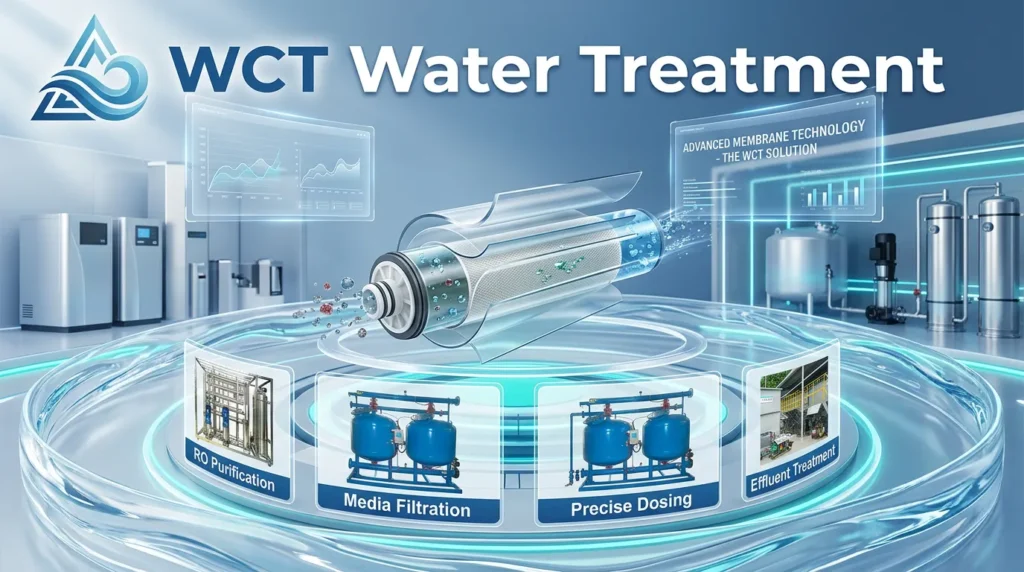
Introduction to Advanced Membrane Filtration
Defining Advanced Membrane Technology
Membrane filtration is an advanced, physical separation technology that pressurizes a stream (water or liquid) through specific semi-permeable membranes. These membranes, work at the molecular and microscopic level isolating suspended solids, bacteria, viruses, organic matter and dissolved ions Our water treatment products can be engineered to function as narrow gates that only allow pure water molecules to flow while rejecting targeted contaminants.
The Evolution of Filtration Processes
This has led to a shift in how we treat water — from trapping dirt and organic matter to separating molecules. Preliminary filtering used sand and carbon beds that were gravity-fed, enormous and unable to trap any dissolved solid or germ. This trend towards membrane filtration is illustrated in the timeline below:
- Traditional Era: Involves sand, multimedia filtration and chemical coagulation. Effective only for large macro-particles.
- Migrating away from settling ponds and implementing standard microfiltration to begin the early Membrane Era while decreasing chemical footprints.
- Modern Advanced Era: High-flux, fouling-resistant polymeric and ceramic materials enabling MWCO-specific tailoring.
Key Differences from Conventional Filtration
Well, the answer lies in filtration methods that have been present for decades — depth filtration. Advanced membrane filtration employs molecular surface rejection, providing stable water quality independent of influent variability.
| Feature | Conventional Filtration (Sand/Multimedia) | Advanced Membrane Filtration |
|---|---|---|
| Mechanism of separation | Trapping at depth, bridging by the particles. | Selective physical size exclusion |
| Excludes | Giant free floating solids, Very small particulate matter such as viruses and bacteria ( ) pressures to get water through and leave contaminants as they will. |
Nanofiltration : Best known as loose RO, nanofiltration separates both monovalent ions (such as sodium and chloride) and divalent ions (including calcium and magnesium) so that it can be an excellent softening method for water in applications too light for total demineralization.
Reverse Osmosis : RO – the gold standard of water purification, 99.98% rejection of dissolved salts, heavy metals & monosalt ions convert brackish or seawater into high purity industrial process water.
| Attribute | Nanofiltration (NF) | Reverse Osmosis (RO) |
|---|---|---|
| Operating Pressure | Moderate | High |
| Target Rejection | Divalent ions, organics, viruses | All dissolved salts, monovalent ions |
| Main Applications | Water softening, color removal | Desalination, ultra-pure water production |
Electrodialysis and Specialized Separation
In addition to pressure-driven systems, different separation techniques exist such as elctrodialysis (ED), which use electrical potential to separate ions. Electrodialysis, on the other hand, uses direct current to draw dissolved ions through either cation or anion exchange membranes instead of pumping water through a barrier and isolates purified water. It is quite suitable for application on highly brackish streams with reduced waste stream concentrate and an excellent water recovery rate in difficult industrial conditions.
Advantages of Advanced Membrane Systems
Advanced Membrane Filtration (AMF) is considered the new gold standard of modern water treatment as it moves the paradigm from “treating” our waters to one that purifies them at a molecular level. Because our systems are physical filters of water, we get the consistency behind our product no matter how raw water conditions vary.
Infecting Pathogen and Dissolving Contaminant Removal High
These systems are enormously successful when it comes to capturing microscopic dangers. The pore size accuracy of newer membranes keeps out anything, be it bacteria, viruses or fresh organic contaminants, and provides a safety net as sustainable water regeneration has always been less possible with sand filters from yore.
| Contaminant Type | Removal Efficiency | Primary Technology |
|---|---|---|
| Bacteria & Protozoa | >99.99% | Ultrafiltration (UF) |
| Viruses | >99.9% | UF / Nanofiltration |
| Heavy Metals | High | Reverse Osmosis (RO) |
| Dissolved Salts | Good | WCT ULP series RO membrane |
Minimization in chemical usage and waste
It is the sustainability aspect of our fit — we cannot be dosing tons with heavy chemicals. The conventional treatment uses a high concentration of coagulants and disinfectants which lead to toxic sludge. Advanced membranes utilizes physical separation, which:
- Reduces the risks of chemical handling and storage.
- The production of sludge can greatly reduce costs for disposal.
- Check — Prevents corrosion of equipment and downstream systems in contact with chemicals.
Energy Efficiency and Operational Sustainability
Contemporary membrane technology is developed to be used at low pressure. With the use of high permeability materials, we assist facilities cut electricity costs with high flow. This makes the complete process energy-efficient and a low total cost of ownership (TCO) over time when coupled with an automated WCT chemical dosing system. The combination of performance and conservation resources makes it the choice for a world level industrial and municipal project.

Advanced Machining of Fibrous Materials
Our expertise lies in providing the industry with materials that define performance efficiency at all levels of any water treatment system. How often polymer and ceramic are used to decide the long-term of ROI of your system.
Polymeric vs. Ceramic Membranes
Material selection is a trade-off between cost and performance. Polymeric membranes are the workhorse of industry when there is no extreme conditions due to their flexibly lower initial cost but ceramic membrane is a powerhouse for extreme conditions.
- Polymeric – typically PVDF, PES or PTFE based Most industrial water treatment applications are versatile and cost-effective.
- Ceramic: The Long Game They deal with high temperatures, caustic acids and abrasive solids that would destroy plastic-based filters.
| Feature | Polymeric Membranes | Ceramic Membranes |
|---|---|---|
| Initial Cost | Lower | Higher |
| Chemical Resistance | Moderate | Excellent |
| Thermal Stability | ≤ 45°C – ≤ 80C | Up to 500°C + |
| Service Life | 3–7 years | 10–20+ years |
Advancements in Nanocomposite Materials
There is a seismic shift that is happening right now towards Thin-Film Nanocomposite (TFN) materials. The concept involves incorporating nanoparticles within the membrane surface to create a synergistic effect that improves permeability without impacting contaminant rejection. The tech shrinks your system’s “footprint” and directly reduces energy costs by requiring less pressure to flow water through.
Membrane Bioreactors (MBR) and Hybrid Process
MBR are considered the gold standard for high strength waste facilities. Pioneering biological treatment with advanced membrane filtration to replace conventional secondary clarifiers.
- Small footprint – Perfect for sites where space is a premium;
- Quality Output: High-quality effluent available for immediate reuse
- Hybrid Integration: MBR is frequently used with industrial process water systems in a closed-loop cycle leveraging every drop and increasing overall membrane life.
Advanced Membrane Filtration as a Critical Application Scenario
Advanced membrane filtration has been at the heart of contemporary water purification process. We am an earnest provider of water treatment items, so we know firsthand the number of extraordinarily convoluted separation difficulties these frameworks tackle for businesses all through the world.
Municipal Wastewater Treatment and Reuse
Municipal wastewater reuse is now a given, as cities around the world are struggling with reduced supplies of freshwater. Municipalities use advanced membrane systems to convert sewage into high-quality reclaimed water. Cities can recycle water, generating water for irrigation or industrial cooling and ensuring indirect potable reuse by implementing a reliable water treatment process.
- Microbial Barrier: Retain Poorly, Intermediate — High Efficiency retention of bacteria, viruses and microplastics.
- Footprint Reduction: Replaces large conventional settling tanks with smaller, high membrane modules to increase throughput.
- Regulatory Compliance: Attains even the most stringent global discharge and environmental regulations comfortably.
Industrial Process Water and Desalination
In the case of heavy industries, both a product quality and greatly equipment life expectancy extensively depend upon water quality. Separation is the primary technology for treating industrial process water in manufacturing facilities that has advanced to ensure zero degradation from scaling or corrosion.
| Industry | Primary Membrane Application | Key Benefit |
|---|---|---|
| Power Generation | HPB Feedwater Treatment | Prevent mineral buildup and downtime |
| Electronics & Semi-conductors | Ultrapure water (UPW) production | Removes trace ions that destroy microchips |
| Seawater Desalination | Reverse osmosis (RO) desalination | Loss of fresh water source in dry and coastal areas |
Utilizing well-established systems designed to manage high-salinity feeds and very aggressive chemical streams, we are able to prolong the working life of membranes over a typical 10-year, multiple-plant useful life cycle whilst also minimizing overall OPEX costs for worldwide factories.
Applications in Biotech and Food Processing
Advanced membranes do much more than clean water they purify, concentrate and fractionate valuable products in the biotech and food and beverage sectors all without utilizing heat.
- Dairy Processing: Whey protein and milk fat solids concentration with nutritional compensation
- Beverages Clarification – we can remove yeast and haze from juices, wine and beer without changing their flavour profiles.
- Biopharma Separation: Concentrate Enzymes, Harvest Cells and Purify Amino Acids in a Highly Sterile Environment.
Challenges and Technical Considerations
Managing Membrane Fouling and Scaling
Still, membrane fouling and scaling are the largest challenges to attain a stable flux. Suspended solids, bacteria, and mineral deposits easily accumulate on membrane surfaces as time passes. This leads to an increase in resistance, reduction of efficiency, and a decrease in the entire lifetime of the membrane. To combat this, systems need to be backwashed frequently and also in slide cleaning intervals with chemicals directed to the particular membranes blockages.
Operational Costs and Infrastructure Requirements
Advanced Membrane Filtration offers the purest water but comes with a high capital investment and operating costs. Nanofiltration and reverse osmosis systems use high-pressure pumps that require a lot of power to run. For an operational team, this is a constant challenge: optimizing energy use while still maintaining that throughput.
| Challenge Type | Primary Cause | Mitigation Strategy |
|---|---|---|
| Biofouling | Growth of microorganisms and biofilm formation | Periodical biocide pumping and backwashing |
| Scaling | Mineral precipitation (calcium, sulfate) | Antiscalant injection and pH adjustment |
| High energy consumption | High trans-membrane pressure requirement | Energy recovery devices and low energy membranes |
Integration with Existing Treatment Plants
A thoughtful plan is required to retrofit high-performance membranes into conventional facilities. Moreover, the current infrastructure is usually required to adapt for varying flow rates and residual waste streams. Thus, in many configurations some form of pretreatment is added to the system to shelter the susceptible membrane elements from early-life fatigue and high solids loads.
Emerging Trends in Membrane Filtration
The field of water treatment is changing, and fast. As a pioneering manufacturer, we are now concentrating on combining digital intelligence and material science to break new boundaries in Advanced Membrane Filtration. The next handful of years will shift to dynamic, adaptive solutions rather than static filters.
Smart Membranes and Real-time Monitoring
Scientists are moving towards what they call “smart” which includes embedding sensors into the membrane modules themselves. This allows for:
- Fouling and Scaling-Free Condition Detection: The first line of defence for detecting mineral scaling or organic build-up before it affects flow
- Automated flux adjustment: Systems that automatically adjust to changes in water quality without operator attention.
- Predictive maintenance: examines data to identify how long membrane can last, minimizing downtime as well as unnecessary replacements.
Next-Generation Permeability and Selectivity
The target is to shift more water with less pressure. We are creating membranes with atomic-level precision using materials such as graphene oxide and carbon nanotubes. These innovations ensure:
- Higher flux rates: More gallons per minute per square foot of membrane.
- Selective removal: Removing certain micropollutants (PFAS, pharmaceuticals, etc.) and leaving useful minerals behind.
- Improved durability, including more natural oils and biological growth resistant coatings.
What Does Filtration Mean in the Context of Global Water Security
Advanced Membrane Filtration: THE FUTURE OF GLOBAL WATER RESILIENCE as freshwater becomes increasingly scarce. We make cities capable of using their wastewater as a fully potable water supply by perfecting municipal water treatment systems.
This continues to be our focus — and we are building sustainable, decentralized treatments. We open up the opportunity even for heavy industry and developing urban populations to more easily tap into water materials with lower energy input needs in desalination and reuse, thus securing more reliable access independent of local climate degradation trends.