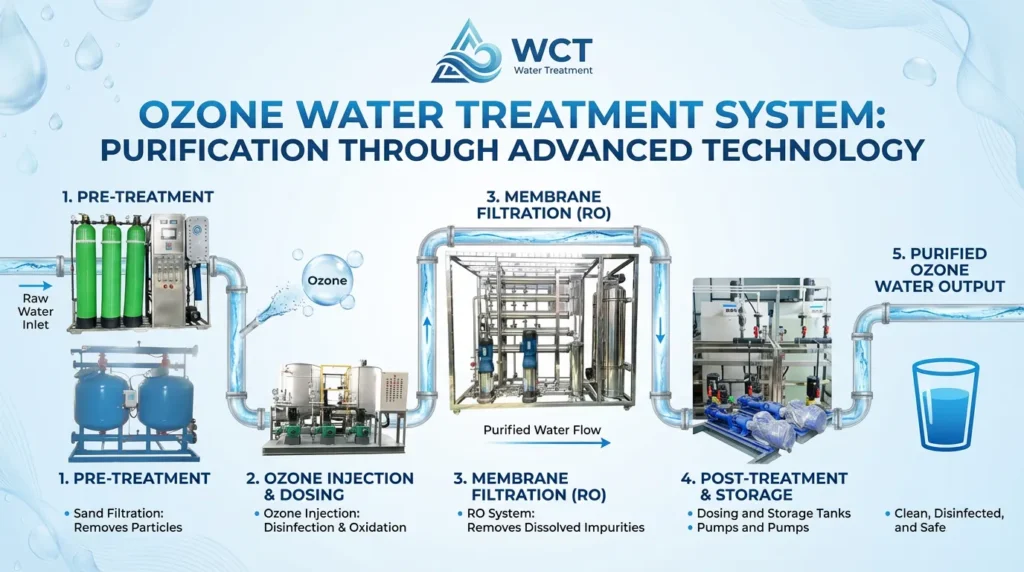
Are you struggling to maintain water purity while keeping chemical costs down? Implementing a commercial ozone water treatment system is the single most effective way to achieve superior pathogen inactivation and crystal-clear water. I’ve helped facilities transition from outdated chemicals to high-efficiency ozone oxidation, and the results—from food and beverage sanitization to cooling tower maintenance—are undeniable. In this guide, I’m breaking down the science of O3 disinfection, the best ozone generation technology, and the exact steps to scale a system for your specific needs.
Let’s dive right in.
What is a Commercial Ozone Water Treatment System?
A commercial ozone water treatment system is a high-capacity purification solution engineered for industrial, municipal, and large-scale commercial applications. These systems utilize ozone (O3) to provide rapid, high-level disinfection and oxidation. Designed for durability and continuous operation, they serve as the primary defense against waterborne pathogens and chemical contaminants in demanding environments.
The Science of Ozone (O3) Disinfection
Ozone is a powerful, naturally occurring gas composed of three oxygen atoms. Its effectiveness as a disinfectant stems from its high oxidation potential.
- Molecular Instability: Ozone is highly reactive and seeks to return to its stable state (O2).
- Pathogen Destruction: It penetrates the cell walls of bacteria, viruses, and protozoa, destroying their life-support systems instantly.
- On-Site Production: Because ozone cannot be stored or transported, our systems generate it on-demand using ambient air or concentrated oxygen.
How Ozone Oxidation Works in Water
When ozone is injected into water, it initiates a process called lysis. This involves two distinct mechanisms:
- Direct Oxidation: The ozone molecule reacts directly with organic matter and dissolved metals.
- Hydroxyl Radical Formation: Ozone decomposes in water to form hydroxyl radicals, which are even more aggressive oxidizers that break down complex micro-pollutants.
This dual-action process ensures that even the most resilient contaminants are neutralized, leaving the water clear, sterile, and oxygen-rich.
Comparison: Ozone vs. Traditional Chemical Treatment
Ozone is significantly more effective than chlorine and other traditional chemical disinfectants. It works faster and leaves no toxic footprints.
| Feature | Commercial Ozone System | Traditional Chlorine Treatment |
|---|---|---|
| Oxidation Strength | 1.5x stronger than Chlorine | Moderate |
| Disinfection Speed | 3,000x faster than Chlorine | Slow (requires contact time) |
| Residuals | Zero (reverts to Oxygen) | Harmful THMs and Chloramines |
| Pathogen Reach | Kills Cryptosporidium & Giardia | Ineffective against many cysts |
| Storage Needs | None (Generated on-site) | Requires hazardous chemical storage |
By integrating a commercial ozone water treatment system, facilities eliminate the need for dangerous chemical handling while achieving a level of purity that traditional methods simply cannot match.
Key Benefits of Commercial Ozone Systems
Investing in a commercial ozone water treatment system provides a level of purification that traditional chemicals simply cannot match. We design these systems to deliver high-performance results while simplifying your facility\’s operational workflow.
Superior Pathogen and Biofilm Inactivation
Ozone is one of the most powerful oxidants available for water treatment. It works up to 3,000 times faster than chlorine at destroying bacteria, viruses, and protozoa like Cryptosporidium. Beyond just killing free-floating microbes, ozone effectively penetrates and strips away biofilm—the protective slime layer inside piping that often harbors persistent pathogens.
Environmentally Friendly and Chemical-Free Process
One of the biggest advantages of our ozone technology is its \”green\” footprint. Because ozone is generated on-site from oxygen and reverts back to pure oxygen after the reaction, it leaves no toxic residues or harmful disinfection byproducts (DBPs). For facilities handling complex discharge, pairing ozone with a sand media filter for sewage treatment creates a robust, eco-friendly solution that meets strict environmental regulations without the need for hazardous chemical storage.
Improved Water Taste, Clarithttps://pt.wxwatertech.com/wct-sand-media-filter-for-sewage-treatment/y, and Odor Removal
Ozone is exceptionally effective at \”polishing\” water. It oxidizes organic compounds and dissolved minerals that cause unpleasant smells, metallic tastes, and discoloration.
- Odor: Instantly neutralizes hydrogen sulfide (rotten egg smell).
- Clarity: Micro-flocculates particles, making them easier to filter out.
- Taste: Removes earthy or chemical taints, ensuring a neutral, fresh profile.
Reduction in Long-Term Operational Costs
While the initial investment in a commercial ozone water treatment system is higher than a simple dosing pump, the long-term ROI is undeniable. By generating your own disinfectant on-demand, you eliminate the recurring costs of purchasing, transporting, and storing dangerous chemicals.
| Benefit Category | Ozone Treatment | Traditional Chlorine |
|---|---|---|
| Disinfection Speed | Extremely Fast (Seconds) | Slow (Minutes to Hours) |
| Byproducts | Pure Oxygen (None) | THMs and Chloramines |
| On-site Safety | High (No chemical storage) | Low (Hazardous fumes/spills) |
| Biofilm Control | Highly Effective | Poor |
| Operating Cost | Low (Electricity only) | High (Continuous chemical buy) |
Our systems are built to run 24/7 with minimal intervention, significantly lowering your labor costs and improving the overall safety of your utility room.
Common Types of Ozone Generation Technology
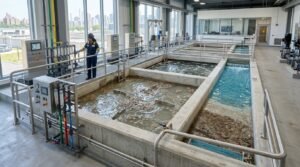
As a trusted water treatment products supplier and manufacturer, we know that the heart of any commercial ozone water treatment system is how it actually creates the ozone. Different facilities have different demands, and the generation method dictates the system\’s efficiency, footprint, and overall capability. Here is a breakdown of the primary technologies used today.
Corona Discharge Ozone Generators
This is the heavy hitter of the industry and the most common method used in large-scale commercial applications. Corona discharge works by passing dried air or concentrated oxygen through a high-voltage electrical field. This \”spark\” splits the oxygen molecules, which then rapidly recombine to form ozone.
- High Output: Capable of producing massive amounts of ozone quickly.
- Cost-Effective: Highly efficient for large commercial and industrial water volumes.
- Feed Gas Requirement: Requires properly dried air or pure oxygen to prevent the formation of nitric acid and maintain equipment longevity.
Ultraviolet (UV) Light Systems
UV ozone generation mimics how the sun creates ozone in our atmosphere. Ambient air is passed over a specialized UV lamp emitting light at a specific wavelength (typically 185 nanometers). This light energy splits the oxygen molecules to create ozone.
- Lower Maintenance: Fewer moving parts and no high-voltage electrical fields.
- Consistent Purity: Does not produce harmful byproducts, even if the feed air isn\’t perfectly dry.
- Ideal for Smaller Volumes: Best suited for lower-demand applications. We often see facilities pair these units with a 500 LPH RO system for water treatment to achieve a comprehensive, multi-barrier purification setup.
Cold Plasma and Electrolytic Generation
These represent the more specialized side of ozone generation, designed for specific, high-purity requirements.
- Cold Plasma: Operates on a similar principle to corona discharge but uses a lower voltage field. This generates significantly less heat, which makes the system more efficient and extends the lifespan of the internal components.
- Electrolytic Generation: Instead of using air or oxygen gas, this method creates ozone directly from the water itself. By applying an electrical current to the water, it splits the H2O molecules to form ozone directly in the solution. This is highly effective for ultra-pure water applications where introducing outside air is not an option.
Contaminants Removed by Ozone Treatment
A commercial ozone water treatment system is one of the most versatile tools we provide for total water purification. It doesn\’t just mask impurities; it physically destroys or precipitates a wide range of contaminants that standard filtration often misses.
Bacteria, Viruses, and Fungal Spores
Ozone is a biological powerhouse. It works by rupturing the cell walls of bacteria and inactivating viruses almost instantly. Because it is such a strong oxidant, pathogens cannot build up a resistance to it like they sometimes do with chlorine. In many of our projects, we find that while UV water treatment for bacteria is excellent for disinfection, ozone adds an extra layer of oxidation that handles high-turbidity water more effectively.
Iron, Manganese, and Sulfur Neutralization
If your facility deals with \”rotten egg\” odors or metallic staining, ozone is the most efficient fix. It oxidizes dissolved minerals into solid particles that can be easily trapped by a post-filter:
- Iron: Converts clear-water iron into a filterable solid.
- Manganese: Removes the cause of black staining and bitter tastes.
- Hydrogen Sulfide: Instantly eliminates the gas responsible for foul sulfur smells.
Micro-Pollutants and Organic Compounds
Modern water sources are increasingly contaminated with complex organic matter, pesticides, and pharmaceutical residues. Our systems break these down into harmless byproducts. For heavy-duty industrial applications, we often integrate ozone with an automated powder liquid dosing system to manage complex wastewater streams. This combination ensures that micro-pollutants and high chemical oxygen demand (COD) levels are brought well within regulatory limits.
Key Applications for Commercial Ozone Systems
As a dedicated water treatment products supplier and manufacturer, we know that a commercial ozone water treatment system is a versatile powerhouse. It delivers rapid, chemical-free disinfection across a wide range of demanding industries, ensuring safety and compliance without leaving harmful residues behind.
Food and Beverage Industry Sanitization
In food and beverage processing, hygiene is non-negotiable. Ozone is a highly effective, FDA-approved method for sanitizing water, equipment, and surface areas.
* **Residue-Free:** Ozone breaks down into pure oxygen, meaning it never alters the taste, color, or odor of food and drinks.
* **Equipment Cleaning:** It safely disinfects bottling lines, processing tanks, and packaging materials, drastically reducing downtime.
Aquatic Facilities and Commercial Swimming Pools
Public pools and water parks rely heavily on ozone to maintain crystal-clear, safe water.
* **Pathogen Destruction:** It instantly neutralizes chlorine-resistant parasites like Cryptosporidium.
* **Better Swimmer Experience:** By destroying chloramines, ozone eliminates the strong chemical smells, skin irritation, and red eyes typically associated with commercial pools.
Cooling Tower Maintenance and Legionella Prevention
Cooling towers are notorious breeding grounds for dangerous bacteria and slime.
* **Legionella Control:** A commercial ozone water treatment system aggressively attacks and destroys Legionella bacteria.
* **Biofilm Removal:** It strips away biofilm buildup inside pipes, which keeps heat transfer rates high and significantly lowers the need for expensive, harsh chemical biocides.
Agricultural and Aquaculture Water Management
Clean water is the lifeline of successful farming and fish breeding. Ozone ensures high survival rates and better yields by keeping water free of diseases and organic waste. Whether you are managing a high-density fish farm or optimizing crop irrigation, pairing ozone technology with comprehensive agriculture water treatment solutions guarantees healthier livestock, robust crops, and a more sustainable operation.
Essential Components of a Professional Ozone System
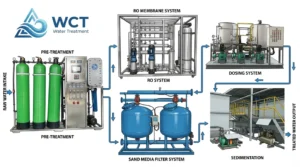
A reliable commercial ozone water treatment system is more than just a generator; it is a precision-engineered assembly of several critical modules. As a manufacturer, we design these systems to work in a closed-loop or integrated fashion to ensure maximum oxidation efficiency and operator safety.
Oxygen Feed Gas Preparation Units
The quality of ozone produced depends entirely on the feed gas. We use industrial-grade air dryers and oxygen concentrators to strip away moisture and nitrogen. Providing a high-purity oxygen stream prevents the formation of nitric acid within the equipment, which protects the internal components and significantly boosts the O3 concentration levels.
Ozone Concentration and Delivery Systems
This is the core of the setup where the electrical discharge occurs. Our systems utilize high-frequency inverters and precision electrodes to convert oxygen into ozone. These units are built for continuous operation, featuring robust cooling mechanisms to maintain stable output even in demanding industrial environments.
Mass Transfer and Injection Manifolds
Ozone is a gas, so it must be dissolved into the liquid to work. We employ high-efficiency Venturi injectors and specialized manifolds to create a vacuum that pulls the ozone into the water stream. This creates micro-bubbles that maximize the surface area for contact. For complex installations, our customized water treatment solutions ensure that the mass transfer rate is optimized for your specific flow requirements.
Safety Monitoring and Ozone Destruction Units
Since high concentrations of ozone can be respiratory irritants, safety is our top priority. Every professional installation includes:
- Ambient Ozone Sensors: To detect any gas leaks in the equipment room.
- Off-Gas Destructors: These units use heat or catalysts to convert excess ozone back into pure oxygen before it is vented.
- Dissolved Ozone Monitors: To ensure the water reaches the exact oxidation-reduction potential (ORP) required for your process.
Selection and Installation Considerations
Choosing the right commercial ozone water treatment system requires a deep dive into your specific water chemistry and facility layout. We focus on delivering a setup that integrates seamlessly without disrupting your existing workflow.
Calculating Required Ozone Dosage and Capacity
Getting the dosage right is the difference between effective disinfection and wasted energy. We calculate the \”Ozone Demand\” based on your water’s flow rate, temperature, and the specific organic load it carries.
| Factor | Impact on Ozone Requirement |
|---|---|
| Flow Rate | Higher GPM requires higher ozone output (grams per hour). |
| Water Temperature | Warmer water holds less dissolved ozone, requiring adjusted dosing. |
| Contaminant Level | High COD or iron levels increase the \”demand\” before disinfection occurs. |
| Target Goal | Simple disinfection needs less ozone than complex micro-pollutant removal. |
System Footprint and Integration Requirements
Space is often at a premium in commercial mechanical rooms. Our systems are designed with a compact footprint, often utilizing modular skids that can be tucked into tight corners. When integrating with existing infrastructure, such as industrial sand filters for wastewater treatment, we ensure the injection manifolds and contact tanks are sized to maintain proper hydraulic pressure without causing backflow issues.
Regulatory Compliance (FDA, EPA, and OSHA)
Staying compliant is non-negotiable. We ensure every installation meets the necessary safety and health standards:
- OSHA: We install ambient ozone monitors to ensure workplace air levels stay below 0.1 ppm.
- FDA/USDA: For food and beverage applications, our systems meet \”GRAS\” (Generally Recognized As Safe) status for direct food contact.
- EPA: Our ozone destruction units ensure that no excess gas is vented into the atmosphere, meeting strict environmental discharge codes.
Maintenance Schedules and Longevity
A professional commercial ozone water treatment system is built for the long haul, but it isn\’t \”set it and forget it.\” Unlike a standard chemical dosing system that requires constant refills, ozone maintenance focuses on mechanical integrity:
- Monthly: Check air prep filters and cooling water flow.
- Quarterly: Inspect check valves and seals to prevent backflow into the generator.
- Annually: Clean the corona discharge cells and calibrate ozone sensors.
- Longevity: With proper care, the core ozone cells in our systems typically last 10+ years before requiring a rebuild.