Why is the Water Treatment Process Essential?
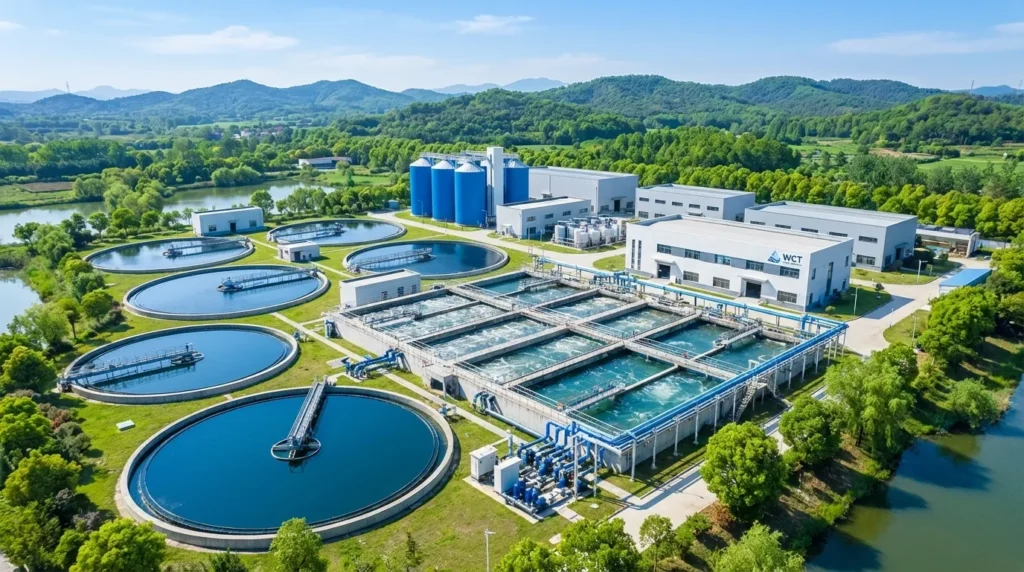
At WCT, we understand that water is the lifeblood of both communities and industries. The process of water treatment isn’t just about making water look clear; it is a critical safeguard for public health and environmental stability. Without a rigorous treatment strategy, raw water sources remain vulnerable to contamination, posing severe risks to human consumption and industrial machinery alike.
We prioritize these three core objectives in every system we design:
- Protecting Public Health: The primary goal of any water treatment process is eliminating waterborne pathogens. Bacteria, viruses, and parasites found in untreated sources are invisible threats that can cause widespread illness. Our advanced filtration and disinfection technologies ensure these biological hazards are neutralized before the water ever reaches a tap.
- Removing Toxins and Heavy Metals: Beyond biological threats, water often carries dissolved chemical pollutants. Industrial runoff or natural mineral deposits can introduce toxic chemicals and heavy metals like lead or mercury. Effective treatment strips these dangerous elements out, ensuring the water is chemically safe for use.
- Meeting Regulatory Standards: Compliance is non-negotiable. Whether it is for municipal supply or industrial discharge, water quality must meet strict local and environmental regulations. Our systems are engineered to help facilities consistently hit these targets, avoiding legal penalties and protecting the local ecosystem from pollution.
The 5 Core Stages of the Water Treatment Process
Turning raw water into clean, safe water relies on a proven series of water purification steps. We break the process of water treatment down into five essential stages to guarantee maximum efficiency and safety.
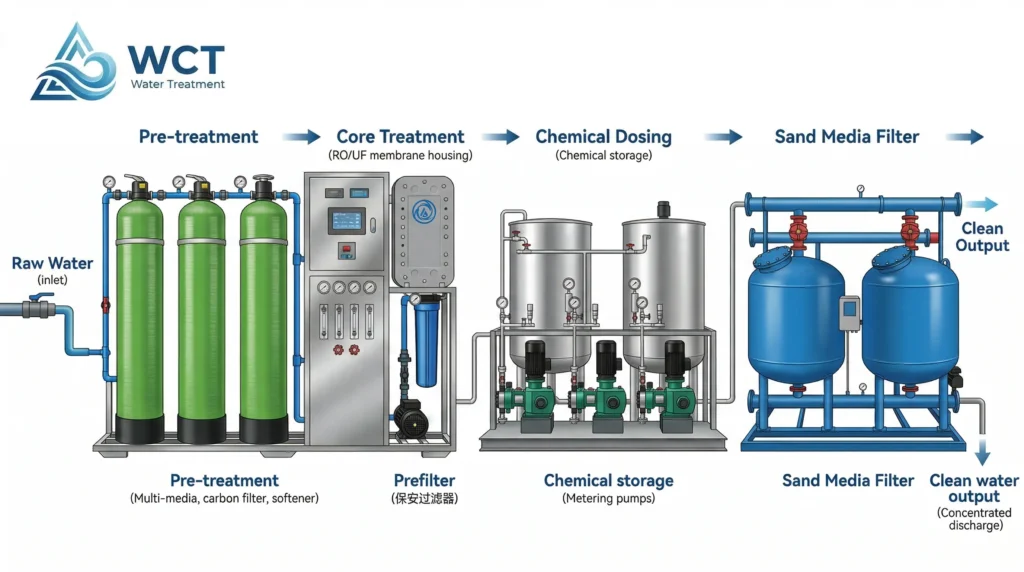
- 1. Coagulation and Flocculation: The first step is neutralizing dirt and dissolved particles. We do this by adding positively charged chemicals to the water. Utilizing a highly precise chemical dosing system for water treatment, these chemicals bind with the negatively charged dirt. This coagulation and flocculation process forces the tiny particles to clump together into larger, heavier masses known as \”floc.\”
- 2. Sedimentation: Once the floc forms, the water moves into a sedimentation basin. Here, gravity takes over. The heavy floc settles at the bottom of the water supply, creating a layer of sludge. This settling process effectively separates the clear water from the waste material.
- 3. Filtration: Next, the clear water on top passes through varying compositions of filters, including sand, gravel, and charcoal. Modern water filtration technology strips out remaining dissolved particles, dust, and microscopic chemicals. We design our advanced filtration products to handle this critical stage with maximum efficiency.
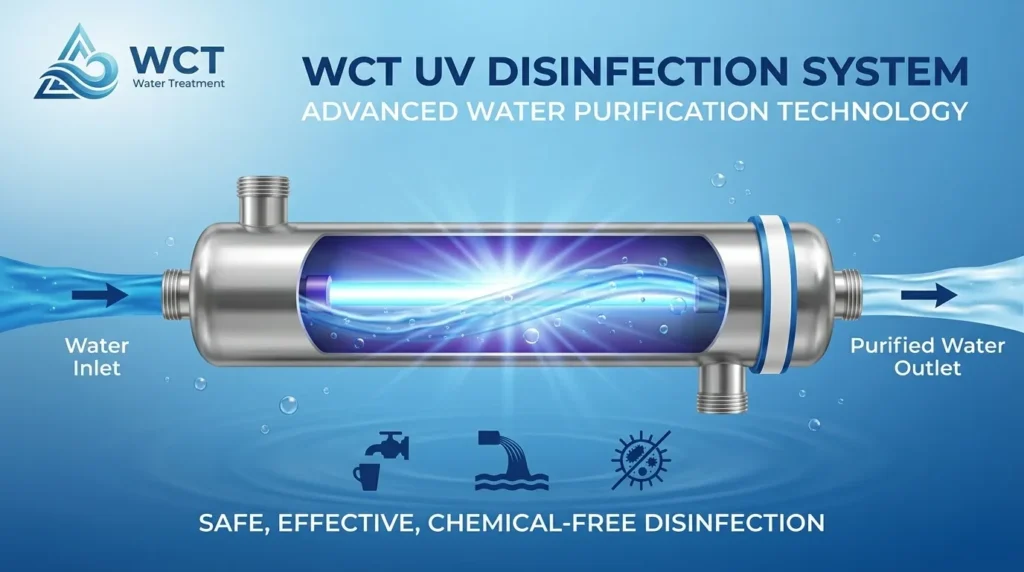
- 4. Disinfection: Even clear water can hide invisible threats. We apply primary disinfection methods by adding disinfectants like chlorine and chloramine, or by utilizing UV and ozone systems. This destroys any lingering bacteria, parasites, and viruses, ensuring the water remains completely safe as it travels through distribution pipes.
- 5. Storage and Distribution: ly, the clean water flows into closed reservoirs or tanks. Storing the water allows the disinfection stage to fully complete its work. From there, the safe water is pumped directly into the municipal water supply system, reaching homes, businesses, and industrial facilities.
Advanced Water Filtration Technology
While the standard process of water treatment handles the bulk of purification, certain facilities require a much higher level of precision. When basic methods aren\’t enough, we rely on advanced water filtration technology to strip out microscopic impurities and deliver ultra-pure results.
Reverse Osmosis Water Systems
Reverse Osmosis (RO) is the heavy hitter of the advanced process of treatment of water. In this stage, pressure forces raw water through a semi-permeable membrane. You can think of thisbasic process of water treatment handles the bulk of common contaminants, certain applications demand absolute purity. For these strict requirements, we rely on advanced water filtration technology to guarantee safety and compliance.
Reverse Osmosis Water System
Reverse osmosis (RO) relies on pressure to force water through a dense, semi-permeable membrane. Think of it as an ultra-fine sieve. This barrier aggressively targets microscopic impurities, dissolved salts, and heavy metals that easily bypass standard filters. In high-demand setups, utilizing top-tier components like our WCT ULP series RO membrane for reverse osmosis filters ensures reliable performance, maximum water recovery, and consistent output quality.
Ultrafiltration and Nanofiltration
Beyond RO, specific industrial water treatment solutions require tailored membrane technologies. Ultrafiltration and nanofiltration are highly effective for municipal processing and large-scale industrial manufacturing.
- Ultrafiltration (UF): Excels at removing suspended solids, bacteria, and larger organic molecules. We frequently deploy UF as a robust pre-treatment step to protect downstream equipment and improve overall system efficiency.
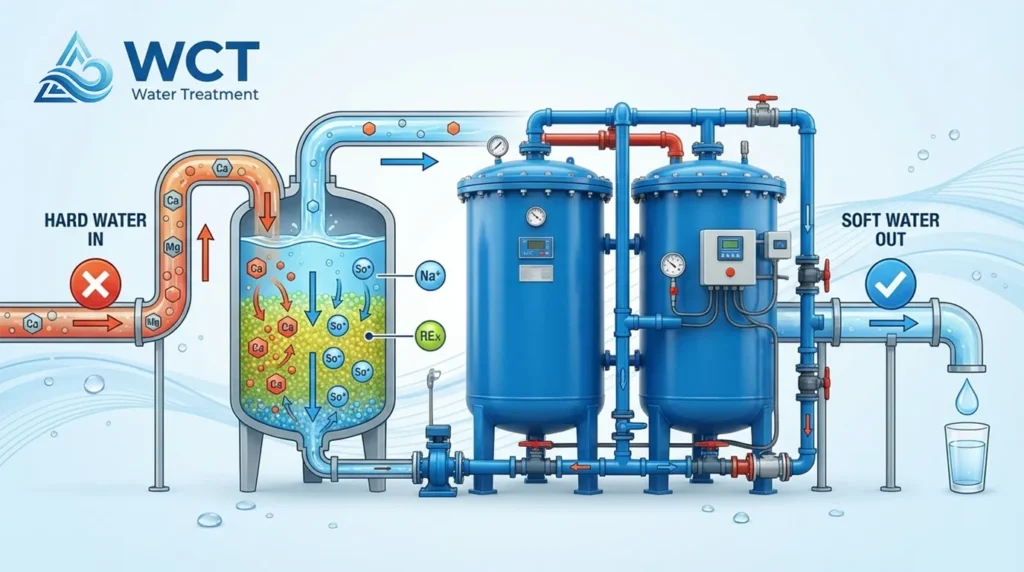
- Nanofiltration (NF): Specifically targets multivalent ions, such as calcium and magnesium. This makes it highly efficient for softening water and removing color or organics without incurring the high energy costs associated with full reverse osmosis.
Integrating these advanced stages ensures the treatment process of water fully meets the exact specifications required for safe drinking water standards and complex machinery operation.
Municipal vs. Industrial Water Treatment Processes
The exact process of water treatment we use depends entirely on the final destination of the water. While the foundational steps remain similar, the end-goals dictate the technology and the intensity of the system.
Distinct End-Goals
We approach industrial water treatment solutions completely differently from city drinking water projects.
- Municipal Water Supply System: The priority is potable water for human consumption. The system must meet strict health and safety standards, focusing heavily on removing pathogens, neutralizing toxins, and ensuring the water is safe to drink.
- Industrial Water Use: The goal is protecting heavy machinery and supporting manufacturing operations. For example, the treatment of boiler water focuses strictly on removing hard minerals that cause equipment scaling and corrosion, entirely ignoring factors like taste or aesthetics.
Adapting to Raw Water Sources
A successful treatment process of water must be customized to the raw water source. Every source presents unique challenges that require specific equipment adjustments:
| Raw Water Source | Primary Contaminants | Focus of Treatment |
|---|---|---|
| Groundwater | Dissolved minerals (iron, manganese, calcium) | Softening and targeted mineral filtration. |
| Surface Water | Organic matter, algae, dirt, and bacteria | Heavy coagulation, flocculation, and sedimentation. |
| Wastewater | High toxicity, chemical runoff, heavy metals | Aggressive industrial wastewater management and membrane filtration. |
When handling severe contamination or factory runoff, the process for water treatment requires heavy-duty intervention. To tackle this efficiently, we implement advanced equipment like our high-capacity 1000 GPD RO system for waste water treatment to strip out microscopic impurities, ensuring the final product is completely safe for industrial reuse or environmental discharge.
How WCT Elevates the Water Treatment Process
At WCT, we understand that an efficient process of water treatment relies heavily on the quality and precision of the equipment used at every stage. Since 2014, we have positioned ourselves as a leading high-tech enterprise, dedicated to designing and manufacturing top-tier solutions that streamline operations for both municipal and industrial clients. Our team of over 20 R&D engineers works tirelessly to develop systems that not only meet but exceed global standards, backed by ISO9001 certification and a portfolio of 30 patents.
We focus on delivering durability and sustainability in every component we produce. Whether it is our robust sludge dewatering systems or our advanced 500 LPH RO systems for water treatment, our equipment is engineered to withstand rigorous daily use while minimizing energy consumption. By integrating our specialized precision filters for water treatment and automated dosing units, facilities can achieve a more reliable and cost-effective treatment process. Our goal is to provide \”One-Stop\” solutions that lower operational costs and ensure your project achieves zero discharge or meets strict potability requirements with absolute confidence.
Frequently Asked Questions About the Process of Water Treatment
How long does the process of water treatment take?
The timeline depends heavily on the system size and the initial raw water purification needs. Generally, it takes anywhere from a few hours to a full day for water to move completely through all the essential drinking water treatment stages, from the initial coagulation step to final storage and distribution.
What chemicals are commonly used in water treatment?
We use specific chemicals based on strict water quality testing parameters to ensure safety and efficiency. The most common include:
- Aluminum Sulfate (Alum): Used to bind suspended dirt and particles during the coagulation and flocculation process.
- Chlorine and Chloramine: The industry standard chemicals used for primary disinfection methods.
- Scale Inhibitors and Softeners: Used in specialized hard water treatment systems to prevent damaging mineral buildup in pipes and industrial machinery.
Why is water filtered before it is disinfected?
Advanced water filtration technology must remove dirt, debris, and organic matter first. If we skip this step, suspended particles can physically shield bacteria, parasites, and viruses from the disinfection stage. Clearing the water ensures that chemical disinfectants or UV water purification equipment can effectively neutralize pathogens and consistently meet safe drinking water standards.