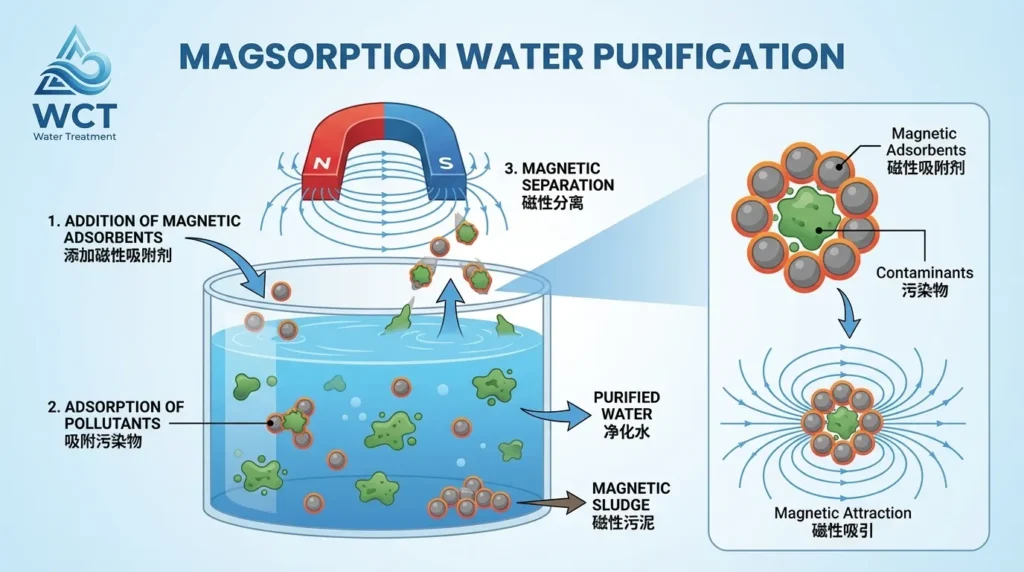
The Science of Magnetic Sorption in Water Decontamination
At Wuxi Chengxi Technology, we tackle complex industrial water challenges daily. One of the most advanced methods gaining traction in our R&D discussions is magsorption water treatment. It sounds futuristic, but the science is grounded in fundamental chemistry and physics. Essentially, we are using magnetic fields to enhance the removal of contaminants that traditional sedimentation tanks might miss.
Core Mechanisms of Magnetic Adsorption
The real workhorse here is the magnetic particle itself. We often look at materials like magnetic layered double hydroxides (MLDHs) or polymer-coated magnetite. Think of these as microscopic magnets with a sticky surface designed to trap specific pollutants.
- Attraction: The surface of these particles is engineered to have a positive charge or specific functional groups.
- Binding: When introduced into wastewater, they act like a magnet for organic anions and heavy metals.
- Removal: Once the contaminants are bound to the particles, we don\’t need to wait for gravity to settle them out slowly. Instead, an external magnetic field can pull these loaded particles out of the water instantly.
This mechanism is particularly effective for pollutants that are too light to settle or too dissolved to be filtered easily by standard screens.
The Fenton Process Connection
While magnetic sorption is powerful on its own for trapping pollutants, sometimes we need to destroy them completely. This is where we integrate chemical degradation. By combining magnetic sorption with the Fenton process, we create a dual-action system.
The magnetic particles often contain iron (like magnetite), which acts as a catalyst in the Fenton reaction. When we introduce hydrogen peroxide, the iron triggers the release of hydroxyl radicals. These radicals are incredibly aggressive oxidizers that break down complex organic structures—like industrial dyes—into harmless byproducts.
Why this combination works:
- Concentration: The sorption step gathers the pollutants together.
- Degradation: The Fenton reaction breaks them down right on the particle surface.
- Result: You get total organic breakdown rather than just moving waste from one place to another.
This synergy aligns perfectly with our philosophy of providing \”One-Stop\” tailored solutions that solve the root cause of contamination efficiently.
Real-World Efficacy of Magsorption Water Treatment
When we implement magnetic nanoparticles in wastewater, the results speak for themselves. We track specific performance metrics across different setups, and the data shows exactly how well magsorption handles tough pollutants in the field.
Heavy Metal Adsorption and Phosphates
Heavy metal adsorption using magnetic particles is one of our strongest capabilities. Magnetic layered double hydroxides lock onto dissolved metals and phosphates quickly. Based on our current wastewater engineering data, the removal efficiency easily outpaces traditional methods.
| Contaminant Target | Expected Removal Rate | Common Application |
|---|---|---|
| Heavy Metals (Lead, Copper, Zinc) | 90% – 98% | Industrial effluent magnetic treatment |
| Phosphates | 85% – 95% | Agricultural and municipal runoff |
Cutting Chemical Oxygen Demand (COD)
High Chemical Oxygen Demand (COD) is a primary indicator of heavy organic pollution. In municipal wastewater magnetic purification setups, magsorption actively binds to the stubborn organic anions and detergents that drive COD up. By pulling these organics out of suspension, we see massive drops in overall COD levels.
To optimize this chemical oxygen demand COD removal, we often pair magnetic resins with precise chemical conditioning. For example, integrating a reliable WCT-TPAD PAC PAM dosing system for wastewater treatment ensures the incoming water is perfectly balanced, allowing the magnetic adsorbent materials to perform at peak efficiency.
Landfill Leachate Magnetic Treatment
Landfill leachates are a toxic, highly complex mess. Traditional sedimentation and basic biological filters usually fail under these harsh conditions. Magsorption thrives here. We use specialized magnetic water treatment efficacy protocols to target the complex, concentrated organics and heavy metals suspended in leachates. Because the magnetic separation water flow relies on physical magnetic fields rather than just gravity, we can forcefully strip out toxic contaminants that standard methods simply leave behind.
Operational Parameters for Magsorption Water Treatment
Taking magnetic nanoparticles wastewater setups from a controlled lab into a real-world plant requires extreme precision. You have to dial in the exact conditions for the magnetic adsorbent materials to do their job effectively. When deploying our integrated sewage treatment equipment for sewage disposal, we closely monitor these key metrics to guarantee high performance at scale.
Scaling Up: Contact Time and Flow Rates
Moving to industrial effluent magnetic treatment means managing continuous flow systems. The contact time must be perfectly timed. The water needs to stay in the system long enough for the magnetic resin to bind with pollutants. However, the magnetic separation water flow must also stay fast enough to keep up with commercial plant demands. If the flow is too fast, you leave contaminants behind; if it is too slow, your daily output drops and operating costs rise.
Balancing pH and Resin Dosage
We break down the core drivers that dictate your sorption capacity and your bottom line.
| Operational Factor | Impact on Magsorption Efficiency | Strategy for Optimization |
|---|---|---|
| Optimal pH Levels | Acidity and alkalinity completely change how well pollutants bind. If the pH is wrong, sorption drops rapidly. | Adjust incoming water pH to match the specific contaminant being targeted. |
| Resin/Particle Dosage | Finding the exact balance between maximum removal efficiency and raw material cost. | Run site-specific kinetic tests to find the minimum dosage needed to hit target purity levels without wasting resin. |
We engineer our core water treatment products to handle these shifting operational parameters easily, keeping your daily costs down and your effluent consistently clean.
The Economic Edge of Magsorption Water Treatment
When we design and operate high-volume facilities, controlling long-term operational costs is the primary goal. The true economic power of magsorption water treatment comes down to three operational phases: rapid separation, consistent regeneration, and extensive reusability.
Magnetic Separation Water Flow
The physics of this process are straightforward but incredibly efficient. We use targeted external magnetic fields to pull Fe3O4 (magnetite) nanoparticles directly out of the moving water stream. Instead of waiting hours for gravity-based settling in massive clarifiers, managing the magnetic separation water flow takes only minutes. This drastically reduces the physical footprint of the treatment plant and accelerates the entire decontamination timeline.
Wastewater Treatment Regeneration Cycle
We don\’t just capture pollutants and discard our magnetic adsorbent materials. The system is designed for a continuous loop. Through a dedicated chemical and physical washing phase, we effectively strip the bound heavy metals and organic contaminants from the magnetic particles.
- High-Yield Recovery: Leveraging nanoparticle recovery via a magnetic field ensures we lose almost zero active resin during the wash cycle.
- Waste Isolation: Once the contaminants are stripped and concentrated, running them through robust precision filters for water treatment ensures the hazardous waste is securely managed, while the clean magnetic particles are immediately pumped back into the primary treatment tanks.
Cost Analysis: Reusability vs. Initial Spend
It is true that engineering polymer-coated magnetite and specialized magnetic layered double hydroxides requires a higher upfront capital investment compared to buying bulk traditional coagulants. However, the operational math heavily favors magsorption.
- Drastic Drop in Consumables: Thanks to the highly efficient wastewater treatment regeneration cycle, you eliminate the endless cycle of purchasing, shipping, and storing single-use chemicals.
- Minimized Sludge Handling: Because the media is reused, the volume of secondary toxic sludge generated is significantly lower, slashing disposal fees.
- Rapid ROI: The ability to reuse the magnetic resins hundreds of times offsets the initial manufacturing costs, ultimately driving down the cost-per-gallon of treated effluent.
Integrating Magsorption Water Treatment with WCT Systems
We design magsorption water treatment to work seamlessly with the equipment you already have. Upgrading a plant shouldn\’t mean tearing everything down. By integrating magnetic water treatment efficacy into your current workflow, we boost overall system performance and cut down on maintenance headaches.
Pre-treatment for MBR and RO Systems
Membrane fouling is the biggest cost drain in municipal wastewater magnetic purification. We deploy magnetic nanoparticles upstream to catch the heavy organics and metals before they ever reach your sensitive filters.
- Prevents Clogging: Blocks sticky organics and foulants from blinding your membranes.
- Extends Equipment Life: Takes the heavy processing load off your WCT MBR integrated equipment and Reverse Osmosis (RO) setups.
- Maintains Flow Rates: Keeps water moving continuously by stopping the severe pressure drops caused by fouled pores.
Clarification Enhancement and Sludge Handling
Pulling the contaminants out is only half the job. Handling the resulting magnetic sludge efficiently is where the real operational savings happen.
- DAF Synergy: Dissolved Air Flotation (DAF) units work in tandem to float out the residual lightweight flocs missed by the primary magnetic separation water flow.
- Sludge Management: The dense magnetic sludge settles fast. We pair this process directly with reliable WCT mud scrapers to efficiently clear out secondary clarifiers and thickener tanks without bogging down the drives.
- Streamlined Recovery: A clean, consistent scrape ensures the wastewater treatment regeneration cycle stays continuous, letting you recover and reuse the magnetic adsorbent materials much faster.
FAQs About Magsorption Water Treatment
What is the primary advantage of magsorption over traditional sedimentation?
Speed and space. Gravity settling takes hours and requires massive tanks. By using magnetic separation water flow, we physically pull the bound contaminants out of the water in seconds using strong external magnets. While traditional systems might rely on sprawling settling basins or standard polishing with a high-efficiency WCT Sand Media Filter, magsorption water treatment drastically shrinks the plant\’s footprint while significantly boosting overall processing throughput.
Can magnetic nanoparticles be fully recovered from the treated water?
Yes. Nanoparticle recovery magnetic field operations are highly efficient. We typically see recovery rates exceeding 99%. The magnetite particles water purification relies on are rapidly captured by magnetic drums or disks, leaving clean water behind and preventing any secondary nanoparticle pollution in the discharge stream.
Is magsorption effective for high-salinity industrial wastewater?
Absolutely. High salt concentrations routinely destroy the bacteria necessary for traditional biological treatments. However, magnetic adsorbent materials are largely unaffected by salinity. This makes industrial effluent magnetic treatment an ideal, robust solution for highly saline manufacturing runoff, textile dyes, and chemical plant discharge.
How does pH fluctuation impact the efficiency of magnetic adsorbents?
pH acts as the master switch for the surface electrical charge on both the target contaminants and the magnetic layered double hydroxides.
- Optimal pH: Maximizes attraction, boosting heavy metal adsorption magnetic efficiency and chemical oxygen demand COD removal.
- Extreme pH: Highly acidic environments can dissolve the magnetic core, while highly alkaline conditions can cause premature precipitation that clogs the system. Maintaining a stable pH is vital for consistent magnetic water treatment efficacy.
What is the typical lifespan of magnetic resin before replacement is needed?
The lifespan is tied directly to the wastewater treatment regeneration cycle. We design water decontamination magnetic resins to be chemically stripped of pollutants and reused repeatedly. Depending on the toxicity and concentration of the influent, a standard batch of resin can seamlessly handle hundreds of cycles—often lasting several months to over a year—before the active chemical coating begins to degrade and requires a top-up.