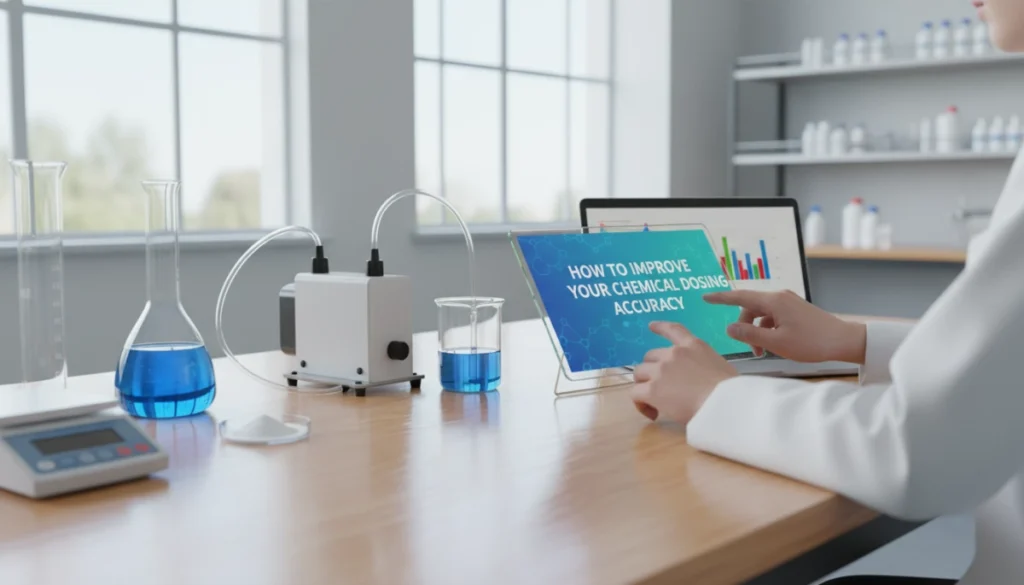
Identifying Variables That Compromise Dosing Precision
To master chemical dosing accuracy, you must first account for the variables that disrupt flow. In my experience as a manufacturer, I have found that precision is rarely a matter of pump quality alone; it is a battle against fluid dynamics and environmental shifts.
Fluid Characteristics: Viscosity and Off-Gassing
The chemical itself is often the primary source of error.
- Viscosity: High-viscosity fluids resist movement and slow down valve seating. Adjust your stroke frequency to allow valves enough time to close fully and prevent backflow.
- Off-Gassing: Media like sodium hypochlorite release gas, causing air binding. Use peristaltic metering pumps or specialized degassing valves to mitigate this risk and maintain prime.
- Temperature: Fluid thickness changes with the weather, altering the chemical feed rate even when pump settings remain untouched.
System Hydraulics: Back Pressure and Suction Lift
Hydraulic resistance is a silent killer of dosing precision.
| Factor | Impact on Accuracy | Engineering Solution |
|---|---|---|
| Back Pressure | Excessive pressure reduces output; inconsistent pressure causes flow drift. | Install a back pressure valve to provide a constant, predictable load. |
| Suction Lift | High lift creates a vacuum, leading to cavitation and reduced tube life. | Position the pump as close to the source as possible; utilize flooded suction where feasible. |
Environmental Factors: Temperature and Density
External conditions affect both the hardware and the media.
- Ambient Fluctuations: Extreme heat can soften peristaltic pump tubing, changing its compression profile and reducing the volume displaced per revolution.
- Chemical Density: If the concentration or density of your water treatment chemicals varies, the mass delivered per stroke changes. This necessitates a rigorous flow control calibration schedule to compensate for batch-to-batch inconsistencies.
- Piping Vibrations: Unstable mounting can lead to \”water hammer,\” which compromises the integrity of the diaphragm metering pump check valves.
Selecting the Right Hardware for Chemical Dosing Accuracy
The foundation of any precise system is the pump itself. We generally categorize the best options into two types: peristaltic and diaphragm. Choosing between them depends entirely on your specific water treatment chemicals and system requirements.
Peristaltic Metering Pumps: Handling the Tough Stuff
Peristaltic metering pumps are the go-to for fluids that are difficult to move. Because the chemical only touches the peristaltic pump tubing, these units excel in specific scenarios:
- Abrasive Slurries: No internal valves to clog or wear down from grit.
- Off-gassing Chemicals: They naturally clear bubbles, preventing the \”gas-locking\” that ruins dosing precision.
- Viscous Fluids: Strong suction makes them ideal for thick polymers that other pumps struggle to pull.
Diaphragm Metering Pumps: Built for Pressure
When your system faces high back pressure, a diaphragm metering pump is often the superior choice. These pumps are engineered for:
- High-Pressure Performance: Maintaining a steady stroke frequency even against significant discharge resistance.
- Durability: Designed for continuous duty in clean water or non-slurry applications where mechanical efficiency is a priority.
Material Compatibility and Metallurgy
To maintain long-term flow rate stability, you must match the pump’s wetted parts to your chemistry. Always consult a chemical compatibility chart before finalizing your hardware selection.
- Tubing Selection: Choose materials like Norprene, Tygon, or Viton based on the aggressiveness of the chemical.
- Pump Head Metallurgy: For diaphragm models, ensure the head material (such as PVDF, PVC, or Stainless Steel) can withstand the specific pH levels and corrosive nature of your dosing solution.
Technical Strategies for Optimizing Flow Control
Achieving peak chemical dosing accuracy requires more than just high-quality hardware; it demands a deep understanding of how your pump operates under different settings. We focus on three core technical areas to ensure flow rate stability and long-term reliability.
Mastering Stroke Frequency and Length
Finding the \”sweet spot\” between stroke length and stroke frequency is essential for continuous dosing. While most pumps allow you to adjust both, we recommend keeping the stroke length above 30% to avoid inconsistent check valve seating. If the stroke is too short, the pump may fail to overcome the inertia of the fluid, leading to erratic delivery.
| Adjustment Type | Impact on Dosing | Best Use Case |
|---|---|---|
| High Frequency | Smoother chemical dispersion | Low-viscosity fluids |
| Long Stroke | Higher volume per pulse | High-viscosity or slurries |
| Balanced Setting | Maximum dosing precision | Standard water treatment |
The Importance of Turndown Ratios
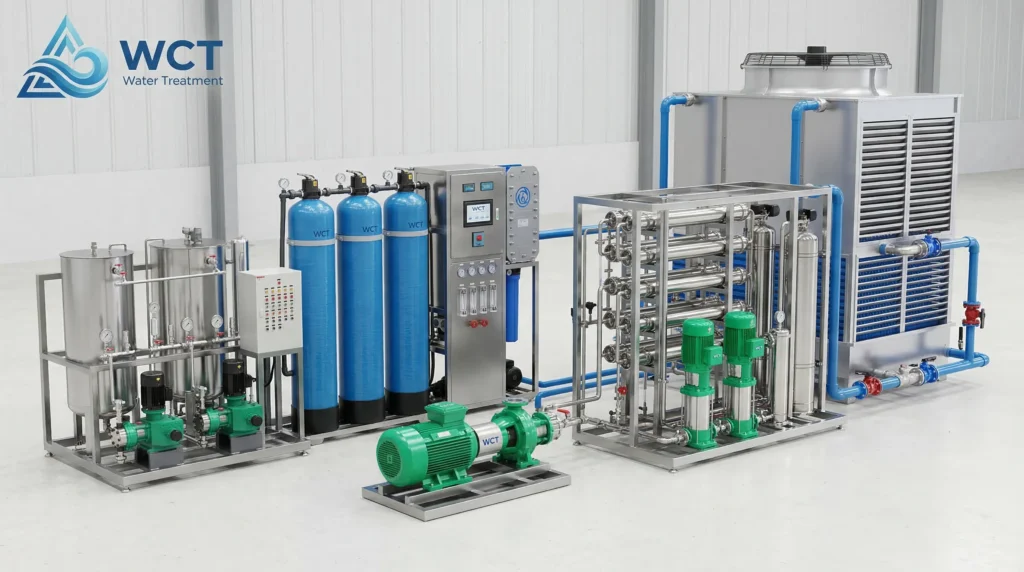
The turndown ratio defines the range over which a pump can maintain its rated accuracy. For example, a 100:1 turndown ratio allows a pump to operate at 1% of its maximum capacity without losing precision. When using our WCT chemical dosing tank setups, selecting a pump with a high turndown ratio ensures that even at flow extremes, your chemical feed rate remains exactly where it needs to be. This is particularly vital in systems where demand fluctuates throughout the day.
Integrating Variable Frequency Drives (VFDs)
For the smoothest delivery, we often integrate Variable Frequency Drives (VFDs). Unlike traditional pulsing, a VFD-controlled motor allows for a more consistent flow profile.
- Continuous Flow: Eliminates the \”slug\” effect in the pipeline, which can cause chemical spikes.
- Reduced Wear: Lowers mechanical stress on the diaphragm metering pump or peristaltic metering pumps by avoiding abrupt starts and stops.
- Automated Response: Syncs directly with system sensors for real-time flow control calibration, adjusting the motor speed instantly based on demand.
By optimizing these parameters, we eliminate the guesswork and ensure every drop of chemical is accounted for, protecting your downstream equipment and maintaining strict process standards.
The Calibration Protocol: From Manual to Automated
We know that even the most advanced pump is only as reliable as its last calibration. To maintain high dosing precision, we implement a strict calibration protocol that transitions from foundational manual checks to sophisticated automated monitoring. This ensures your chemical feed rate stays consistent despite changing variables.
Mastering the Draw-Down Test
The manual draw-down test remains the gold standard for verifying pump performance. By using a graduated calibration column, we can visually confirm exactly how much liquid the pump moves under actual operating conditions.
- Isolate the Source: Switch the pump suction from the main water treatment tank to the calibration cylinder.
- Timed Run: Operate the pump at its standard stroke frequency for a set period, typically 60 seconds.
- Calculate and Adjust: Compare the actual volume displaced against the pump’s setting. This accounts for losses caused by suction lift or system back pressure.
Real-Time Feedback with In-Line Flow Meters
For critical processes like hydrogen peroxide water treatment, manual tests aren\’t frequent enough. We integrate magnetic or ultrasonic flow meters to provide instantaneous feedback. These sensors monitor flow rate stability in real-time, allowing the automated dosing system to detect deviations immediately. If the flow drops due to air binding or debris, the system alerts the operator or self-adjusts to maintain the required concentration.
Automated Re-Calibration for Long-Term Accuracy
Mechanical wear is inevitable. As peristaltic pump tubing loses its elasticity or diaphragm valves begin to wear, the output will naturally drift. Our smart control systems utilize flow control calibration software to perform \”on-the-fly\” adjustments. By comparing the data from in-line sensors against the programmed set point, the system automatically ramps up the motor speed to compensate for component fatigue, ensuring your chemical delivery remains precise until the next scheduled maintenance.

Maintenance Procedures to Prevent Drift
Maintaining chemical dosing accuracy isn\’t just about the initial setup; it’s about preventing the slow \”drift\” in performance that happens as components wear down. We have found that a rigorous maintenance schedule is the only way to ensure your system continues to hit its targets month after month.
Proactive Peristaltic Tube Replacement Cycles
In our experience, the most common cause of lost dosing precision in peristaltic metering pumps is tube fatigue. Over time, the tubing loses its elasticity and fails to \”spring back\” fully after being compressed by the rollers. This reduces the internal volume and leads to a steady decline in flow rate.
- Scheduled Swaps: Do not wait for a leak to occur. Replace tubing based on run-hours or a fixed 6-month calendar to maintain a consistent flow rate.
- Visual Checks: Look for \”flat spots\” or thinning walls during routine inspections.
- Lubrication: Ensure the pump head is properly lubricated to reduce friction and heat, which are the primary killers of tube life.
Valve Seating and Cleaning
For diaphragm pumps, the check valves are the gatekeepers of accuracy. If a valve doesn\’t seat perfectly due to debris or wear, you will experience backflow or siphoning. This is a critical step in any waste water treatment process where chemical costs must be tightly controlled.
- Address Weeping Valves: If you notice chemical moving through the line when the pump is off, your valves are \”weeping\” and need immediate cleaning or replacement.
- Debris Removal: Even tiny particles can prevent a ball valve from sealing. Regular flushing of the pump head prevents buildup that compromises flow control calibration.
Air Binding Prevention and Suction Routing
Air is the enemy of accuracy. When air bubbles get trapped in the pump head—especially with off-gassing chemicals like sodium hypochlorite—the pump may continue to cycle without actually moving any fluid.
- Degassing Valves: Install an automatic degassing valve on the discharge side to vent gas pockets before they cause the pump to lose its prime.
- Suction Line Routing: Keep suction lines as short and straight as possible. Avoid \”loops\” or high spots where gas can accumulate.
- Stroke Frequency Adjustments: If you are running at a very low stroke frequency, gas has more time to build up between strokes. Increasing the frequency while shortening the stroke length can often help \”flush\” small bubbles through the system more effectively.
Leveraging Automation and Smart Monitoring for Dosing Precision
We’ve found that manual adjustments only go so far in maintaining long-term accuracy. To achieve peak dosing precision, we integrate our metering pumps into SCADA systems. This allows us to monitor every parameter remotely, ensuring the chemical feed rate stays consistent without the need for constant manual oversight.
- PID Control: We utilize Proportional-Integral-Derivative (PID) loops to connect sensors directly to the pump. If a sensor detects a change in water quality, the automated dosing system automatically adjusts the stroke frequency to hit the target set-point instantly.
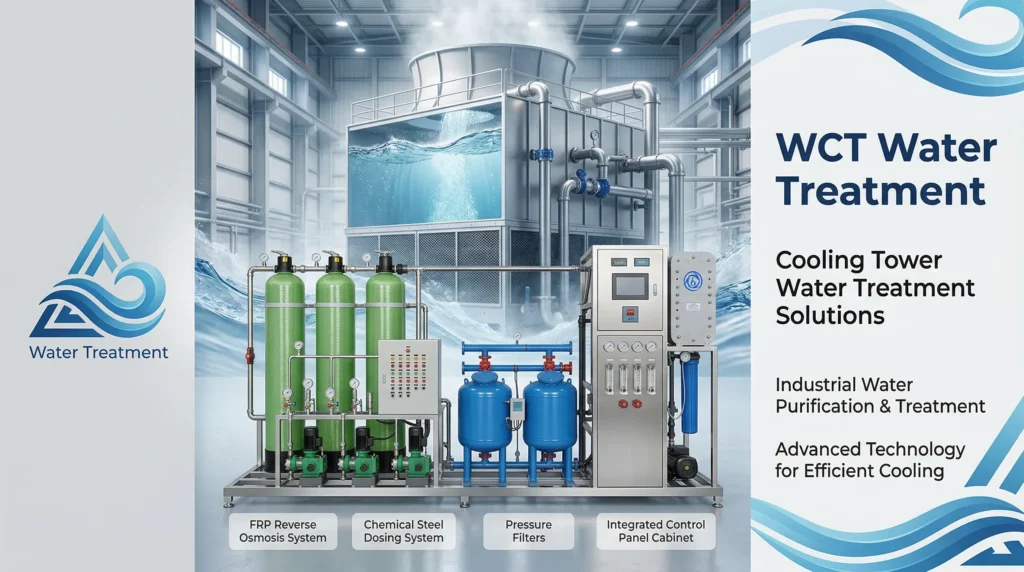
- Data Logging: By analyzing historical dosing trends, we can predict maintenance needs before they become emergencies. This is vital in critical applications like cooling tower water treatment, where even a minor drift in chemical levels can lead to rapid scaling or corrosion.
- Flow Rate Stability: Smart monitoring compensates for variables like temperature or pressure changes, keeping your delivery smooth and predictable.
For industrial setups requiring high-intensity output, pairing an automated controller with a high-pressure pump for waste water treatment ensures that your chemical delivery remains spot-on, even when facing significant system back pressure. Using these smart tools, we move from reactive maintenance to proactive, data-driven management.
Frequently Asked Questions About Chemical Dosing Accuracy
How often should I calibrate my chemical dosing pump?
You should perform a flow control calibration during the initial system setup and whenever you switch to a chemical with a different viscosity or density. For most industrial water treatment applications, we recommend a monthly calibration check. If your process involves high-temperature fluctuations or critical dosing precision, weekly checks using a calibration column will help prevent drift and ensure your chemical feed rate remains within spec.
What is the best pump for off-gassing chemicals like sodium hypochlorite?
Peristaltic metering pumps are often the preferred choice for off-gassing fluids because they handle trapped bubbles without losing prime. However, for higher pressure requirements, a mechanical diaphragm metering pump fitted with a degassing head is a powerful alternative. These systems effectively vent accumulated gases to prevent air binding, ensuring the pump maintains a consistent flow.
How does back pressure affect dosing accuracy?
Back pressure is a major variable in chemical dosing accuracy. If the system pressure rises beyond the pump\’s design limits, the volume delivered per stroke may decrease, leading to under-dosing. Conversely, too little back pressure can cause \”siphoning\” or over-dosing. To maintain a stable stroke frequency and output, always use a back pressure valve to provide a constant load for the pump to push against.
What are the signs of a failing peristaltic tube?
Monitoring the condition of your peristaltic pump tubing is vital for maintaining flow rate stability. Watch for these specific indicators of wear:
- Dimensional Changes: The tube looks flattened or fails to \”spring back\” after the rollers pass over it.
- Flow Degradation: You notice a gradual drop in output despite maintaining the same motor speed.
- Physical Damage: Small cracks, \”pilling\” (small bits of tube material), or discoloration on the outer wall.
- Fluid Leaks: Any moisture inside the pump head housing is a sign of an immediate breach.
Does stroke length or frequency matter more for precision?
For maximum dosing precision, it is generally better to run a pump at a higher stroke frequency with a shorter stroke length rather than long, infrequent pulses. This creates a more \”continuous\” flow profile, which is easier to monitor and control. Integrating an automated dosing system allows the hardware to balance these variables in real-time based on sensor feedback.