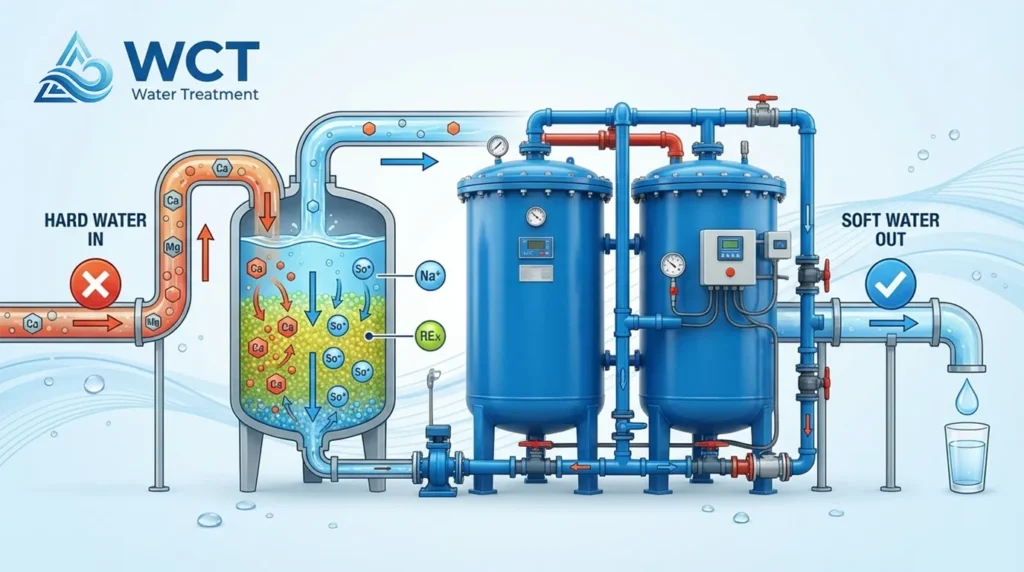
Tired of scrubbing chalky white stains off your faucets or replacing appliances years before you should? If so, you are likely fighting a very common enemy. Before investing in a proper hard water treatment, it helps to understand exactly what we are up against.
What Exactly is Hard Water?
Scientifically speaking, hard water is simply water carrying a heavy payload of dissolved minerals. The primary culprits are high concentrations of calcium and magnesium in water.
How does it get so dense? As natural rainwater falls, it starts out completely soft. However, as it seeps into the earth and navigates our groundwater systems, it acts like a powerful solvent. It filters through porous rock layers like limestone, chalk, and gypsum, stripping away and absorbing those mineral deposits before the water ever reaches your plumbing.
Measuring Water Hardness
To engineer the right hard water treatment solution for a property, we never just guess—we rely on exact data. Industry professionals measure mineral concentration using two distinct metrics:
- Grains per Gallon (GPG): This is the gold standard measurement for the US water treatment industry. One grain equals roughly 1/7000th of a pound. If your water tests anywhere above 3 GPG, it is officially classified as hard water and requires attention.
- Parts Per Million (PPM): Also listed as milligrams per liter (mg/L), this is the metric you will most likely see on your local municipal water report. To convert between the two, simply remember that 1 GPG equals exactly 17.1 PPM.
The Hidden Costs of Hard Water
Ignoring the high levels of calcium and magnesium in water does more than just cause a daily nuisance. Without an effective hard water treatment strategy in place, you are looking at expensive, long-term damage creeping across your entire property.
Plumbing and Pipe Failures
- Scale Accumulation: Over time, dissolved minerals bind to the interior walls of your pipes, creating a thick, stubborn crust.
- Reduced Water Pressure: As this scale thickens, it slowly chokes your plumbing, causing water pressure to drop significantly throughout the building.
- Eventual Failure: Left completely unchecked, this relentless mineral buildup stresses the plumbing system to the point of burst pipes and costly emergency overhauls.
Appliance Efficiency Drops
- Shorter Lifespans: Your water heaters, dishwashers, and washing machines take a daily beating. Hard water degrades internal mechanisms much faster than soft water.
- Higher Operating Costs: Scaled heating elements have to work much harder to do their job, draining energy efficiency. If you are upgrading your systems for serious scale buildup prevention, housing your media in durable FRP tanks for water treatment is critical to outlasting these harsh mineral conditions.
Daily Aesthetic and Personal Impacts
- Surface Damage: Cloudy water spots ruin the look of clear glassware, while thick soap scum coats your shower walls, making hard water stains removal an exhausting, never-ending chore.
- Skin and Hair: The damage isn\’t just mechanical. Bathing in untreated hard water leaves soap residue on your body, stripping away natural moisture to leave your skin uncomfortably dry and your hair brittle and lifeless.
Temporary Band-Aids vs. Real Treatments
DIY and Short-Term Fixes
When faced with the daily annoyance of hard water stains removal, many property owners initially turn to quick, inexpensive household hacks. We often see people soaking clogged showerheads in bags of vinegar to dissolve mineral deposits or relying heavily on specialized rinse aids to keep glassware from looking cloudy. Some even attempt to lower their water heater temperature to slow down the rate at which scale bakes onto the heating elements. While these descaling solutions can offer immediate visual relief, they are merely temporary patches on a much larger problem.
The Limitation of Quick Fixes
The fundamental flaw with these methods is that they never address the root cause. You are essentially scrubbing away the aftermath, but the dissolved calcium and magnesium are still flowing through your pipes every time you turn on the tap. This approach requires constant manual effort and results in an ongoing expense for cleaning supplies that never actually solves the issue.
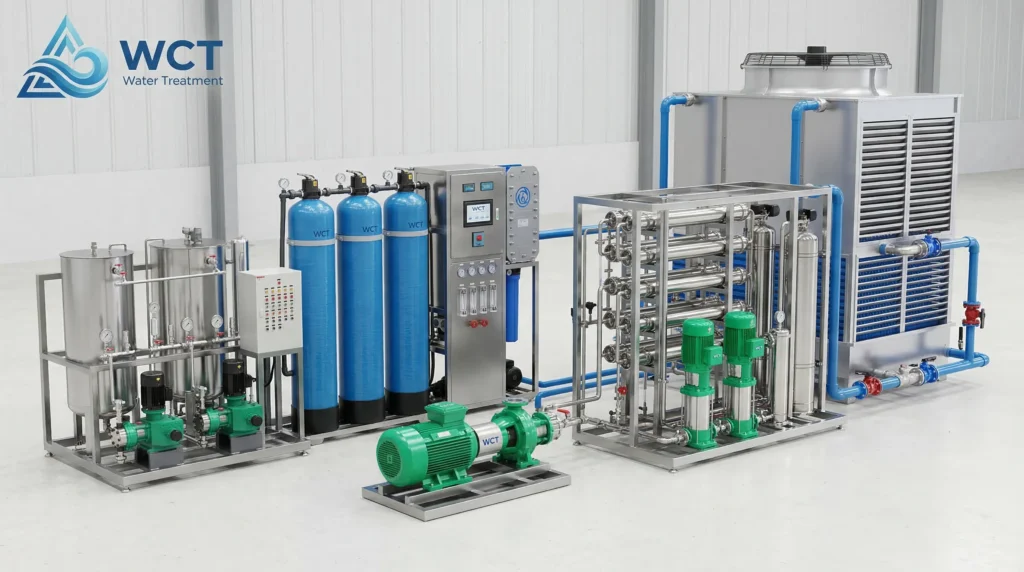
True hard water treatment isn\’t about cleaning up the mess; it\’s about preventing it entirely. In professional or industrial scenarios, relying on manual cleaning is simply not an option due to the scale of operations. Instead, facilities must utilize automated solutions, such as a WCT chemical dosing system for water treatment, to proactively manage water chemistry and stop scale formation before it starts. Without a permanent system in place, you are simply managing a symptom while your infrastructure continues to suffer from the inside out.
Permanent Hard Water Treatment Solutions
To truly fix your water issues, you need a system that targets the root cause: the excess calcium and magnesium in water. Here are the most reliable whole house water filtration methods we use for permanent hard water treatment.
Ion-Exchange Water Softener (Salt-Based)
These traditional water softening systems physically remove hard minerals from your water supply.
- How it works: A specialized resin bed inside the tank traps the calcium and magnesium, swapping them out for sodium ions.
- The result: You get completely soft water and guaranteed scale buildup prevention across your entire plumbing network.
Salt-Free Water Conditioner (TAC)
If you prefer to avoid salt and heavy maintenance, a salt-free water conditioner is an efficient alternative.
- How it works: This method utilizes Template assisted crystallization (TAC) to change the physical structure of the hard minerals.
- The result: The minerals are converted into microscopic crystals that simply flow through your pipes without sticking to surfaces, protecting your home without adding sodium to your diet.
Reverse Osmosis (RO) Systems
For the highest level of purification, RO systems rely on advanced reverse osmosis membranes to treat the water.
- How it works: Pressure forces water through a dense, semi-permeable membrane, stripping out up to 99% of all dissolved solids.
- The result: Exceptionally pure water. Whether you use them as point-of-use water filters or scale up for larger property demands with something like our reliable WCT 500 LPH RO System, RO technology effectively eliminates hardness alongside nearly all other impurities.
Comparing Your Treatment Options
Selecting the right hard water treatment isn\’t about finding a \”perfect\” system; it\’s about matching the technology to your specific water quality goals and operational constraints. Whether you are managing industrial process water or residential supply, understanding the trade-offs between removal efficiency and maintenance is critical.
We have broken down the three primary technologies—Ion-Exchange, Salt-Free Conditioning, and Reverse Osmosis—to help you visualize how they stack up against each other.
| Feature | Ion-Exchange Water Softeners | Salt-Free Conditioners (TAC) | Reverse Osmosis (RO) Systems |
|---|---|---|---|
| Primary Function | Physically removes calcium and magnesium ions. | Alters mineral structure to prevent scale adhesion. | Removes 99% of all dissolved solids (TDS), including hardness minerals. |
| Scale Prevention | High. Eliminates the minerals that cause scale. | Moderate. Prevents scale buildup but leaves minerals in the water. | Maximum. Removes scale-causing minerals and other contaminants. |
| Maintenance | Requires regular salt refills and periodic valve maintenance. | Low maintenance; requires media replacement every few years. | Requires pre-filter changes and periodic membrane replacement (e.g., ULP Series). |
| Water Feel | \”Slick\” or silky feeling due to sodium content. | Natural water feel; no change in texture. | Neutral, crisp, and extremely pure. |
| Best Application | Whole-house protection, boiler feed water, and laundry operations. | Areas with salt restrictions or where low maintenance is a priority. | Drinking water, medical/lab use, and precision industrial manufacturing. |
Key Takeaway: If your goal is strictly to stop pipes from clogging, a softener or conditioner works well. However, if you require high-purity water for sensitive industrial applications or consumption, a system utilizing Reverse Osmosis membranes is the only method that provides comprehensive filtration alongside hardness reduction.
How to Choose the Right System for Your Needs
Selecting the correct hard water treatment solution isn\’t just about picking a product off the shelf; it requires a calculated approach based on your specific water chemistry and operational capacity. We recommend following these three critical steps to ensure you invest in a system that solves the problem permanently.
Step 1: Test Your Water
You cannot effectively treat what you haven\’t measured. Before browsing equipment, you must quantify the hardness level. While basic strips give a general idea, a professional water analysis is superior. You need to know the exact Grains per Gallon (GPG) or Parts Per Million (PPM) of calcium and magnesium.
- 7–10 GPG: Hard water (Requires standard softening).
- 10.5+ GPG: Very hard water (Requires robust, high-capacity systems).
Step 2: Assess Your Infrastructure
Sizing is critical. A system that is too small will exhaust its capacity quickly, leading to \”hardness breakthrough,\” while a system that is too large wastes water and salt during regeneration.
- Flow Rate: Calculate your peak demand (gallons per minute). Your system must handle the maximum number of fixtures running simultaneously.
- Space Availability: Measure your mechanical room or installation site. Ensure there is adequate footprint for the main media tank and the brine tank (if using ion exchange).
Step 3: Factor in Long-Term Value
The initial purchase price is only a fraction of the total cost of ownership. Cheap systems often fail due to poor component quality, leading to leaks and expensive repairs. Prioritize industrial-grade durability.
- Tank Quality: Look for Shede FRP Tanks. These fiberglass-reinforced plastic vessels are corrosion-resistant and designed to withstand the pressure fluctuations of daily operation.
- Control Efficiency: The valve is the brain of the operation. Installing a reliable WCT Automatic Multiport Valve for Water Pure System ensures precise control over backwashing and regeneration cycles, optimizing water usage and extending the life of your media.
By focusing on durable components like high-pressure pumps and quality valves rather than just the lowest upfront cost, you secure a system that delivers consistent soft water for years.
The WCT Difference in Hard Water Treatment
At WCT, we know that effective hard water treatment relies entirely on the quality of the hardware inside the system. We specialize in designing and manufacturing high-performance water treatment components engineered for the global market. Whether you are building a whole house water filtration setup or a large-scale industrial water softening plant, the parts you choose dictate your success.
We do not cut corners. Our focus is on providing industrial-grade equipment that guarantees greater efficiency and absolute reliability.
Core Components for Permanent Solutions
Our manufacturing standards ensure your systems run smoothly without constant maintenance. Here is what we bring to the table:
- Premium Filtration: Our WCT ULP Series RO Membranes deliver maximum filtration at ultra-low pressures, capturing the most stubborn dissolved solids.
- Structural Integrity: We produce incredibly durable FRP tanks for water treatment built to withstand high pressure and resist corrosion, making them perfect for heavy ion-exchange resin loads.
- Precision Control: Our multiport valves automate the backwashing and regeneration cycles with zero guesswork.
Why Component Quality Matters
Using industrial-grade components is the only way to secure long-term scale buildup prevention.
| WCT Component | Engineering Advantage | Impact on Your System |
|---|---|---|
| Reverse Osmosis Membranes | Advanced thin-film composite | Maximum mineral rejection with lower energy costs |
| FRP Tanks | Seamless fiberglass construction | No leaks, no rust, lifelong durability |
| Multiport Valves | Wear-resistant ceramic cores | Uninterrupted, precise water flow control |
When you build your water softening systems with WCT, you eliminate the weak links. We provide the foundational hardware that makes permanent water conditioning reliable, efficient, and cost-effective.
Frequently Asked Questions About Hard Water Treatment
What is the most effective treatment for very hard water?
For extremely high hardness levels, an ion-exchange water softener is the gold standard. It physically removes the calcium and magnesium in water, providing the most reliable scale buildup prevention for your entire plumbing system and extending the life of your appliances.
Can I drink water from a water softener?
Yes, it is generally safe to drink. However, the ion-exchange process adds trace amounts of sodium to the water. If you are on a low-sodium diet or simply prefer the taste of pure water, we recommend pairing your whole house system with point-of-use water filters or a dedicated drinking water tap.
How often do I need to replace RO membranes?
Typically, you should replace your reverse osmosis membranes every 2 to 3 years. This timeline depends heavily on your daily water usage and the initial hardness of your water supply. Regular replacements ensure your system continues rejecting up to 99% of dissolved solids effectively.
Is a salt-free conditioner as effective as a softener?
It depends on your goal. A salt-free water conditioner relies on Template Assisted Crystallization (TAC) to crystalize minerals so they do not stick to pipes. It is excellent for protecting plumbing, but it does not physically remove the minerals. If you want true hard water stains removal, softer skin, and better soap lather, a traditional salt-based hard water treatment remains the most effective choice.