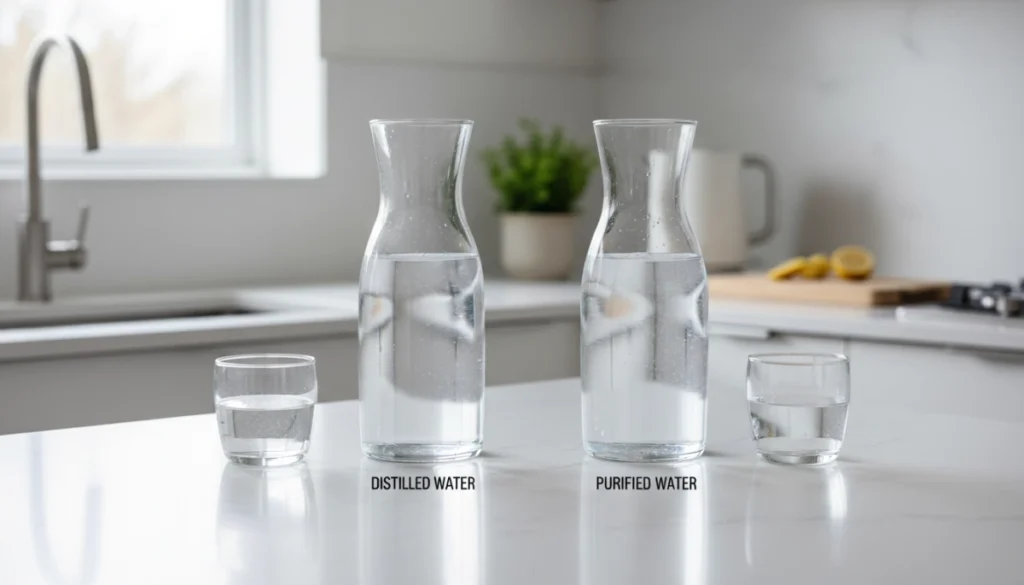
Distilled vs. Purified Water: Understanding the Key Differences
Choosing between distilled vs. purified water is essential for both health and the longevity of your appliances. While both types undergo rigorous treatment to remove contaminants, they are not identical. As a leading manufacturer in the water treatment industry, we recognize that the difference between distilled and purified water lies in the processing method and the final mineral composition.
What is Purified Water?
Purified water is water that has been processed to remove impurities like bacteria, fungi, parasites, and chemical pollutants. To be labeled as \”purified,\” the water must be treated to meet high standards, often reducing the total dissolved solids (TDS) to less than 10 parts per million (ppm).
- Primary Goal: To provide safe, clean water for human consumption.
- Common Methods: Reverse osmosis, carbon filtration, and UV sterilization.
- Result: Water that is free of harmful pathogens but may still contain trace beneficial minerals depending on the specific filtration system used.
What is Distilled Water?
Distilled water is a specific subtype of purified water created through the process of distillation. This involves boiling water into steam and then condensing that steam back into a liquid in a separate, sterile container.
- Primary Goal: To achieve maximum purity by removing absolutely everything, including minerals.
- The Process: Contaminants with higher boiling points (like minerals and heavy metals) are left behind in the original boiling chamber.
- Result: An exceptionally \”clean\” water that lacks the minerals typically found in spring or filtered water.
Quick Comparison: Purity, Taste, and Mineral Content
Understanding the purified vs. distilled water debate is easier when you look at the technical specifications. Use the table below to quickly identify which water suits your specific needs:
| Feature | Purified Water | Distilled Water |
|---|---|---|
| Mineral Content | May contain trace minerals | Near-zero minerals |
| Taste Profile | Crisp and refreshing | Flat or neutral |
| Primary Use | Drinking and hydration | Medical devices and labs |
| Contaminant Removal | High (Chemicals & Bacteria) | Maximum (Minerals & Metals) |
| Production Method | Filtration/Reverse Osmosis | Boiling and Condensation |
When evaluating distilled water vs. purified water, remember that purified water is generally preferred for daily drinking due to its taste and mineral balance, while distilled water is the industry standard for preventing mineral scale and buildup.
The Processes: How Water is Purified and Distilled
Understanding the difference between distilled and purified water starts with how they are made. While both aim to remove impurities, the mechanical journey the water takes is entirely different. As a manufacturer of high-end water systems, we focus on precision to ensure the final product meets specific industrial and residential standards.
The Distillation Process Step-by-Step
Distillation mimics the Earth\’s natural water cycle. It is a phase-change process that separates pure H2O from everything else.
- Boiling: The source water is heated until it reaches its boiling point and turns into steam.
- Separation: As the water evaporates, heavy metals, salts, and minerals are left behind in the boiling chamber because they cannot turn into gas.
- Condensation: The steam travels through cooling coils where it reverts to a liquid state.
- Collection: The resulting droplets are collected in a sterile container, resulting in highly pure distilled water.
Reverse Osmosis and Other Common Purification Methods
Purified water is defined by its low level of total dissolved solids (TDS), often achieved through advanced filtration rather than boiling. Our plants for water treatment typically utilize a combination of methods to reach these purity levels.
- Reverse Osmosis (RO): Water is forced through a semi-permeable membrane that blocks microscopic contaminants.
- UV Sterilization: A commercial UV water treatment system uses ultraviolet light to scramble the DNA of bacteria and viruses, making the water safe without chemicals.
- Deionization (DI): This process uses ion-exchange resins to remove mineral ions, often used in tandem with RO for ultra-pure requirements.
Distilled vs. Filtered Water: Understanding the Difference
It is common to confuse \”filtered\” with \”distilled,\” but the level of purity varies significantly. Standard carbon filters found in pitchers mainly improve taste by removing chlorine, whereas distillation and advanced purification remove almost everything.
| Feature | Filtered Water | Purified Water | Distilled Water |
|---|---|---|---|
| Primary Method | Physical Mesh/Carbon | RO, UV, or DI | Boiling & Condensing |
| Mineral Content | Mostly Retained | Very Low | Near Zero |
| Bacteria Removal | Partial | High | Total |
| Common Use | Drinking | Drinking/Medical | Appliances/Labs |
When comparing distilled vs. purified water, the choice often comes down to whether you need a specific mineral profile or a completely blank slate. Distillation is the \”cleanest\” in terms of inorganic content, while purification via RO is often more efficient for large-scale daily consumption.
Pros and Cons: Evaluating Each Water Supply
Choosing between distilled vs. purified water depends on whether you prioritize mineral intake or absolute purity. Both types undergo rigorous processing to remove contaminants, but they serve different roles in daily life and industry.
The Advantages and Drawbacks of Purified Water
Purified water is the most common choice for daily consumption. It is treated to remove chemicals, parasites, and bacteria while often maintaining a \”crisp\” taste that people prefer.
- Pros:
- Better Taste: Most people find purified water more palatable than distilled water.
- Convenience: Easily accessible through home filtration systems or bottled sources.
- Safety: Effectively removes harmful pathogens and toxic metals.
- Cons:
- Maintenance: Systems like RO units require regular filter changes to remain effective.
- Waste: Some purification methods, like reverse osmosis, can waste a significant amount of water during the process.
The Benefits and Potential Risks of Distilled Water
Distilled water is the \”cleanest\” form of water available, but its lack of mineral content creates a unique set of pros and cons.
- Pros:
- Total Purity: It is virtually free of all minerals, bacteria, and inorganic chemicals.
- Equipment Longevity: Since there are no minerals, it won\’t cause scale buildup in machinery.
- Cons:
- Flat Taste: Many describe the flavor as \”dead\” or metallic because the oxygen and minerals are gone.
- Mineral Leaching: Because it is mineral-free, it can absorb small amounts of minerals from the containers it is stored in.
- Health Considerations: Long-term exclusive consumption may lead to minor electrolyte imbalances if minerals aren\’t replaced through food.
Mineral Retention vs. Total Contaminant Removal
The primary difference between distilled and purified water lies in what stays in the water. Purified water focuses on removing the \”bad\” while sometimes leaving the \”good\” (like calcium and magnesium). Distilled water removes everything.
| Feature | Purified Water | Distilled Water |
|---|---|---|
| Mineral Content | Low to Moderate | Zero |
| Primary Use | Drinking & Cooking | Medical & Industrial |
| Taste Profile | Fresh and clean | Flat and bland |
| Contaminant Removal | High (95-99%) | Absolute (99.9%) |
As a specialized manufacturer, we recognize that different environments require different standards. For instance, while distillation is great for purity, many industrial setups rely on UV light water treatment to ensure biological safety without stripping the water of its natural properties. Balancing purified vs. distilled water is about matching the water\’s purity level to the specific requirements of your health or your equipment.

Practical Applications: Which Water to Use When?
Best Water for Household Appliances (CPAP, Humidifiers, and Irons)
For household maintenance, the choice between distilled vs. purified water is clear: distilled is the standard. Appliances that use heat or evaporation, such as steam irons, humidifiers, and CPAP machines, are highly sensitive to mineral buildup. Because distilled water is entirely free of dissolved solids, it prevents the \”white dust\” and scale deposits that eventually clog and destroy internal components. Using purified water in these devices might seem safe, but over time, even trace minerals will cause mechanical failure.
Usage in Medical, Laboratory, and Aquarium Settings
In technical and medical environments, precision is everything. We recommend distilled water for laboratory experiments and medical sterilization because it provides a \”blank slate\” free of any organic or inorganic contaminants. This ensures that chemical reactions remain predictable. For aquarium enthusiasts, the difference between distilled and purified water matters for biological balance. Purified water is often the better base for fish tanks because it removes harmful chlorine and heavy metals while being easier to stabilize. Understanding the specific stages of filtration, often illustrated in a water treatment process diagram, helps in choosing the right purity level for sensitive aquatic ecosystems.
Distilled vs. Purified Water for Baby Formula and Plants
When preparing baby formula, purified water is generally the preferred option. It offers a high level of safety by removing parasites and lead while retaining a mineral profile that is closer to natural water. On the other hand, the distilled vs. purified water debate for gardening depends on the species. Most houseplants thrive on purified water, but sensitive or carnivorous plants, such as Venus flytraps and orchids, require distilled water. These specific plants are adapted to nutrient-poor environments and can suffer \”mineral burn\” from the salts found in standard purified or tap water.
- CPAP & Irons: Use Distilled to prevent scale.
- Aquariums: Use Purified (RO) to remove toxins while maintaining stability.
- Baby Formula: Use Purified for a balance of safety and minerals.
- Sensitive Plants: Use Distilled to avoid salt accumulation in the soil.
Health and Drinking: Which Option is Best for Daily Use?
When deciding on distilled vs. purified water for your daily hydration, the \”best\” choice usually comes down to your lifestyle and nutritional needs. As a provider of water treatment solutions, I find that most people prefer the balance found in purified water for long-term consumption.
Is Distilled Water Safe to Drink Long-Term?
Yes, it is safe, but it is not always the most \”complete\” option. Because distillation removes 99.9% of everything, it lacks the essential minerals like calcium, magnesium, and potassium that your body naturally expects from a water source.
- Mineral Loss: Long-term exclusive use might lead to minor mineral deficiencies if your diet isn\’t rich in nutrients.
- Acidity: Distilled water tends to be slightly more acidic as it absorbs CO2 from the air.
- Purity: It is the safest choice if your local tap water is heavily contaminated with heavy metals.
Taste Differences and Everyday Experience
The difference between distilled and purified water is immediately obvious when you take a sip. Most people find distilled water tastes \”flat\” or \”dead\” because it lacks the dissolved minerals and gases that give water its character.
| Feature | Purified Water | Distilled Water |
|---|---|---|
| Taste | Crisp, refreshing, and clean | Flat, neutral, or \”empty\” |
| Mouthfeel | Smooth and hydrating | Very thin |
| Best Use | Drinking, coffee, and tea | Medical use and appliances |
For those who want the highest safety standards without the flat taste, many modern systems incorporate UV water treatment for bacteria to ensure the water is biologically pure while remaining pleasant to drink.
Hydration and Nutrient Absorption Considerations
Hydration is about more than just quenching thirst; it’s about maintaining electrolyte balance. In the purified vs. distilled water debate, purified water (especially RO water with remineralization) is generally superior for active individuals.
- Electrolyte Balance: Purified water often retains or adds back trace minerals that aid in nerve and muscle function.
- Absorption: Some studies suggest that mineralized water is absorbed slightly more efficiently by the body\’s cells.
- Cooking: Purified water is better for cooking as it doesn\’t \”leach\” flavor and nutrients out of your food as aggressively as distilled water does.
For daily use, I recommend purified water for its superior taste and mineral content, leaving distilled water for specialized tasks where total mineral absence is a requirement.
Choosing the Right Water for Your Needs
Deciding between distilled vs. purified water depends entirely on the intended use. While both are significantly cleaner than raw tap water, their applications are distinct based on their mineral content and purity levels.
When to Choose Purified Water
Purified water is my top recommendation for daily hydration and cooking. It goes through rigorous filtration to remove toxins like lead and chemicals like chlorine while often maintaining a crisp, refreshing taste.
- Drinking: Best for flavor and a balanced mineral intake.
- Cooking: Enhances the natural flavors of coffee, tea, and delicate recipes.
- Pet Care: Generally the safest and most palatable option for domestic animals.
The water treatment sedimentation process is often a critical preliminary step in creating purified water, ensuring that large particles are removed before the water undergoes advanced filtration or reverse osmosis.
When Distilled Water is Necessary
I advise using distilled water whenever mineral buildup could damage a device or interfere with a chemical reaction. Since distillation removes nearly 100% of all minerals, it leaves no residue or scale behind.
- Medical Devices: Essential for CPAP machines to prevent mineral crusting and bacterial growth.
- Household Appliances: Use it in steam irons and humidifiers to prevent clogging.
- Automotive: Ideal for topping off lead-acid car batteries and cooling systems.
How to Purify or Distill Water at Home
You can manage the difference between distilled and purified water by using specific home systems. Here is a quick breakdown of the most effective methods:
| Method | Type Produced | Best For |
|---|---|---|
| Reverse Osmosis (RO) | Purified | Whole-home drinking water |
| Countertop Distiller | Distilled | Small-batch appliance use |
| Activated Carbon Filter | Purified | Removing odors and chlorine |
| UV Sterilization | Purified | Killing bacteria and viruses |
To produce distilled water at home, you must boil water and collect the condensed steam in a separate, sterile container. For purified water, installing a multi-stage filtration system is the most efficient way to ensure high-quality distilled water vs purified water standards are met for your family\’s health.
Frequently Asked Questions
Can I use purified water instead of distilled for my CPAP machine?
While purified water is cleaner than standard tap water, it is not a perfect substitute for distilled water in a CPAP machine. The main difference between distilled and purified water in this context is the mineral content. Distilled water is entirely free of minerals, whereas some purification methods may leave trace amounts behind. Over time, these minerals can create scale buildup in your machine, potentially shortening its lifespan or harboring bacteria. For the best results and equipment longevity, we always recommend sticking to distilled water.
Does boiling water make it distilled?
No, boiling water does not make it distilled. Boiling is a disinfection process that kills bacteria, viruses, and parasites, but it does not remove minerals, salts, or heavy metals. In fact, boiling can slightly increase the concentration of these impurities as the water volume decreases through evaporation. Distillation requires a specialized setup to capture the steam and condense it back into a clean liquid in a separate container, effectively leaving the contaminants behind.
Should you remineralize purified or distilled water?
If you intend to use distilled vs. purified water for daily drinking, remineralization is often a smart choice. Because these waters are stripped of natural minerals, they can taste flat and may not provide the electrolytes your body needs. Adding a trace mineral supplement or a pinch of Himalayan salt can improve the flavor and health profile. In industrial or large-scale applications, we often utilize a wct chemical dosing system for water treatment to precisely reintroduce necessary elements and balance the water\’s pH for specific uses.
How should you store purified and distilled water safely?
To maintain the integrity of your purified vs. distilled water, proper storage is essential. We suggest using airtight, BPA-free plastic or glass containers to prevent the water from absorbing odors or chemicals from the environment. Keep the containers in a cool, dark place away from direct sunlight, which can trigger algae growth if any contaminants are present. Once a bottle is opened, it is best to consume or use it within a few weeks to ensure maximum purity and freshness.