Choosing the right dewater filter press for an industrial plant is rarely about a single number. It is a balance between the slurry’s specific resistance, the target cake dryness, and the level of automation the site can support. A poor match between plate design and slurry characteristics can lead to cloth blinding, extended cycle times, and mechanical overload.
This guide addresses the engineering trade-offs that process engineers and procurement teams must evaluate before specifying a system. We focus on the physical separation mechanism, the technical gap between recessed chamber and membrane plates, slurry-specific sizing, and the automation features that reduce total cost of ownership.
The Mechanics of Solid-Liquid Separation in a Dewater Filter Press
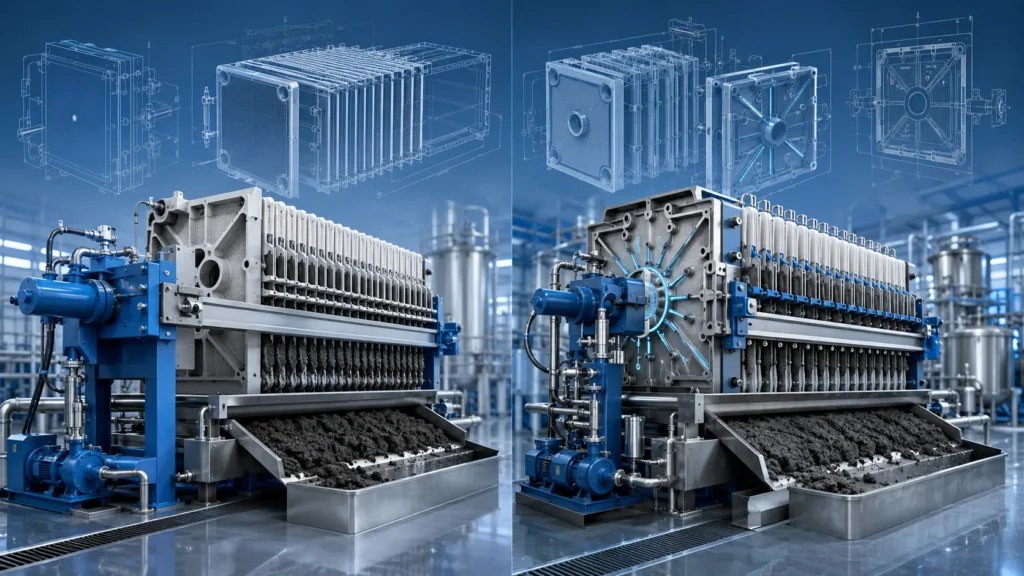
A dewater filter press operates by pumping slurry under high pressure into a series of recessed plates lined with filter cloth. Solids accumulate inside the chambers while the filtrate escapes through drainage ports. The entire cycle depends on the interaction between the feed pump, the hydraulic closure force, and the filter media.
Phase 1: Slurry Feed and High-Pressure Chamber Filling
The cycle begins with a low-volume, high-pressure slurry feed pump pushing conditioned slurry into the sealed plate pack. The hydraulic closure system maintains a constant clamping force, preventing leaks even when internal pressures climb. A critical but often overlooked factor is the pump’s pressure ramp-up curve: a sharp pressure spike can force fine particles into cloth fibers, causing irreversible blinding. A staged ramp allows the cake to build a permeable bed first.
Phase 2: Cake Consolidation and Filtration
Once the chambers fill, the pump continues to feed against increasing resistance. Liquid is driven through the filter cloth, leaving a compacted cake. The filtration rate follows Darcy’s law—it declines as the cake grows thicker. Terminal pressure often reaches 7–15 bar for recessed chamber presses. The goal is to end this phase when the filtrate flow drops sharply, indicating the cake has reached practical density before the final dewatering step.
Phase 3: Cake Washing and Air Blowing (Optional)
For processes requiring high-purity solids or maximum water recovery, an intermediate wash cycle can remove residual mother liquor. After washing, a low-pressure air blow can purge remaining free water from the cake and core channels. This step improves dryness but adds cycle time. It is most valuable in chemical and food-grade applications where product purity or water recovery rates matter.
Phase 4: Core Plate Separation and Cake Discharge
After pressure release, the hydraulic cylinder retracts and the plates separate. An automated plate shifter moves each plate sequentially, allowing gravity or a scraper to discharge the dry cake. The plate shifting speed must match the cake release behavior; sticky cakes require slower, controlled movement to avoid cloth damage. A well-integrated discharge system can reduce total cycle time by 15–20%.
Chamber vs. Membrane Plate Designs: Technical Comparison
Recessed chamber plates remain the industry standard for straightforward slurries where feed pressure alone achieves acceptable cake dryness. Membrane plates add a physical squeezing phase, making them more adaptable for sludges that resist simple filtration—especially biological slurries and fine tailings. The choice affects capital cost, maintenance, and achievable cake dryness percentages.
Recessed Chamber Plates: High-Durability Standard Sizing
A recessed chamber filter press relies solely on the feed pump to force liquid out. The plates are typically thicker and mechanically robust, making them ideal for abrasive mineral slurries where a membrane bladder could be punctured. The cake forms uniformly within each chamber, and dryness depends entirely on pump pressure and slurry filterability. For mineral concentrates and aggregate wash water, chamber plates often provide a lower total cost of ownership over a decade of operation.
Membrane Squeeze Plates: Variable Volume and Maximum Dryness
Membrane plates incorporate a flexible bladder inside the plate surface. After initial filtration, the bladder is inflated with air or water at 15–20 bar, physically compressing the cake from both sides. This step can cut terminal filtration time by 30–50% and raise cake solids by 10–15 percentage points over chamber-only results. Membrane systems also accommodate variable feed volumes: the bladder adjusts the chamber volume, so a partial cycle still produces a dry cake. The trade-off is increased complexity and the need to monitor bladder integrity over thousands of cycles.
| Design Parameter | Recessed Chamber Plate | Membrane Squeeze Plate |
|---|---|---|
| Primary Dewatering Force | Feed pump pressure (typically 7–15 bar) | Mechanical squeeze (air or water pressure up to 15–20 bar) |
| Typical Cake Dryness % | 50% – 70% (slurry dependent) | 65% – 85% (slurry dependent) |
| Cycle Times | Longer (relies entirely on pump feed curve) | Shorter (squeeze step cuts terminal filtration time) |
| Operational Flexibility | Low (requires a full chamber to form dry cake) | High (can handle variable slurry feed volumes) |
| Capital Cost (CAPEX) | Lower base cost | Higher initial plate/system cost |
| Maintenance Profile | Low maintenance; high mechanical durability | Higher maintenance; membrane bladder wear over time |
| Ideal Applications | Mineral concentrates, aggregates, simple tailings | Fine municipal sludge, biological slurries, chemical cake washing |
Note: Cake dryness percentages and cycle times are slurry dependent. Engineering confirmation through pilot testing is recommended before final specification.
Industrial Slurry Selection Matrix: Engineering Configurations
Selecting a dewater filter press configuration requires matching the specific chemical and physical characteristics of the target slurry—such as particle size distribution, pH, and temperature—to the correct plate volume, feed pressure, and cloth permeability. Overlooking one variable can lead to prolonged cycle times or unacceptable filtrate quality.
Mining and Mineral Tailings Processing
Mining slurries—often dominated by clays, silts, and finely ground rock—require high-pressure operation and robust plate materials. Heavy-duty recessed chamber plates are the default, with chamber depths of 15–25 mm to handle high solids loading. Feed pressures frequently exceed 15 bar to achieve cake solids above 75%. Plate materials must withstand abrasive wear; polypropylene with a high calcium carbonate fill offers a good balance between chemical resistance and mechanical strength. WCT sludge dewatering solutions for mining often integrate automated plate shifters and drip trays to manage high-throughput, 24/7 operations.
Municipal and Industrial Wastewater Sludges
Municipal sludges, particularly after anaerobic digestion, form sticky, compressible cakes that resist simple pump pressure. Membrane squeeze plates are the preferred configuration because the mechanical compression overcomes the cake’s high specific resistance. Chamber depth often extends to 30–40 mm to handle larger volumes of low-concentration feed. Chemical conditioning with polymer or lime is standard, and the filter press must interface with a reliable chemical dosing system. The target cake dryness for municipal sludge is typically 28–38%, sufficient for landfill disposal or incineration.
Chemical, Food-Grade, and High-Purity Applications
Chemical slurries and pigments often demand cake washing and precise pH resistance. Plate materials shift from standard polypropylene to PVDF (polyvinylidene fluoride) when solvents or aggressive acids are present. Membrane plates combined with an integrated wash manifold allow thorough cake washing to remove soluble impurities. For food-grade applications, plate packs and manifolds must meet FDA-compliant material standards. Cycle times here are longer because of the wash sequence, but the value comes from product recovery and lower waste disposal costs.
| Industry Slurry Type | Recommended Plate Configuration | Sizing Factor (Liters/m² of area) | Typical Cycle Time | Target Cake Dryness |
|---|---|---|---|---|
| Mining Tailings / Clay | Recessed Chamber (High-Pressure) | 15 – 25 mm chamber depth | 30 – 60 minutes | 70% – 82% solids |
| Municipal Sludge (Anaerobic) | Membrane Squeeze | 30 – 40 mm chamber depth | 45 – 90 minutes | 28% – 38% solids |
| Chemical Slurries / Pigments | Membrane (with cake washing) | 25 – 35 mm chamber depth | 60 – 120 minutes | 45% – 65% solids |
| Aggregate Wash Water | Recessed Chamber | 30 – 50 mm chamber depth | 20 – 45 minutes | 75% – 85% solids |
Note: Sizing factors and cycle times are benchmarks based on typical slurry characteristics. Actual performance depends on specific particle size distribution, chemical conditioning, and operating pressure. Laboratory filter leaf tests should confirm sizing for any new slurry.
Critical Sizing & Engineering Specifications to Consider
When specifying a system, the key engineering parameters are the total dry solids output per hour, the liquid volume to be processed, and the specific resistance of the slurry. Underestimating filtration area leads to insufficient throughput; oversizing wastes capital and plant footprint.
Total Filtration Area and Cake Volume Calculations
Filtration area is the primary sizing variable. A standard approach is to run a bench-scale filter leaf test to determine the cake formation rate (kg of dry solids per m² per hour). Multiply that rate by the available operating hours per day to arrive at the minimum total filtration area. Cake volume per cycle then determines plate pack configuration: the number of plates, recess depth, and overall frame dimensions. We typically recommend a plate pack that allows 10–20% capacity headroom for fluctuating feed conditions.
Operating Pressures and Hydraulic Closing Force
The feed pump’s maximum pressure rating and the hydraulic cylinder’s closing force must be matched. If the closing force cannot resist the internal pressure, plates will leak or separate. Hydraulic force is calculated by multiplying the filter area by the maximum intended feed pressure, then applying a safety factor (typically 1.5–2.0). For high-pressure membrane squeeze cycles, the closing force must also account for the additional 15–20 bar exerted by the bladder.
Filter Cloth Selection: Monofilament vs. Multifilament Weaves
Cloth selection directly influences cake release, filtrate clarity, and cleanability. Monofilament weaves offer smooth surfaces and easy cake discharge, making them suitable for sticky municipal and biological sludges. Multifilament weaves provide finer filtration and higher solids capture, but they retain particles and require more frequent high-pressure washing. Chemical compatibility—especially resistance to hydrolysis, acids, and oxidizing agents—must also be verified. The wrong cloth can double cleaning time and reduce overall plant throughput.
The physical layout of the plant also determines cake discharge configuration. A filter press elevated on a mezzanine can discharge cake directly into dump trucks or conveyors, eliminating intermediate handling. This integration must be planned early in the wastewater treatment process design phase.
Automation & Process Optimization in Modern Systems
Automation transforms the dewater filter press from a labor-intensive batch system to a highly efficient, semi-continuous industrial process requiring minimal operator intervention. The most impactful upgrades address plate handling, cloth maintenance, and intelligent feed control.
Automated Plate Shifters and Drip Trays
An automated plate shifter uses a motorized carriage to move each plate individually, reducing cycle time and eliminating the safety risk of manual plate separation. Drip trays that extend during plate opening catch residual filtrate and prevent housekeeping issues. In a high-throughput filter press for sludge dewatering, these two features can reduce the total batch turnaround by 10–15 minutes per cycle.
High-Pressure Automatic Cloth Washing Systems
Cloth blinding increases cycle time and reduces production. Automatic cloth washing systems, integrated into the plate pack, use high-pressure water jets (up to 100 bar) to flush embedded particles from cloth pores on a set schedule. Systems can be configured to wash every 50–100 cycles without any manual labor, keeping filtration efficiency stable over the cloth lifespan.
Smart Controls: SCADA Integration and Slurry Feed Monitoring
Modern filter presses run on PLC controllers that adjust the feed pump speed in real time based on pressure transducer feedback and filtrate flow meter readings. This prevents dry running and optimizes the pressure ramp rate. Integration with a plant-wide SCADA system allows operators to track cycle performance, schedule maintenance, and receive alerts on cloth wear or membrane integrity. The data generated also supports long-term capacity planning and industrial wastewater equipment lifecycle management.
Contact Our Engineering Team for Custom Slurry Analysis and System Quotes
Every dewater filter press specification should start with a thorough slurry characterization. Before requesting a quote, we recommend gathering the following data points: the required dry solids production rate (tons per hour or per day), the incoming slurry solids concentration (weight %), the chemical additives currently or planned for use, and the target cake moisture limit for downstream handling or disposal. Additionally, note any corrosives, abrasives, or temperature extremes that could affect plate and cloth material selection.
Our process engineers can use this information to run a filter leaf test and recommend the correct plate package, pump size, and automation level. We also offer pilot rental units for on-site confirmation runs. What to verify: Ask for a detailed cycle time projection and a mechanical guarantee on plate life before final procurement. Contact our team today to begin the wastewater sludge treatment engineering review.
Frequently Asked Questions
What is the main difference between a belt press and a dewater filter press?
A belt press relies on gravity drainage and low-pressure rollers, typically achieving cake solids concentrations 10–20% lower than a dewater filter press. Filter presses operate at 7–20 bar, producing significantly drier cakes and cleaner filtrate, but they require a batch cycle rather than a continuous belt process.
How often do filter cloths need to be cleaned or replaced?
Cloth cleaning frequency depends on slurry characteristics. Most operations run an automatic high-pressure wash every 50–100 cycles. Cloth lifespan ranges from 1,000 to 5,000 cycles, with chemical aggressiveness and mechanical abrasion being the primary failure modes. Visual inspection for pinholes or thinning is recommended every 500 cycles.
Can a dewater filter press operate continuously?
No filter press can be truly continuous because the process is inherently batch-based. However, by combining automated plate shifting, quick-opening hydraulics, and parallel press configurations, plants can engineer a semi-continuous operation that matches continuous feed streams without large buffer tanks.
Why is my filter cake sticking to the cloths during discharge?
Cake sticking is typically caused by a mismatch between the cloth surface and the slurry, insufficient dewatering time leaving the cake too wet, or incorrect chemical conditioning. Switching to a monofilament cloth, extending the air blow phase, or adjusting polymer dosage often resolves the problem.