What is a Circular Clarifier in Water Treatment?
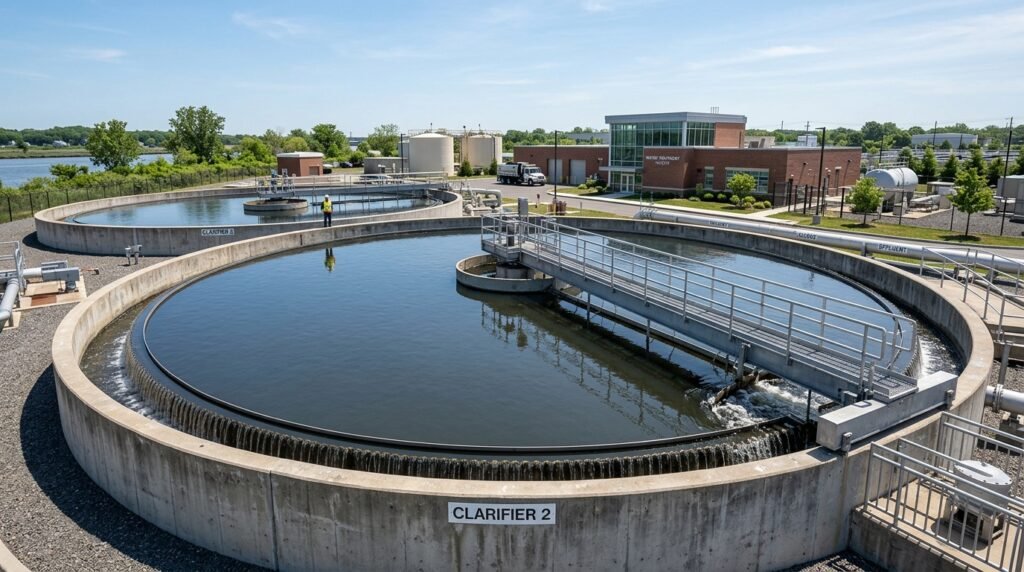
A circular clarifier in water treatment is an essential mechanical structure designed to continuously remove solid particulates from liquids. As a dedicated water treatment products supplier and manufacturer, we engineer these robust systems to harness the power of gravity. By carefully controlling fluid dynamics, circular clarifiers allow heavy solids to settle to the bottom while clear, treated effluent flows smoothly over the top.
The Role of Clarification in Wastewater Processing
Clarification is the backbone of efficient wastewater processing. It serves as the critical defense against suspended solids, significantly reducing the pollutant load before water advances to subsequent, more sensitive treatment stages.
Key functions include:
- Turbidity Reduction: Clears the water by effectively settling out suspended particles.
- Equipment Protection: Prevents premature wear and clogging in downstream filters and membranes.
- Load Management: Lowers the biological and organic load entering aeration basins.
How Circular Clarifiers Work: The Sedimentation Process
The operation of a circular clarifier relies on the fundamental principle of gravity sedimentation. Influent enters the center of the tank, where a feed well or baffle disperses the water and slows its velocity. This calm, controlled environment allows heavier particles to sink to the tank floor, forming a sludge blanket. Slowly rotating mechanical scraper blades then sweep this settled sludge toward a central hopper for extraction, while the clarified water gently rises and overflows into a peripheral launder.
Difference Between Primary and Secondary Clarification
Understanding the distinction between primary and secondary clarification is crucial for optimizing your circular clarifier water treatment system. Each serves a distinct purpose within the treatment lifecycle.
| Feature | Primary Clarification | Secondary Clarification |
|---|---|---|
| Process Location | Immediately after screening and grit removal | Following biological treatment (aeration basins) |
| Target Solids | Raw, untreated suspended solids and organics | Biological floc and activated sludge |
| Settling Dynamics | Faster settling rates due to heavier raw particles | Slower settling; highly sensitive to turbulence |
| Primary Objective | Reduce initial solid load to save downstream energy | Separate clean effluent from active biomass for return |
Key Components and Engineering Design
Our circular clarifier water treatment systems are built for long-term reliability. We focus on heavy-duty mechanical internals that can withstand 24/7 operation in demanding environments.
Inlet and Outlet Structures
The design starts with the energy-dissipating inlet. We use a center feed well to slow down incoming water, preventing turbulence that could disturb the settling zone. On the discharge side, V-notch weirs ensure a uniform flow of clean effluent over the perimeter, maintaining a consistent hydraulic profile.
Sludge Removal Mechanisms: Scrapers and Suction Headers
We offer two primary ways to handle settled solids based on your specific process needs:
- Scraper Arms: Heavy-duty angled blades move thickened sludge toward a central hopper for easy discharge.
- Suction Headers: Designed for rapid removal of biological solids, these are ideal for secondary clarification where keeping sludge fresh is a priority.
Scum Removal and Baffle Systems
To keep the surface clean, we integrate a rotating skimmer arm and a peripheral scum baffle. This system effectively traps and removes floating oils, grease, and debris before they can exit the tank. This level of surface management is a critical step in industrial water treatment and municipal processing to ensure high-quality effluent.
Drive Units and Mechanical Internals
The drive unit is the powerhouse of the system. We use high-torque, precision-engineered gearboxes equipped with overload protection to prevent mechanical failure. Our internal components are typically manufactured from corrosion-resistant materials like 304 or 316 stainless steel, ensuring the system survives the harshest chemical environments.
Types of Circular Clarifiers and Thickeners
Choosing the right configuration for circular clarifier water treatment depends entirely on your specific flow rates and solids loading. We provide several specialized designs to ensure optimal separation across various industrial and municipal settings.
Conventional Center-Feed Clarifiers
This is the most common design used in modern facilities. The water enters through a central influent well, which dissipates energy and directs the flow downward.
- Uniform Flow: Water moves radially from the center to the peripheral weirs.
- Efficiency: Ideal for standard sedimentation where steady, predictable settling is required.
- Simplicity: Fewer moving parts make these units easy to maintain over long lifecycles.
Peripheral Feed (Spiraflo) Systems
In a peripheral feed system, the influent is introduced at the outer rim of the tank. This design forces the water to travel a longer path toward the center or around the perimeter, which can significantly increase hydraulic capacity. It is particularly effective for plants looking to maximize their waste water treatment process efficiency without increasing the tank\’s physical footprint.
Solids Contact and Sludge Blanket Clarifiers
These high-rate units combine mixing, flocculation, and sedimentation in a single tank.
- Enhanced Filtration: They maintain a suspended sludge blanket that acts as a natural filter for rising particles.
- Chemical Efficiency: Perfect for applications requiring lime softening or specific chemical precipitation.
- Compact Design: Because they combine multiple steps, they often require less space than traditional setups.
Circular Thickeners for Sludge Management
While they look similar to standard clarifiers, circular thickeners are built for heavy-duty performance. They are designed to handle much higher solids concentrations.
- High-Torque Drives: Equipped with heavy-duty motors to move dense, heavy sludge.
- Deep Pockets: Often feature deeper floor slopes to facilitate the collection of thickened material.
- Volume Reduction: These units are essential for reducing the total volume of sludge before it moves to dewatering or disposal, saving significant operational costs.
Operational Benefits of Circular Mechanical Systems
As a dedicated water treatment products supplier and manufacturer, we consistently see facilities transform their daily operations by upgrading their core equipment. Implementing a circular clarifier water treatment system delivers measurable advantages across the board, fundamentally improving how plants handle heavy daily loads.
High Solids Removal Efficiency
The primary goal of any clarifier is to separate solids from liquids effectively. The circular design naturally promotes an even radial flow, which slows down the water velocity and allows heavier particles to drop to the bottom. Optimizing this sedimentation water treatment process is critical for achieving crystal-clear effluent and meeting strict environmental discharge standards.
- Maximized Settling Area: Symmetrical design ensures no dead zones.
- Consistent Flow: Radial distribution minimizes disruptive turbulence.
- Higher Concentration: Produces thicker sludge for easier downstream processing.
Space-Saving Footprint and Scalability
Land is a premium asset for most industrial and municipal facilities. Circular clarifiers pack a massive processing capacity into a highly compact area. Compared to traditional rectangular basins, the circular geometry offers a superior surface-area-to-volume ratio, making it the smart choice for facilities with limited space.
| Feature | Circular Clarifiers | Rectangular Basins |
|---|---|---|
| Footprint | Highly compact and efficient | Requires extensive land area |
| Scalability | Easy to add parallel units | Difficult and costly to expand |
| Flow Distribution | Even 360-degree radial flow | Prone to flow short-circuiting |
Reduced Maintenance and Operational Downtime
Downtime costs money. Circular mechanical systems are engineered for continuous, heavy-duty operation with minimal human intervention. The central drive mechanisms and rotating sludge scrapers move slowly, which drastically reduces wear and tear on moving parts. Routine maintenance is straightforward, and the robust construction ensures decades of reliable service without the need for constant repairs or unexpected system shutdowns.
Common Applications Across Industries
Circular clarifiers are versatile workhorses found in almost every sector that requires large-scale liquid-solid separation. As a leading manufacturer, we design these systems to handle diverse flow rates and varying solids concentrations, ensuring reliable performance regardless of the environment.
Municipal Wastewater Treatment Plants
In the municipal sector, our circular clarifier water treatment systems are the backbone of sewage processing. They handle massive volumes of influent, effectively removing organic solids and grit. Whether used in primary sedimentation or as secondary clarifiers after biological treatment, they ensure that the effluent meets strict environmental regulations before discharge.
Industrial Process Water Treatment
Many factories require high-quality intake water to prevent equipment scaling and fouling. Our systems integrate seamlessly into professional water treatment plant design to provide a steady supply of clarified process water. This is critical for:
- Cooling Tower Makeup: Removing suspended solids to prevent clogging.
- Boiler Feed Pre-treatment: Reducing the load on downstream filtration.
- General Manufacturing: Ensuring water quality remains consistent for production lines.
Mining and Oil & Gas Facilities
These industries deal with some of the toughest wastewater challenges, often involving heavy sediments and oily residues. We provide heavy-duty circular clarifiers specifically engineered for:
- Tailings Management: Separating water from ore waste for immediate recycling.
- Produced Water: Removing bulk oil and heavy solids in oilfield operations.
- Resource Recovery: Capturing valuable minerals that settle during the clarification process.
Food and Beverage Production
Processing plants for dairy, meat, and beverages generate wastewater rich in fats, oils, and organic debris. Our circular mechanical systems efficiently separate these solids, significantly reducing the chemical oxygen demand (COD). This makes the water much easier to treat or recycle within the facility, helping plants stay compliant with local discharge permits while lowering operational costs.
Selection Criteria and Performance Optimization
Choosing the right circular clarifier water treatment system requires a balance between hydraulic capacity and solids handling capability. We focus on engineering systems that handle peak flow events without compromising effluent quality.
Sizing for Flow Rate and Surface Loading
The primary factor in sizing is the Surface Overflow Rate (SOR). We calculate the upward velocity of the water against the settling velocity of the particles. If the flow is too high, solids are carried over the weirs. Proper sizing ensures:
- Optimal Detention Time: Sufficient time for gravity to pull solids to the floor.
- Weir Loading Rates: Even distribution of flow to prevent localized high velocities.
- Peak Flow Resilience: Ability to manage storm surges or industrial batch dumps.
Evaluating Sludge Characteristics and Settling Rates
Not all sludge behaves the same. We analyze the Sludge Volume Index (SVI) to determine how well your solids compact. For lighter, fluffier biological solids, we design deeper tanks or incorporate specialized flocculating feed wells. Heavier industrial solids may allow for a more compact footprint but require heavy-duty torque drives for the scraper arms.
Addressing Performance Issues: Short-Circuiting and Turbulence
Short-circuiting occurs when water finds a direct path from the inlet to the outlet, bypassing the settling zone. We eliminate this through:
- Energy Dissipating Inlets (EDI): Reducing the velocity of incoming water.
- Strategic Baffling: Directing flow downward to maximize the effective settling area.
- Density Current Baffles: Preventing \”wall effects\” where cold or dense water rushes along the tank floor.
Retrofitting and Upgrading Existing Systems
You don\’t always need a brand-new installation to improve results. We specialize in upgrading older infrastructure by replacing worn-out mechanical internals. Enhancing an existing waste water treatment tank with modern suction headers or high-efficiency drives can significantly increase throughput. For plants dealing with fine particulates that refuse to settle, integrating industrial sand filters for wastewater treatment as a post-clarification step ensures total suspended solids (TSS) remain within regulatory limits.