Are you struggling to find a reliable, chemical-free way to purify your industrial water?
Choosing the right ultraviolet water treatment system can make or break your operational efficiency and compliance.
As an engineer at WCT, I know that investing in precision, high-capacity equipment is crucial for your facility\’s success. I’m going to give you guidance that goes beyond the basic spec sheets, backed by over a decade of real environmental engineering experience.
You might already know that UVC light neutralizes biological contaminants…
But how do you sequence it correctly to avoid costly downtime?
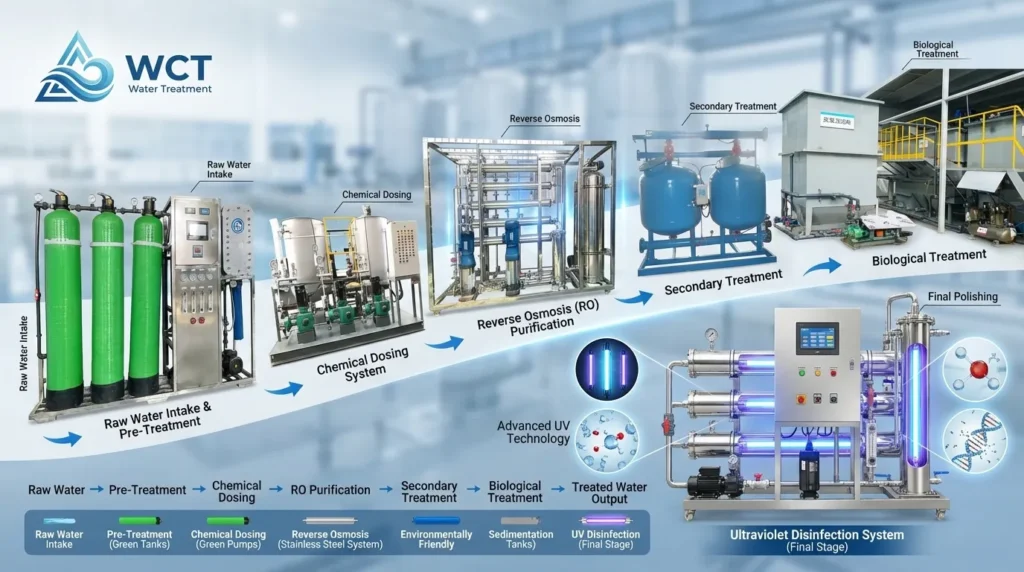
In this post, you\’re going to learn exactly how to size, maintain, and integrate your setup. I’ll even break down a complete water treatment plant diagram so you know exactly where UV technology belongs within your specific water treatment facility diagram for maximum efficacy.
So if you\’re looking to eliminate chemical treatments and upgrade your industrial water recycling, this guide is for you.
Let\’s dive right in.
Would you like me to continue drafting the next section, \”The Science of UV Disinfection,\” using this same high-energy, engaging format?
The Science of UV Disinfection: How an Ultraviolet Water Treatment System Purifies Water
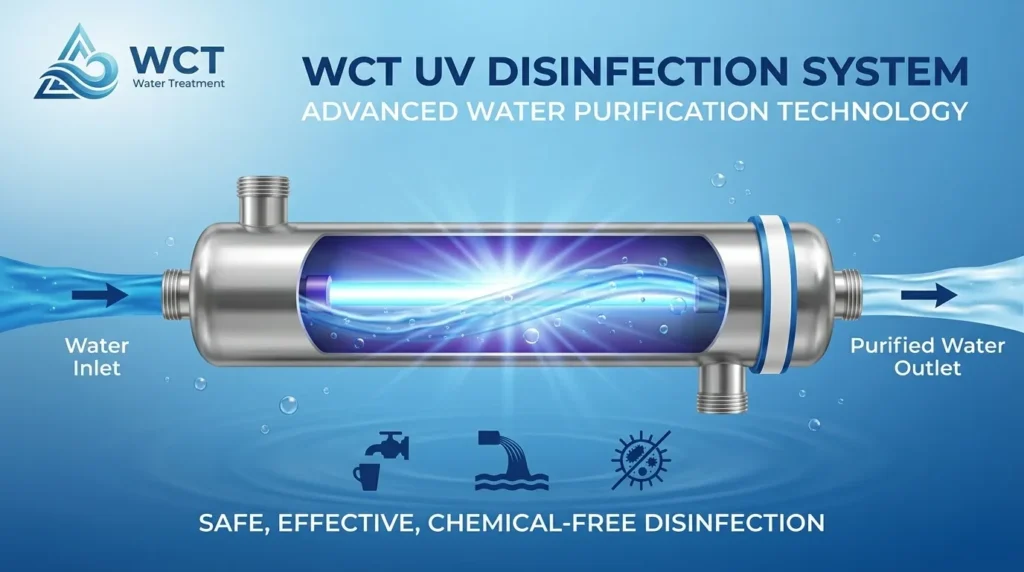
Are you struggling to manage microbial contamination in your industrial processes but need to avoid harsh chemical additives? I constantly see facilities battling bio-fouling and pathogen risks without realizing the impact chemicals have on their downstream equipment. The most efficient and reliable solution is an ultraviolet water treatment system, which delivers powerful, chemical-free water disinfection. Instead of dumping chlorine into your supply, UV technology neutralizes biological threats instantly as water flows through the chamber, leaving zero residue.
Disrupting Microorganism DNA
The mechanism behind our UV water purification technology is strictly physics, not chemistry. Inside a commercial UV sterilizer, we utilize high-output lamps calibrated to emit the precise UVC light wavelength (254 nm).
When water passes through the system, this intensive light penetrates the cell walls of harmful pathogens. The result is rapid microorganism DNA disruption. The UV energy shatters the thymine bonds within the DNA and RNA of the bacteria, viruses, and protozoa, completely stripping their ability to replicate. A pathogen that cannot reproduce is inert—it cannot cause infection or biological fouling.
What UV Does (and Doesn\’t) Remove
It is critical to understand the exact capabilities of an ultraviolet water treatment system to ensure proper integration into your facility. UV is a highly targeted biological sterilization tool, not a physical filter.
What UV Effectively Neutralizes:
- Bacteria: E. coli, Legionella, Salmonella, and Coliforms.
- Viruses: Hepatitis, Enterovirus, and Rotavirus.
- Protozoan Cysts: Cryptosporidium and Giardia (which are notoriously highly resistant to standard chlorine treatments).
What UV Does NOT Remove:
- Heavy Metals: Iron, manganese, lead, and arsenic.
- Suspended Solids: Dirt, mud, and turbidity (particulates actively block UV light and reduce your Ultraviolet Transmittance, or UVT).
- Dissolved Chemicals: Volatile organic compounds (VOCs), salts, and existing chlorine.
Because UV specifically targets living organisms, pre-filtration is always a mandatory step. To guarantee optimal DNA disruption and absolute biological safety, the incoming water must be clear of physical obstructions before it ever reaches the UV chamber.
Where Does UV Fit? Analyzing a Water Treatment Plant Diagram
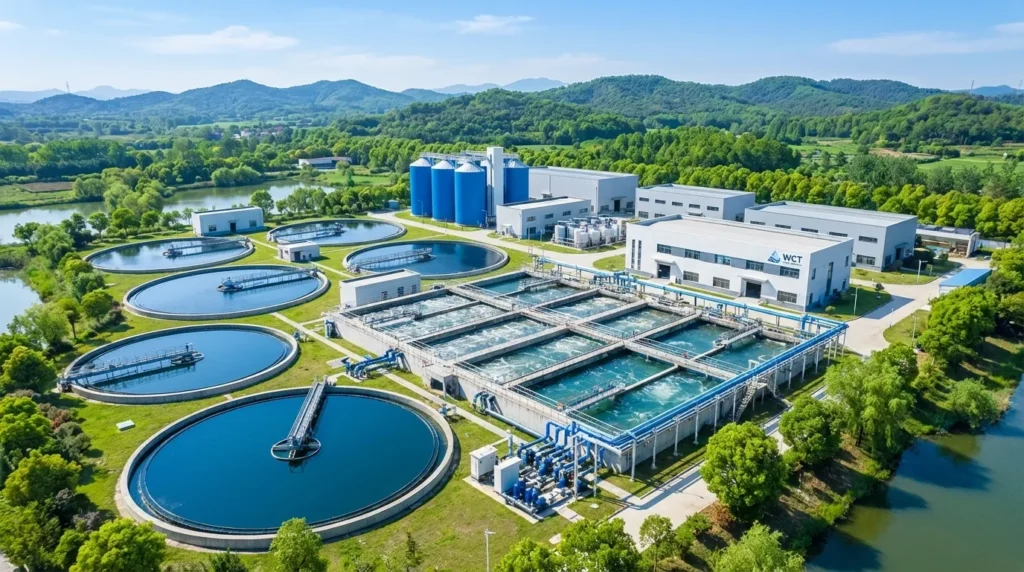
When setting up an ultraviolet water treatment system, location is everything. If you review a standard water treatment plant diagram, you will notice that UV technology is never placed at the raw water inlet. Instead, this chemical-free water disinfection method acts as a final safeguard at the end of the line.
The reason is practical: UV light requires clear water to operate. Suspended solids, dirt, and cloudy water create \”shadows\” that block the UVC light wavelength (254 nm) from hitting its target. Without crystal clear water, the light cannot effectively achieve microorganism DNA disruption.
The Critical Role of Sequencing in a Water Treatment Facility Diagram
A well-planned water treatment facility diagram relies on a strict, non-negotiable order of operations. Proper sequencing guarantees your commercial UV sterilizer performs reliably and keeps your maintenance costs low. Here is the standard flow we use to maximize ultraviolet transmittance (UVT):
- Phase 1: Pre-Filtration: We first strip out sediment, turbidity, and large particles. Meeting strict pre-filtration water quality requirements is mandatory before water ever reaches the UV chamber.
- Phase 2: Primary Purification: This stage heavily relies on Reverse Osmosis (RO) integration or carbon filters to remove dissolved solids, organics, and chlorine. You can see how these primary stages connect in our broader overview of plants for water treatment.
- Phase 3: UV Disinfection: Positioned right before the storage tank or the point-of-use distribution, the UV system provides the final sterilizing polish.
By sticking to this proven water treatment diagram, we ensure the UV system operates at peak efficiency, easily handling its rated GPM flow rate capacity while delivering consistently safe water.
Key Prerequisites for an Effective UV Water Treatment System
Pre-Treatment Water Quality Standards
For an ultraviolet water treatment system to do its job, the water must be physically clear first. UV light cannot penetrate cloudy water. If the light cannot reach the microorganisms, it cannot neutralize them. That is why strict pre-filtration water quality requirements are absolutely non-negotiable.
When we design a setup, we focus heavily on Ultraviolet Transmittance (UVT). This metric tells us exactly how much UV light successfully passes through the water column. If your feed water contains suspended solids, high iron, or excessive hardness, those particles act like physical shields, creating shadows where bacteria can hide from the UVC light.
If you are pulling from an underground source, passing the water through a reliable well water treatment system is the most practical first step. This effectively removes heavy minerals, sediment, and scaling factors before the water ever touches the UV chamber.
Critical Pre-Treatment Baselines to Hit:
- Turbidity: Must be less than 1 NTU. Crystal clear water ensures maximum UV light penetration.
- Iron: Keep it strictly under 0.3 ppm. Iron quickly stains the quartz sleeve, blocking the UV rays over time.
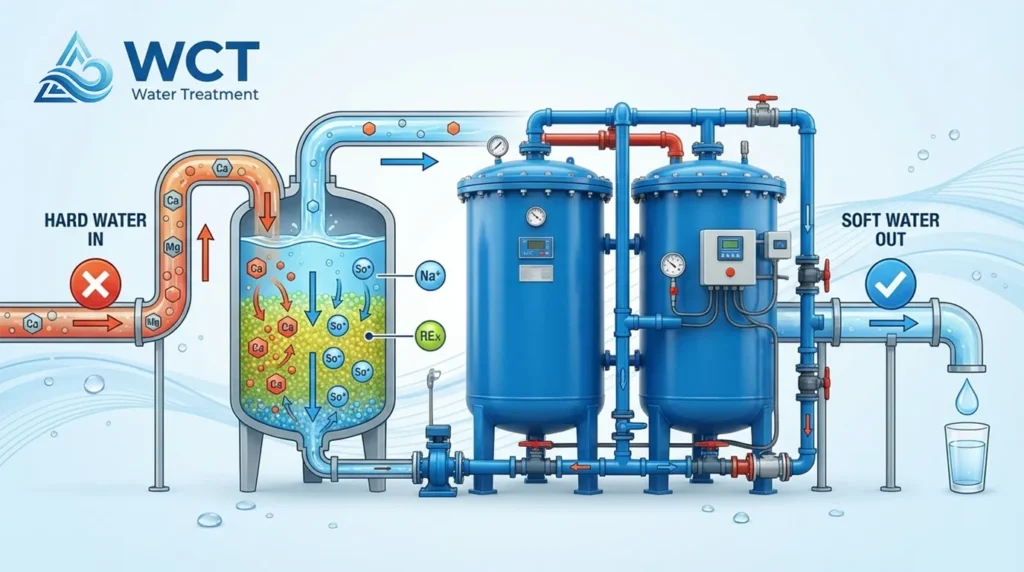
- Hardness: Needs to be below 7 gpg (120 mg/L). Hard water causes calcium scale buildup directly on the lamp sleeve, insulating the light.
- Tannins & Color: Must be virtually zero. Discolored water absorbs the UVC light, dropping the UVT levels significantly.
Handling these physical water characteristics upfront guarantees your commercial UV sterilizer operates at peak efficiency, delivering safe, chemical-free disinfection without unnecessary downtime.
Sizing and Specifications: Choosing the Right UV System
When sizing an ultraviolet water treatment system, accuracy is everything. An undersized unit rushes water past the lamps too quickly, leaving pathogens alive. Whether you are outfitting a compact commercial facility or integrating UV purification alongside a high-capacity 1000 GPD RO system for wastewater treatment, matching the equipment specifications to your daily water demand is a non-negotiable step for guaranteed safety.
Flow Rates (GPM) and UV Dose
Your system\’s success relies entirely on contact time. We evaluate this using two critical metrics: GPM flow rate capacity and UV dose.
- GPM (Gallons Per Minute): The volume of water traveling through the UV chamber at any given moment.
- UV Dose (mJ/cm²): The actual amount of UVC light energy absorbed by the water and the microorganisms within it.
Here is a quick breakdown of how we typically size these systems:
| Application Level | Target Flow Rate (GPM) | Recommended UV Dose |
|---|---|---|
| Light Commercial | 10 – 20 GPM | 30 mJ/cm² |
| Standard Commercial | 20 – 50 GPM | 40 mJ/cm² |
| Industrial Scale | 50+ GPM | 40 to 186 mJ/cm² |
NSF Certifications Explained
You need reliable proof that your equipment performs exactly as promised. That is exactly what NSF 55 certified UV systems provide. This independent certification guarantees that the unit delivers the exact UV dose required for true chemical-free water disinfection.
- NSF/ANSI 55 Class A: Built to disinfect microbiologically unsafe water. These systems mandate a minimum UV dose of 40 mJ/cm² and feature fail-safe alarms to alert you if the UV intensity drops.
- NSF/ANSI 55 Class B: Designed for supplemental treatment on water that is already treated and deemed safe. These require a lower minimum dose of 16 mJ/cm² and are strictly for nuisance bacteria.
When deploying an industrial-grade ultraviolet water treatment system, we strongly advise meeting Class A specifications to ensure absolute operational security and compliance.
Maintenance Requirements for Maximum Uptime
To keep your ultraviolet water treatment system running at peak performance, you need a strict maintenance schedule. We understand that in any industrial setting, downtime costs money. Proper care guarantees your commercial UV sterilizer continues to deliver reliable, chemical-free water disinfection without interruption. If you want to see how these systems integrate into a larger plant setup, reviewing the standard process of industrial water treatment can provide valuable context.
Routine Upkeep for Industrial Reliability
Staying ahead of wear and tear is the only way to protect your investment. Below is a quick, actionable checklist for maintaining high ultraviolet transmittance (UVT) and system efficiency.
Essential Maintenance Schedule:
| System Component | Required Action | Maintenance Frequency |
|---|---|---|
| UV Lamps | Replace lamps before UVC intensity drops. Adhere strictly to the UV lamp 9000-hour lifespan. | Annually (approx. every 12 months) |
| Quartz Sleeves | Perform routine quartz sleeve maintenance. Clean off mineral scaling to ensure maximum light penetration. | Every 3 to 6 months |
| Pre-filtration | Inspect and replace filters to maintain strict pre-filtration water quality requirements. | Monthly |
| O-Rings & Seals | Inspect for degradation and replace to prevent water damage to electrical components. | Annually (during lamp replacement) |
Key Takeaways for Operators:
- Never bypass the 9000-hour mark: Even if the lamp still lights up, its disinfection power degrades significantly after 9000 hours.
- Keep it clean: A dirty quartz sleeve blocks the 254 nm UVC light wavelength, rendering the system useless regardless of lamp age.
- Log everything: Track your GPM flow rate capacity and maintenance dates to catch potential pressure drops early.
Integrating UV into Your WCT One-Stop Water Solution
End-to-End Environmental Engineering
Installing an ultraviolet water treatment system is rarely a standalone fix; it operates at peak performance when serving as the vital final stage of a comprehensive purification process. At WCT, we do not just supply isolated parts. We engineer end-to-end water solutions that integrate seamlessly into your broader operational infrastructure.
When you map out a standard water treatment facility diagram, UV disinfection always sits downstream from primary and secondary filtration. UVC light requires high water clarity to effectively disrupt microorganism DNA. If the water is highly turbid, pathogens can essentially \”hide\” behind suspended solids, reducing the system\’s effectiveness. Because pre-filtration water quality requirements are so strict, pairing your UV setup with a high-quality WCT precision filter for water treatment ensures maximum ultraviolet transmittance (UVT) and protects your system\’s overall efficiency.
Our environmental engineering approach covers the entire lifecycle of your water management:
- Pre-Filtration Clarity: Stripping out sediment and bulk contaminants before they can interfere with light transmission.
- Reverse Osmosis (RO) Integration: Combining precision UV technology with RO membranes to guarantee ultra-pure, safe output.
- Complete System Synergy: Designing custom integrated sewage treatment equipment that seamlessly links biological waste treatment with final-stage, chemical-free water disinfection.
- Industrial Water Recycling Solutions: Reclaiming facility wastewater for safe, continuous reuse, drastically cutting your utility costs and environmental footprint.
We build reliable, one-stop configurations tailored to global industrial demands. By treating your facility\’s entire water cycle as one unified ecosystem, we guarantee that your WCT ultraviolet components deliver maximum sterilization with absolute reliability.