Choosing a septic tank manufacturer is about more than just finding a container for waste; it’s about securing the structural integrity of your entire wastewater treatment system.
Whether you are a developer managing a large-scale project or a homeowner prioritizing long-term environmental compliance, the supplier you choose determines the lifespan of your investment.
In this guide, you’re going to learn exactly how to distinguish a high-quality FRP septic tank from a \”budget\” alternative that’s destined to fail. I’ve put together the ultimate checklist for evaluating tank structural integrity, material standards, and corrosion resistance.
If you\’re looking to invest in a system that lasts 30+ years, this guide is for you.
Let’s dive right in.
Choosing a Reliable Septic Tank Manufacturer
When you invest in a wastewater treatment system, you aren\’t just buying a container; you are securing the long-term safety of your property and the surrounding environment. As a leading septic tank manufacturer, we know that the difference between a high-performing system and a catastrophic failure lies in the engineering standards applied during production. A poorly made tank can lead to structural collapse, soil contamination, and massive repair costs.
Engineering Standards and Structural Integrity
Professional septic tank manufacturing focuses on more than just holding liquid. We engineer our tanks to withstand heavy soil loads and hydrostatic pressure. Without rigorous standards, tanks often suffer from:
- Structural Failure: Cracking or bowing due to improper wall thickness.
- Groundwater Contamination: Seepage of untreated sewage into the water table.
- System Backups: Poorly designed internal baffles that disrupt the flow of the sewage disposal unit.
Material Integrity: High-Grade vs. Budget Alternatives
The longevity of your underground storage tanks depends entirely on the raw materials used. As a dedicated septic tank maker, we prioritize high-grade resins and reinforced composites over \”budget\” materials that degrade quickly in acidic soil conditions.
| Feature | High-Grade Manufacturing | Budget Alternatives |
|---|---|---|
| Corrosion Resistance | High (Resistant to sulfuric acid) | Low (Prone to thinning) |
| Wall Consistency | Uniform (Precision molded) | Uneven (Manual application) |
| Lifespan | 30+ Years | 5–10 Years |
| Impact Strength | High (Resists shifting soil) | Brittle (Prone to stress cracks) |
Environmental Compliance and Certifications
As a global septic tank supplier and manufacturer, we ensure every unit meets strict environmental compliance protocols. Our septic tank manufacturing company adheres to international standards, including ISO and CE certifications, ensuring that our anaerobic digestion tanks facilitate efficient waste breakdown and produce cleaner effluent.
We take our role as a manufacturer of septic tank systems seriously, ensuring that every septic tank system manufacturer process we oversee results in a product that protects public health and meets local building codes. Choosing a professional septic tank manufacturer means choosing a partner committed to engineering excellence and environmental safety.
Choosing the Right Septic Tank Manufacturing Material
As a leading septic tank manufacturer, we know that one size never fits all. The material choice dictates the lifespan of your wastewater system and how it handles environmental stress.
FRP (Fiberglass Reinforced Plastic) Tanks
FRP is the gold standard in modern septic tank manufacturing. It offers an incredible strength-to-weight ratio, making it easy to install without sacrificing structural integrity. Unlike steel or concrete, FRP is naturally immune to the corrosive gases produced during anaerobic digestion.
Polyethylene (Plastic) Tanks
These are the go-to for residential projects. They are lightweight, impact-resistant, and can be transported to remote locations with ease. While lighter than FRP, our high-density polyethylene designs ensure they stand up to soil pressure without cracking.
Concrete vs. Modern Composites
While traditional concrete is durable, it is prone to cracking over time and requires heavy machinery for installation. Modern composite materials have largely overtaken concrete in efficiency, especially when integrated into broader municipal water treatment systems where longevity is non-negotiable.
Comparison of Manufacturing Materials
| Feature | FRP (Fiberglass) | Polyethylene (Plastic) | Precast Concrete |
|---|---|---|---|
| Durability | Extreme | High | Moderate (can crack) |
| Corrosion Resistance | Excellent | Excellent | Poor (acid sensitive) |
| Installation Speed | Fast | Fastest | Slow |
| Weight | Light | Very Light | Heavy |
WCT’s Specialized Manufacturing Approach
We don\’t just act as a septic tank maker; we function as your engineering partner. Our manufacturing process involves:
- Soil-Specific Engineering: Adjusting wall thickness based on whether the tank sits in clay, sand, or high-water-table areas.
- Custom Load Ratings: Designing internal ribbing to support H-20 traffic loads if the tank is placed under driveways.
- Precision Baffling: Customizing internal compartments to maximize solids separation and protect your drainage field.
By focusing on these technical details, we ensure every unit leaving our facility is more than just a container—it’s a high-performance sewage disposal unit built for the long haul.
Key Criteria for Evaluating a Septic Tank Supplier
When you partner with a septic tank manufacturer, you are investing in the long-term success of your infrastructure. We focus on four critical pillars to ensure every unit meets the highest industry standards and project-specific requirements.
Essential Supplier Benchmarks
| Criteria | What to Look For | Why It Matters |
|---|---|---|
| Production Capacity | High-volume output and optimized lead times. | Prevents costly project delays and construction downtime. |
| Customization | Flexible inlet/outlet sizes and internal baffle placement. | Ensures the tank fits your specific site layout and flow rates. |
| Quality Control | Hydrostatic testing and wall thickness verification. | Guarantees tank structural integrity and prevents environmental leaks. |
| Technical Support | CAD drawings and detailed installation manuals. | Simplifies the setup of your integrated sewage treatment equipment on-site. |
Beyond the Product: Technical Reliability
As a dedicated septic tank manufacturing company, we provide more than just a container. Our process is designed to support contractors and engineers through every stage of the project:
- Rigorous Testing: Every unit undergoes pressure testing and leak detection to ensure it functions as a reliable sewage disposal unit.
- Engineering Documentation: We provide comprehensive drawings and structural data to assist with local regulatory approvals and site planning.
- Design Flexibility: We can tailor the internal configurations of our underground storage tanks to handle specific hydraulic loads or unique soil conditions.
Choosing a manufacturer of septic tank systems requires a partner who understands the nuances of soil pressure and effluent chemistry. We prioritize transparency in our manufacturing standards so you can install with total confidence in the system\’s longevity.
The WCT Manufacturing Edge: Innovation in Water Treatment
As a leading septic tank manufacturer, we don\’t just build containers; we engineer high-performance systems designed for the toughest environments. Our focus is on merging advanced material science with practical field requirements to deliver a superior product.
Advanced Molding Technology
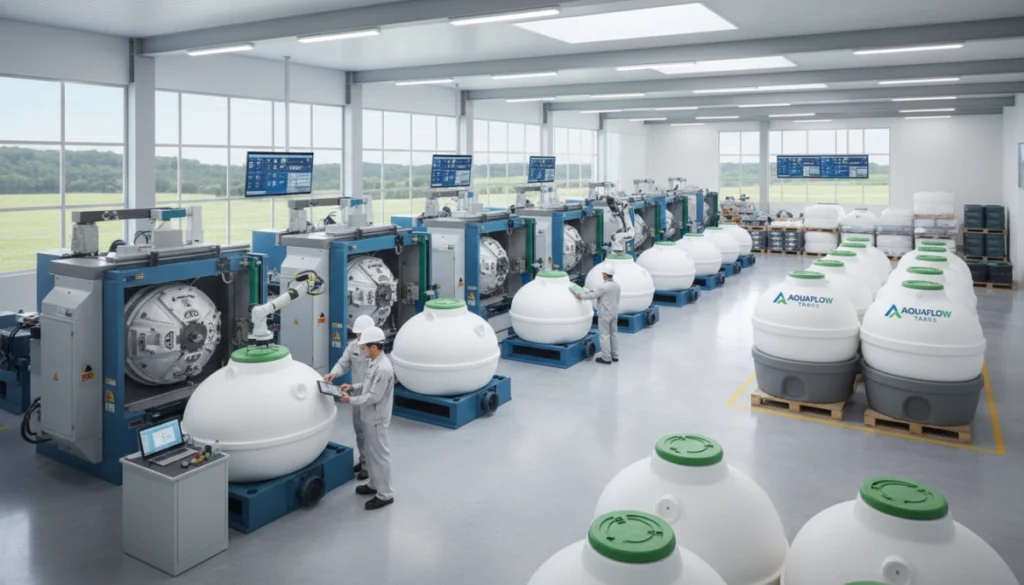
We utilize precision molding processes to ensure uniform wall thickness across the entire vessel. Unlike traditional methods that can leave thin spots, our manufacturing technique incorporates:
- Integrated Structural Ribbing: Provides maximum resistance against soil pressure and shifting.
- High-Grade Resin Blends: Enhances tank structural integrity and prevents leaks over decades of use.
- Seamless Construction: Minimizes joints to eliminate potential failure points.
Eco-Friendly Initiatives for Cleaner Effluent
Our role as a septic tank manufacturer involves a commitment to environmental protection. We design our tanks to facilitate optimal anaerobic digestion, ensuring that solids break down efficiently before liquid exits the system. By improving the internal baffles and flow patterns, we create a more effective sewage disposal unit that produces cleaner effluent, protecting local groundwater and soil health.
Global Logistics and Large-Scale Shipping
Navigating the complexities of transporting massive wastewater treatment systems is part of our core service. We have mastered the logistics of moving large-scale equipment across borders, ensuring:
- Custom Crating: Protecting the FRP septic tank or composite unit during sea and land transit.
- Regulatory Documentation: Handling all international compliance paperwork for smooth customs clearance.
- On-Time Delivery: Coordinating with local contractors to meet strict project deadlines.
By controlling every step from the initial mold to the final delivery, we maintain our reputation as a reliable water treatment supplier for residential, commercial, and industrial sectors worldwide.
Essential FAQs for Choosing a Septic Tank Manufacturer
Choosing the right septic tank manufacturer is about more than just finding the lowest price; it’s about ensuring long-term site safety and environmental compliance. Before you commit to a supplier, I recommend asking these critical questions to verify the quality of your sewage disposal unit.
What is the expected lifespan of the tank material?
The durability of your system depends entirely on the material used by the septic tank maker.
- FRP (Fiberglass): Typically lasts 30 to 50 years due to its extreme corrosion resistance against soil chemicals and sewage gases.
- Polyethylene: Offers a solid lifespan of 20 to 30 years, provided the septic tank manufacturing process includes UV stabilizers.
- Concrete: Can last decades but is susceptible to cracking and hydrogen sulfide corrosion if not properly coated.
Does the manufacturer provide a comprehensive warranty?
Any reputable septic tank system manufacturer should stand firmly behind their engineering. We provide clear, written warranties that cover structural integrity and material defects. If a manufacturer of septic tank systems is vague about their warranty terms, it is a major red flag regarding the long-term reliability of their products.
Are the tanks rated for H-20 traffic loading?
This is a deal-breaker if your tank will be installed under a driveway, parking lot, or any area with vehicle access.
- H-20 Rating: Specifically engineered to support the weight of a full semi-truck (32,000 lbs per axle).
- Non-Traffic Rating: Only suitable for landscape areas or \”green space\” where no vehicles will ever drive.
Always confirm the load rating with your septic tank manufacturing company to prevent catastrophic structural collapse.
How does the tank integrate with other treatment components?
A septic tank is often the primary stage of a larger wastewater treatment system. You should ask if the manufacturer provides compatible components like internal baffles, effluent filters, or specialized outlets that allow the tank to work seamlessly with secondary filtration units.
Quick Checklist for Evaluating a Supplier
- Certifications: Do they meet ISO or local environmental standards?
- Wall Thickness: Is the thickness uniform across the entire tank body?
- Technical Support: Can they provide stamped engineering drawings for your local permit office?
- Testing: Do they perform vacuum or hydrostatic leak testing before the tank leaves the factory?
Maintaining Your Septic Tank: The Manufacturer’s Perspective
As a dedicated septic tank manufacturer, we design our systems to minimize the owner\’s workload. Long-term durability is a direct result of how we handle the initial manufacturing process. When a water treatment tank is engineered with precision, it resists the corrosive gases produced during anaerobic digestion, ensuring the structural integrity remains intact for decades.
Engineering for Easy Upkeep
Proper manufacturing simplifies maintenance through several key features:
- Accessible Manhole Covers: We position reinforced risers and covers to allow for easy inspection and pumping without destroying your landscaping.
- Integrated Effluent Filters: These filters act as a final barrier, preventing suspended solids from escaping into the drainage field and causing a total system failure.
- Corrosion-Resistant Surfaces: By using high-grade composite materials, we eliminate the risk of \”concrete rot\” or rust, which are common in budget sewage disposal units.
A high-quality wastewater treatment system should not be a recurring problem. By focusing on wall thickness and internal baffle stability, we ensure that the only maintenance required is the standard professional pump-out, protecting your investment and the surrounding environment.