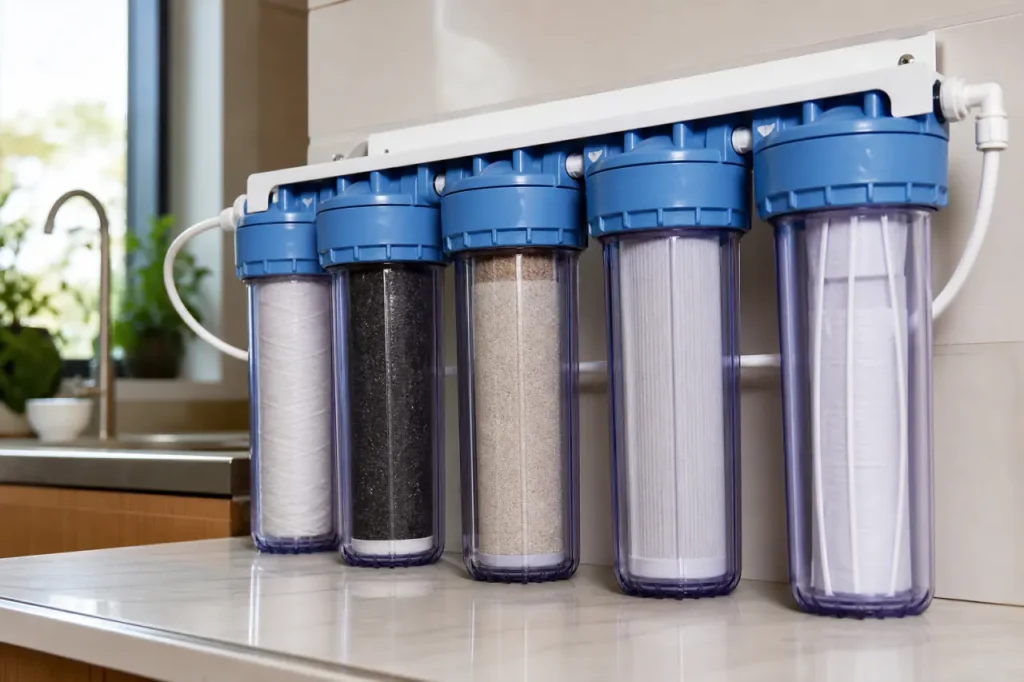
Standing in the filtered water aisle-or scrolling through products online-it’s easy to feel lost.
Marketing labels promise 3-, 5-, even 7-stage purification, but it’s rarely clear what those extra stages actually do for your tap water. Multi-stage filtration doesn’t have to be confusing.
Once you understand what each layer removes, you can choose a system matched to your real water quality, not just the highest stage count.
What is Multi-Stage Filtration?
Multi-stage filtration forces water through a sequence of distinct filter materials-one after another. Each layer is designed to catch specific contaminants that the previous layer missed.
It works like a funnel: large particles are trapped first, then progressively finer filtration handles dissolved chemicals, heavy metals, and microscopic organisms.
This staged approach protects the more expensive, tight filters from premature clogging and extends their advanced membrane filtration life.
In a typical home system, you might start with a sediment stage to capture sand and rust, then move through activated carbon blocks to remove chlorine and organic compounds, and finally push water through a dense reverse osmosis membrane stage that rejects dissolved solids.
The result is water that tastes clean, smells fresh, and meets far stricter purity levels than a single-stage pitcher filter can deliver.
- It’s a sequence, not a single filter. Each stage uses a different physical or chemical mechanism.
- Stage order matters. Coarse filtration always comes first to prevent high-end membranes from fouling in days.
- Not all systems use the same stages. Marketing counts vary, so compare what each stage actually contains rather than just the number.
The Core Stages Explained: What Each Filter Layer Does
Every stage targets a different family of impurities. Knowing what a sediment filter, a carbon block, and an RO membrane actually remove helps you read spec sheets with confidence-instead of guessing which add-on stages are useful for your water.
Stage 1: Sediment Filtration
The first line of defense is a mechanical sieve. Sediment filters are typically made of wound polypropylene, pleated polyester, or melt-blown layers. Their job is straightforward: physically block suspended solids.
If you skip this stage, the carbon block downstream clogs fast, flow drops, and the whole system stops working efficiently.
For homes on well water or older municipal pipes, a precision sediment filter with a smaller micron rating (5 microns or less) can dramatically reduce visible turbidity.
- What it removes: Dirt, sand, silt, rust particles, pipe scale, and other suspended solids.
- What it doesn’t touch: Dissolved chemicals, metals, viruses, or chlorine taste.
- Replacement cadence: Every 3-6 months, depending on sediment load. A clear housing lets you visually check when it turns brown.
Stages 2 & 3: Activated Carbon Blocks
The next one or two stages almost always rely on compressed activated carbon. Carbon works by adsorption: organic contaminants stick to the massive internal surface area of the carbon granules. This is the stage that makes water taste and smell better.
It’s also where PFAS removal with multi-stage filtration can begin-high-quality catalytic carbon blocks are one of the most effective consumer-level methods for reducing PFOS and PFOA.
- Chlorine and chloramine: Carbon neutralizes disinfectant taste and odor.
- Volatile organic compounds (VOCs): Pesticides, herbicides, and industrial solvents are adsorbed.
- Lead and heavy metals (limited): Some carbon blocks are specially treated to capture lead, but don’t rely on carbon alone for high heavy-metal levels.
Many systems split carbon into two stages: a granular activated carbon (GAC) stage for rough organics removal, followed by a denser carbon block for finer polishing. This dual-carbon approach reduces breakthrough risk if you use the system heavily.
Stage 4: Reverse Osmosis (RO) Membrane or Sub-Micron Filter
Here’s where a multi-stage system achieves serious dissolved solids reduction. An RO membrane is a thin-film composite sheet wrapped into a tight spiral.
It rejects almost everything larger than a water molecule: dissolved salts, nitrates, heavy metals like lead and chromium-6, arsenic, fluoride, and most pharmaceuticals.
RO systems with multi-stage filtration often use 0.0001-micron membrane pores, far tighter than even the best carbon block. Some mid-range systems skip RO and use a sub-micron filter instead, which can reduce cysts and fine sediment but won’t lower TDS (total dissolved solids).
For well water with high hardness or municipal supplies with lead service lines, RO is the stage that makes a health difference.
- What it removes: Total dissolved solids (TDS), heavy metals, nitrates, arsenic, fluoride, microorganisms.
- Flow rate note: RO is slow; the membrane produces water at a drip pace. A pressurized storage tank is essential for keeping the faucet flow usable.
- Not always needed: If your water has low TDS and no heavy-metal concerns, you might skip this stage to avoid the cost, water waste, and slower output.
Stage 5+: Post-Carbon and Remineralization
After the RO membrane or primary filtration, the water can taste slightly flat. A post-carbon filter-often an inline granular carbon cartridge-polishes any lingering odor from the storage tank and provides a final taste improvement.
Some systems add a remineralization stage, which reintroduces small amounts of calcium and magnesium for a more natural, spring-like flavor. This stage is about sensory quality, not safety. It’s a nice-to-have, not a must-have.
- Post-carbon: Sweetens water by removing any faint tank or hose taste.
- Remineralization: Raises pH slightly and adds back minerals removed by RO.
- UV sterilization stage (optional): Some high-end systems add a UV lamp as the final stage to guarantee microorganism inactivation, useful for untreated well water with bacterial risks.
3-Stage vs. 5-Stage vs. 7-Stage: Which Do You Need?
More stages usually mean purer water-but they also increase upfront cost and maintenance complexity. The right choice depends on what’s actually in your water, not just the biggest number on the box.
| Stage Level | Typical Filter Composition | Primary Contaminants Targeted | Relative Cost & Complexity |
|---|---|---|---|
| 3-stage | Sediment + Carbon Block + Carbon Block (or GAC and Block) | Sediment, chlorine taste/odor, some VOCs, limited heavy metals | Low to moderate. Simple design, fewer cartridge replacements, minimal water waste. |
| 5-stage | Sediment + Carbon Block + Carbon Block + RO Membrane + Post-Carbon | All of the above plus TDS, heavy metals, nitrates, arsenic, fluoride, PFAS | Moderate. RO membrane adds cost, a storage tank, and wastewater line; more annual cartridge swaps. |
| 7-stage | Sediment + 2-3 Carbon stages + RO + Post-Carbon + Remineralization + UV (optional) | All 5-stage contaminants plus microorganism disinfection, taste refinement, and mineral balance | Higher. Additional polishing filters and UV lamp require more maintenance, more costs, and may need extra under-sink space. |
What this means in practice: If you’re on treated municipal water that already meets EPA standards, a high-quality 3-stage system can make it taste great and catch residual lead or disinfection byproducts.
A 5-stage RO system becomes valuable when you have high TDS (above 500 ppm), well water, or known lead/arsenic contamination.
A 7-stage system is often overkill unless you need microbial disinfection or want mineral-enhanced flavor. The expensive mistake is buying a 7-stage system with UV and remineralization when a 3-stage carbon system would have solved your taste issues perfectly.
- Treated city water, decent taste, only odor concerns: 3-stage is usually sufficient.
- Well water, high hardness, or local boil-water advisories: 5-stage RO is the practical standard.
- Bacterial risks, luxury kitchen upgrade, or very high contaminant awareness: 7-stage can be justified, but confirm your water report first.
- Watch out for false stage inflation: Some brands count a sediment filter and a single carbon block split into two housings as separate stages; always check what each housing contains.
Choosing Your Configuration: Under-Sink vs. Whole-House
Your choice comes down to one question: Do you want treated water for drinking and cooking only, or for every tap, shower, and appliance in the house?
Under-Sink (Point of Use) Systems
These units install neatly inside the kitchen cabinet and supply a dedicated faucet. They’re compact, affordable, and far easier to maintain. Because they treat only the water you consume, the filter cartridges last longer and the system puts no drag on household water pressure elsewhere.
An under-sink multi-stage system with RO typically produces 50-75 gallons per day, stored in a 3-4 gallon tank, enough for a family’s drinking and cooking needs.
- Best for: City water, renters, anyone who wants premium drinking water without opening walls.
- Limitations: It won’t help with hard water scaling in bathrooms, chlorine skin irritation during showers, or protect appliances from mineral buildup.
Whole-House (Point of Entry) Systems
A whole-house multi-stage filter is installed where the main water line enters the home. That means every faucet, showerhead, washing machine, and water heater receives treated water.
These systems use larger, high-flow cartridges-often 20-inch big blue housings-to handle flow rates of 10-20 GPM without choking water pressure.
However, because they treat all incoming water, the replacement costs add up faster, and the upfront investment is significantly higher.
You’ll also need enough wall space and perhaps a sand media filter for sediment removal as a first stage if your supply contains heavy sediment loads.
- Best for: Well water, large families, homes with older plumbing where protecting the entire system matters.
- Limitations: Twice the cost of under-sink for similar stage counts; may cause a slight pressure drop if filter housings are undersized; professional installation highly recommended.
For many homes, a hybrid approach works best: a simple whole-house sediment and carbon system to protect pipes and remove chlorine odor, plus a dedicated under-sink multi-stage RO at the kitchen sink for drinking water.
Key Certifications and Features to Verify
Don’t take marketing claims at face value. Third-party testing is the only way to know a filter actually removes what it promises.
Certification Standards to Request
- NSF/ANSI Standard 42: Covers chlorine, taste, odor, and particulate reduction-the “aesthetic effects” standard. Most carbon stages should carry this.
- NSF/ANSI Standard 53: The health effects standard. Verifies lead, cysts, asbestos, VOCs, and some pesticides. If a system claims to remove lead, it must have Standard 53 certification specifically for lead reduction.
- NSF/ANSI Standard 58: The reverse osmosis standard. Confirms the RO membrane meets TDS reduction, nitrate rejection, and efficiency requirements. A must for any RO-equipped system.
- NSF 401 or P473: Emerging contaminant standards; P473 specifically covers PFOS/PFOA reduction. For PFAS concerns, look for this certification.
Performance Numbers That Matter
- Flow rate at 60 psi: A whole-house system should deliver at least 10 GPM peak; under-sink RO units specify daily production (e.g., 50 GPD). Match this to your household peak demand.
- Filter capacity in gallons: Manufacturers rate carbon blocks for a certain gallon throughput before replacement (e.g., 1,000 gallons). Check this against your family’s consumption-a family of four drinking 2-3 gallons a day will reach that capacity in under a year.
Even if a system claims to meet these standards, confirm that the certification is for the entire complete system, not just a single component.
A carbon block might be certified, but if the housing leaks or the O-rings fail, the system isn’t actually performing as tested.
Maintenance Expectations and Ongoing Costs
A multi-stage system isn’t a buy-and-forget device. Ignoring filter replacement schedules turns the system from a purifier into a potential breeding ground for bacteria and spent contaminants that can release back into your water.
Staying ahead of changes keeps performance high and protects the pricey RO membrane.
Most systems follow a staggered schedule:
- Sediment cartridge: Replace every 3-6 months (or when visibly dirty). Cost: $5-$20 each.
- Carbon block cartridges: Replace every 6-12 months, depending on water usage and chlorine load. Cost: $15-$35 per block; a two-carbon system might run $30-$70 annually.
- RO membrane: Replace every 2-3 years. Cost: $40-$100. A low-pressure RO membrane can be a good upgrade if your inlet pressure is low, reducing pump strain and improving efficiency.
- Post-carbon and remineralization cartridges: Replace every 12 months for best taste. Cost: $15-$30 each.
Annual maintenance for a typical 5-stage under-sink RO system runs roughly $75-$150, plus the cost of labor if you aren’t doing the swaps yourself. Whole-house systems will cost more because the cartridges are larger and treat higher water volumes.
The real mistake is buying a cheap system and then skipping cartridge replacements to save money-the system will lose effectiveness and may even contaminate the water if biofilms grow inside.
If you’re ready to explore certified residential under-sink or whole-house multi-stage filtration systems that match your specific water quality needs, comparing cartridge costs and certification data upfront makes the long-term expense predictable.
Frequently Asked Questions
Does a multi-stage filtration system lower home water pressure?
Whole-house systems can cause a modest pressure drop if filter housings are undersized or cartridges become clogged. A well-designed system with high-flow ports and properly rated cartridges keeps the drop under 2-3 psi.
Under-sink RO systems use a dedicated faucet and pressurized storage tank, so they don’t affect pressure elsewhere.
Do I need a plumber to install a multi-stage system?
Most under-sink systems are designed for DIY installation and come with push-to-connect fittings and color-coded tubing. If you’re comfortable drilling a faucet hole and tapping into the cold water line, an afternoon is usually enough.
Whole-house point-of-entry systems require cutting into the main water supply. A licensed plumber is the safer route and may be needed to meet local code.