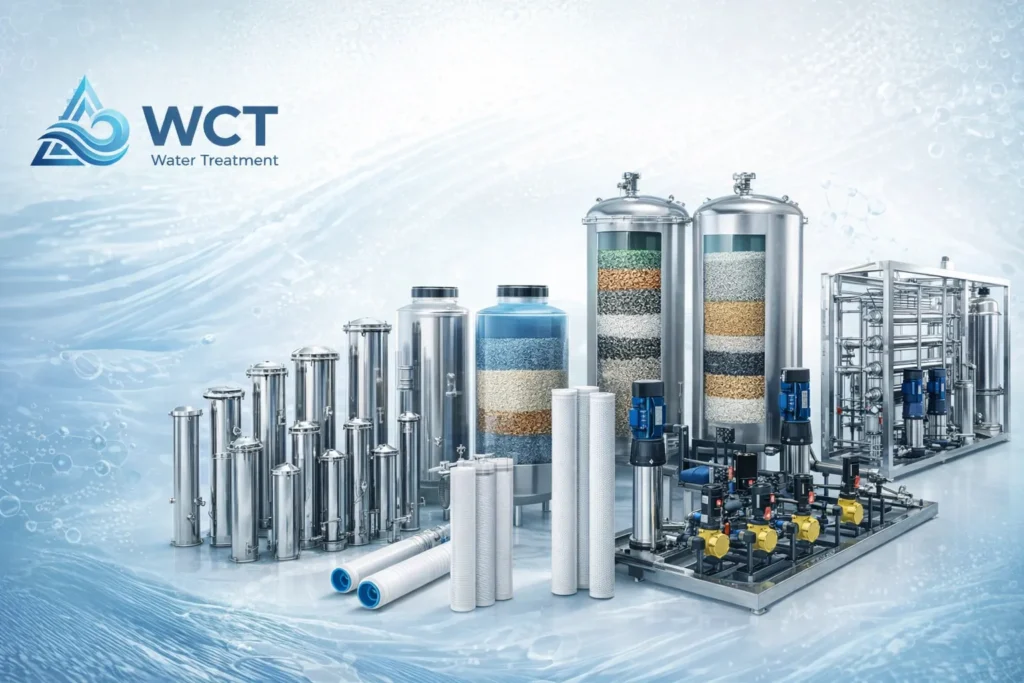
You might already know that the efficiency of your filtration system depends on its engineering—but the real \”heart\” of the process is the water treatment filter media.
The wrong choice leads to excessive pressure drop, frequent backwash, and premature media exhaustion. The right choice? It ensures superior suspended solids removal, optimizes turbidity reduction, and slashes your long-term operational costs.
At WCT, we’ve spent years perfecting the science of granular filter media for global industrial and municipal systems. Whether you are tackling industrial wastewater treatment or meeting strict potable water standards, selecting the correct media is critical for a high-performance multi-media filtration system.
In this guide, you’ll learn exactly how to evaluate adsorption capacity, catalytic oxidation, and depth filtration to choose the perfect solution for your specific challenge.
Let’s dive right in.
Fundamentals of Water Treatment Filter Media
At its core, water treatment filter media acts as a physical and chemical barrier, stripping contaminants from a liquid stream as it passes through a structured bed. We design our media to target specific impurities through three primary mechanisms. Understanding these processes is essential for selecting the right material for your system.
Primary Filtration Mechanisms
| Mechanism | Process Description | Common Media Examples |
|---|---|---|
| Mechanical Filtration | Traps suspended solids within the voids of the media bed. | Silica Sand, Anthracite, Garnet |
| Adsorption | Molecules or atoms adhere to the surface of the media via chemical or physical attraction. | Activated Carbon, Catalytic Carbon |
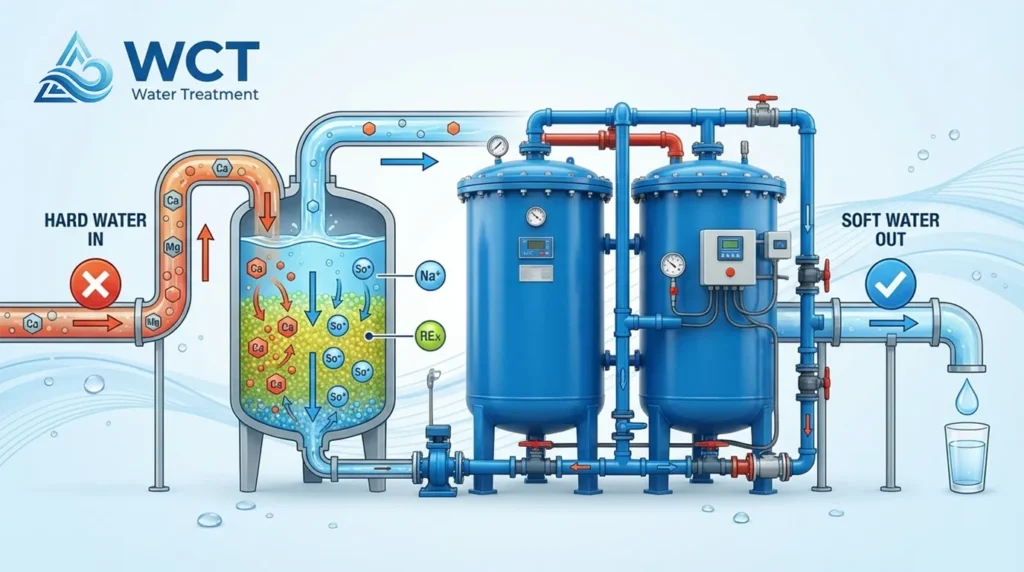
| Ion Exchange | Undesirable ions are swapped for harmless ones on the media surface. | Zeolite, Ion Exchange Resins |
Critical Physical Properties for Performance
The efficiency of a water purification process depends on the physical characteristics of the granular filter media. We focus on these specific metrics to ensure long-term stability and optimal flow rates.
- Effective Size (d10): This is the sieve opening that allows 10% of the media to pass. It determines the minimum particle size the bed can effectively trap.
- Uniformity Coefficient (UC): Calculated as the ratio of d60 to d10. A lower UC (closer to 1.0) indicates more uniform grains, which leads to lower pressure drop and more efficient backwashing.
- Specific Gravity and Bulk Density: These determine the weight of the media. High-density media like garnet require higher backwash flow rates to achieve the necessary filter bed expansion.
- Hardness and Attrition Rate: We prioritize high Mohs hardness to ensure the media resists physical breakdown during the vigorous friction of backwashing and air scouring. Low attrition rates mean less media loss and longer replacement cycles.
By balancing these physical properties, we provide media that maximizes turbidity reduction while maintaining the structural integrity required for industrial and municipal applications. Selecting the correct grain sizing is the first step in optimizing depth filtration and ensuring your system meets strict water quality standards.
Particulate and Sediment Removal Media
Effective suspended solids removal starts with selecting the right granular filter media. We provide high-purity materials designed to trap turbidity and debris throughout the entire depth of the filter bed, rather than just on the surface. By utilizing different densities and grain sizes, our systems achieve superior water clarity and longer run times between backwashes.
Silica Sand and Gravel for TSS Removal
Silica sand is the workhorse of the water purification process. It is specifically graded to trap fine particles and is often supported by a layer of high-purity gravel. This combination ensures even flow distribution and prevents the migration of finer media into the underdrain system. For systems requiring even higher accuracy, integrating a precision filter for water treatment downstream can further safeguard your water quality.
Anthracite Coal for Deep-Bed Penetration
Anthracite is essential for depth filtration. Because it is less dense than sand, it sits at the top of a multi-media bed. Its angular shape allows it to trap large amounts of sediment without clogging the surface, allowing the water to penetrate deeper into the filter. This reduces pressure drop and extends the operational life of the filter bed.
Garnet for High-Clarity Requirements
When your application demands the lowest possible turbidity, garnet is the solution. As a high-density, fine-grain media, it stays at the bottom of the filter during backwashing. It acts as the final polishing layer, catching the smallest remaining particles that pass through the anthracite and sand layers.
| Media Type | Primary Function | Key Benefit |
|---|---|---|
| Anthracite | Pre-filtration / Large TSS | High dirt-holding capacity |
| Silica Sand | Standard Sediment Removal | Reliable, cost-effective TSS reduction |
| Garnet | Fine Polishing | Achieves maximum water clarity |
| Gravel | Support Bed | Ensures uniform flow and drainage |
Our water treatment filter media are processed to meet strict effective size and uniformity specifications. This precision ensures that when you backwash, the layers reset perfectly, maintaining the integrity of your multi-media filtration system for years of consistent performance.
Adsorption and Chemical Removal Media
We provide specialized water treatment filter media designed to tackle dissolved contaminants that standard mechanical filtration cannot reach. Adsorption is a critical phase in the water purification process, where pollutants physically or chemically adhere to the surface of the media to ensure high-purity output.
Activated Carbon (GAC/PAC) for Organics
Activated carbon remains the industry standard for removing organic compounds, pesticides, and unpleasant tastes or odors. We manufacture these media to ensure high porosity and maximum surface area.
- Granular Activated Carbon (GAC): Best for continuous flow systems, offering a high adsorption capacity for long-term use.
- Powdered Activated Carbon (PAC): Ideal for batch treatments or addressing sudden spikes in organic loads.
- Primary Use: Essential for industrial wastewater treatment to reduce TOC (Total Organic Carbon) and remove chlorine.
Catalytic Carbon for Chloramines and Hydrogen Sulfide
Standard carbon often struggles with chloramines and \”rotten egg\” smells. Our catalytic carbon is surface-modified to accelerate chemical reactions, making it far more effective for specific chemical stripping.
- Chloramine Removal: Efficiently breaks the bond between chlorine and ammonia, which standard GAC often misses.
- Hydrogen Sulfide (H2S) Reduction: Converts dissolved H2S into elemental sulfur, eliminating odors without requiring heavy chemical pre-treatment.
- Performance: Faster reaction kinetics allow for higher flow rates and smaller equipment footprints.
By selecting the right chemical removal media, we help operators meet strict discharge limits and potable water standards while protecting downstream equipment like RO membranes from oxidative damage.
Iron and Manganese Removal with Catalytic Water Treatment Filter Media
Dealing with \”red water\” or black staining requires specialized water treatment filter media designed for catalytic oxidation. We provide high-performance solutions that target dissolved iron and manganese, converting them into solid particles that are easily trapped and removed during the filtration cycle.
Manganese Greensand and Greensand Plus
These are the industry standards for removing iron, manganese, and hydrogen sulfide. While traditional greensand requires potassium permanganate regeneration, Greensand Plus utilizes a silica sand core with a manganese dioxide coating. It is exceptionally effective in municipal water treatment systems because it can handle higher operating temperatures and higher differential pressures without media breakdown.
Birm and Pyrolox Catalytic Solutions
For applications where chemical regeneration isn\’t ideal, we offer advanced catalytic media that simplify the water purification process:
- Birm: An efficient and economical choice for iron and manganese reduction. It acts as an insoluble catalyst to enhance the reaction between dissolved oxygen and the metal compounds. It is not consumed in the process, making it a low-maintenance option.
- Pyrolox: A heavy-duty, naturally mined ore used for high-concentration contaminant removal. Its high capacity for catalytic oxidation makes it a powerhouse for industrial-grade water treatment.
- Greensand Plus: Offers dual-functionality by acting as both a filter and an oxidant, ensuring low effluent turbidity and high-clarity water.
Why Catalytic Media Matters
- Effective Precipitation: Rapidly converts dissolved metals into filterable solids.
- Long Service Life: High resistance to attrition ensures the media lasts through years of rigorous backwashing.
- System Versatility: Compatible with both pressure and gravity-fed filtration setups.
- Reliable Performance: Maintains high flux rates even when dealing with fluctuating influent metal concentrations.
Specialized and Advanced Water Treatment Filter Media
When standard filtration isn\’t enough to meet strict potable water standards, we provide specialized media engineered for specific chemical and physical challenges. These advanced materials target dissolved gases, ions, and ultra-fine particles that traditional sand filters might miss.
Zeolite for Ammonia and Fine Particles
Zeolite is a high-performance granular filter media known for its exceptional surface area and cation exchange capacity. It is the premier choice for industrial wastewater treatment where ammonia removal is critical.
- Ammonia Removal: Effectively captures ammonium ions through ion exchange.
- Superior Clarity: Provides significant turbidity reduction, filtering down to 3-5 microns.
- High Loading Capacity: Handles higher solids loads than silica sand, extending run times between backwashes.
Calcite and Magno-Dol for pH Neutralization
Acidic water causes pipe corrosion and leaches metals into the supply. We utilize sacrificial water treatment filter media like Calcite (calcium carbonate) and Magno-Dol to stabilize effluent.
- Self-Limiting Neutralization: Calcite dissolves only enough to reach a non-corrosive pH, preventing over-correction.
- Magno-Dol: A magnesium-based media that reacts faster than calcite, ideal for high-flow applications or very low pH levels.
- Remineralization: Often used in a water treatment for well system to add essential minerals back into soft or desalinated water.
Key Benefits of Specialized Media
| Media Type | Primary Function | Key Application |
|---|---|---|
| Zeolite | Ammonia & Fine Particle Removal | Wastewater & High-Purity Process Water |
| Calcite | pH Neutralization (Slow) | Residential & Light Industrial Well Water |
| Magno-Dol | Rapid pH Correction | Municipal & Large Scale Industrial Water Treatment |
These advanced solutions ensure your water purification process remains efficient while protecting downstream infrastructure from chemical imbalances and fine sediment fouling.
Multi-Media vs. Single-Media Filtration Systems
In our experience, choosing the right configuration for water treatment filter media determines the long-term efficiency of your plant. While single-media filters are straightforward, a multi-media filtration system utilizes layers of varying density and size to achieve superior depth filtration. By stacking materials like anthracite over sand and garnet, we ensure that the entire bed depth is used for solids capture rather than just the top few inches.
Advantages of Layered Media Beds
Layered beds offer significant operational benefits over traditional mono-medium setups:
- Higher Turbidity Loading: They handle higher concentrations of suspended solids without clogging.
- Increased Flux Rates: You can process more water through the same vessel footprint.
- Longer Filter Runs: Less frequent backwashing saves water and energy.
When we handle water treatment plant design, we often recommend multi-media configurations for high-clarity requirements.
Comparison: Mono-Medium vs. Multi-Media
| Feature | Single-Media (Mono) | Multi-Media (Layered) |
|---|---|---|
| Media Types | One (e.g., Silica Sand) | Two or Three (Anthracite/Sand/Garnet) |
| Filtration Type | Surface Filtration | Depth Filtration |
| Flow Rate | 2-3 gpm/sq.ft | 5-8+ gpm/sq.ft |
| Backwash Frequency | High | Low |
| Solids Capacity | Low | High |
Optimizing Backwash and Flux
To maintain performance, the backwash flow rate must be precisely calculated to achieve proper filter bed expansion without washing out the lighter media. We focus on balancing the flux rate to prevent premature pressure drops while ensuring the media remains stratified after the cleaning cycle.
When to Choose Mono-Medium
Despite the benefits of multi-media, single-medium filters are still the right choice for:
- Simple applications with consistent, low-turbidity influent.
- Specific chemical removal processes where only one type of catalytic media is required.
- Systems with limited backwash water availability or lower complexity requirements.
Critical Selection Criteria for Water Treatment Filter Media
Choosing the right water treatment filter media is a balancing act between water chemistry, hydraulic performance, and operational costs. For engineers, the selection process starts with a deep dive into the raw water profile to ensure the media can handle the specific contaminant load without premature fouling.
Influent Water Analysis and Flow Dynamics
Before specifying a pressure sand filter or a multi-media system, we analyze the influent water for turbidity, particle size distribution, and chemical composition. These factors dictate the required turbidity reduction and the physical strength of the media needed.
| Selection Factor | Engineering Impact |
|---|---|
| Influent Turbidity | Determines if single-layer or multi-media depth filtration is required. |
| Flow Rate (Flux) | Higher flux rates increase the pressure drop across the bed. |
| Pressure Drop | Excess drop reduces run times and increases energy consumption. |
| Particle Size | Guides the selection of the effective size (d10) to prevent breakthrough. |
Backwash Requirements and Water Consumption
A critical part of system design is the backwash flow rate. If the media is too heavy, the pump might not provide enough lift for proper bed expansion; if it is too light, media will be lost to the drain. We focus on optimizing water consumption during these cycles to keep the water plant treatment process efficient and cost-effective.
- Bed Expansion: Typically 30% to 50% expansion is required to release trapped solids.
- Water Recovery: High-efficiency media reduces the volume of water wasted during cleaning cycles.
- Air Scouring: Often used in conjunction with backwashing to break up stubborn clumps in the filter bed.
Compliance and Potable Water Standards
For municipal and food-grade applications, compliance is non-negotiable. We ensure our water treatment filter media meets strict NSF/ANSI 61 Standards, guaranteeing that the materials do not leach harmful substances into the effluent. This is essential for maintaining potable water standards in large-scale infrastructure projects. By aligning media physical properties with these regulatory benchmarks, we provide a reliable solution that passes inspection and delivers safe, clean water consistently.
Maintenance and Lifecycle Management of Water Treatment Filter Media
Maintaining your water treatment filter media is the only way to ensure long-term performance and avoid costly system failures. We see many operators wait until the water quality drops, but the real signs of trouble usually start much earlier within the bed itself.
Signs of Media Exhaustion or Fouling
- Pressure Drop: A significant, rapid increase in differential pressure across the pressure sand filter or multi-media tank.
- Turbidity Breakthrough: Fine particles appearing in the effluent, indicating the depth filtration capacity is maxed out.
- Shortened Filter Runs: The time between necessary backwash cycles decreases significantly over a short period.
- Media Mudballing: Clumping of granular filter media due to the accumulation of organics, oils, or biological growth.
Best Practices for Backwashing and Air Scouring
To keep the bed clean and prevent \”channeling,\” we recommend a strict backwash protocol. Achieving the correct backwash flow rate is critical for proper filter bed expansion (typically 30-50%).
- Air Scouring: We suggest using air to vigorously agitate the media before the water wash to break up stubborn solids and \”mudballs.\”
- Chemical Cleaning: For fouled media, using a WCT AX series mechanical diaphragm metering pump to dose specialized cleaning agents ensures precise delivery and effective media regeneration.
When to Replace vs. Regenerate
While some media types have a specific adsorption capacity and can be regenerated through chemical washes, others eventually wear down physically.
- Regenerate: If the media is chemically exhausted but physically intact (common with activated carbon or catalytic media).
- Replace: If the effective size (d10) of the grains has changed significantly due to attrition, or if the media is permanently fouled with mineral scale. Keeping fresh media is essential to consistently meet potable water standards and maintain high turbidity reduction rates.
Why Source Your Water Treatment Filter Media from WCT
As a dedicated water treatment products supplier and manufacturer, we understand that the performance of your filtration system depends entirely on the quality of the media inside. We maintain strict control over the entire production process to ensure our water treatment filter media delivers consistent results in turbidity reduction and contaminant removal.
Manufacturing Excellence and Precise Grain Sizing
Our facility utilizes advanced screening and grading technology to produce media with exact Effective Size (d10) and a low Uniformity Coefficient. This precision prevents premature head loss and ensures that your filter bed expands correctly during backwash cycles.
| Feature | WCT Manufacturing Standard | Benefit to Your System |
|---|---|---|
| Grain Sizing | Automated multi-stage screening | Prevents media migration and clogging |
| Material Purity | High-grade raw material sourcing | Minimizes leaching and chemical interference |
| Custom Blending | Tailored multi-media ratios | Optimized for specific influent water profiles |
| Durability | High hardness and low attrition rates | Longer media lifespan and fewer replacements |
Global Supply Chain and Timely Delivery
We recognize that project timelines are critical. Our robust global supply chain is designed to move large volumes of media filter water treatment products quickly and efficiently. Whether you are managing a municipal plant or an industrial site, we ensure that your media arrives on-site, on time, and properly packaged to prevent contamination during transit. To ensure your system is fully integrated, we also offer high-performance water treatment tanks engineered to withstand the rigorous pressures of industrial filtration.
Technical Support and Custom Blending
We provide more than just raw materials; we offer technical expertise. Our team assists engineers in selecting the right water treatment media based on specific flux rates, backwash requirements, and water chemistry.
- Custom Media Mixes: We can pre-blend anthracite, sand, and garnet to your specific ratios, saving you labor costs during installation.
- Performance Analysis: We help calculate bed expansion and required backwash flow rates to ensure your system operates at peak efficiency.
- Compliance: All our media products are manufactured to meet international standards, ensuring safety for potable water applications.
By choosing us as your partner, you gain access to a reliable manufacturer that prioritizes technical accuracy and long-term media stability. We focus on delivering the exact specifications required to keep your water treatment processes running without interruption.
FAQs About Water Treatment Filter Media
We receive many technical questions regarding the performance and longevity of water treatment filter media. Understanding these basics ensures your media filter water treatment system operates at peak efficiency.
How often should I replace my filter media?
The lifespan depends entirely on the media type and the process of water treatment industrial applications require.
- Silica Sand and Anthracite: Typically last 3 to 5 years before physical wear rounds the edges, reducing filtration sharpness.
- Activated Carbon: Usually requires replacement every 12 to 24 months due to adsorption capacity exhaustion.
- Catalytic Media (Birm/Greensand): Can last 5+ years if backwashed correctly and not fouled by oils or high polyphosphates.
What is the best media for iron removal?
For high-efficiency iron and manganese reduction, we recommend catalytic oxidation media like Manganese Greensand Plus or Pyrolox. These materials facilitate the precipitation of dissolved metals into solid particles, which are then captured through depth filtration.
Can I mix different types of media in one tank?
Yes, this is the foundation of a multi-media filtration system. By layering materials with different densities and an optimized effective size (d10)—such as anthracite over sand over garnet—you achieve higher suspended solids removal and longer run times between backwashes. This configuration allows for true depth filtration rather than just surface loading.
How does the uniformity coefficient affect filtration?
The uniformity coefficient (UC) measures the variety in grain sizes. A lower UC (closer to 1.0) is superior because:
- It ensures more consistent filter bed expansion during cleaning.
- It prevents smaller grains from filling the voids between larger grains, which maintains a lower pressure sand filter drop.
- It provides more predictable flow rates across the entire bed.
Choosing the right water treatment media is critical for meeting industrial water treatment standards. We ensure all our granular filter media meet strict grain sizing and hardness requirements to prevent premature attrition and ensure reliable turbidity reduction.